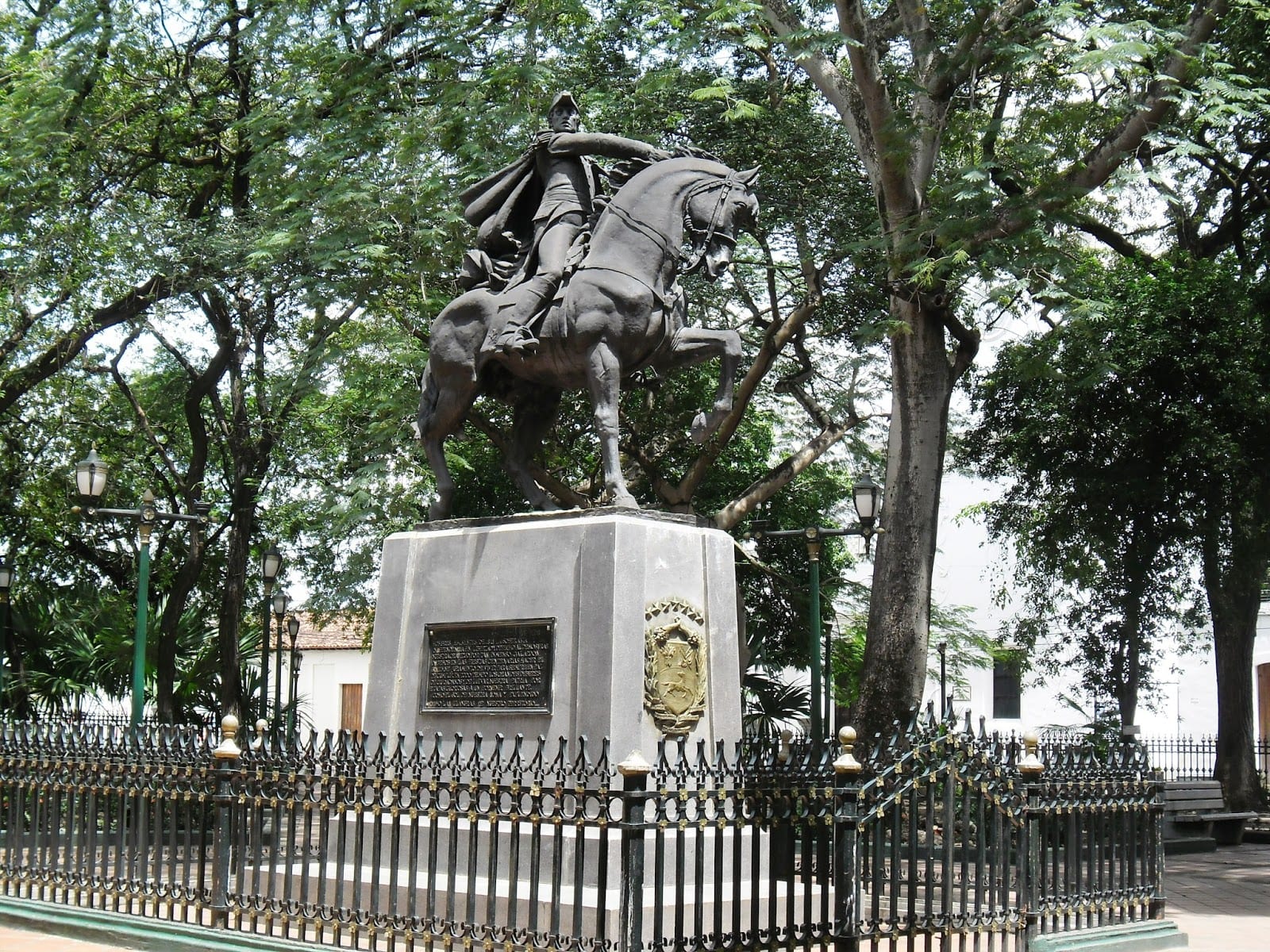
A bronze equestrian statue on a stone plinth behind an iron railing, shaded by tall trees in a town square

Los Llanos, Venezuela

Calabozo

The equestrian statue of Simón Bolívar in Plaza Bolívar, the founding square of Calabozo. (Rondoncamacho / Wikimedia Commons · CC BY-SA 4.0)

The largest city of Guárico state, on the Guárico river in Venezuela's central llanos. Founded beside Capuchin missions in 1724, it was a cattle town and a prize of the independence war, and since the Generoso Campilongo Dam of 1956 it has been the country's main rice-growing centre, with a historic core of colonial churches. This page is written to explain the city, not to encourage travel.

Neighbourhoods

  • Historic centre
    • First-time visitors
    • Historic district

    The colonial core around Plaza Bolívar, declared a Zone of Historical Value in 1979. The cathedral, the Municipal Palace, several 18th- and 19th-century churches, old colonial houses, the City Museum and the Francisco Lazo Martí Cultural House are all within a few blocks.

    Open in Maps
  • The reservoir and the outskirts
    • Water views
    • Fishing

    The outskirts of the city near the Guárico river and the reservoir held back by the Generoso Campilongo Dam, used for sport fishing and recreation, with the rice silos and processing plants that mark the city's industrial landscape.

    Open in Maps

Things to do

Churches and the old town

  • All Saints Cathedrallandmark

    The Metropolitan Cathedral of All Saints, built between 1754 and 1790 and facing Plaza Bolívar, with a neoclassical facade carrying Baroque elements.

    Open in Maps
  • Plaza Bolívarpark

    The square in front of the cathedral, traced out at the founding of the town and now the heart of the historic centre, surrounded by the Municipal Palace and old colonial houses.

    Open in Maps
  • Church of Our Lady of the Angelslandmark

    The city's oldest church, a single-nave colonial building of the 18th century.

    Open in Maps
  • Church of Our Lady of Carmenlandmark

    A church built between 1835 and 1846 and declared a national historic monument in 1979.

    Open in Maps

Museums

  • City Museummuseum

    The municipal museum in an old colonial house in the historic centre, acquired by the city in 2004.

    Open in Maps
  • Francisco Lazo Martí Cultural Housemuseum

    A cultural centre in the historic centre named after Calabozo's best-known poet, a 19th-century physician and writer of the plains.

    Open in Maps

The dam and the plains

  • Generoso Campilongo Damviewpoint

    The dam on the Guárico river, built in 1956, whose reservoir feeds the irrigation system that turned the savanna into rice fields; it is also used for sport fishing and recreation.

    Open in Maps
  • Calabozo Airporttransit hub

    The city's airport, with a paved runway and regional connections.

    Open in Maps

Short trips from the town

  • Aguaro-Guariquito National Parkpark

    A large national park of savanna, gallery forest and moriche-palm swamps in southern Guárico, about 50 kilometres south of the city, protecting species such as the Orinoco crocodile and the jaguar.

    Open in Maps

Eat and drink

Long-standing places and food districts in Calabozo. Hours, ratings and directions come from your maps app, always current.

Food districts

  • The historic centreneighborhood

    The streets around Plaza Bolívar, with simple places to eat serving everyday llanero food.

    Open in Maps
  • The reservoirneighborhood

    The reservoir on the edge of the city, a place for fishing and recreation, where river fish are part of the local table.

    Open in Maps

Experience Calabozo

History

The plains around Calabozo were home to indigenous peoples who hunted, fished and farmed the river banks. In 1723 Andalusian Capuchin missionaries organised mission villages here, gathering Guaiqueríes, Mapoyes, Tamanacos, Otomacos and other groups, and on 1 February 1724 a cross was raised to found a Spanish town beside them. Disputes over land between the town, the missions and the cattle owners lasted for decades, until a royal decree of 1774 confirmed the Villa de Todos los Santos de Calabozo. By 1780 it had about 3,400 inhabitants and was a centre of the cattle, mule and horse trade with Caracas.

In 1800 Alexander von Humboldt and Aimé Bonpland stayed here and recorded the electrical instruments built by the self-taught local inventor Carlos del Pozo y Sucre. In the independence war the town changed hands several times; the royalist José Tomás Boves led plains horsemen from Calabozo in 1814, and on 12 February 1818 Bolívar and Páez attacked the royalist army there, forcing it to withdraw two days later. Calabozo became the first capital of Guárico in 1848 and the seat of a bishopric in 1863, and the German physician Carl Sachs studied the electric eels of the llanos here in 1877–78.

The state capital moved to San Juan de los Morros in 1934. The Generoso Campilongo Dam, completed in 1956, and the Guárico irrigation system turned the savanna into rice fields, and the population grew from about 4,700 in 1950 to more than 130,000 by 2011. The historic centre was protected in 1979.

Culture & Customs

Calabozo's identity is llanero: rooted in cattle, horses and the plains, and in the music of harp, cuatro and maracas that the region regards as its own. Toros coleados, in which riders chase a bull and topple it by the tail, and horse racing are held at local festivals, and baseball, traditional in the region, has its own stadium in the city.

The town is proud of its literary and scientific history. Francisco Lazo Martí, the 19th-century poet and physician of the plains, is the town's own poet, and a cultural house in the historic centre bears his name. The stories of del Pozo's electrical experiments and of Humboldt's visit are part of the local sense of the past, and the city has its own anthem, "Villa Heroica".

The Catholic Church has shaped the town since the Capuchin missions: Calabozo has been a bishop's seat since 1863, and its cathedral and colonial churches are the heart of religious life. The plains' tradition of ghost stories, such as La Sayona and El Silbón, is part of the shared culture here as across the llanos.

Daily Life

Calabozo is the most populous city in Guárico, with more than 130,000 inhabitants in 2011. Growth came with migration from the countryside and the arrival of the industries that process the region's crops.

Rice is the backbone of the economy. The irrigation system fed by the reservoir was designed to serve about 60,000 hectares, making Calabozo Venezuela's main rice-producing centre, and the city's mills and storage silos are among the most visible features of its skyline. Cattle raising, food processing and commerce add to it, and a campus of the Rómulo Gallegos university trains students in health, agriculture and social sciences.

The national crisis has been felt sharply: in 2018 lootings hit local businesses, and fuel shortages stop tractors and trucks, while long power cuts disrupt work and home life. Days start before dawn, when the air is coolest, slow down in the midday heat, and pick up again in the evening around the squares.

Food

Calabozo eats like the rest of the plains, with beef at the centre. Carne en vara is beef skewered on stakes around an open fire and roasted slowly. Pisillo, the emblem of Guárico, is shredded, salted and sun-dried meat or fish fried with garlic and sweet peppers, and it is also made with chigüire, the capybara, whose meat is traditionally eaten during Lent and Holy Week.

As the country's rice capital, the town puts rice on most plates. Gallopinto, a dish of rice and black beans similar to pabellón, sits alongside pabellón criollo, the national plate of shredded beef, black beans, rice and fried plantain. Fresh cheeses such as queso de mano, a soft stretched cheese, are eaten with cachapas, sweet fresh-corn pancakes, and the rivers and reservoir supply fish.

Coffee is drunk strong and black through the day, and sweets are made from milk and papelón, the raw cane sugar of the region.

Planning tools

Budget

Calabozo is inexpensive for anyone carrying US dollars in cash, with simple hotels and local food. A wildlife visit to the plains further south means a ranch stay with full board and guided excursions, priced in dollars, plus private transport to reach it.

Daily Budget Midrange
USD 100–220 (better hotel with a hired driver, or a ranch lodge with full board and guided wildlife trips)
Daily Budget Shoestring
USD 30–60 (simple hotel, local food, shared transport where running)

Arrange any ranch stay and transfers together through the lodge or an established operator, and bring US dollar cash for the whole trip.

Best Time to Visit

The dry season, roughly November to April, is best for roads and for wildlife on the surrounding plains, though the heat is intense. The rainy months from May to October turn the savanna green and fill the reservoir. Security matters more than the season.

Suggested Number of Days

The town itself needs about a day. Most visitors pass through on the way to the southern plains, and a stay in the surrounding countryside brings the visit to three or four days; wet-season flooding can lengthen any trip.

First Visit
1 day
With Surroundings
3–4 days

Transportation

Buses and vans link the centre with the outer neighbourhoods, and taxis are the practical way to get around. Calabozo lies on the Troncal 2 highway, which runs north to Caracas and south towards San Fernando de Apure.

Travel with a trusted driver, move only in daylight, and expect fuel shortages and flood closures on rural roads.

Airport & Station Connections

Calabozo is about 260 kilometres south-west of Caracas by the Troncal 2 highway, a long day's drive with fuel stops. Calabozo Airport has a paved runway with regional connections, but flights are scarce. Most international arrivals come through Maiquetía, which was heavily damaged by the earthquakes of 24 June 2026 and reopened at about half capacity in August 2026.

Walkability

The historic centre is flat and compact, with the cathedral, the churches, the museum and Plaza Bolívar close together. The heat makes midday walking hard, and the reservoir and the outer districts need a taxi.

Safety

Calabozo is far from the dangerous Colombian border in Apure, but it shares the national crisis: in 2018 the city saw a series of lootings of local businesses. Rural roads across the plains are isolated, with little medical care, and fuel shortages and power cuts are common.

Most governments advise against all or all-but-essential travel. Anyone who does go should travel only in daylight with trusted drivers, avoid demonstrations, and keep to established places to stay. Check current official travel advice before travelling.

Climate

A tropical savanna climate with an average annual temperature of about 27.5°C. Rain is concentrated in the wet season from about May to October; the rest of the year is dry and very hot.

Summer
the wet season, May to October: hot and humid, 24–33°C, with heavy rain and mosquitoes
Winter
the dry season, roughly November to April: very hot, often above 35°C by day, dusty and sunny

Local Customs

Calabozo is a llanero town: joropo music, toros coleados and horse racing are part of local festivals, and baseball is followed keenly. People are proud of the town's history, from the colonial churches to the poet Francisco Lazo Martí.

Greet people before asking for anything, dress modestly in the cathedral and churches, and never photograph security forces, checkpoints or military installations.

Common Payment Methods

The currency is the bolívar, but US dollars in cash are used in practice, and card and ATM access for foreigners barely works. Carry enough cash in small notes for the whole stay.