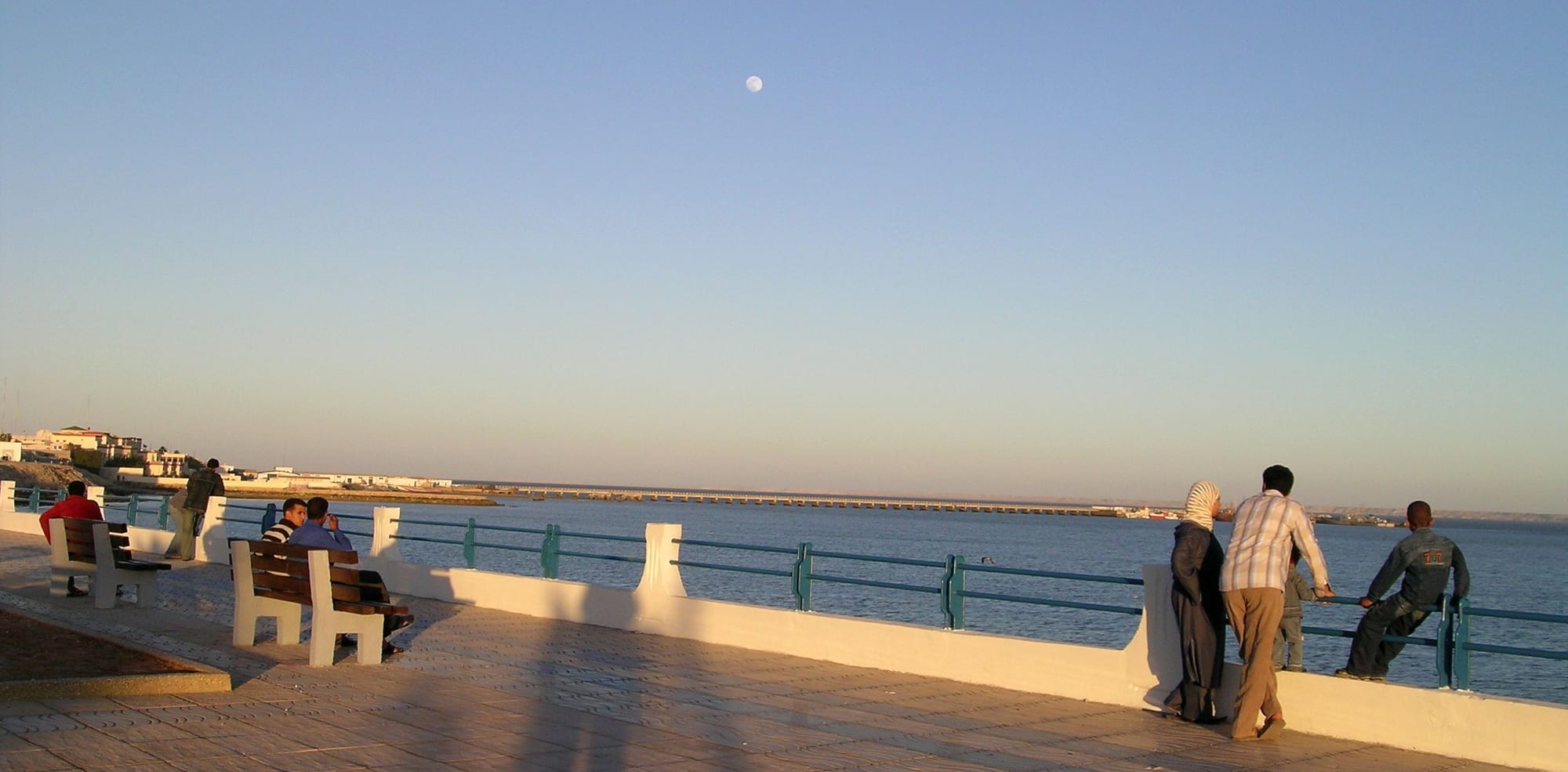
A white-walled seafront promenade with benches above calm blue water, low pale buildings along the far shore

Western Sahara

Dakhla

The promenade on the edge of the peninsula at Dakhla, looking across the water. (Hugues / Wikimedia Commons · CC BY-SA 2.0)

A town near the end of a long, thin Atlantic peninsula in Western Sahara, a disputed territory administered by Morocco and claimed by the Polisario Front's self-declared Sahrawi republic. Founded by Spain in 1884 as Villa Cisneros, it lives on fishing and on the shallow, windy lagoon behind the peninsula, now a kitesurfing destination. This page is written to explain the town, not to encourage travel.

Neighbourhoods

  • The town centre
    • First-time visitors
    • Cafes
    • Seafood

    A small grid of streets near the tip of the peninsula, with the market, banks, cafés, fish restaurants and most of the town's hotels. The seafront promenade along the sheltered side is where people walk in the evening.

    Open in Maps
  • The port and the fishing quarter
    • Local life
    • Seafood

    The working end of town, where the Atlantic fleet lands sardines, octopus and white fish and the processing plants operate. It is busy, functional and the reason most residents are here.

    Open in Maps
  • The lagoon shore
    • Kitesurfing
    • Wildlife
    • Quiet

    The sheltered inner side of the peninsula and the bay behind it, a band of shallow water, sandbanks and low dunes strung with wind-sports camps. Flamingos and waders feed on the flats, and the wind blows almost daily.

    Open in Maps
  • The peninsula road and the isthmus
    • Beaches
    • Desert scenery

    The single road north links the town to the mainland along 40 kilometres of sand spit, with the ocean on one side and the bay on the other. Beaches, dunes and scattered camps lie along it, and the desert takes over at the far end.

    Open in Maps

Things to do

The lagoon and the coast

  • Dakhla Bayattraction

    The long shallow lagoon behind the peninsula, sheltered from the ocean swell and consistently windy, which made the town a centre for kitesurfing and windsurfing.

    Open in Maps
  • The oyster farms of the bayattraction

    Shellfish beds worked by hand in the shallow, nutrient-rich water of the lagoon, where oysters are grown and sold locally.

    Open in Maps
  • Dragon Islandviewpoint

    An island in the lagoon, reached by boat or catamaran, with a wide panoramic view over the whole lagoon system around the bay.

    Open in Maps

Town landmarks

  • The seafront promenadeviewpoint

    A walled walkway along the sheltered edge of the town, with benches facing the water and the town's main evening gathering place.

    Open in Maps
  • The Spanish churchlandmark

    A Catholic church built in the Spanish period, when the town was Villa Cisneros, capital of the province of Río de Oro, and still a point of interest in the town.

    Open in Maps
  • Dakhla Airporttransit hub

    The airport about 2 kilometres from the centre, built by Spain in the 1960s and used by Royal Air Maroc, with flights to Casablanca and other Moroccan cities.

    Open in Maps

Outside the town

  • Asmaa hot springattraction

    A natural hot spring about 36 kilometres from the town, popular with visitors for its thermal water at about 38°C, drawn from a well some 700 metres deep.

    Open in Maps

Eat and drink

Long-standing places and food districts in Dakhla. Hours, ratings and directions come from your maps app, always current.

Dakhla classics

  • Grilled and fried Atlantic fishneighborhood

    Octopus, sardines, sea bream and sole come straight off the boats; simple grills near the port and in the centre cook them over charcoal with cumin and salad.

    Open in Maps
  • Lagoon oystersneighborhood

    Oysters farmed by hand in the bay, a long-standing local practice, are sold first in the town and eaten raw with lemon.

    Open in Maps
  • Sahrawi teacafe

    Sweet green tea poured from a height in three rounds, served in cafés, desert camps and homes, and the standard gesture of welcome.

    Open in Maps

Markets and food streets

  • The fish marketmarket

    The daily landing and sale of the fleet's catch, the clearest view of what the town lives on and where most restaurants buy.

    Open in Maps
  • Cafés and grills in the centreneighborhood

    The central streets hold tagine kitchens, rotisserie counters, juice bars and cafés, cooking southern Moroccan food alongside the seafood.

    Open in Maps

Experience Dakhla

History

The peninsula was known to Europeans long before the town existed: Portuguese navigators rounded the peninsula in 1436 and named the inlet Rio do Ouro, the river of gold, in the mistaken belief that it was the mouth of a gold-bearing river; the Spanish form is Río de Oro. Spain claimed the coast in 1884 and built a trading and military post on the peninsula, naming it Villa Cisneros. It became the main Spanish base on the southern part of the coast, with a fort, a church and a small garrison supplied by sea, and in the 1920s it served as a way-station for the Toulouse–Dakar airmail service.

The Spanish colony ended in 1975. Mauritania administered the southern part of the territory for a few years and withdrew in 1979, after which Morocco took over the area and has administered it since; the Polisario Front, which had declared a Sahrawi republic, fought a war that ran until the United Nations ceasefire of 1991. Renamed Dakhla under Mauritanian administration in 1976, the town grew steadily under Moroccan investment, above all around its harbour, as this coast holds some of the richest fishing grounds in the world.

Tourism arrived late and from an unexpected direction. Windsurfers and then kitesurfers found that the lagoon behind the peninsula combined flat, shallow water with reliable trade wind, and in recent decades camps appeared along the bay. A programme of Moroccan investment has since added roads and hotels, and as of 2024 a large new Atlantic port was being built. The political status of the territory remains unresolved, and a low-level armed confrontation resumed along the sand berm, far inland, in November 2020.

Culture & Customs

Dakhla's culture is Sahrawi first: Hassaniya Arabic is the everyday language of many families, poetry and sung verse are valued, and the tea ceremony — three small glasses of sweet green tea, poured from a height to raise the foam, drunk slowly and never in a hurry — frames conversation, business and idleness alike. The melhfa, a long piece of bright printed cloth, is the everyday dress of many women and the most visible marker of Sahrawi identity on the street. Desert hospitality is taken as an obligation: a visitor is fed and given tea.

Layered over this is the Moroccan public culture brought south over the past five decades by families arriving for work in fishing and administration, with Moroccan Arabic widely spoken beside Hassaniya, French on official signs and Spanish surviving among older residents. Moroccan national holidays set the calendar, and Ramadan reorders the day for almost everyone.

The newest layer is the international wind-sports crowd, seasonal and mostly confined to the camps along the bay, which has given the town a small foreign economy of instructors, cooks and drivers. The mix stays polite rather than blended: beachwear is normal on the water and out of place in the town, alcohol is not part of public life, and politics is discussed guardedly with strangers. Fishing families, desert families and visitors share a small place without much overlapping.

Daily Life

Dakhla has a population of about 160,000, spread along the last few kilometres of the peninsula. Fishing dominates everything: the fleet, the processing and freezing plants, the ice works and the lorries that run the catch north to Morocco. Public administration, a growing tourism sector built on the lagoon, greenhouse agriculture on the mainland and the building of the new port account for most of the remaining work.

The day follows the wind and the heat. Boats go out early, the market handles the catch in the morning, the middle of the day is slow, and the promenade and the cafés fill in the evening when the air cools. Most residents live in low concrete housing in the centre and the districts near the port; the camps along the bay operate as a separate world, reached by a road with almost nothing on it.

Water and distance are the constant constraints. Fresh water is scarce, and supplies of most goods arrive by lorry over a thousand kilometres of desert highway. Growth has been fast enough to strain housing and services, and the unresolved status of the territory shows in the checkpoints on the road and the caution of public talk.

Food

Dakhla eats from the Atlantic. The cold, nutrient-rich current that chills the coast also makes it one of the world's richest fishing grounds, and the town's kitchens work through sardines, mackerel, sea bream, sole and octopus, which is grilled, stewed with tomato and garlic, or served cold in salad. Fish is generally cooked simply: charcoal grilling, or a light flour coating and a hot pan, with cumin, salt, bread and a chopped tomato and onion salad alongside.

Oysters are the town's speciality and its surprise. Grown by hand on beds in the shallow, plankton-heavy lagoon, they are sold in the town and eaten raw with lemon, an unlikely product of a desert coast, and some now go to restaurants in Marrakesh, Casablanca and Europe.

The rest of the table is Sahrawi and southern Moroccan. Camel meat is eaten, stewed or grilled; méchoui, a whole roast lamb or goat, marks celebrations; couscous appears on Fridays; tagines of chicken with preserved lemon or of lamb with prunes are everyday restaurant food; and harira soup breaks the fast during Ramadan. Bread accompanies everything and often replaces cutlery. Tea closes every meal and most encounters — three glasses, heavily sugared, poured in sequence, with the sugar sold in the market as hard cones wrapped in blue paper.

Planning tools

Budget

Dakhla has more visitor infrastructure than anywhere else in the territory, largely built around wind sports, so prices split between cheap town hotels and café food on one side and camps and packages on the other. Transfers along the peninsula and desert excursions are the main extras.

Daily Budget Midrange
USD 70–160 (mid-range hotel or camp, a kitesurf package or 4x4 excursion, meals)
Daily Budget Shoestring
USD 25–50 (basic town hotel, café food, shared transport)

Staying in the town is cheaper than staying at a camp on the bay, though it means arranging transport to the water each day.

Best Time to Visit

The wind blows most reliably from spring to early autumn, roughly March to October, which is the main season for kitesurfing and windsurfing. October to April is the most comfortable for everything else, with warm days and cool nights; the cold current keeps the coast mild year-round.

Suggested Number of Days

Two or three days covers the town, the bay and a trip into the desert behind it. Anyone here for wind sports, or breaking the long drive down the Atlantic coast, usually stays longer, since lessons and conditions both take time.

First Visit
2–3 days
With Surroundings
4–6 days

Transportation

The town is small enough to cross on foot, and petit taxis cover the rest of it cheaply. Everything beyond the town — the camps, the dunes and the spots along the bay — needs a taxi, a hired car or a camp transfer, as the peninsula road runs for about 40 kilometres with nothing in between.

Agree fares in advance, and expect a passport check at the police post on the road onto the peninsula.

Airport & Station Connections

Dakhla Airport is about 2 kilometres from the centre, with flights from Casablanca and other Moroccan cities. The alternative is the coastal highway: long-distance coaches run from Laayoune, Agadir and Marrakesh, a drive of many hours across empty desert with repeated police checks.

Walkability

The centre is compact and flat, and the promenade makes an easy walk along the water. Outside it there are few pavements, the wind carries sand, and distances along the peninsula are far too long to walk, so anything on the bay means arranging a lift.

Safety

The town is calm, policed and used to visitors, and ordinary crime is low. The main practical risks are on the water and in the desert: strong wind, cold Atlantic currents, and unmarked tracks inland where vehicles get stuck. There is a visible security presence, and photographing police, soldiers, checkpoints or installations is not permitted.

Most governments advise against travel to areas near the 2,700-kilometre sand berm that divides the territory, where uncleared landmines from the war remain a serious hazard, and against travel to the Polisario-controlled zone and the wider buffer strip. Keeping to the coastal highway and marked tracks, going into the desert with a local driver, and carrying a passport for road checks are the usual precautions. Check current official travel advice before travelling.

Climate

Desert climate strongly moderated by the cold Canary Current, giving mild temperatures, high humidity, frequent morning fog, almost no rain and a near-constant north-easterly wind that is the reason for the town's wind sports.

Summer
warm rather than hot — often around 25–28°C by day, windy, with cool nights
Winter
mild — days commonly around 20–22°C, nights cool, with grey, foggy mornings

Local Customs

Sahrawi and Moroccan custom sets the tone: a conservative Muslim society where tea is pressed on guests in three rounds and hospitality is taken seriously. Many women wear the melhfa, a length of bright printed cloth wrapped over the clothes. Beachwear belongs on the water, not in the town, and politics is a subject handled carefully in public.

Dress modestly away from the beach and camps, ask before photographing people, never photograph security forces or installations, and use the right hand for eating and greeting.

Common Payment Methods

The Moroccan dirham (MAD) is the currency in use and may not be taken out of the country. Banks and ATMs are in the town centre, cards are taken by hotels, camps and larger shops, and cash is needed for taxis, the market and small cafés.