Attractions & Natural Wonders · Cabo Verde
Is the sand on Cabo Verde's beaches really from the Sahara?
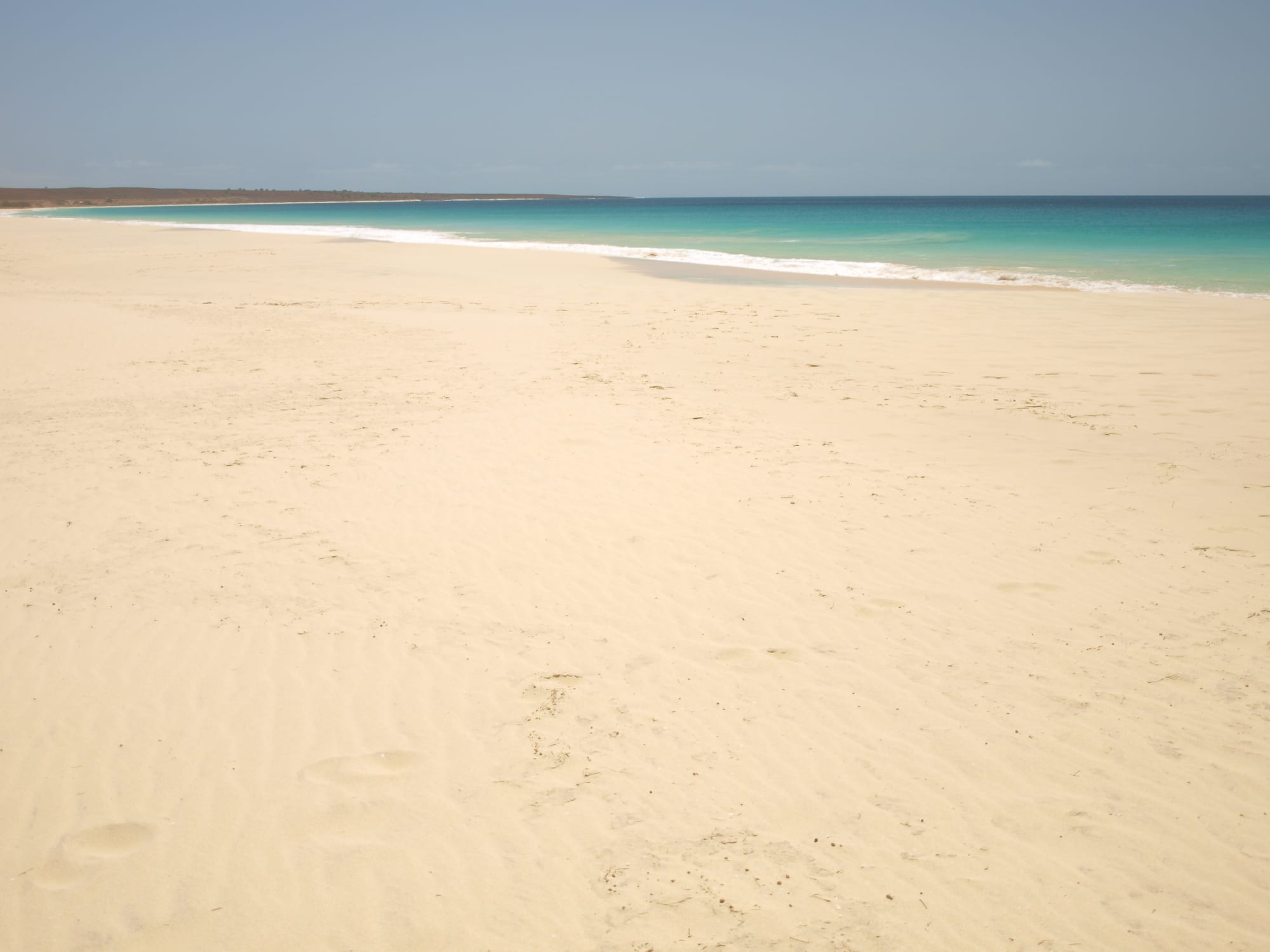
The Sahara reaches Boa Vista as a haze of fine dust, but the white beaches and dunes were made by the sea and shaped by the trade wind.
By Globeway Editorial · 2 November 2026
The short answer
Mostly, it did not. Boa Vista, the easternmost island of Cabo Verde and the one closest to Africa, about 450 kilometres (280 miles) from the coast of Senegal, looks so much like a piece of the Sahara that the story of desert sand blown across the ocean is easy to believe. The Sahara does reach the island, but as dust: particles so fine that they float in the air for days. Real sand grains are far too heavy to be carried hundreds of kilometres over open sea.
The island's beaches and dunes were made on the spot. Boa Vista is an old volcano that the Atlantic has been wearing down for millions of years, and the sea has left behind sand of its own: ground-down rock and, above all, fragments of limestone formed from the remains of marine life. The strong northeast trade wind then piles that sand into the dunes that make the island look like a desert.
Dust is not sand
The difference between the two is mostly a matter of size. Geologists call a particle sand when it measures between 0.0625 millimetres and 2 millimetres across; anything smaller is silt, which feels like flour, and smaller still is clay. Wind moves sand by bouncing it along the ground in short hops, a motion called saltation. Only particles under about 0.07 millimetres are lifted high enough to stay suspended in the air and travel far. That is why the world's great sand seas sit in or beside their deserts, while the fine, silty deposits blown out of them settle much farther away.
The Sahara is the largest source of wind-blown dust on Earth, producing an estimated 400 to 700 million tons a year. Between the end of November and the middle of March, a dry northeasterly wind called the harmattan blows from the desert across West Africa and picks up particles between 0.5 and 10 micrometres across. Even the largest of those is about one-sixth the width of the smallest grain of sand.
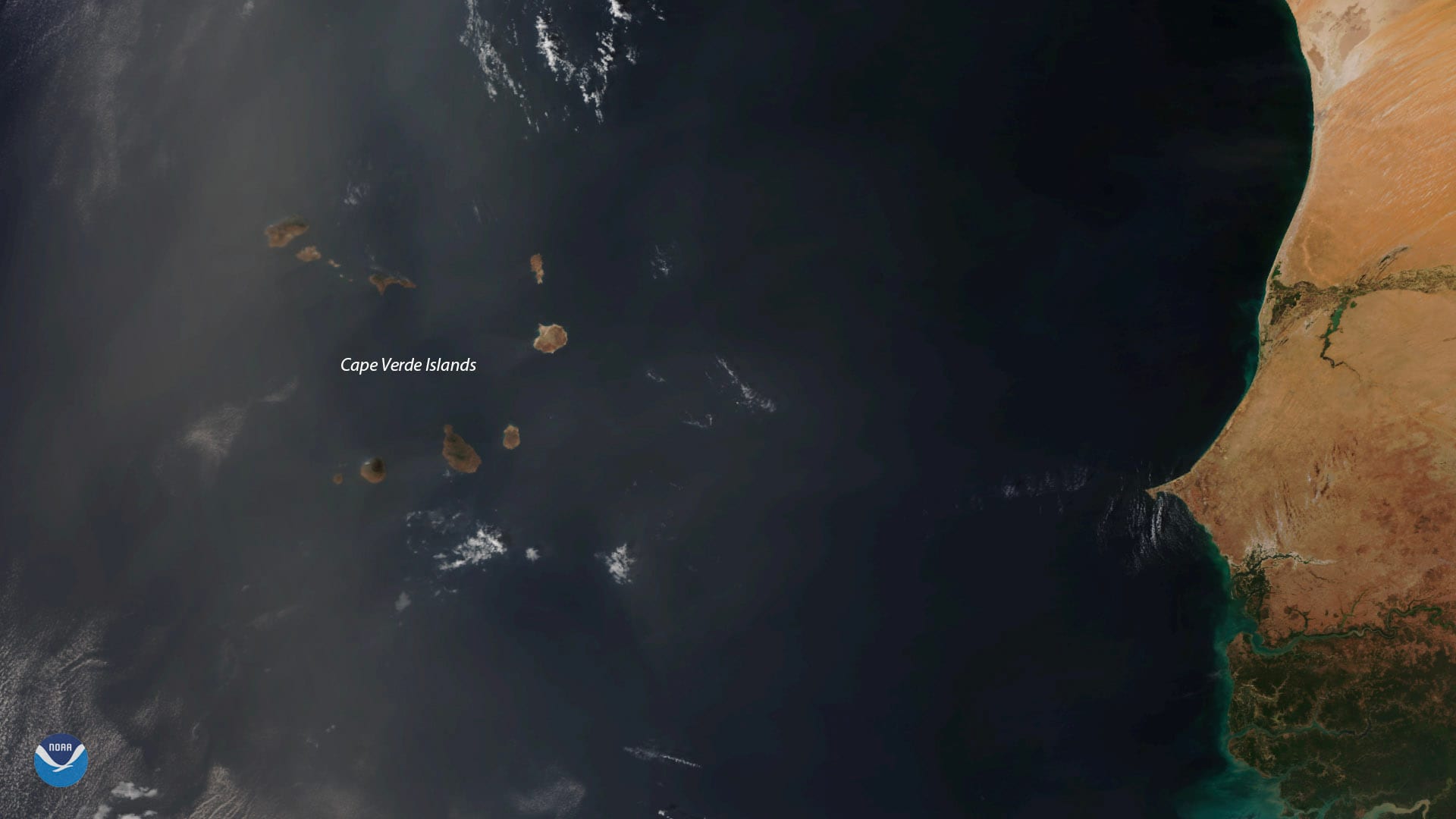
Dust like this crosses the whole ocean. Plumes carried west from the Sahara take about five to seven days to reach the Caribbean.
What the desert wind really brings
Cabo Verde sits squarely in the path of that dust. In winter, storms blowing from the Sahara sometimes cloud the islands' sky; across West Africa, the harmattan haze can block the sun for days and costs airlines millions of dollars a year in cancelled and diverted flights. Some of the dust settles on the islands and the sea around them, but it arrives as a fine powder, not as the clean, coarse grains that make a beach.
Most of it keeps going. Saharan dust has been traced to the Amazon basin, where it supplies phosphorus that the rainforest's poor soils lack, and to the Caribbean and the southeastern United States. Over the Atlantic it also feeds the ocean, delivering iron that tiny drifting plants called phytoplankton need in small amounts in order to grow.
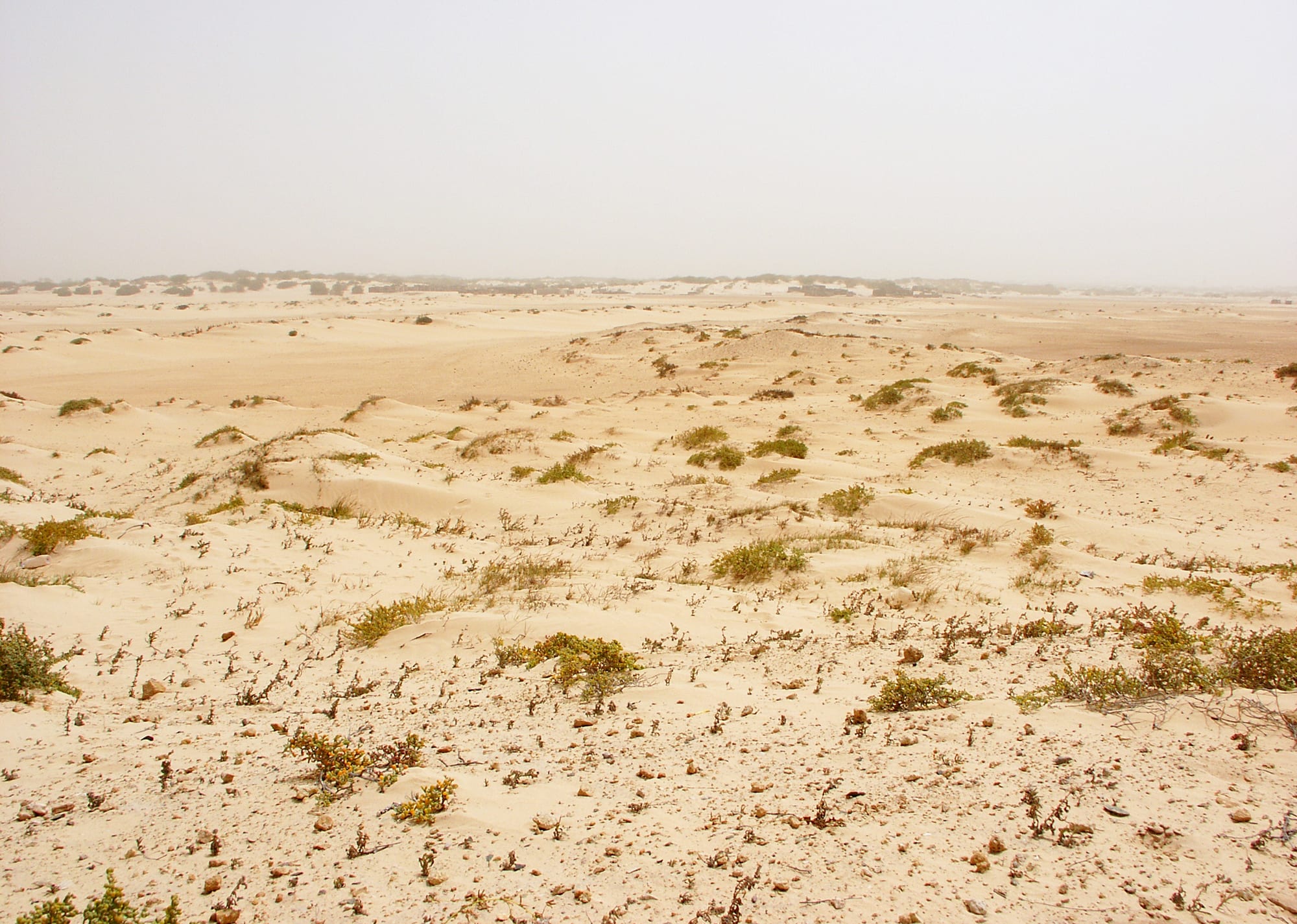
When the harmattan blows, the horizon disappears into a pale glare and the island looks even more like the desert the dust came from.
A volcano planed flat by the sea
Cabo Verde's ten islands are all volcanic, and the eastern ones are the oldest, far older and more worn down than those in the west. Volcanic activity on Boa Vista began more than 16 million years ago and had largely ended by about 4.5 million years ago. Since then the sea has done most of the work. Boa Vista is one of the best examples in the archipelago of a volcanic island worn down by waves, which is why it is so flat. Its highest point, Monte Estância, reaches only 387 metres, and the island's weathered volcanic peaks rise above a base of limestone.
During the Pleistocene, the period of the Ice Ages, the waves cut up to ten separate terraces into the island, the highest now 130 metres above today's sea level. Those terraces are made mostly of limestone formed from the broken remains of sea creatures, and some of them carry old dunes. In the last ten thousand or so years the sea has gone on leaving sand along the coast.
That matches what happens on warm coasts around the world. Away from the tropics, most sand is quartz. The bright white sands of tropical and subtropical shores are largely eroded limestone, often mixed with fragments of coral and shell, so in a real sense they are made by living things.
How the wind builds a desert
Once the sea has delivered the sand, the wind takes over. Boa Vista lies in the Barlavento, or windward, group of islands, and a steady breeze from the northeast blows for much of the year. It lifts dry sand off the beaches and drives it inland, where it collects into dune fields. Sand carried by strong winds has eroded every island in Cabo Verde, especially the windward ones.
The climate helps. Sal Rei, the island's main town, receives an average of only 67 millimetres of rain a year, so nothing binds the sand down. The largest of these sandy areas, the Deserto de Viana in the north of the island, is the biggest of Cabo Verde's three deserts and is counted among the country's seven natural wonders. It is a desert made from the sea, not from the Sahara.
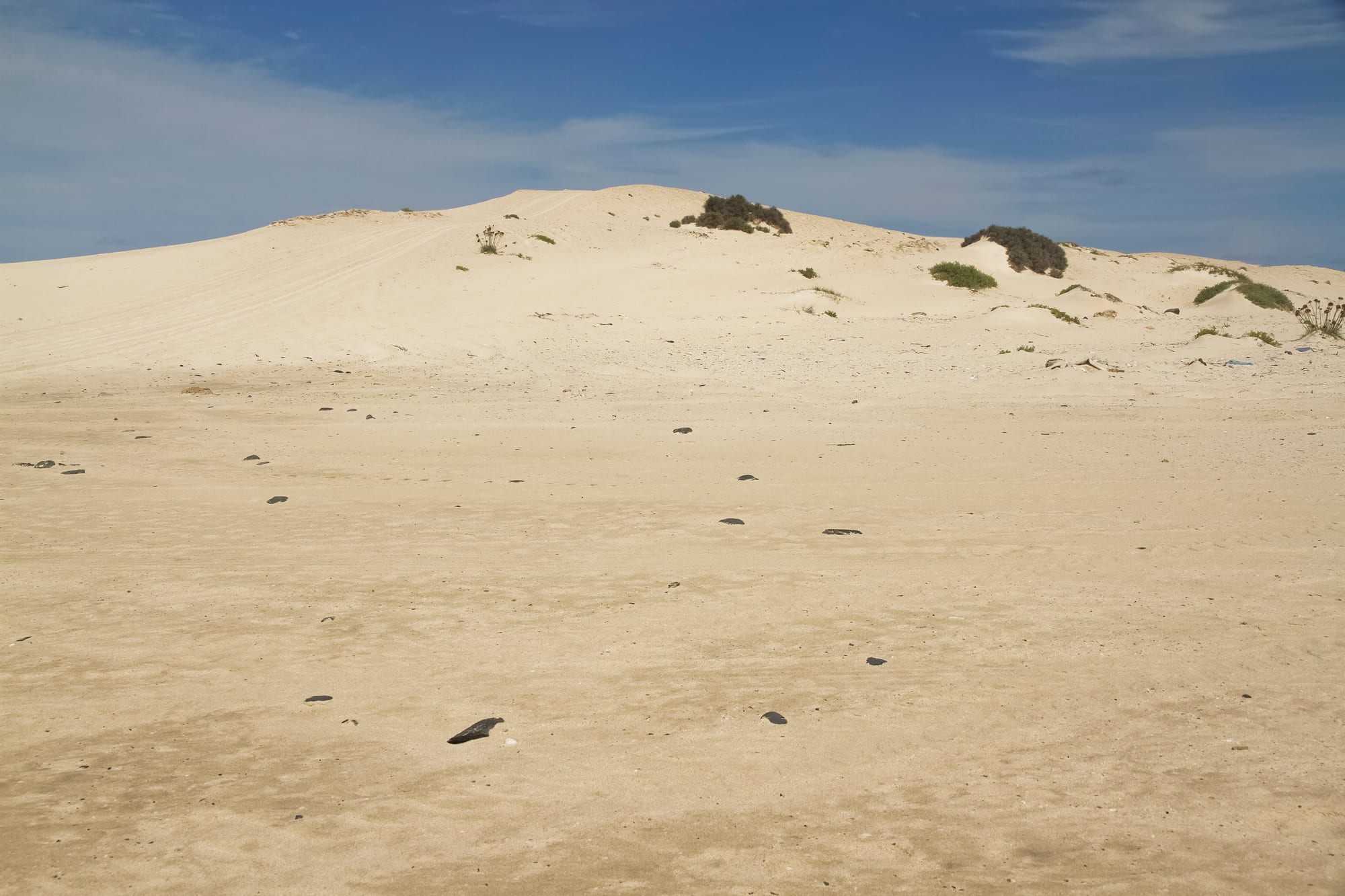
The dark stones scattered across the sand are a reminder of the volcanic island underneath.
Seeing the sand today
Boa Vista is known above all for its beaches: Atalanta, Cabral, Chaves, Ervatão, Gatas, Santa Mónica and Varandinha among them. Tourism has grown quickly since the international airport opened in 2007, yet the island remains the least densely populated in the archipelago, with about 14,500 people in 2015, most of them in Sal Rei. More than a third of the island is protected, including beaches where loggerhead sea turtles come ashore to nest; Cabo Verde is the species' only significant nesting ground on the eastern side of the Atlantic.
The sand itself is under pressure. Illegal extraction of beach sand is one of the newer threats to Cabo Verde's coasts. The harmattan haze is a winter sight, from late November to mid-March. The rest of the year, the beaches show their true origin plainly: pale sand made by the sea, washed up by the Atlantic and heaped into dunes by the wind.