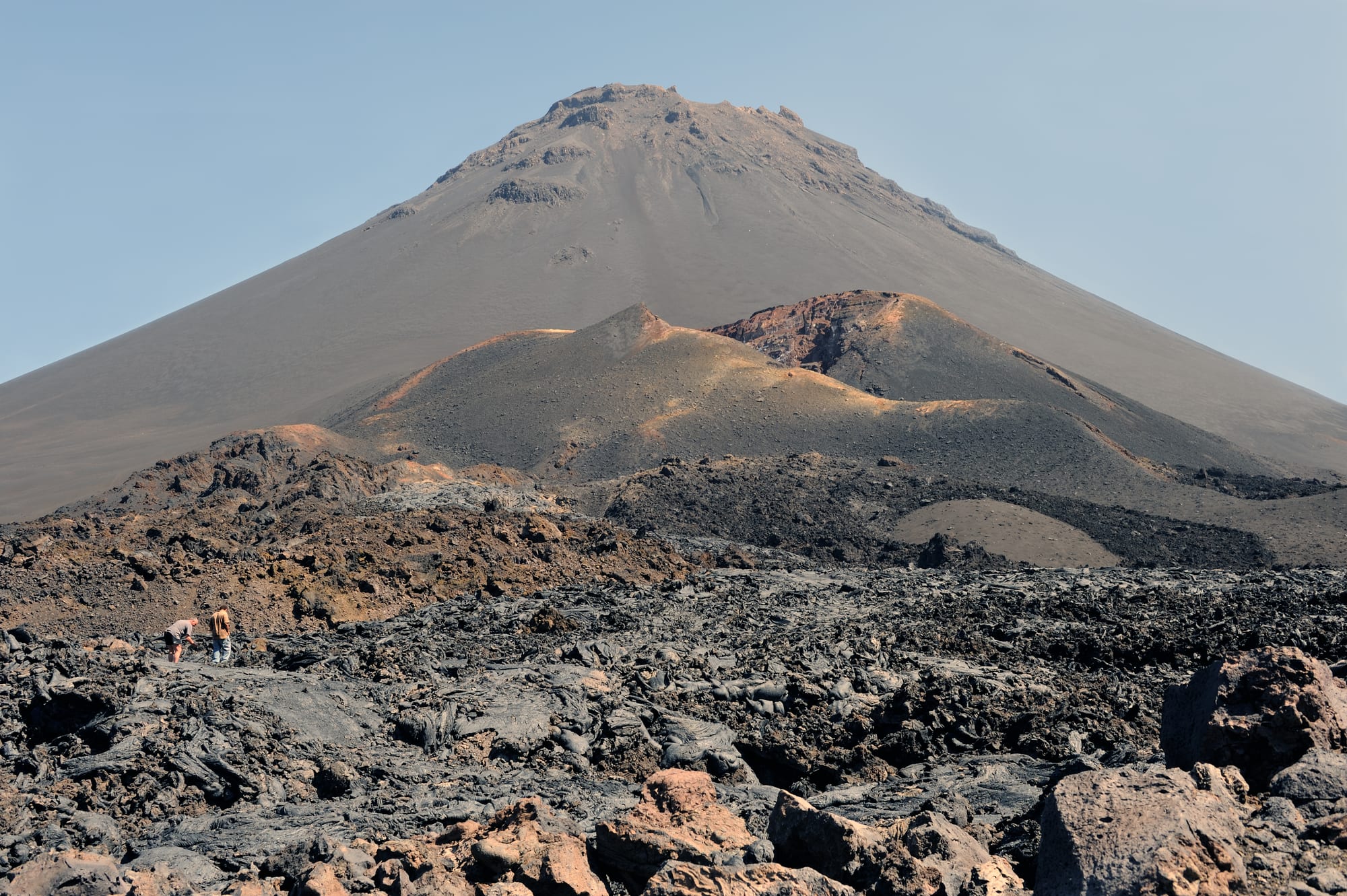
A dark cinder cone volcano rising from a bare lava plain inside a huge caldera wall, a few small buildings at its foot

Cabo Verde

Pico do Fogo, an active volcano rising from the caldera floor of Fogo island; its last eruption was in 2014. (Cayambe / Wikimedia Commons · CC BY-SA 3.0)

A dry volcanic archipelago in the Atlantic off West Africa — a former Portuguese slave-trade waypoint turned stable island democracy, with a Creole culture, the melancholy music of morna, and a diaspora larger than its population.

Explore Cabo Verde

History

The islands were uninhabited when Genoese and Portuguese navigators reached them around 1456. Their position on the Atlantic sea lanes made them a base for the slave trade, and the first town, Ribeira Grande — founded on Santiago in 1462 and now called Cidade Velha — became a place where enslaved Africans were held, "seasoned," and shipped onward. Out of the mixing of Portuguese settlers and enslaved Africans grew the Creole society and language that define the country.

Cycles of severe drought and famine, some killing a large share of the population, pushed Cabo Verdeans to emigrate from the nineteenth century onward — first on American whaling ships, later to Portugal, West Africa, and the north-eastern United States. Emigration became a permanent feature of national life.

The islands won independence from Portugal in 1975, briefly linked politically with Guinea-Bissau before going their own way. After a single-party period, Cabo Verde moved peacefully to multiparty democracy in 1991 and has since been rated one of the most stable and democratic countries in Africa, though it remains dependent on imports, tourism, and money sent home by the diaspora.

  • Cabo Verde: The Atlantic Creole Nation — Uninhabited islands that became a hub of the slave trade, a Portuguese colony shaped by drought and emigration, and one of Africa's steadiest democracies

Culture & Customs

Cabo Verdean identity is Creole — a blend of Portuguese and West African roots expressed in the language, the food, the Catholicism laced with older practices, and above all the music. Morna, slow and wistful, is the national genre, its lyrics full of sodade, a Creole word for longing and homesickness; the singer Cesária Évora carried it around the world, and UNESCO added it to its intangible cultural heritage list in 2019. Faster styles — coladeira, funaná, and batuque — fill the dance floors.

Emigration shapes the culture as much as the music. There are thought to be more people of Cabo Verdean descent living abroad than in the islands themselves, and returning migrants, remittances, and family split across continents are simply part of ordinary life.

The islands differ sharply from one another — the green, mountainous heights of Santo Antão, Fogo and Santiago against the flat, sandy deserts of Sal, Boa Vista and Maio, with the archipelago itself split into a windward (Barlavento) and a leeward (Sotavento) group — and locals are quick to tell you which island someone is from by their accent and manner. The unofficial national ethos is morabeza, an open, easy-going hospitality.

  • Cabo Verde: Morabeza and Sodade — A Catholic island nation of saints' day parties, warm greetings repeated through the day, a meal for every guest, and a song of longing that carries the feeling of a people spread across the world

Daily Life

About half the population lives on Santiago, the largest island, mostly in and around the capital, Praia. São Vicente, with the port city of Mindelo, is the cultural centre; Sal and Boa Vista live off beach tourism; and Santo Antão, Fogo, São Nicolau, and Maio are quieter and more agricultural.

With few natural resources and little arable land, the economy runs on tourism, services, fishing, and remittances, supplemented by construction and a growing push into renewable energy. Water is scarce and often desalinated, and drought still shapes farming on the greener islands.

Life is unhurried, family-centred, and tied to the sea and the diaspora. Sunday Mass, football, the evening stroll, and live music in a bar are the fixed points of the week.

  • Cabo Verde: Life Lived Between Two Shores — A dry, close-knit archipelago where many households have someone working abroad, remittances land as regularly as the ferry, and the day still closes with football, Mass, or live music in a bar

Food

Cabo Verdean cooking makes the most of limited ingredients: maize, beans, cassava, sweet potato, fish, and pork. The national dish is cachupa, a slow-cooked stew of hominy corn, beans, and whatever meat or fish is to hand, often fried up with an egg the next morning as cachupa refogada.

Fresh fish and seafood are excellent — tuna above all, and percebes (goose barnacles), stewed as a speciality of São Vicente — grilled or in a sauce. The pastel, a fried parcel filled with fish or meat, is the classic snack.

Grogue, a fiery sugarcane spirit distilled especially on Santo Antão and Santiago, is the classic local drink, often sweetened with sugarcane molasses or condensed milk into a ponche. Local coffee from Fogo, grown on the volcano's slopes, has a small but serious reputation.

  • Cabo Verde: Food and the National Dish — A corn and bean stew cooked slowly enough to feed two meals, a spicy pastry nicknamed after the devil, and a sugarcane spirit still pressed in traditional mills

Attractions & Natural Wonders

The islands split into beach destinations and hiking destinations. Sal and Boa Vista have long white beaches, warm shallow water, dunes, and world-class conditions for kitesurfing and windsurfing, plus beaches where loggerhead turtles nest, with hatchlings emerging from July to September — Cabo Verde is the species' only major nesting ground in the eastern Atlantic.

Santo Antão is the trekking island: deep green ribeiras, terraced fields clinging to near-vertical slopes, and old cobbled paths between villages, reached by ferry from Mindelo. Fogo is dominated by Pico do Fogo, an active volcano you can climb, rising from a caldera whose floor is farmed for wine and coffee even though eruptions periodically bury the settlements.

On Santiago, Cidade Velha — the first European colonial town in the tropics — has a ruined cathedral, a hilltop fort, and a pillory in its square, and is a UNESCO World Heritage Site. Mindelo, on São Vicente, is the place for live morna and the February carnival, the liveliest in the country.

Planning basics

Budget

Cabo Verde is more expensive than mainland West Africa, partly because nearly everything is imported and partly because Sal and Boa Vista are built around package-holiday resorts. The other islands are cheaper and simpler. Cards work in resorts and larger towns; carry cash elsewhere and for inter-island ferries.

Daily Budget Midrange
EUR 80–160 (hotel, restaurants, a rental car or island tour, some flights)
Daily Budget Shoestring
EUR 40–65 (guesthouse or residencial, local food, aluguer shared vans)

Island-hopping adds up fast — inter-island flights are limited and can be unreliable, ferries slow.

Visa Requirements

Citizens of the EU, the UK, the US, Canada, and many other countries do not need a visa for a short stay — 30 days for British visitors, and up to 90 days in a calendar year for some other nationalities. Visitors must instead pre-register on the EASE portal at least five days before arrival and pay an airport security fee of 3,400 escudos online; since 1 July 2026 anyone arriving without pre-registration pays double the fee at the border.

Typical Stay
Visa-free for short stays: 30 days for British visitors, up to 90 days per calendar year for some nationalities

Register and pay the airport security fee online before you fly to save time on arrival.

Safety

Cabo Verde is one of the safer countries in the region, with a stable democracy and low levels of violent crime. The main issues are petty theft and bag-snatching in Praia and the tourist areas of Santa Maria on Sal, and strong ocean currents on many beaches.

Keep valuables out of sight, avoid quiet urban areas of Praia after dark, and ask locally about currents before swimming off unpatrolled beaches.

Climate

Dry, warm, and steadied by the trade winds. There is a short, unreliable rainy season from about August to October; the rest of the year is almost rainless. The islands are cooler and windier than their latitude suggests, and Sal and Boa Vista are a magnet for windsurfers and kitesurfers.

Rain
sparse; drought is a recurring national problem
Wind
steady north-east trade winds, with kitesurfing on Sal all year round
Temperature
22–29°C most of the year

Transportation

International flights land mainly on Sal and Santiago, with some on Boa Vista and São Vicente. Between islands, the domestic airline links the main islands but schedules are thin and prone to change; ferries connect several islands, slowly and subject to the sea. On land, shared "aluguer" vans and hired cars or 4x4s get you around.

Don't plan a tight multi-island itinerary around domestic flights — build in spare days.

Best Time to Visit

November to June for warm, dry, sunny weather. The trade winds that suit kitesurfing and windsurfing can make the beaches feel blustery. Hiking on Santo Antão and São Nicolau is best after any rain, around October and November, when the valleys are green.

Events
Carnival in Mindelo (February); saints' day festivals in June

Currency

The currency is the Cabo Verdean escudo (CVE), pegged to the euro at a fixed rate of about 110 to 1. Euros are widely accepted in the resort islands, often at a round rate.

Cards
Accepted in resorts and towns; cash needed in villages and for ferries
Symbol
$ — the cifrão, used as the decimal separator, as in 500$00
Currency Code
CVE — Cabo Verdean escudo

Language

Portuguese is the official language, used in government, schools, and the media. Everyday life is conducted in Cabo Verdean Creole (Kriolu), a Portuguese-based creole that varies noticeably from island to island. French is understood by some; English mainly in the resorts.

English
In the resort islands; limited elsewhere
Everyday Language
Cabo Verdean Creole (Kriolu)
Official Language
Portuguese