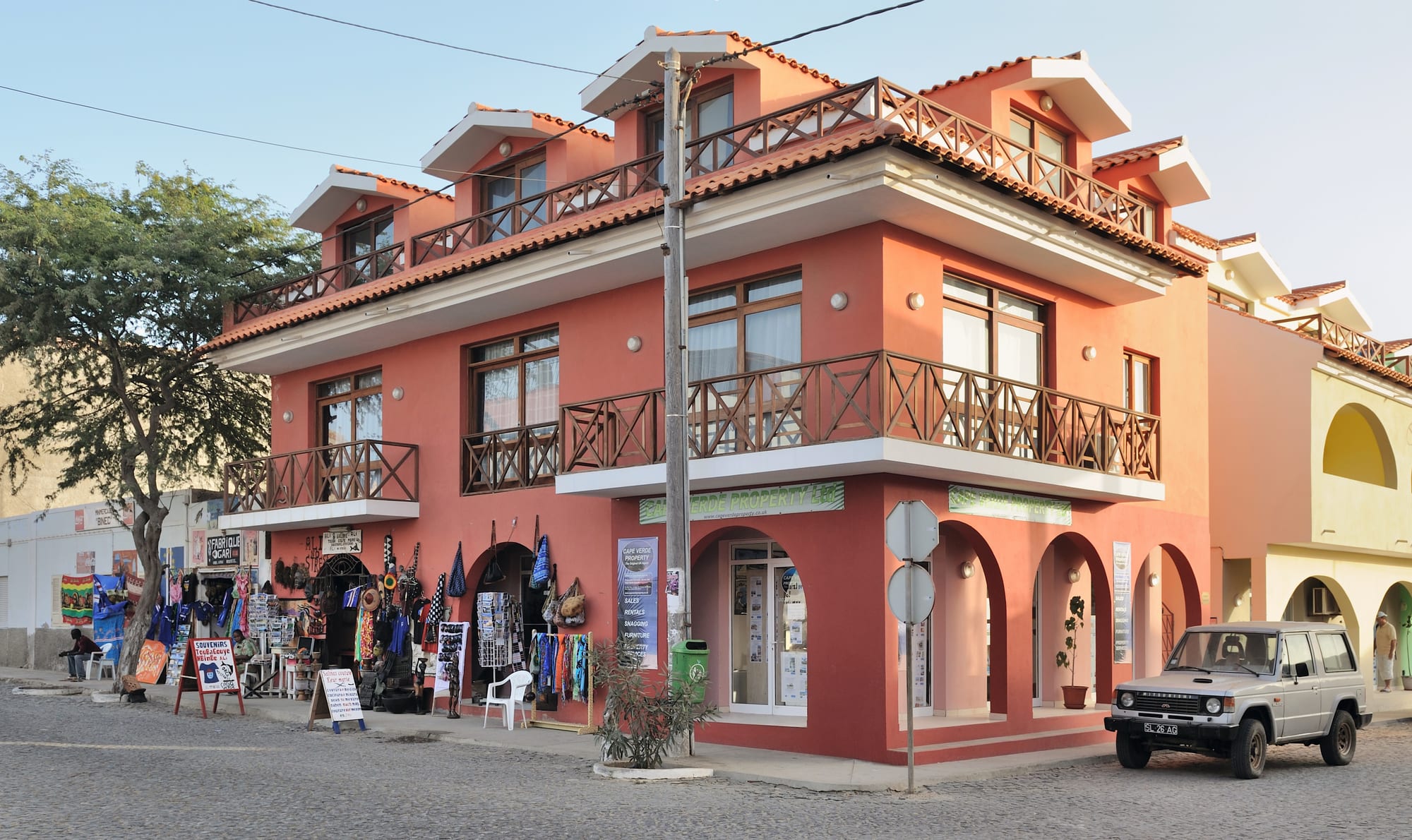
A coral-pink two-storey corner building with wooden balconies in Santa Maria, souvenir stalls under the arcade and a dusty street outside

Cabo Verde

Sal

A street corner in the centre of Santa Maria, the beach town at the southern tip of Sal. (Cayambe / Wikimedia Commons · CC BY-SA 3.0)

A flat, almost rainless island in the eastern, windward group of Cabo Verde, named for the salt once dug from a flooded volcanic crater at Pedra de Lume. An airport built in 1939 as a mid-Atlantic refuelling stop opened the island to the world, and since the late twentieth century its white beaches and steady trade winds have made it the country's main beach and watersports destination.

Neighbourhoods

  • Santa Maria
    • First-time visitors
    • Beaches
    • Best for food

    The town at the island's southern tip, laid out behind a long white beach and a pier first built for the salt trade. Founded in 1830 for salt production, it is now a grid of low, brightly painted streets with restaurants, dive shops and craft stalls, and the resorts spread along the sand on either side.

    Open in Maps
  • Espargos
    • Local life
    • Close to the airport

    The island's administrative centre, sitting inland beside the airport runway on a low rise in the middle of the island. There is little for visitors beyond a shaded square, the market, banks and everyday shops, but it is the island's main commercial centre and where the island's shared vans converge.

    Open in Maps
  • Palmeira
    • Quiet and residential
    • Harbour life

    A small town on the west coast, about 4 km from Espargos, home to the island's main port — the third busiest in Cabo Verde for freight. Boats are pulled up on the rocks below pastel houses, and the harbour front is a calm place to watch the day's catch being sorted.

    Open in Maps
  • Pedra de Lume
    • Historic district
    • Scenery

    A small village on the east coast beside the crater that gave the island its salt trade and its name. A tunnel cut through the crater wall leads to the pans; salt is still produced there on a small scale, mainly for beauty products and thalassotherapy.

    Open in Maps

Things to do

Beaches and the water

  • Santa Maria Beachbeach

    A long crescent of pale sand and clear shallow water along the town's seafront, the focus of almost everything visitors do on the island.

    Open in Maps
  • Kitesurfing beachesbeach

    The wind-exposed beaches of the island's south, where windsurfing and kitesurfing have grown for about 25 years and Sal has become one of the country's leading places for both.

    Open in Maps
  • Murdeira Baybeach

    A large bay on the west coast, a nature reserve known for its rich underwater life and a small coral reef, with a seaside holiday village built from the late 1990s.

    Open in Maps

Salt, sights and the landscape

  • Pedra de Lume salt craterlandmark

    Salt pans inside the crater of an extinct volcano, worked commercially from 1796 and reached through a tunnel cut in 1804; a little salt is still produced here.

    Open in Maps
  • Buraconalandmark

    A small bay about 5 km north of Palmeira with natural rock pools in the lava of the north-west coast, inside the protected landscape of Buracona-Ragona.

    Open in Maps
  • Palmeira harbourlandmark

    The island's main port and the third busiest in Cabo Verde for freight traffic, with fishing boats drawn up alongside the cargo quay.

    Open in Maps

Towns

  • Santa Maria pierlandmark

    The pier at Ponta de Vera Cruz, first built with a small rail track to carry salt out to ships, and now where the town's fishing boats come in.

    Open in Maps
  • Espargosneighborhood

    The island capital, a working Cabo Verdean town of squares, small shops and a market beside the airport, about 20 km north of Santa Maria.

    Open in Maps
  • Amílcar Cabral International Airporttransit hub

    First built by Italy from 1939 as a fuel stop on routes between Europe and South America and completed by the Portuguese in 1949, it is Cabo Verde's main and busiest international airport.

    Open in Maps

Eat and drink

Long-standing places and food districts in Sal. Hours, ratings and directions come from your maps app, always current.

Sal classics

  • Cachuparestaurant

    The national dish of hominy corn, beans and whatever meat or fish is to hand, simmered slowly and fried up with an egg the next morning as cachupa refogada.

    Open in Maps
  • Grilled tuna and wahoorestaurant

    Tuna, wahoo and grouper landed at the pier appear the same day, grilled whole or in steaks with rice, beans and a tomato and onion salad.

    Open in Maps
  • Lagosta and buziorestaurant

    Spiny lobster and the large sea snail known as buzio are the island's special-occasion seafood, usually grilled, or cooked in a red sauce as lagosta suada.

    Open in Maps

Where to eat and drink

  • Santa Maria town centreneighborhood

    The streets around Praça Marcelo Leitão, the town's main square, lined with small restaurants, bars and cafés and busiest in the evening.

    Open in Maps
  • Espargos market and local eateriesmarket

    Fruit, vegetables and fish brought in from other islands, with simple Creole kitchens around the market serving the day's stew to people who work here.

    Open in Maps

Experience Sal

History

Sal was named for the salt that formed naturally in its two great ponds, in the flooded crater at Pedra de Lume and near Santa Maria, and for centuries that mineral was the island's only reason to be settled. Reached by the Portuguese in 1460, the island was only sparsely inhabited for three centuries, with a small fishing village near present-day Palmeira by 1720. Commercial salt working began at Pedra de Lume in 1796 under Manuel António Martins, who had a tunnel driven through the crater wall in 1804, and in 1830 he founded Santa Maria on the southern tip so that salt could be shipped from the bay. Up to 30,000 tons a year went out, most of it to Brazil, until Brazil taxed imported salt in 1887 and the trade collapsed. Production revived in the twentieth century — a French company built an aerial tramway at Pedra de Lume in 1921 — and continued at Santa Maria until 1984.

What changed the island was aviation. In 1939 Italy began building an airfield on the flat ground near Espargos as a fuel and provisions stop on routes between Europe and South America. The Second World War ended the Italian project, and the Portuguese colonial government bought the site and had it fully operational by 1949. It grew into the archipelago's main international airport, later named for the independence leader Amílcar Cabral, and for decades it gave Sal a role out of all proportion to its size and population, serving airlines that needed to refuel between Europe, Africa and the Americas.

Tourism began with Cabo Verde's first resort hotel, the Morabeza, opened at Santa Maria in 1967, and after 1986 hotels and resorts spread along the coast either side of the town. The island's population, under 3,000 until 1960, has grown quickly with workers from elsewhere, turning a salt outpost into the country's main holiday destination, with almost half of Cabo Verde's hotel beds by 2017.

Culture & Customs

Sal's culture is Cabo Verdean Creole culture as it is lived everywhere in the archipelago — Portuguese and West African in origin, Catholic in its calendar, musical by habit — but with an unusually mixed population, since many residents came here for work from other islands. That gives Santa Maria and Espargos a transient, outward-looking feel compared with older communities such as Santo Antão.

Music is everywhere: morna and coladeira in the bars of Santa Maria, funaná and the harder dance styles at weekend parties, and live bands playing to a mixed audience of islanders and visitors. Football is followed closely, with island clubs competing in the island's own league, and beach football and volleyball are played on the sand in the late afternoon.

Manners are courteous and unhurried. Greetings open every exchange, families are large and closely involved, and Sunday Mass and the saints' day festivities still organise the year. The tension that runs through island conversation is the familiar one of a resort economy: tourism pays most of the wages, but much of it happens behind hotel gates, and residents talk frequently about water, housing and how much of the money stays on the island.

Daily Life

Around 40,000 people live on Sal, most of them in Espargos and Santa Maria, and the number has risen sharply in a generation. Espargos is the everyday town — the municipal offices, the schools, the market — while Santa Maria is where the work is, in hotels, restaurants, dive centres and construction. Palmeira handles the shipping, and the rest of the island is empty stone and sand.

Almost nothing is grown here. Fresh food arrives by boat and plane from Santiago, Santo Antão and abroad, and much of the fresh water is desalinated, which makes both expensive and makes supply interruptions a routine part of life. Fishing remains important, both for the pier at Santa Maria and for the boats at Palmeira.

The day starts early, before the heat and the wind get up, and slows in the middle of the afternoon. Workers commute between Espargos and the hotels by aluguer van; children walk to school in uniform; the evening belongs to the street, the church square and the football pitch. Water supply, rising rents and the seasonality of tourism are the issues residents raise most often.

Food

Food on Sal is the Cabo Verdean repertoire with more fish than most places manage. Cachupa, the national dish, is the daily anchor: hominy corn and beans stewed for hours with whatever meat or fish is available, often with blood sausage, and fried the next morning, often with an egg, as cachupa refogada.

The sea provides the rest. Tuna, wahoo, grouper and moray are landed at the Santa Maria pier; they are grilled simply, or cooked in a tomato and onion sauce, and served with rice and beans. Lagosta, the spiny lobster of these waters, and buzio, a large sea snail, are the celebratory dishes. Fried moray eel is another favourite across the islands.

Drinks follow the national pattern. Grogue, the sugarcane spirit distilled chiefly on Santo Antão and Santiago, is drunk neat or sweetened with molasses into a ponche; local beer, imported Portuguese wine and strong coffee fill out the list. Tropical fruit is largely imported, but papaya, mango and banana from the greener islands appear in juices and as papaya jam, eaten with goat's cheese.

Planning tools

Budget

Sal is one of the most expensive islands in Cabo Verde, because almost everything is shipped or flown in and because Santa Maria is built around package-holiday resorts. Room rates fall away sharply outside the beach strip, and eating in the back streets of Santa Maria or in Espargos costs a fraction of what the seafront does. Water sports, boat trips and hired cars are the other main costs.

Daily Budget Midrange
USD 100–190 (hotel or resort room, restaurant meals, a hire car or boat trip)
Daily Budget Shoestring
USD 50–80 (guesthouse or residencial room, local food, shared aluguer vans)

Prices in Santa Maria are often quoted in euros as well as escudos; the beach, the pier and the salt crater walk cost little or nothing.

Best Time to Visit

The island is warm and dry all year, so the choice is about wind. November to March is the windy season and the peak of the kitesurfing and windsurfing calendar, with pleasant air temperatures but blustery beaches. April to July is calmer and better for swimming and diving. August to October is hotter and more humid, with the archipelago's short and unreliable rains.

Suggested Number of Days

Sal is small and flat, and three or four days covers the beach, the salt crater and the north coast. Longer stays make sense for divers, kitesurfers and anyone treating the island as a base for a flight or ferry on to the other islands. Weather rarely changes the plan.

First Visit
3–4 days
With Surroundings
5–7 days

Transportation

The island is about 30 km long, with main roads linking Santa Maria, Espargos and Palmeira. Shared minibuses known as aluguers run along it for a small fare, stopping wherever passengers ask; taxis are plentiful and cheap between the airport and Santa Maria. Hire cars, scooters and quad bikes are widely available, and organised 4x4 tours cover the unsurfaced tracks to the north coast.

Tracks off the main road are rough and sandy; small hire cars are not built for them, and driving on dunes and inland tracks damages a fragile desert surface.

Airport & Station Connections

Amílcar Cabral International Airport, on the edge of Espargos, is about 16 km from Santa Maria — roughly 20 minutes by taxi or transfer bus. It was built as a refuelling stop in 1939 and remains one of the country's main international gateways, with charter and scheduled flights from Europe and West Africa and domestic connections to the other islands. Ferries call at Palmeira, but sailings are infrequent.

Walkability

Santa Maria is entirely walkable: a compact grid of level streets between the church square and the pier, with the beach a few minutes from anywhere. Espargos is small enough to cross on foot as well. Everything outside the two towns — the salt crater, Buracona, the north coast — needs a vehicle, as distances are long, shade is non-existent and the wind and sun are relentless.

Safety

Sal is a safe island by most measures, with very little violent crime. The practical risks are petty theft and bag-snatching in the tourist areas of Santa Maria, strong currents and shore break on some beaches, sunburn and dehydration in a desert climate, and injuries on rented quad bikes and scooters on rough tracks.

Keep valuables out of sight, avoid quiet urban areas of Praia after dark, and ask locally about currents before swimming off unpatrolled beaches. Check current official travel advice before travelling.

Climate

Hot desert climate, tempered by the sea and the north-east trade winds. Rain is rare and falls, if at all, between July and mid-October; the wind blows hardest from December to March, which is what brought the watersports industry here.

Summer
August to October is the warmest and most humid time, with daytime temperatures around 28–30°C and warm sea
Winter
December to March stays around 24–26°C by day, sunny and dry but persistently windy

Local Customs

Greetings matter: a bom dia or a Creole bon dia before asking a question is expected. Portuguese is the official language and Cabo Verdean Creole the language of daily life; some English and Italian are spoken in Santa Maria. Beachwear belongs on the beach, not in shops, churches or the streets of Espargos. People are relaxed about time, and the national word for open, easy hospitality is morabeza.

Ask before photographing people, particularly fishermen working at the pier and market traders. Tipping is not obligatory but small amounts are appreciated in restaurants and for guides.

Common Payment Methods

The currency is the Cabo Verdean escudo (CVE), pegged to the euro at about 110 to 1. Euros are widely accepted in Santa Maria, often at a round rate, and cards work in hotels, larger restaurants and dive centres. Cash is needed for aluguers, market stalls and small kitchens, and ATMs are in Santa Maria and Espargos rather than the villages.