History · Austria
How did Vienna become the music capital of the world?
Four centuries of imperial patronage, music-mad aristocrats and new public institutions drew Haydn, Mozart, Beethoven and Brahms to one city.
By Globeway Editorial · 2 November 2026
The short answer
Vienna became a musical magnet because, for more than four centuries, it was the capital of the Habsburgs, a dynasty that paid for music on a grand scale. The court founded its own body of musicians in 1498, and the nobles who gathered around the emperor competed to employ composers, commission works and pay pensions. That money and that audience drew the greatest talents of the late 18th century: Joseph Haydn, Wolfgang Amadeus Mozart and Ludwig van Beethoven all made their careers there, and Franz Schubert was born there.
In the 19th century the city turned private patronage into public institutions: a music society in 1812, the Vienna Philharmonic in 1842, a new court opera house in 1869 and the Musikverein concert hall in 1870. Add the waltz of the Strauss family, Brahms and Mahler, and Schoenberg's revolution in the early 20th century, and Vienna earned a reputation as a world capital of music. "Music capital of the world" is a title rather than a measurable ranking, but few cities have a stronger claim to it.
An emperor's choir and a musical court
The story begins with a letter. On 30 June 1498 the Holy Roman Emperor Maximilian I instructed his court officials to employ a singing master, two basses and six boys. This was the founding of the Wiener Hofmusikkapelle, the musicians of the imperial court, and it lasted more than 420 years until its dissolution in 1922. The Vienna Boys' Choir traces its origins to those six boys, and over the centuries the court's singers worked with composers from Heinrich Isaac and Johann Joseph Fux to Gluck, Salieri, Mozart, Schubert and Bruckner.
Music was not a sideline for the Habsburgs. The emperor Leopold I was both a composer and a considerable patron of music, and the court had its own opera house, built in 1636 inside the Hofburg palace. Antonio Salieri, who later taught Beethoven, was for many years in charge of music at the imperial court. A city with an emperor who wrote music, and a court that employed musicians for life, set a standard that the aristocracy around it copied.
Why the great composers came
The nobles of the Habsburg lands typically spent their winters in fashionable Vienna and their summers on country estates, so the capital was where patrons, salons and money gathered each season. Composers followed.
Haydn arrived in 1740 as a choirboy at St Stephen's Cathedral and spent much of his career as music director to the Esterházy princes, longing for visits to Vienna for its friendships. One of those friends was Mozart, whom he met around 1784; they played chamber music together, and both became Freemasons in Vienna, Mozart in 1784 and Haydn in 1785. Mozart himself had been a salaried musician in Salzburg until a visit to Vienna in 1781 ended in his dismissal. He chose to stay and work freelance, and that December he played in a competition before the emperor against the pianist Muzio Clementi. He soon had a reputation as the finest keyboard player in the city.
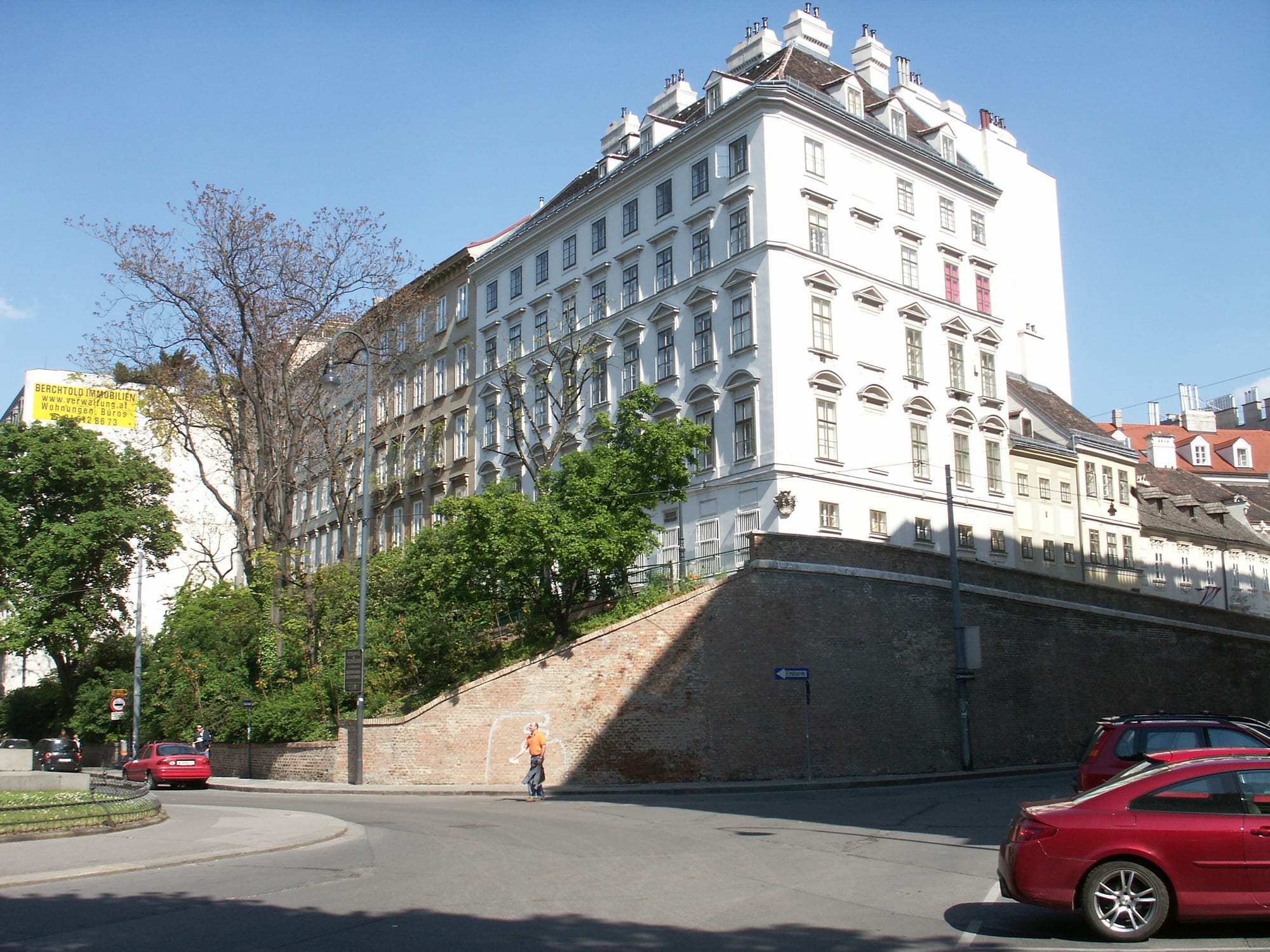
The house belonged to one of Beethoven's patrons, who let him live there for a total of eight years.
Beethoven moved from Bonn in November 1792, aged 21, to study with Haydn. Viennese noblemen, among them Prince Lichnowsky, Prince Lobkowitz and Baron Gottfried van Swieten, quickly offered him financial support. When, in 1808, Napoleon's brother Jérôme offered him a well-paid post in Kassel, Archduke Rudolf and Princes Kinsky and Lobkowitz pledged him a pension of 4,000 florins a year to keep him in Vienna. Schubert, born in a Vienna suburb in 1797, completed the picture. By 1834 the critic Raphael Georg Kiesewetter was already speaking of a "Viennese School"; today Haydn, Mozart and Beethoven are called the First Viennese School.
From palace music to public concerts
In the 19th century music moved out of palaces and into institutions that any paying listener could enter. The Gesellschaft der Musikfreunde, the Society of Friends of Music, was founded in 1812 by Joseph Sonnleithner, a friend of Beethoven. In 1842 a group meeting at an inn persuaded the composer Otto Nicolai to conduct a concert by musicians from the court opera orchestra; that concert, on 28 March 1842, was the birth of the Vienna Philharmonic, still drawn today from the orchestra of the Vienna State Opera.
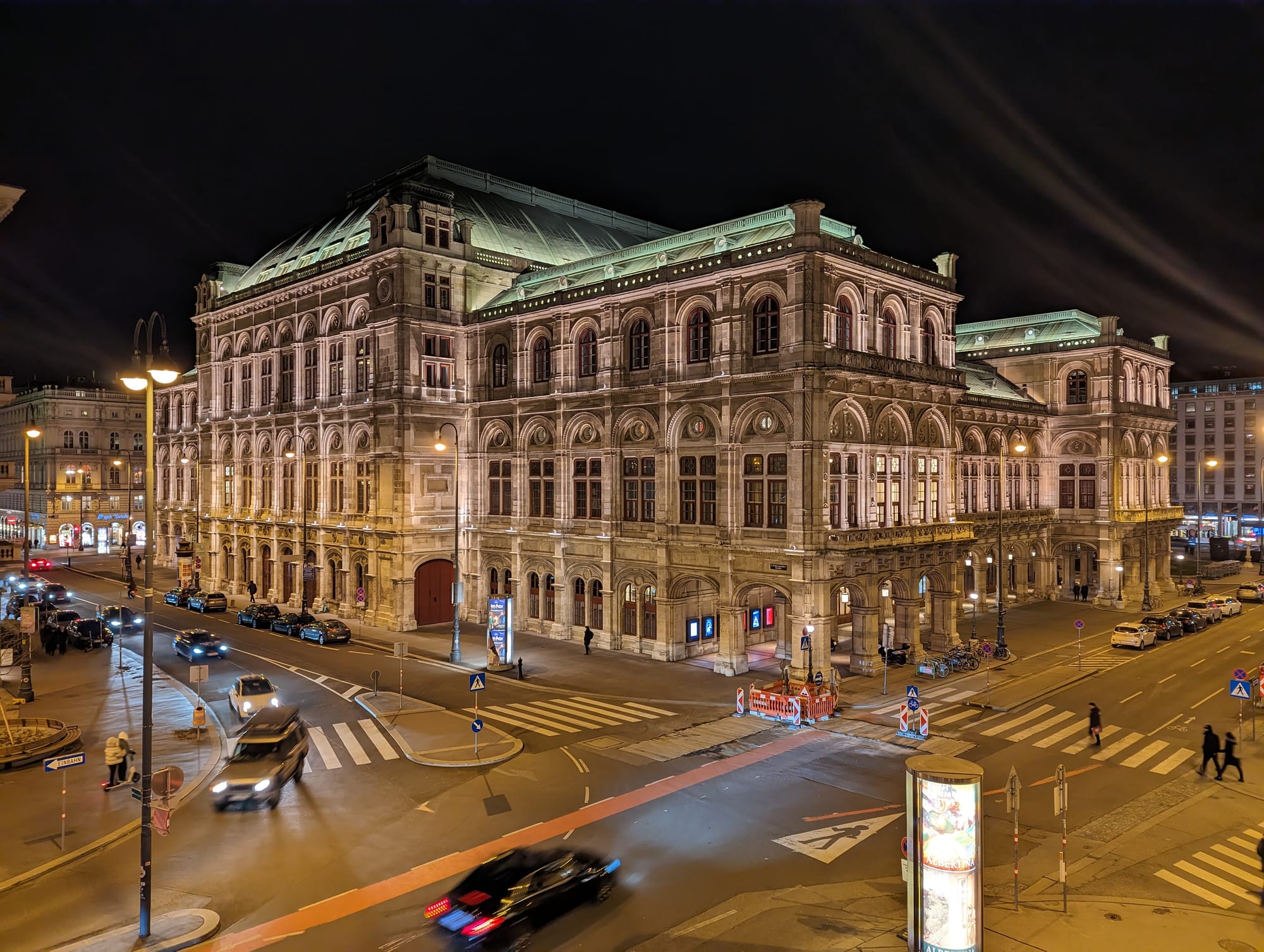
Its first performance, on 25 May 1869, was Mozart's Don Giovanni.
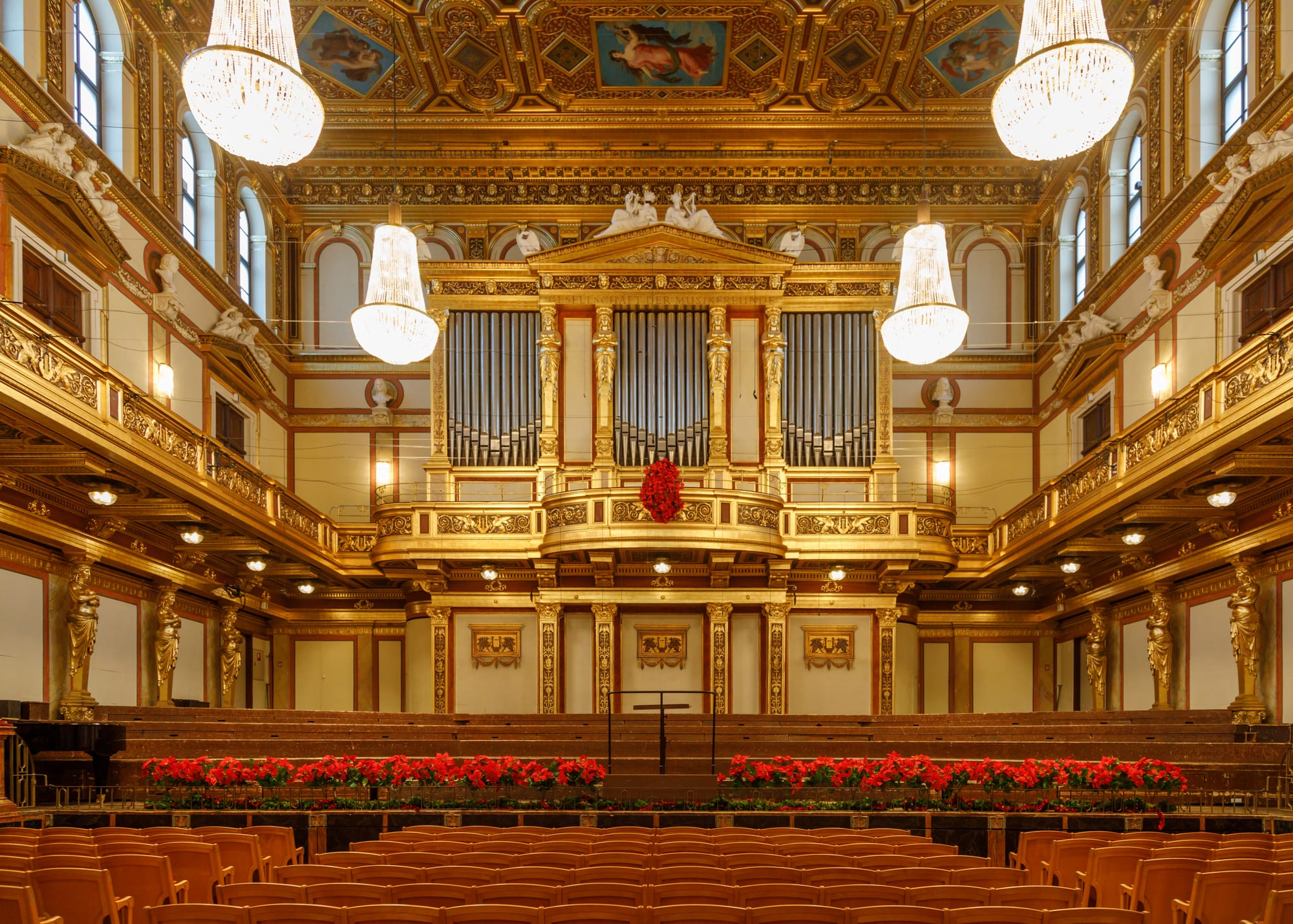
When the city's old walls were replaced by the Ringstrasse boulevard, music was given pride of place. The new Court Opera, built from 1861 to 1869 and paid for by Emperor Franz Joseph, was the first major building on the Ring. The emperor also granted land to the music society for a concert hall, the Musikverein, designed by Theophil Hansen and inaugurated on 6 January 1870. Its Great Hall, known as the Golden Hall, seats 1,744 with standing room for 300, and is considered one of the best concert halls in the world. Hansen had no science of acoustics to rely on; its warm, clear sound comes from his intuition, a narrow "shoebox" shape and thick plaster walls.
The magnet kept working. Johannes Brahms first visited in 1862, soon made the city his home and directed the music society's concerts from 1872 to 1875. Gustav Mahler became director of the Court Opera in 1897 and held the post for ten years, despite hostility from the anti-Semitic press.
The waltz, and a revolution in sound
Vienna also gave the world a dance. The Viennese waltz is the original form of the waltz, and was the first ballroom dance performed in the closed hold, with partners facing each other in an embrace. Johann Strauss II (1825–1899), known in his lifetime as "The Waltz King", wrote more than 500 waltzes, polkas and other dances, including "The Blue Danube", as well as the operetta Die Fledermaus. The city's ball season runs from 11 November to Shrove Tuesday, and its balls still open with dancing that traditionally includes a Viennese waltz.
At the other extreme, Arnold Schoenberg and his pupils Alban Berg and Anton Webern, known as the Second Viennese School, pushed music in the early 20th century beyond traditional keys into atonality and then Schoenberg's twelve-tone technique, which builds a melody from all 12 notes of the chromatic scale. Later composers such as Pierre Boulez built on that method.
Broken by war, rebuilt as a tradition
The 20th century shattered this world. After the Anschluss, Nazi Germany's annexation of Austria in 1938, the thirteen Jewish members of the Vienna Philharmonic were expelled; seven are now known to have been murdered. Schoenberg, born in Vienna, had already left for the United States, where he taught in Los Angeles. In the Second World War around a third of the city centre was destroyed and the State Opera was burned; it reopened only in 1955.
The institutions nonetheless survived, and they turned the city's past into a global ritual. The Vienna New Year's Concert, first given on 31 December 1939 as a Nazi propaganda event and held on New Year's Day since 1941, is now broadcast from the Golden Hall to an estimated audience of about 50 million, in 95 countries in 2018. It traditionally ends with "The Blue Danube" and the Radetzky March, with the audience clapping along. Vienna's operas, its Philharmonic, the Haus der Musik museum and the composers' homes kept by the city museum are why music still defines how the world sees Vienna.