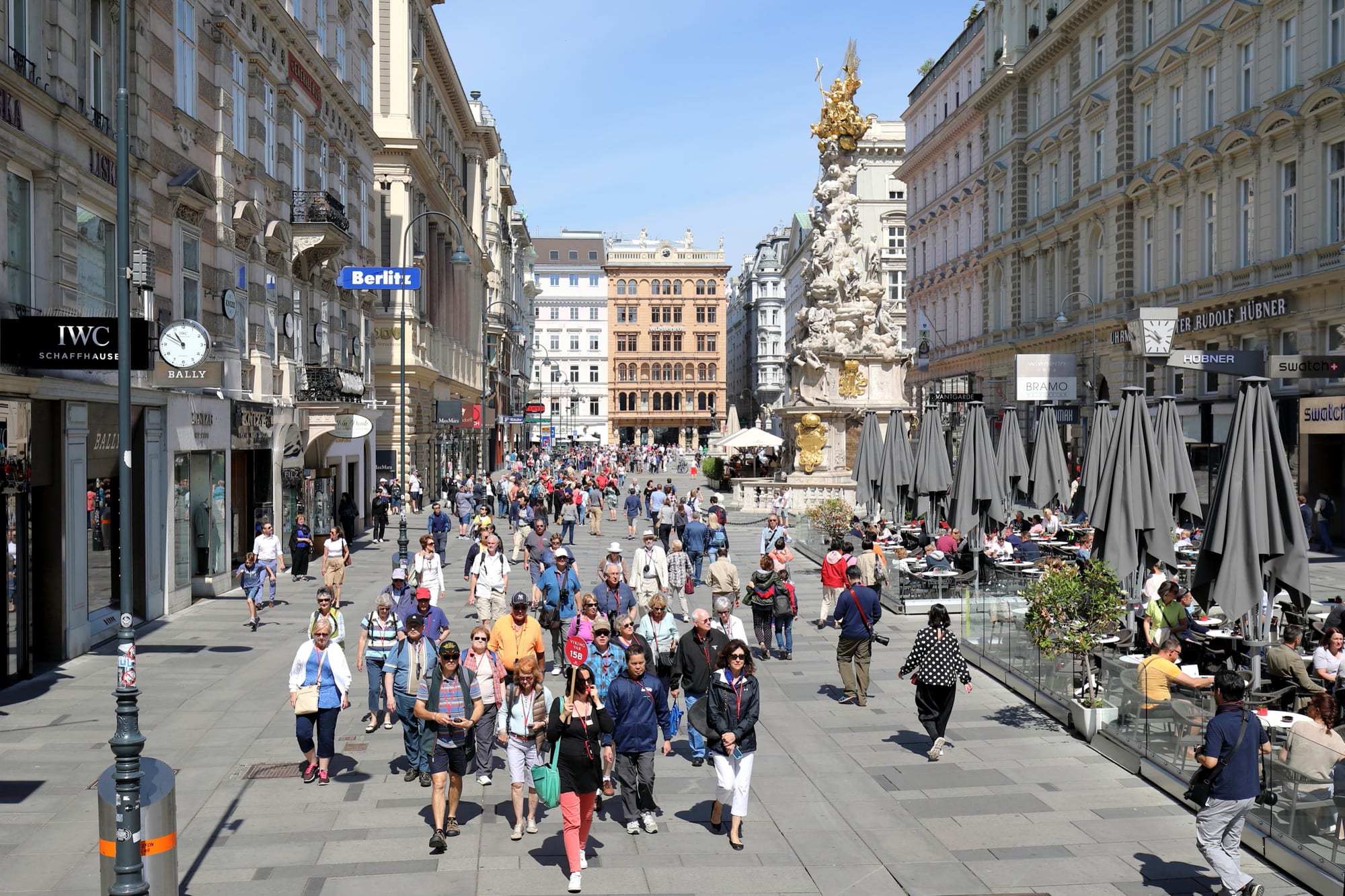
The broad pedestrian Graben lined with grand facades and café umbrellas, with the white and gold Plague Column in the middle

Vienna, Lower Austria & Burgenland, Austria

Vienna

The Graben, a pedestrian street in the Innere Stadt, with the Plague Column endowed in 1679. (C.Stadler/Bwag / Wikimedia Commons · CC BY-SA 4.0)

Austria's capital on the Danube, a Roman frontier camp that became the seat of the Habsburg emperors and the music capital of Europe. Its old centre of Baroque palaces and the grand Ringstrasse is a World Heritage Site, and today the city of just over two million mixes coffee houses, opera and wine taverns with United Nations offices and a large student population.

Neighbourhoods

  • Innere Stadt
    • First-time visitors
    • Historic district
    • Close to public transport

    The first district, the old walled city inside the Ringstrasse. St. Stephen's Cathedral, the Hofburg, the Albertina, the Graben and the old coffee houses are all within a short walk, and the boulevard around it holds the State Opera, parliament and the great museums.

    Open in Maps
  • Leopoldstadt
    • Parks
    • Local life
    • Close to public transport

    The second district, across the Danube Canal from the centre, on the island it shares with Brigittenau. The Prater park and its giant wheel fill much of it, and the streets nearer the canal have cafés, bars and a long Jewish history.

    Open in Maps
  • Neubau and Spittelberg
    • Shopping
    • Best for food
    • Nightlife

    The seventh district, just behind the MuseumsQuartier, bounded by Mariahilfer Straße to the south. Its old suburb of Spittelberg has small Biedermeier lanes, and the district as a whole is a dense mix of independent shops, studios, cafés and flats.

    Open in Maps
  • Mariahilf and Wieden
    • Best for food
    • Markets
    • Shopping

    The sixth and fourth districts meet along the Wienzeile, where the Naschmarkt runs above the covered River Wien. Mariahilfer Straße, the city's largest shopping street, forms Mariahilf's northern edge, and Wieden has the Karlskirche and the streets of small restaurants and galleries around it.

    Open in Maps
  • Josefstadt
    • Quiet and residential
    • Theatre

    The smallest district, a middle-class neighbourhood behind the parliament and the university, home to many students and to the Theater in der Josefstadt. Quiet streets of apartment houses, neighbourhood cafés and taverns make it a calm base close to the centre.

    Open in Maps
  • Döbling and Grinzing
    • Wine taverns
    • Quiet and residential
    • Walks

    The 19th district climbs from city streets to the edge of the Vienna Woods and the Kahlenberg. Grinzing, Sievering and Neustift am Walde are former wine villages, now among the most expensive places to live in the city, where vineyards and Heuriger taverns sit among the villas.

    Open in Maps

Things to do

Famous landmarks

  • St. Stephen's Cathedrallandmark

    The Gothic cathedral at the centre of the old city, with its tall south tower and patterned tiled roof, standing over Stephansplatz.

    Open in Maps
  • Hofburglandmark

    The Habsburgs' main city palace, a complex of wings and courtyards built up over centuries, now holding the president's offices, museums, the imperial treasury and the Spanish Riding School.

    Open in Maps
  • Schönbrunn Palacelandmark

    The imperial summer residence in Hietzing, with formal gardens climbing to the Gloriette and the city's zoo in its grounds.

    Open in Maps
  • Vienna State Operalandmark

    The opera house on the Ringstrasse, burned in the Second World War and reopened in 1955, and the scene of the Opera Ball each winter.

    Open in Maps
  • Karlskirchelandmark

    A Baroque church on Karlsplatz with a great dome flanked by two columns carved with spiral reliefs.

    Open in Maps
  • Hundertwasserhauslandmark

    An apartment house of uneven floors, bright colours and rooftop trees, completed in 1985 to the idea of the artist Friedensreich Hundertwasser.

    Open in Maps

Museums

  • Kunsthistorisches Museummuseum

    The Habsburg collections of old masters on the Ringstrasse, known for Bruegel's paintings, among them The Tower of Babel and The Hunters in the Snow.

    Open in Maps
  • Belvederemuseum

    Two Baroque palaces facing each other across a terraced garden, now a gallery of Austrian art from the Middle Ages to the present, with Klimt's The Kiss.

    Open in Maps
  • Leopold Museummuseum

    A modern Austrian art collection in the MuseumsQuartier, with large holdings of Egon Schiele and works by Gustav Klimt and the Vienna Secession.

    Open in Maps
  • Albertinamuseum

    A palace museum in the first district holding one of the world's great print rooms, with about 65,000 drawings and around a million old master prints.

    Open in Maps
  • Secession Buildingmuseum

    Joseph Maria Olbrich's exhibition hall of 1898, built as a manifesto for the rebel artists of the Vienna Secession.

    Open in Maps
  • Sigmund Freud Museummuseum

    Freud's former rooms at Berggasse 19, where he lived for 47 years, now a museum of his life and work.

    Open in Maps

Parks and the Danube

  • Praterpark

    A large public park in Leopoldstadt, with a long chestnut avenue, meadows and woods, and an amusement park at its city end.

    Open in Maps
  • Wiener Riesenradviewpoint

    The 64.75-metre Ferris wheel at the entrance to the Prater, built in 1897 and one of the best-known sights of the city.

    Open in Maps
  • Donauinselpark

    A 21-kilometre artificial island between the Danube and the New Danube, made from flood-defence works and given over to swimming, cycling, running and summer parties.

    Open in Maps
  • Kahlenbergviewpoint

    A 484-metre hill at the edge of the Vienna Woods in Döbling, with views over the city and the Danube.

    Open in Maps
  • Vienna Central Cemeterylandmark

    The best known of the city's nearly 50 cemeteries and one of the largest in the world by number of burials, where Beethoven, Schubert, Brahms and Falco lie, with the crypt of Austria's presidents in front of its church.

    Open in Maps

Music and nights out

  • Musikvereinattraction

    The concert hall of the Vienna Philharmonic, whose golden main hall is the setting of the New Year's Concert.

    Open in Maps
  • Wiener Konzerthausattraction

    The city's other great concert hall, home of the Vienna Symphony Orchestra.

    Open in Maps
  • Spanish Riding Schoolattraction

    The classical riding academy of the Lipizzaner horses, which performs in the Winter Riding School of the Hofburg, built in 1729–1735.

    Open in Maps

Short trips from the city

  • Klosterneuburg Abbeylandmark

    An Augustinian monastery founded in 1114 just beyond the city limits, overlooking the Danube, which holds the Verdun Altar of 1181.

    Open in Maps
  • Carnuntummuseum

    The remains of a Roman legionary fortress and provincial capital on the Danube, halfway between Vienna and Bratislava, now an archaeological park.

    Open in Maps

Seasonal events

  • Ball season11 November to Shrove Tuesday

    Formal balls with white or black tie and ball gowns, many in the Hofburg, Rathaus and Musikverein; the Opera Ball takes over the State Opera on the Thursday before Ash Wednesday.

  • New Year's Concert1 January

    The Vienna Philharmonic's morning concert of Strauss family music at the Musikverein, broadcast around the world.

  • Vienna FestivalMay and June

    Five or six weeks of theatre, opera and dance from around the world, founded in 1951 and opened with a free event outside the City Hall.

  • Donauinselfesta weekend in late June

    A free open-air music festival on the Danube Island, held since 1984, drawing around three million visitors over three days.

  • Christmas marketslate November to December

    Advent markets fill the city's squares, the best known in front of the City Hall, selling mulled wine, food and decorations.

Eat and drink

Long-standing places and food districts in Vienna. Hours, ratings and directions come from your maps app, always current.

Coffee houses and cake

  • Café Centralcafe

    A traditional coffee house on the ground floor of the Palais Ferstel, once frequented by Trotsky, Tito and Stefan Zweig.

    Open in Maps
  • Café Sperlcafe

    A listed traditional coffee house in Mariahilf, opened in 1880.

    Open in Maps
  • Café Hawelkacafe

    A small traditional café in a side street off the Graben in the first district.

    Open in Maps
  • Demelcafe

    A confectioner established in 1786 and once a purveyor of sweets to the imperial court, known for its cakes and pastries.

    Open in Maps

Markets, taverns and street food

  • Naschmarktmarket

    A market about 1.5 kilometres long over the River Wien, with fruit, spices, cheese, fish and many small restaurants, and a flea market beside it on Saturdays.

    Open in Maps
  • Heuriger taverns in Grinzingneighborhood

    Wine growers' taverns in a former wine village at the edge of the Vienna Woods, serving their own young wine with simple food; Nussdorf, Sievering and Neustift am Walde have more.

    Open in Maps
  • Würstelständerestaurant

    Sausage stands found all over the city, selling Frankfurter, Käsekrainer and other sausages, many of them into the late evening.

    Open in Maps

Experience Vienna

History

Vienna began as Vindobona, a Roman legionary camp built from around AD 97 on the Danube frontier of Pannonia, with a civilian town beside it that gained city rights in 212. In 1155 Duke Henry II of the Babenberg family moved his residence here from Klosterneuburg, at the time the Schottenstift was founded. Under the Habsburgs Vienna became the seat of the Holy Roman emperors, and it survived two Ottoman attacks, the siege of 1529 and the Battle of Vienna in 1683, as well as the Great Plague of 1679, which killed nearly a third of its people.

Victory over the Ottomans began a century of Baroque building, and in the late 19th century the old bastions were replaced by the Ringstrasse, lined with the opera, parliament, city hall and museums. By 1910 Vienna had more than two million inhabitants, the third-largest city in Europe, the capital of Austria-Hungary and the city of the Secession, Loos, Wittgenstein and Freud. After 1918 the Social Democrats ran "Red Vienna", building the Gemeindebauten, the council housing still central to the city, until the civil war of 1934, when the army shelled the Karl-Marx-Hof.

In 1938 Hitler announced the Anschluss to a crowd of 200,000 on the Heldenplatz. Of almost 200,000 Viennese Jews, around 120,000 were driven to emigrate and about 65,000 were murdered. Bombing destroyed around a third of the centre and burned the State Opera and the Burgtheater, and the Red Army took the city in April 1945. Four-power occupation lasted until 1955, when both theatres reopened, and the Vienna International Centre later brought the UN. Its centre became a World Heritage Site in 2001 and was on UNESCO's endangered list from 2017 until July 2026.

Culture & Customs

Vienna's reputation rests on music. Haydn, Mozart, Beethoven, Brahms, Bruckner, Mahler, Schubert, Schoenberg and the Strauss family lived and worked here, and the city still keeps an unusually full calendar: the Vienna Philharmonic at the Musikverein, with its New Year's Concert broadcast around the world, the Vienna Symphony at the Konzerthaus, the State Opera and the Theater an der Wien. Many concerts aimed at visitors play Mozart and Strauss. The city also has a strong popular and electronic music scene, and the Wiener Stadthalle hosted the Eurovision Song Contest in 2015 and again in 2026.

The ball season runs through Carnival, with formal balls in the Hofburg, the City Hall and the Musikverein. Debutantes wear white, the dancing opens with a Viennese waltz around ten at night and ends at about five in the morning. The coffee house is the other great institution: a place to read the papers for hours over one cup, where the waiter brings a glass of water unasked. Manners are formal and polite forms of address are used, and the local humour, the Wiener Schmäh, can be charming and barbed at once.

Art is never far away, from the Bruegels of the Kunsthistorisches Museum to Klimt and Schiele at the Belvedere and the Leopold Museum, and Otto Wagner's Art Nouveau stations and churches. Football divides the city between Rapid Wien, who play in Penzing, and Austria Wien, in Favoriten, and in summer the Viennese head for the Danube Island, the Prater and the wine taverns.

Daily Life

Vienna has just over two million inhabitants, and its metropolitan area nearly 2.9 million, close to a third of Austria's population. It is the fifth-largest city in the European Union and has the largest student population in the German-speaking world, with about 197,000 enrolled in 2023–24. Many residents have family roots elsewhere, above all in the former Yugoslavia, and in Turkey, Poland and Germany.

The economy runs on government, the universities, finance, tourism and international organisations: the United Nations, OPEC and the OSCE all have offices here. The city's council housing, the Gemeindebauten, still provides affordable homes, and cyclists have more than 1,000 kilometres of cycle paths.

The inner districts are dense with apartment blocks, while the outer ones run from council estates and new developments across the Danube to the villas of Hietzing and Döbling. Shops close on Sundays, and summer evenings are spent on the Danube Island, along the canal and at the Heuriger. The city's flood defences kept it largely dry during the European floods of 2024, but summer heat is a growing concern: the temperature reached a record 41°C in August 2026. The city's governing coalition stayed in office after the April 2025 election.

Food

Viennese cooking is best known for Wiener Schnitzel, a veal cutlet pounded flat, coated in flour, egg and breadcrumbs and fried in clarified butter; versions made with pork or chicken are common too. Tafelspitz, very lean boiled beef, comes with Geröstete Erdäpfel, boiled potatoes sliced and pan-fried, and Apfelkren, a mixture of horseradish, cream and apple. These dishes belong to the Beisl, the small traditional Viennese tavern.

Cake is a serious matter. Sachertorte, a moist chocolate cake with a layer of apricot jam under a chocolate glaze, is the city's most famous, and confectioners such as Demel, a former supplier to the imperial court, and the old coffee houses serve it alongside strudel and Palatschinken, sweet pancakes. Coffee comes in many forms, the Melange among the best known. In winter small street stands sell hot chestnuts, Maroni, and potato fritters, and the Würstelstand sells Frankfurter, as Vienna sausages are called here, and Käsekrainer, a cheese-filled sausage, through the day and into the night.

Vienna is one of the few capitals with its own vineyards. Its growers sell young wine in their taverns, the Heuriger, in Grinzing, Nussdorf, Sievering, Neustift am Walde and other former villages, and the typical local wine is Gemischter Satz, a blend of grape varieties grown in the same vineyard. The Naschmarkt along the Wienzeile is the city's best-known market, with fruit, spices, fish and small restaurants serving food from around the world.

Planning tools

Budget

Vienna is the most expensive place in the region for hotels, above all in Advent, at New Year and in the ball season. Public transport passes, standing-room opera tickets and café lunches keep daily costs down.

Daily Budget Midrange
USD 170–300 (mid-range hotel, coffee-house breakfasts, Beisl dinners, museum and concert tickets)
Daily Budget Shoestring
USD 80–130 (hostel or private room, Würstelstand and lunch menus, a transport pass)

Café lunches are often cheaper than restaurant meals, and a public transport pass covers the U-Bahn, trams and buses.

Best Time to Visit

April to June and September to October are mild and good for walking and the wine taverns. Winter brings the Advent markets and the balls of the Carnival season. July and August can be hot, and the Danube Island is at its liveliest.

Suggested Number of Days

Three or four days covers a first visit to the city itself. Allow five to seven to include the Vienna Woods, the Wachau or a trip down the river. Concert and opera evenings, and the opening days of museums, can stretch the stay.

First Visit
3–4 days
With Surroundings
5–7 days

Transportation

The U-Bahn, trams and buses of Wiener Linien cover the whole city, and a car is more trouble than it is worth. The U-Bahn runs all night at weekends and before public holidays. Trams circle the Ringstrasse, and cyclists have more than 1,000 kilometres of cycle paths.

Keep out of the marked bicycle lanes on pavements, and buy and carry a valid ticket for every journey.

Airport & Station Connections

Vienna International Airport is at Schwechat, 18 kilometres south-east of the centre. The S7 suburban train takes about 25 minutes, the dearer City Airport Train reaches Wien Mitte in about 15. The Hauptbahnhof has direct trains to Bratislava, Budapest, Munich, Prague, Zürich and other European cities.

Walkability

The first district is compact, with pedestrian streets such as the Graben and Kärntner Straße at its heart. The inner districts beyond it are pleasant on foot, while Schönbrunn, the Prater and the wine villages are best reached by U-Bahn or tram.

Safety

Austria is very safe, with low levels of violent crime. In Vienna the main risk is pickpockets, who grab and run as passengers board the U-Bahn, and around the Prater amusement area at night.

Watch bags in crowds, and buy concert tickets from box offices rather than street sellers. Check current official travel advice before travelling.

Climate

A mild continental climate. Summers are warm to hot and showery, and winters relatively dry and fairly cold. Snow has become much rarer over recent decades, especially in the centre.

Summer
warm to hot — average highs between 27 and 32°C, with a record of 41°C set on 3 August 2026
Winter
fairly cold and relatively dry — daily means around 0°C or a little above, with snow less common than it once was

Local Customs

Manners are formal, with polite forms of address, and in an old coffee house the waiter brings a glass of water with the coffee and guests may linger for hours. Most shops, and many restaurants and cafés, close on Sundays. Balls have strict dress codes.

A tip of around 10 per cent is usual in restaurants, given by naming the total when paying. Dress modestly in churches, and keep quiet during services.

Common Payment Methods

The currency is the euro. Cards and contactless are accepted in most places, but Austria is fonder of cash than many neighbours, and small cafés, bakeries, market stalls and sausage stands may prefer it. ATMs are easy to find.