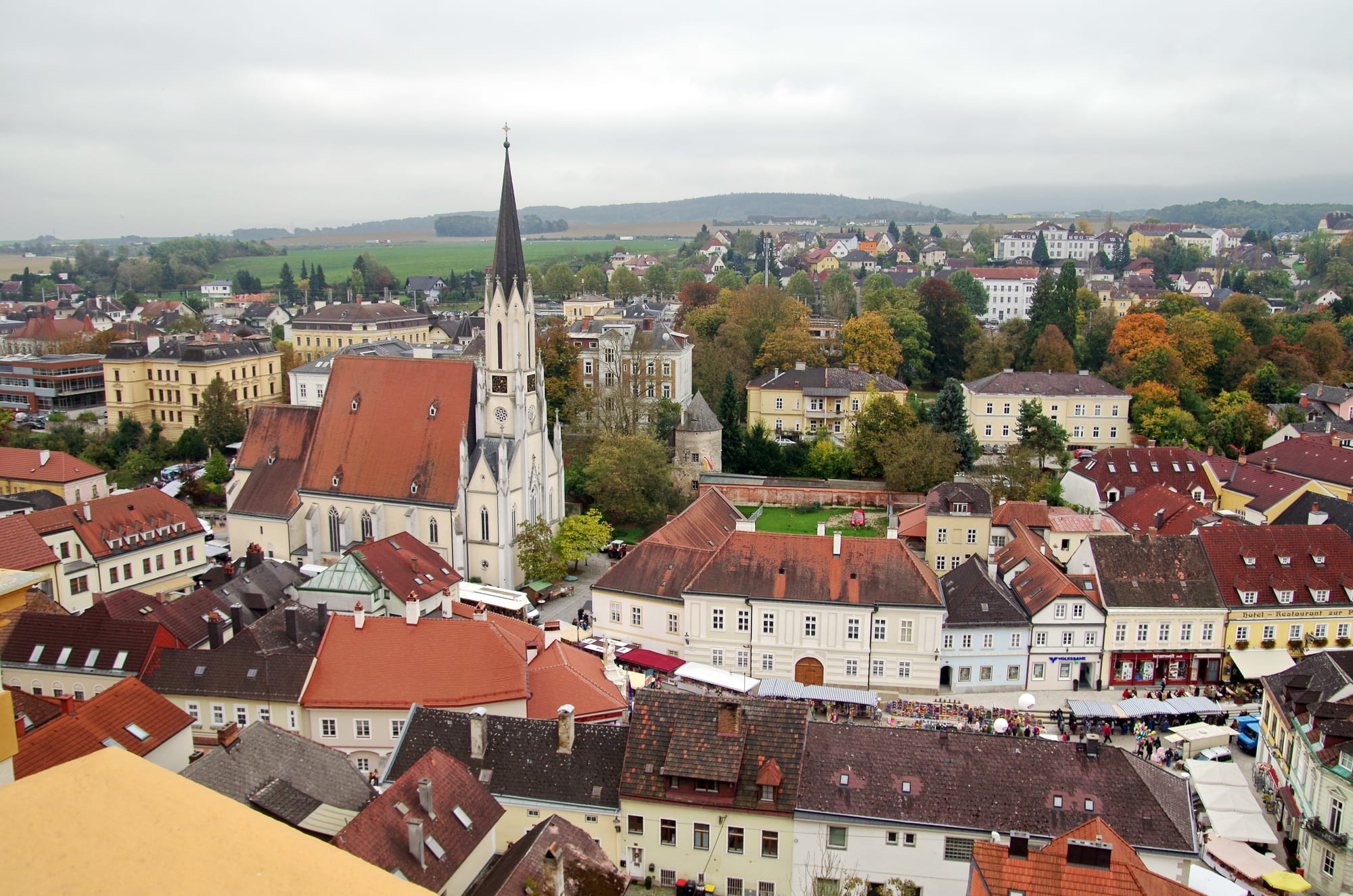
Red and grey roofs of Melk's old town seen from above, with the tall Gothic spire of the parish church and market stalls on the square

Vienna, Lower Austria & Burgenland, Austria

Melk

The old town of Melk and its Gothic parish church, seen from the terrace of Melk Abbey. (Balou46 / Wikimedia Commons · CC BY-SA 4.0)

A small Danube town in Lower Austria below Melk Abbey, the vast Baroque Benedictine monastery built in 1702–36 on a rocky bluff above the river. It marks the western end of the Wachau, and its old streets of town houses, its main squares and its landing stages fill each summer with visitors arriving by boat, bicycle and train.

Neighbourhoods

  • Old town
    • First-time visitors
    • Historic district

    The compact centre below the abbey rock, around the Hauptplatz and the Rathausplatz with its town hall of 1575 and St. Koloman's fountain. The Sterngasse, the oldest lane, has painted house fronts and old courtyards, and remnants of the town wall survive along the Zaglauergasse.

    Open in Maps
  • The abbey hill
    • Sightseeing
    • Views

    The bluff above the town, crowned by the yellow Baroque abbey, its park and its garden pavilion. The terraces look down over the roofs of the town and along the Danube towards the Wachau.

    Open in Maps
  • The Danube arm and landing stages
    • Boats and cycling
    • Riverside walks

    Along the side arm of the Danube, the Nibelungenlände leads past the Round Tower, remains of the old walls and the Schiffsmeisterhaus with its flood marks to the landing stages where the river boats and the cycle path arrive.

    Open in Maps

Things to do

Melk Abbey and the old town

  • Melk Abbeylandmark

    The Benedictine abbey rebuilt in Baroque style in 1702–36 to designs by Jakob Prandtauer, with a twin-towered, domed church frescoed by Johann Michael Rottmayr and Paul Troger, a Marble Hall and a library of rare medieval manuscripts.

    Open in Maps
  • Melk concentration camp memorialmuseum

    The former crematorium of a subcamp of Mauthausen, where prisoners were forced to dig tunnels for an underground ball-bearing factory in 1944–45, now kept as a memorial museum.

    Open in Maps

Short trips into the Wachau

  • Schallaburg Castlelandmark

    A castle 5 kilometres south of Melk, its central part built in German Renaissance style from about 1540 by the Losenstein family, now used for large exhibitions.

    Open in Maps
  • Aggstein Castlelandmark

    The ruin of a 12th-century castle high on the right bank of the Danube downstream from Melk, with views over the Wachau.

    Open in Maps
  • The Wachau by boatattraction

    The 36-kilometre World Heritage valley of vineyards, monasteries and castles between Melk and Krems, travelled by river boats from mid-April to October.

    Open in Maps
  • Dürnsteinattraction

    A small wine town with the blue tower of its Baroque abbey and the ruined castle where Richard the Lionheart was held captive.

    Open in Maps
  • Danube Cyclewaytrail

    The Danube Cycleway, one of Europe's most popular cycle routes, passes Melk on its way through the Wachau to Krems and Vienna.

    Open in Maps

Seasonal events

  • Melker SommerspieleJuly and August

    A summer theatre season staged in the Donauarena.

  • Melker Höfefestthird week of July

    A two-day festival in the old town.

Eat and drink

Long-standing places and food districts in Melk. Hours, ratings and directions come from your maps app, always current.

Melk and the Wachau

  • Cafés on the Hauptplatz and Rathausplatzneighborhood

    The two linked squares below the abbey hold the town's cafés and restaurants, with outdoor tables in summer.

    Open in Maps
  • Wachau wine tavernsneighborhood

    Downstream from Melk, growers' taverns in the Wachau villages serve their own Riesling and Grüner Veltliner with simple food during their short opening periods.

    Open in Maps

Experience Melk

History

Melk is first mentioned as Medilica in 831, in a donation by Louis the German; the name comes from a Slavic word for border. In 976 the area was given to Leopold I, the first Babenberg margrave, as a buffer between the Magyars to the east and Bavaria to the west, and the Babenbergs had a castle on the rocky bluff above the river. In 1089 Leopold II gave the site to Benedictine monks from Lambach, and their abbey became the town's reason for being. A monastic school was founded in the 12th century, and the library became known for its manuscripts.

The town below received market rights in 1227. It lived from the river, which could also destroy it: in 1501 the Danube rose 15.8 metres above its usual level, a mark still recorded on the Schiffsmeisterhaus. The town hall dates from 1575. Between 1702 and 1736 the abbey was rebuilt to designs by Jakob Prandtauer as one of the great Baroque monasteries of Europe. It survived the Napoleonic Wars, and Melk became a municipality in 1898.

After the Anschluss of 1938 the abbey school and much of the abbey were confiscated. In 1944 a subcamp of Mauthausen concentration camp was set up in the town's barracks; more than 14,000 prisoners passed through it, and about 5,000 died digging tunnels for an underground factory. The school returned to the monks after the war. A fire damaged the abbey in 1974, and in December 2000 the Wachau, from Melk to Krems, was listed as a World Heritage cultural landscape. The town was flooded again in 2002 and 2013.

Culture & Customs

Life in Melk still turns around the abbey. It is a working Benedictine house, the burial place of St. Coloman and of several members of the Babenberg family, and its school, the Stiftsgymnasium, teaches nearly 900 boys and girls. The library's medieval manuscripts made the name of Melk known far beyond Austria, and Umberto Eco paid tribute to it in The Name of the Rose, whose William of Baskerville is accompanied by his assistant Adso of Melk. St. Coloman also stands on the market fountain in the Rathausplatz, a gift from the abbey to the town.

The town keeps its own small calendar. In July and August the Melker Sommerspiele stage theatre in the Donauarena, and in the third week of July the two-day Höfefest fills the old town. A tablet near the Rathausplatz commemorates the composer Anton Bruckner, and in 1950 Melk hosted Austria's first official women's chess championship. The painted fronts of the houses in the Sterngasse still show the trades once carried on inside them.

Melk shares the customs of the Wachau around it: wine taverns that open for a few weeks at a time, the apricot harvest, and a Catholic calendar of feast days. Visitors are expected to be quiet and decently dressed in the abbey church.

Daily Life

Melk had about 5,300 inhabitants in 2012, a small town between the Melk and Pielach rivers on a side arm of the Danube. It is the centre of the surrounding district, with schools, offices and shops serving the villages around it, and an army barracks on the site of the former concentration camp. Tourism is the most visible part of the economy: coaches, trains and river boats bring day visitors to the abbey, and in summer cyclists on the Danube path fill the squares.

Daily life follows the season. From spring to autumn the landing stages, cafés and squares are busy, and the town quietens again in the evening once the day visitors have left; in winter it belongs to its residents. The abbey school brings hundreds of pupils into the centre each weekday. The A1 motorway and the main western railway make Vienna an hour away, and some residents commute.

The Danube is both the town's living and its risk. Floods reached Melk in 2002 and 2013, and the town council elected in 2025 has an ÖVP majority.

Food

Melk eats as the rest of Lower Austria does, with Wiener Schnitzel, goulash, dumplings and roast pork with sauerkraut on tavern menus, and Austrian pastries such as apple strudel and Kaiserschmarrn, a shredded, lightly sweetened pancake, in the cafés around the squares.

What sets the area apart is the Wachau just downstream. Its apricots, Marillen, are also made into speciality spirits, and the terraced vineyards along the river grow Riesling and Grüner Veltliner. Wachau wines are graded by ripeness as Steinfeder, Federspiel and Smaragd, the last named after the green lizard that lives on the vineyard walls.

The Heuriger, the grower's own tavern, is the local way to drink them. Taverns in the wine villages open for a few weeks at a time, serving their own wine with simple food, and at the start of autumn Sturm, a partially fermented young wine. Along the river the cycle path and the boat landings are lined with places to stop for wine and food in season.

Planning tools

Budget

Melk costs less than Vienna, though summer is its busiest season, when the river boats and cyclists arrive. A room in a private house or a winery in the Wachau, and a tavern supper with a glass of local wine, keep costs well below city prices.

Daily Budget Midrange
USD 170–300 (mid-range hotel, abbey admission, restaurant dinners, a Wachau boat or hire bicycle)
Daily Budget Shoestring
USD 80–130 (hostel or private room, bakery and tavern food, regional trains and buses)

Combine the train and the river boat for a round trip through the Wachau, and hire a bicycle for the riverside path.

Best Time to Visit

April to October, when the river boats run and the cycle path is busy; the Wachau's apricot trees blossom in spring and the grape harvest comes in autumn. July and August bring the summer theatre and the most visitors. Winter is quiet and grey.

Suggested Number of Days

Many visitors see Melk in a day. Two or three days allow time to travel down the valley by river or bicycle and to see the villages beyond the town; the season and the boat timetable change how much fits in.

First Visit
1 day
With Surroundings
2–3 days

Transportation

The old town and the abbey are close enough to walk. Regional buses, river boats from April to October and the Danube cycle path link Melk with the rest of the Wachau, and bicycles can be hired in town and taken on the boats.

Check the boat season before planning to travel by river; outside it, buses and trains are the alternative.

Airport & Station Connections

Melk station has frequent trains from Vienna, taking about an hour. By road the town is 85 kilometres from Vienna along the A1 motorway. The nearest major airport is Vienna International Airport, on the far side of the capital. Many visitors arrive by river boat or on the Danube cycle path.

Walkability

The centre is small and easy on foot, with the station, the squares and the landing stages all close together. The climb to the abbey is short but steep.

Safety

Austria is very safe, with low levels of violent crime. Melk is a quiet town; the practical risks are ticks in the woods and meadows of Lower Austria and traffic on the busy cycle path. The town has been hit by Danube floods, most recently in 2002 and 2013.

Check for ticks after country walks, and keep to the right on shared cycle paths. Check current official travel advice before travelling.

Climate

The Danube valley of eastern Austria has warm to hot summers and cold winters.

Summer
warm to hot — daytime temperatures in July and August around 25°C, sometimes reaching 35°C
Winter
cold — in nearby Krems the January average is −0.6°C

Local Customs

Melk Abbey is a working Benedictine monastery and school, and its church is a place of worship. Most shops close on Sundays. Wine taverns in the Wachau open for a few weeks at a time and hang out a bush to show they are serving.

Tipping is expected in restaurants, but not where goods are bought over the counter. Dress modestly and keep quiet in the abbey church.

Common Payment Methods

The currency is the euro. Cards and contactless are accepted in most places, but small cafés, bakeries, taverns and market stalls may prefer cash, so a little is useful. There are ATMs in the town centre.