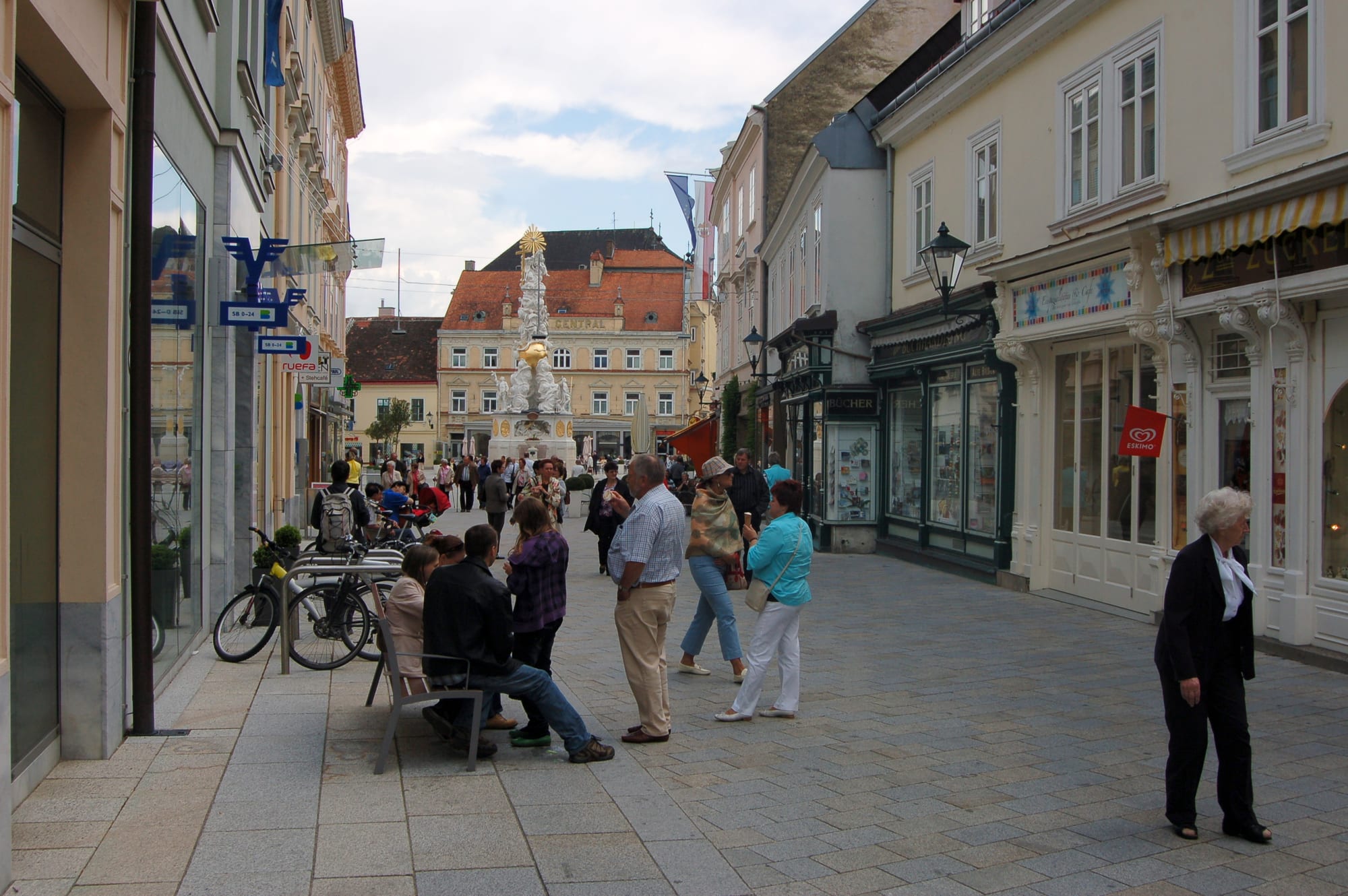
A paved shopping street of pastel town houses leading to the main square and its white and gold Trinity Column

Vienna, Lower Austria & Burgenland, Austria

Baden bei Wien

Looking towards the Hauptplatz of Baden bei Wien and its Trinity Column. (Wolfgang Glock / Wikimedia Commons · CC BY-SA 3.0)

A spa town on the edge of the Vienna Woods, about 26 kilometres south of Vienna, built around fourteen warm sulphur springs used since Roman times. Rebuilt in Biedermeier style after a fire in 1812 and long the summer residence of the imperial court, it is now part of the Great Spa Towns of Europe World Heritage Site and a wine town of the Thermenregion.

Neighbourhoods

  • The Biedermeier centre
    • First-time visitors
    • Historic district
    • Shopping

    The streets around the Hauptplatz, rebuilt after the fire of 1812 to plans by Joseph Kornhäusel, with the town hall, the Trinity Column and the Beethoven House in the Rathausgasse. Shops and cafés fill the ground floors of the low, pastel-coloured houses.

    Open in Maps
  • Kurpark and the spa quarter
    • Spas
    • Parks
    • Evenings out

    The spa park around the casino, at the heart of the spa quarter. A bandstand, a Beethoven temple and monuments to artists and emperors stand among its paths, and the Sommerarena and the Römertherme baths are close by.

    Open in Maps
  • Helenental and the vineyards
    • Walks
    • Wine taverns
    • Quiet and residential

    West of the centre the Schwechat river leaves the Vienna Woods through the Helenental, guarded by the castle ruins of Rauheneck and Rauhenstein. On the slopes of the Hartberg and around the town, vineyards supply the local Heuriger taverns.

    Open in Maps

Things to do

Spa town sights

  • Kurparkpark

    The spa park beside the casino, with a Beethoven temple, a bandstand with summer concerts and monuments to artists and emperors.

    Open in Maps
  • Rosarium in the Doblhoffparkpark

    Austria's largest rose garden, with more than 860 varieties, which bloom twice a year in June and October.

    Open in Maps
  • Casino Badenlandmark

    A Neo-Renaissance building of 1884–86, put up as the new spa house on the site of an old bath and reopened in 1995 as a casino and congress centre.

    Open in Maps
  • Beethovenhausmuseum

    The 16th-century house in the Rathausgasse where Beethoven spent the summers of 1821 to 1823 and worked on his Ninth Symphony, now a museum.

    Open in Maps
  • Burgruine Rauhensteinlandmark

    A ruined 12th-century castle above the Helenental, with a tower 20 metres high.

    Open in Maps

Baths and theatres

  • Römerthermeattraction

    A thermal bath under a wide glass roof on the Brusattiplatz, built in 1997–99 on the site of the old indoor pool.

    Open in Maps
  • Thermalstrandbadattraction

    An open-air thermal bathing lido on the Helenenstrasse.

    Open in Maps
  • Sommerarenaattraction

    An Art Nouveau summer theatre of 1906 with a glass roof, used for the town's summer operetta productions.

    Open in Maps

Short trips

  • Heiligenkreuz Abbeylandmark

    A Cistercian monastery in the Vienna Woods about 9 kilometres from Baden, the oldest continuously occupied Cistercian monastery in the world.

    Open in Maps
  • Mayerlingattraction

    A small village up the Schwechat valley, where Crown Prince Rudolf and Mary Vetsera were found dead in his hunting lodge in 1889, apparently by suicide.

    Open in Maps
  • Gumpoldskirchenattraction

    A wine village at the foot of the Anninger, known for its Zierfandler and Rotgipfler white wines.

    Open in Maps

Seasonal events

  • Operetta summersummer

    Operetta, musicals and plays at the Sommerarena and the municipal theatre, in a town whose theatre life has long centred on operetta.

  • Festival La Gacilly-Baden Photosummer

    An open-air photography festival held across the town each summer since 2018, in partnership with La Gacilly in France.

Eat and drink

Long-standing places and food districts in Baden bei Wien. Hours, ratings and directions come from your maps app, always current.

Thermenregion wine

  • Heuriger taverns of Badenneighborhood

    Growers' taverns in and around the town serve their own wine with simple food; Baden is the centre of the Thermenregion's wine country.

    Open in Maps
  • Gumpoldskirchen wine tavernsneighborhood

    The neighbouring wine village's taverns pour Zierfandler and Rotgipfler, the white grapes of this stretch of the Thermenlinie.

    Open in Maps

Cafés

  • Cafés around the Hauptplatzneighborhood

    Coffee houses and pastry shops line the squares and streets of the Biedermeier centre.

    Open in Maps

Experience Baden bei Wien

History

The Romans knew the warm springs as Aquae Cetiae or Thermae Pannonicae. It was recorded as Padun in a deed of 869, and in the 12th century the castles of Rauheneck and Rauhenstein were built above the Helenental. Baden received its town privileges in 1480. It was sacked by Hungarians and by Ottoman troops more than once but flourished again each time.

Its great age began when Emperor Franz I spent every summer from 1796 to 1834 here with his family, making Baden the court's summer residence; the aristocracy followed, Metternich took a house, and the emperor and his chancellor prepared the Congress of Vienna here in 1814. A fire in 1812 destroyed much of the town, which was rebuilt to plans by Joseph Kornhäusel and is still called the Biedermeier town. Archduke Charles built the Weilburg Palace in 1820–25, Beethoven stayed a number of times, and the railway between Vienna and Graz brought thousands of Viennese to take the waters.

By the First World War Baden was Vienna's main resort, receiving about 20,000 guests a year, double its own population, and it served as a temporary seat of the Austro-Hungarian high command. A new casino in 1934 made it the leading spa in Austria. The Weilburg Palace was destroyed in the Second World War, and from 1945 to 1955 Baden was the headquarters of the Soviet forces in occupied Austria. In 2021 it became one of the eleven towns of the Great Spa Towns of Europe World Heritage Site.

Culture & Customs

Baden's culture is that of the spa and the summer court. The town was the model for the setting of Johann Strauss's operetta Die Fledermaus, and its theatre life still centres on operetta, staged in the municipal theatre of 1909 and, in summer, under the glass roof of the Sommerarena. The casino hosts balls, readings and concerts as well as the Ave Verum international choir competition, and since 2018 the town has staged an open-air photography festival with the French town of La Gacilly each summer.

Beethoven is the best-remembered guest. He stayed in Baden a number of times and spent the summers of 1821 to 1823 in the house in the Rathausgasse where he worked on the Ninth Symphony; his nephew Karl attempted suicide at the Rauhenstein ruin in 1826. The actress Katharina Schratt, Emperor Franz Joseph's confidante, was born in Baden.

Wine is the other strand. Baden is the centre of the Thermenregion's wine country, and the town keeps up long-standing traditions of folk dancing, town music, the singing wine growers and several local costumes of its own. Most residents are Roman Catholic, and the town's churches and feast days mark the year.

Daily Life

Baden had 26,097 inhabitants on 1 January 2026, and it is the administrative seat of the Baden district. It lies in the commuter belt south of Vienna, and many residents travel to the capital on the Southern Railway or the Badner Bahn, the tram-train whose terminus is in the town. The A2 motorway passes the town.

The spa remains central to the economy. Fourteen springs, between 22 and 36°C and rich in mineral salts, rise mostly at the foot of the Calvary hill and are among the most sulphurous in Austria. They supply the thermal baths and clinics that bring guests for treatment and recreation. Tourism, the casino, the theatres, wine and local services provide much of the rest of the town's work.

Life is unhurried by city standards. The Biedermeier centre is busy with shoppers on weekdays and Saturday mornings, the Kurpark and the Doblhoffpark fill on fine afternoons, and in summer the outdoor thermal lido and the theatres draw the crowds. The town council, elected in 2025, has 41 seats shared among six parties, with the ÖVP the largest.

Food

Baden eats as the rest of Lower Austria does: Wiener Schnitzel, goulash, dumplings, roast pork with sauerkraut, and in the cafés apple strudel, Sachertorte and Kaiserschmarrn, a shredded, lightly sweetened pancake. The coffee house tradition of Vienna carries on in the cafés of the Biedermeier centre.

The town's own speciality is wine. It sits at the heart of the Thermenregion, the wine country along the Thermenlinie at the edge of the Vienna Woods, and its vineyards cover the slopes of the Hartberg and the hills around. Nearby Gumpoldskirchen is known for its wine, grown from varieties such as Zierfandler and Rotgipfler.

The Heuriger is where this wine is drunk. A grower opens a tavern for a few weeks at a time, hangs out a bush to show it is serving and offers its own wine with simple food. The singing wine growers and the town's other old societies keep the wine tradition alive.

Planning tools

Budget

Baden is cheaper than Vienna for food and rooms, and it is easy to visit as a day trip from the capital. Thermal baths, theatre tickets and a Heuriger supper are the main extra costs.

Daily Budget Midrange
USD 170–300 (mid-range hotel, thermal bath entry, restaurant and Heuriger dinners, operetta tickets)
Daily Budget Shoestring
USD 80–130 (private room or guesthouse, bakery and Heuriger food, regional trains or the Badner Bahn)

The Badner Bahn tram-train from central Vienna is the simplest way to arrive and leave.

Best Time to Visit

May to October. The roses of the Doblhoffpark bloom in June and again in October, summer brings the operetta season, the photo festival and the outdoor thermal lido, and autumn is the wine harvest. The indoor baths make winter visits worthwhile too.

Suggested Number of Days

Many visitors come for a day from Vienna. Two or three days allow time for the baths, an evening at the theatre and the villages and woods around the town; the theatre and festival calendar changes the number.

First Visit
1 day
With Surroundings
2–3 days

Transportation

The centre is small enough to walk. Baden station is on the Southern Railway, with S-Bahn, regional and Cityjet Xpress trains to Vienna and Wiener Neustadt, and the town is the terminus of the Badner Bahn, a 30-kilometre tram-train line from Vienna.

Regional buses and walking paths lead into the Helenental and the Vienna Woods.

Airport & Station Connections

Baden is about 26 kilometres south of Vienna. Cityjet Xpress trains run to Vienna every 30 minutes at peak times, the Badner Bahn tram-train links the town with central Vienna, and by road the A2 Süd Autobahn passes the town. Vienna International Airport is the nearest airport.

Walkability

The Biedermeier centre, the Kurpark and the casino are all within a short walk of each other, and the Doblhoffpark and the Helenental are pleasant walks further out. The Calvary hill and the vineyard paths involve some climbing.

Safety

Austria is very safe, with low levels of violent crime. Baden is a quiet spa town; the practical risks are ticks in the woods and meadows of the Vienna Woods and steep, slippery paths in wet weather.

Check for ticks after walks in the woods, and follow the bathing rules at the thermal baths. Check current official travel advice before travelling.

Climate

Eastern Austria has warm to hot summers and cold winters, and the area around Vienna often has strong easterly winds.

Summer
warm to hot — daytime temperatures in July and August around 25°C, sometimes reaching 35°C
Winter
fairly cold — in nearby Vienna daily means are around 0°C or a little above

Local Customs

Spa manners apply: thermal baths have their own rules, and quiet is expected in rest areas. Most shops close on Sundays. Heuriger taverns open for a few weeks at a time and hang out a bush when they are serving. Balls and concerts are held at the casino.

Tipping is expected in restaurants, but not where goods are bought over the counter. Dress smartly for the theatre and the casino.

Common Payment Methods

The currency is the euro. Cards and contactless are accepted in most places, but small taverns, bakeries and market stalls may prefer cash, so a little is useful. There are ATMs in the centre.