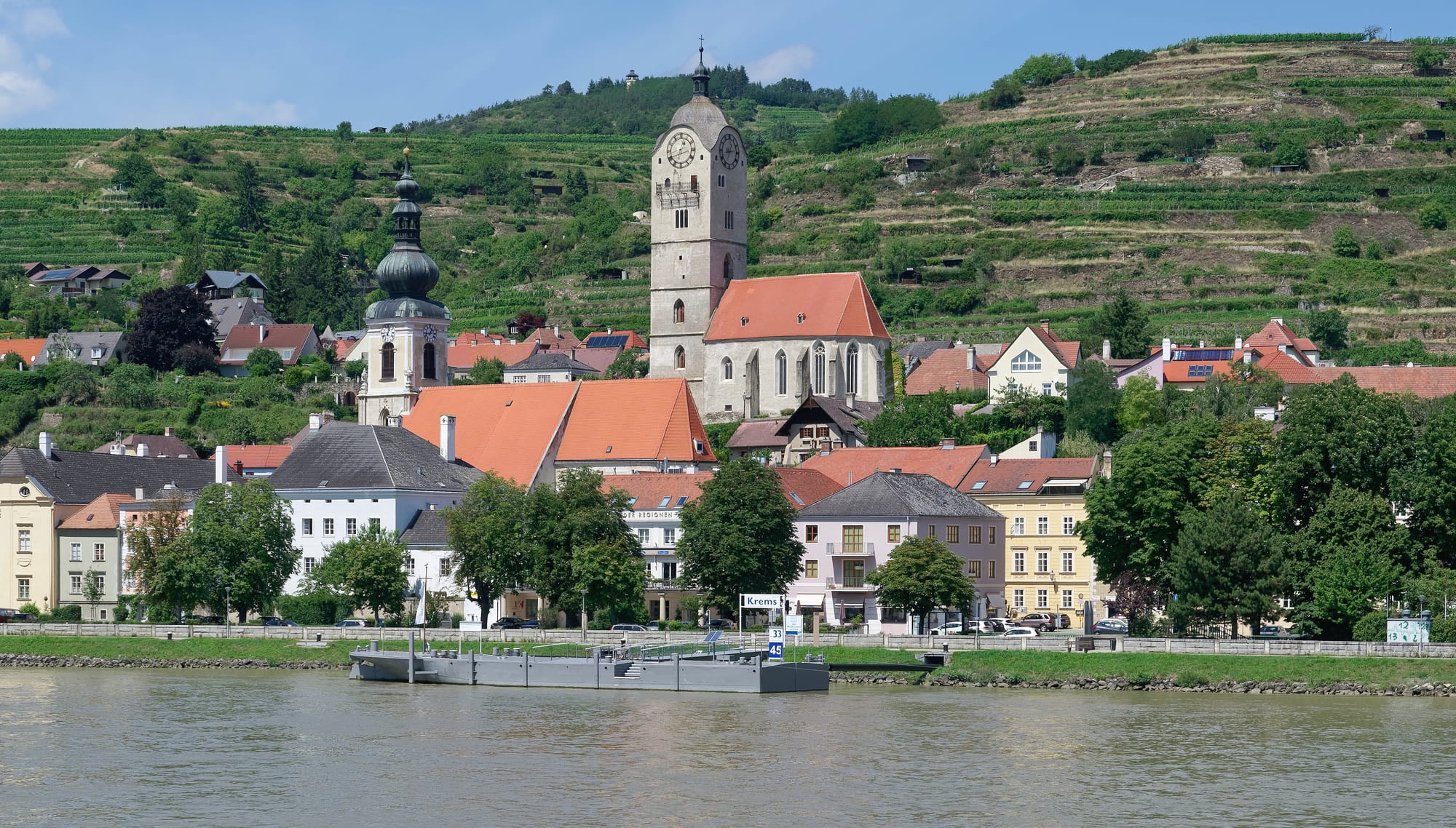
Red-roofed houses and two church towers of Stein on the Danube bank, below terraced vineyards and a hilltop church

Vienna, Lower Austria & Burgenland, Austria

Krems an der Donau

Stein, the riverside quarter of Krems, seen from the Danube, with its parish church and the Frauenbergkirche above. (Jakub Hałun / Wikimedia Commons · CC BY-SA 4.0)

A wine and university town where the Krems river meets the Danube at the eastern end of the Wachau, about 70 kilometres west of Vienna. A medieval trading town once almost as large as Vienna, it keeps its old centre and the riverside quarter of Stein, linked by the Kunstmeile, an art mile of museums and galleries below terraced vineyards.

Neighbourhoods

  • Krems old town
    • First-time visitors
    • Historic district
    • Shopping

    The old centre, walled until the late 19th century and still entered through the Steiner Tor. Churches, painted house fronts and the Gozzoburg sit among cafés and shops.

    Open in Maps
  • Stein
    • Historic district
    • Museums
    • Riverside walks

    The riverside town upstream, now part of Krems, strung along the Steiner Landstrasse below terraced vineyards. Its Gothic churches, gates and town houses lead to the Kunstmeile's museums in the former tobacco factory, the university campus and the boat landings.

    Open in Maps
  • Mitterau
    • Sport
    • Close to the river
    • Quiet and residential

    The flat ground between the old town and the Danube, opened up when the flood dam was moved in 1976, now home to the town's sports grounds and swimming baths.

    Open in Maps

Things to do

The old town and Stein

  • Steiner Torlandmark

    The town gate, built in the late 15th century and later refashioned in Baroque style, with a stone dated 1480, and the symbol of Krems.

    Open in Maps
  • Gozzoburglandmark

    An early Gothic town palace named after the town judge Gozzo, with remarkable frescoes and chapels.

    Open in Maps
  • Piaristenkirchelandmark

    An old-town church with the Frauenberg tower, once the seat of the town's fire watchman, built onto it.

    Open in Maps
  • Minoritenkirche in Steinlandmark

    A friars' church in Stein, consecrated in 1264 and now the Klangraum Krems event venue.

    Open in Maps

The Kunstmeile

  • Kunsthalle Kremsmuseum

    The main gallery of the Kunstmeile, in a former tobacco factory in Stein, known for large international exhibitions.

    Open in Maps
  • Karikaturmuseum Kremsmuseum

    A museum of caricature and cartoon art, with a permanent display of work by Manfred Deix and Gustav Peichl (Ironimus).

    Open in Maps
  • Landesgalerie Niederösterreichmuseum

    Lower Austria's state gallery of art, opened on the Kunstmeile in 2019.

    Open in Maps

Short trips into the Wachau

  • Göttweig Abbeylandmark

    A Benedictine monastery founded in 1083 on a hill across the Danube, rebuilt after a fire of 1580 and visible from much of the valley.

    Open in Maps
  • Dürnsteinattraction

    One of the most visited towns in the Wachau, a small wine town with a blue abbey tower and the ruined castle where Richard the Lionheart was held.

    Open in Maps
  • Langenloisattraction

    A wine town on the Kamp river, home of the Loisium wine centre designed by Steven Holl.

    Open in Maps
  • The Wachau by boatattraction

    The 36-kilometre World Heritage valley upstream to Melk, travelled by river boats between mid-April and October.

    Open in Maps

Seasonal events

  • Donaufestivalspring

    An annual festival of avant-garde rock, experimental and electronic music, performance and film, held in Krems alone since 2007.

Eat and drink

Long-standing places and food districts in Krems an der Donau. Hours, ratings and directions come from your maps app, always current.

Wine and apricots

  • Heuriger taverns of Krems and Steinneighborhood

    Growers' taverns in and around the town serve their own wine with simple food, open for a few weeks at a time.

    Open in Maps
  • Wineries of the Wachau and Kremstalneighborhood

    Krems and its neighbours Stein, Dürnstein and Spitz are known for Riesling and Grüner Veltliner, and many wineries offer tastings.

    Open in Maps

The old town

  • Cafés in the old townneighborhood

    The streets of the old town have cafés and restaurants, with tables outside in summer.

    Open in Maps

Experience Krems an der Donau

History

People have lived where the Krems meets the Danube for a very long time: a child's grave found here is more than 27,000 years old, the oldest found in Austria. The town was first mentioned in 995 in a charter of Otto III, and in the 11th and 12th centuries Chremis, as it was then called, was almost as large as Vienna, a trading town on the river with its twin, Stein, just upstream. Its oldest surviving written town charter dates from 1305.

Hungarian troops caused heavy destruction in 1477, and the fortifications were restored soon afterwards; the Steiner Tor carries the date 1480. Near the end of the Thirty Years' War Swedish troops took Krems in 1645, and imperial forces won it back on 5 May 1646. The 18th century brought Martin Johann Schmidt, the Kremser Schmidt, one of the outstanding Austrian painters of the late Baroque, who died in Stein in 1801. In the last third of the 19th century the town walls were pulled down, leaving the Steiner Tor and a few other remnants.

In August 1938 a larger municipality named Krems an der Donau was formed. After the Second World War the town grew again as a centre of schools, culture and trade. The Donau-Universität and the arts institutions of the Kunstmeile, gathered in the former tobacco factory in Stein, gave Krems a new role late in the 20th century. Today it is a statutory city, both a municipality and a district of its own.

Culture & Customs

Krems is a town of trade, culture, schools and universities, and culture and wine meet along the Kunstmeile, the town's art mile of museums and galleries. The Kunsthalle stages large international exhibitions, the Karikaturmuseum shows caricature and cartoon art, and the state gallery of Lower Austria opened in 2019. In spring the Donaufestival brings avant-garde rock, noise, electronic music and performance art, and the town also hosts the Glatt & Verkehrt music festival.

Wine is the other culture. Krems, Stein, Dürnstein and Spitz are known for their Rieslings and Grüner Veltliners, and the Heuriger, the grower's own tavern, is the natural place to meet. A tavern hangs a bunch of conifer twigs over its door when it is open, serves its own wine with simple food and closes again after a few weeks. The town is also the main producer of Marillenschnaps, the apricot brandy of the Wachau.

Students give the centre a younger rhythm than most Wachau towns. Its higher-education institutions, among them the University for Continuing Education, the Karl Landsteiner private university of health sciences and the IMC university of applied sciences, bring people from across Austria and abroad, and church feasts and the vineyard calendar still mark the year.

Daily Life

Krems had 25,581 inhabitants at the start of 2026, making it the fifth-largest town in Lower Austria, and about 50,000 people lived in its wider area at the end of 2010. It is a centre of trade, culture, schools and universities, and the seat of the surrounding Krems district. The university hospital is a major employer, and the town also has chemical industry and a Danube port that handled about 2.2 million tonnes of goods in 2024. Austria's largest prison stands in Stein.

The town is divided into the old centre, Stein, Mitterau by the river, the hillside districts and outlying villages such as Gneixendorf. The pedestrian streets of the old town are busy on weekdays and Saturday mornings, students fill the cafés, and in summer cyclists and boat passengers arrive from the Wachau. Trains and the S5 and S33 expressways link the town with Vienna and St. Pölten.

The Danube shapes local concerns. The town stores a mobile steel and aluminium flood wall that can be put up along the river to protect its low-lying districts, and floods are watched closely. A new swimming complex beside the old Badearena has been one of the town's large building projects.

Food

Krems shares the cooking of Lower Austria: Wiener Schnitzel, goulash, dumplings and roast pork with sauerkraut, followed by apple strudel or Kaiserschmarrn, a shredded, lightly sweetened pancake. The Heuriger is the local way to eat, with simple food served alongside the grower's own wine.

The Wachau's apricots, Marillen, are also made into speciality spirits, and Krems is the main producer of Marillenschnaps, the apricot brandy. The vineyards on the terraces above Stein and along the valley grow Riesling and Grüner Veltliner, and Wachau wines are graded by ripeness as Steinfeder, Federspiel and Smaragd, the last named after the green lizard of the vineyard walls.

Autumn is the season for Sturm, a partially fermented young wine sold at its start, and for the grape harvest in the vineyards around the town. The old town's cafés and the taverns of Stein and the surrounding wine villages are where most of this is eaten and drunk.

Planning tools

Budget

Krems is cheaper than Vienna, and a room at a winery or a private house, a tavern supper and a glass of local wine cost a fraction of city prices. The Kunstmeile sells a combined ticket for its museums.

Daily Budget Midrange
USD 170–300 (mid-range hotel, Heuriger dinners, museum tickets, a Wachau boat or hire bicycle)
Daily Budget Shoestring
USD 80–130 (hostel or private room, bakery and Heuriger food, regional trains and buses)

Take the boat upstream to Melk and return by bus or train, and look for the Kunstmeile combined ticket.

Best Time to Visit

April to October. The Wachau's apricot trees blossom in spring, the river boats run from mid-April, and the grape harvest and the young Sturm come in autumn. Spring brings the Donaufestival. Winter is quiet, grey and cold.

Suggested Number of Days

One or two days cover the town itself. Three or four allow time for the wider valley by river or bicycle and for the wine country around it; the season and how much time is spent at the taverns change the number.

First Visit
1–2 days
With Surroundings
3–4 days

Transportation

Krems station is a junction of lines to Vienna, St. Pölten, Spitz and Horn, and regional buses fan out from it. A town bus links the station, the old town and Stein. The Danube cycle path and the river boats are the classic ways to travel up the Wachau.

Bicycles can be taken on the river boats; check the season before relying on them.

Airport & Station Connections

Regional express trains run hourly from Vienna's Franz-Josefs-Bahnhof, Spittelau and Heiligenstadt, taking about an hour. By road Krems is about 70 kilometres west of Vienna on the S5 expressway. The nearest major airport is Vienna International Airport, beyond the capital.

Walkability

The old town is compact, and Stein, the Kunstmeile and the river are a pleasant walk away along the Steiner Landstrasse. The vineyard paths above town are steep.

Safety

Austria is very safe, with low levels of violent crime. Krems is a quiet town; the practical risks are ticks in the woods and meadows of Lower Austria and Danube floods, against which the town keeps a mobile flood wall.

Check for ticks after country walks, and take care on shared cycle paths. Check current official travel advice before travelling.

Climate

A transitional climate, with oceanic influences from the west and continental ones from the east, well suited to wine growing. July is the warmest month and January the coldest.

Summer
warm — July averages about 19.5°C over the day and night, and the highest reading of 1971–2000 was 36.8°C
Winter
cold — January averages about −0.6°C, and the lowest reading of 1971–2000 was −22.8°C

Local Customs

Heuriger taverns open for a few weeks at a time and hang out a bush to show they are serving. Most shops close on Sundays, and wine is part of everyday life. The churches are places of worship.

Tipping is expected in restaurants, but not where goods are bought over the counter. Dress modestly in churches.

Common Payment Methods

The currency is the euro. Cards and contactless are accepted in most places, but small taverns, bakeries and market stalls may prefer cash, so a little is useful. There are ATMs in the old town.