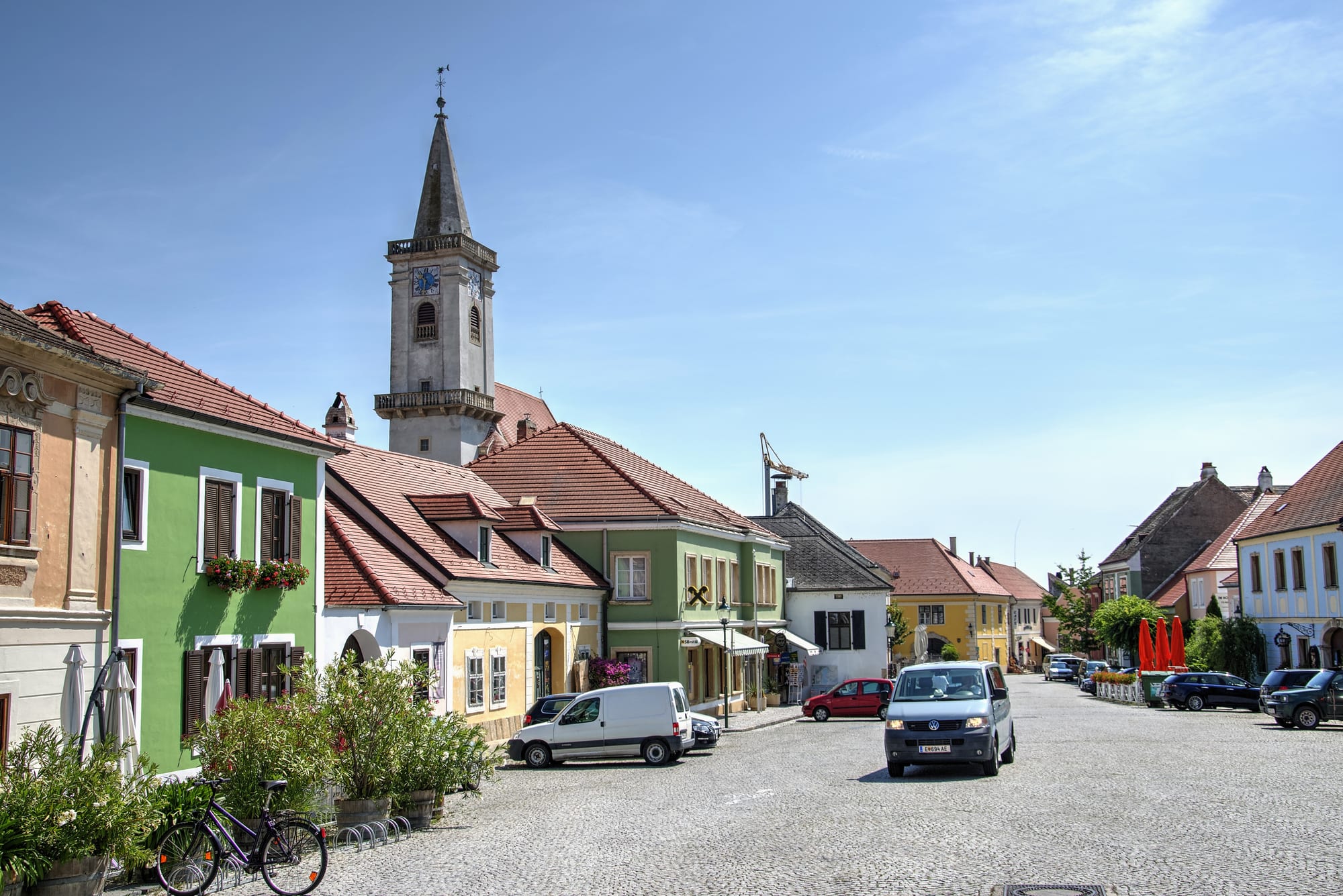
A cobbled square of green, yellow and white houses with red roofs, below a slender church tower in Rust

Vienna, Lower Austria & Burgenland, Austria

Rust

The Rathausplatz in Rust's old town, with the tower of the Holy Trinity Church. (Doronenko / Wikimedia Commons · CC BY-SA 4.0)

A small walled wine town on the western shore of Lake Neusiedl in Burgenland, close to the Hungarian border. A royal Hungarian free town since 1681 and Austrian since 1921, it is the country's smallest statutory city, known for white storks on its rooftops, a protected old town of burghers' houses and the sweet Ruster Ausbruch wine.

Neighbourhoods

  • The old town
    • First-time visitors
    • Historic district
    • Wine taverns

    The whole old town is a protected monument: burghers' houses of the 16th to 19th centuries with Renaissance, Baroque and later façades, arched gateways leading to courtyards, and long stretches of the 1614 town wall. The houses are still lived in and worked by local families, and storks nest on many of the chimneys.

    Open in Maps
  • The lakeshore
    • Swimming and sailing
    • Birdwatching

    Beyond the reed belt that rings Lake Neusiedl, the town has its own bathing beach on the open water, and the lake is used for swimming and sailing. The reeds shelter large numbers of breeding and migrating birds.

    Open in Maps
  • The vineyards of the Ruster Hügelland
    • Walks
    • Wine

    About 450 hectares of vines cover the low hills of the Ruster Hügelland above the town, part of the Leithaberg wine area. Several of Austria's long-distance footpaths cross the town's land, and quiet lanes run between the vineyards above the lake.

    Open in Maps

Things to do

The old town

  • Old town and Rathausplatzneighborhood

    The cobbled main square and lanes of a living old town that was named one of Austria's three model towns in European Architectural Heritage Year 1975 and listed by UNESCO with the Lake Neusiedl landscape in 2001.

    Open in Maps
  • Fischerkirchelandmark

    The fishermen's church, the oldest and most important building in the town, with wall paintings from the 12th century uncovered during the 20th; it is now used as a museum and for concerts.

    Open in Maps
  • Stadtmuseum Kremayrhausmuseum

    The town museum in the Kremayr House on the main square.

    Open in Maps
  • Pulverturmlandmark

    The north-east corner tower of the town wall, standing with surviving sections of the 16th-century fortifications.

    Open in Maps

The lake

  • Lake Neusiedlpark

    Central Europe's largest endorheic lake, about 36 kilometres long and very shallow, ringed by reeds and known as the 'Sea of the Viennese' for its sailing and windsurfing.

    Open in Maps
  • Seefestspiele Mörbischattraction

    The neighbouring village's operetta festival on a stage beside the lake, the largest festival of its kind in the world, first held in 1957.

    Open in Maps

Short trips from the town

  • Schloss Esterházylandmark

    In Eisenstadt, the Baroque palace of the Esterházy princes, where Joseph Haydn worked as court musician for most of his life.

    Open in Maps
  • St. Margarethen and its Roman quarryattraction

    A neighbouring village with a large quarry worked since Roman times, where a passion play has been staged in summer for more than seventy years.

    Open in Maps
  • Neusiedler See-Seewinkel National Parkpark

    Austria's steppe national park on the lake and the salt pans beyond its eastern shore, known for its varied birdlife.

    Open in Maps
  • Sopronattraction

    The old Hungarian town just across the border, which voted to stay in Hungary in 1921, where much of the medieval centre remains.

    Open in Maps

Seasonal events

  • Seefestspiele MörbischJuly and August

    Summer operetta on the lake stage in Mörbisch, the next village to the south.

  • Summer concerts in the Fischerkirchesummer

    Concerts held every summer in the old fishermen's church, chosen for its acoustics.

  • International Guitar Festival Rustannual

    A guitar festival held in the town since 1999, with concerts, master classes and an international competition.

Eat and drink

Long-standing places and food districts in Rust. Hours, ratings and directions come from your maps app, always current.

Rust classics

  • Ruster Ausbruch at the wineriesneighborhood

    The town's famous sweet wine, made from grapes touched by noble rot and legally protected since 2020; many old-town houses are working wineries that sell their own bottles.

    Open in Maps
  • Heuriger tavernsneighborhood

    Growers' taverns where local winemakers pour their own new wine with simple food, often in the courtyards of the old town.

    Open in Maps
  • Cafés on the Rathausplatzcafe

    Café and restaurant terraces set out on the cobbles of the main square in summer.

    Open in Maps

Experience Rust

History

The town first appears in 1317 as Ceel, in a deed of King Charles I of Hungary, a name taken from the Hungarian word for elm; the German Rust is a translation of it, and the modern Hungarian Ruszt was in turn borrowed back from the German. Rust received market rights around 1470; in 1524 Queen Mary of Hungary granted its growers the right to brand their barrels with a crowned "R".

Rust was walled in 1512 but destroyed during the Ottoman wars in 1529 and 1532; a second ring wall followed in 1614, and much of it still stands. By the end of the 16th century the town was almost entirely Protestant. In 1649 it bought its freedom from feudal subjection, paying the Habsburgs 60,000 gold florins and 500 buckets of its best wine — nearly 30,000 litres of Ruster Ausbruch — and on 3 December 1681 Leopold I made it a royal free town at the diet held in Sopron.

With the rest of Burgenland, Rust passed from Hungary to Austria in 1921, and because it was already a free town it became the country's smallest statutory city. Under Nazi rule it lost that status from 1938, its three Jewish families were robbed and driven out or murdered, and Roma were deported to camps; the Red Army arrived on 2 April 1945. The old town was listed by UNESCO with the Lake Neusiedl landscape in 2001.

Culture & Customs

Rust calls itself the town of storks. The white stork is treated almost as an emblem across the whole Lake Neusiedl area, and in Rust the birds nest on the chimneys and roofs of the old town. The old town itself is the other point of pride: in 1975 it was chosen, with Salzburg and Krems, as one of Austria's three model towns, praised for a historic centre that had not been restored as a museum but was still lived and worked in, and its houses remain homes, wineries and shops.

Protestant history is part of the town's identity. The present Catholic parish church was permitted in 1647 as a Protestant church, and the town's Reformation past brought the European title it received in 2019. Music has a place too: the small fishermen's church, the Fischerkirche, is used for concerts each summer for its acoustics, and since 1999 the town has hosted an international guitar festival with concerts, master classes and a competition.

Wine runs through the town's calendar and conversation. Since 1989 the Austrian Wine Academy, the first in the German-speaking world, has been based in a 17th-century house in the town, and Rust has served as the setting and filming location of the television series Der Winzerkönig, about a winemaking family.

Daily Life

Rust had 1,918 inhabitants at the start of 2026, slightly fewer than its peak of 1,984 in 2021, which makes it the smallest administrative district and statutory city in Austria. It governs itself through its own town charter and council, while its police station reports to the Eisenstadt command and it lies within Eisenstadt's district court. Gerold Stagl has been mayor since 2012.

Wine is the town's living. Its vineyards cover about 450 hectares on the hills above the lake and belong to the Leithaberg wine area, and the old town's houses still serve their original purpose as homes and working premises for the families who own them. Tourism adds summer visitors who come for the lake, the beach, sailing and the cycle routes, and day trippers from Vienna who come to walk the old town and sit in the wine taverns.

The rhythm of the year follows the vines and the lake: pruning in winter, summer evenings on the shore, the harvest in autumn and the new wine around St. Martin's Day in November. The town has a kindergarten, a primary and a lower secondary school. The lake's water level, which falls sharply in droughts, is a recurring worry for the whole shore.

Food

Rust's fame is a sweet wine. Ausbruch is an Austrian quality grade for dessert wine made from grapes affected by noble rot, ranked between Beerenauslese and Trockenbeerenauslese, and Ruster Ausbruch is the best known of all; the category entered Austrian wine law in 1970 to recognise a method long used around Rust, and since 2020 Ruster Ausbruch has had its own protected designation. The town's history is bound up with it: it was partly with Ausbruch that the burghers paid for their freedom in 1649.

The vineyards also produce dry wines, and the reds of the area include Blaufränkisch, a late-ripening dark grape whose wines are typically rich in tannin and often spicy. Austrian wine as a whole is mostly white, but the sweeter wines made around Lake Neusiedl are among its specialities.

The everyday place to drink them is the Heuriger, a tavern where winemakers serve their own new wine under a special licence for part of the year, with simple food alongside. In Rust many of these are in the courtyards of the old town, and wines can be tasted and bought directly at the cellar door of the family wineries.

Planning tools

Budget

Rust costs less than Vienna but is not a bargain in high summer, when the lake and the Mörbisch festival fill the rooms of the area. Many visitors stay in private rooms or at wineries, and eating at a Heuriger is the cheapest way to dine. Wine bought at the cellar door is often the main extra expense.

Daily Budget Midrange
USD 160–280 (mid-range guesthouse or winery room, restaurant dinners, wine tastings, a lake festival ticket)
Daily Budget Shoestring
USD 80–130 (private room, Heuriger suppers and bakery lunches, buses and a hire bicycle)

Eating at a Heuriger is usually the cheapest way to dine, and wine bought at the cellar door is the easiest extra to overspend on.

Best Time to Visit

Late spring to early autumn. July and August bring swimming, sailing and the lake festivals, and September and October bring the grape harvest. Around St. Martin's Day in November the cellars open for the new wine. Winter is quiet, grey and windy.

Suggested Number of Days

The town itself is small and is often seen in a day from Vienna or Eisenstadt. Staying two or three nights allows time for the lake, the neighbouring villages and the wine cellars; cyclists circling the lake usually spend longer in the area.

First Visit
1 day
With Surroundings
2–3 days

Transportation

The old town is walked, and bicycles are the usual way to reach the lakeshore, the vineyards and the neighbouring villages on the cycle routes around the lake. Buses run to Eisenstadt and directly to Vienna. The railway that once ended near the town closed in 1953, and the nearest station is now at Schützen am Gebirge.

Rust has its own harbour on the lake, used by passenger boats as well as sailing boats.

Airport & Station Connections

Most visitors arrive by road from Eisenstadt, the state capital, along the Ruster Strasse, or by bus from Vienna. Vienna International Airport, at Schwechat, is the nearest large airport. Travellers by train change to a bus at Schützen am Gebirge or Eisenstadt.

Walkability

The old town is compact, flat and entirely walkable, with cobbles on the main square. The lake beach lies beyond the reed belt east of the town, and the vineyard lanes above the town make easy walks.

Safety

Austria is very safe, with low levels of violent crime. Rust is a small, quiet town. The practical risks are outdoors: ticks in the meadows and woods of Burgenland, and strong winds on the shallow, windy lake.

Check for ticks after country walks and watch the weather before going out on the lake. Check current official travel advice before travelling.

Climate

Northern Burgenland lies on the edge of the Pannonian Plain, with a continental climate and less rain than the Alpine areas: hot summers, cold grey winters and a mild but windy climate around the lake.

Summer
warm to hot across northern Burgenland, around 25–32°C, with occasional heatwaves
Winter
cold and often overcast, around -3 to 4°C, with a biting wind

Local Customs

Rust was Hungarian until 1921, and its Hungarian and Croatian names, Ruszt and Rušta, recall its history. A bunch of twigs hung above a doorway shows that a grower's tavern is open. Shops close by early evening and all day on Sunday, and Catholic tradition and courtesies such as the use of titles still matter in Austria.

Storks' nests are protected; watch and photograph them from the street without disturbing the birds or the houses' residents.

Common Payment Methods

The currency is the euro. Cards are widely accepted, but some small wineries, taverns and market stalls prefer cash, so it is worth carrying some notes and coins.