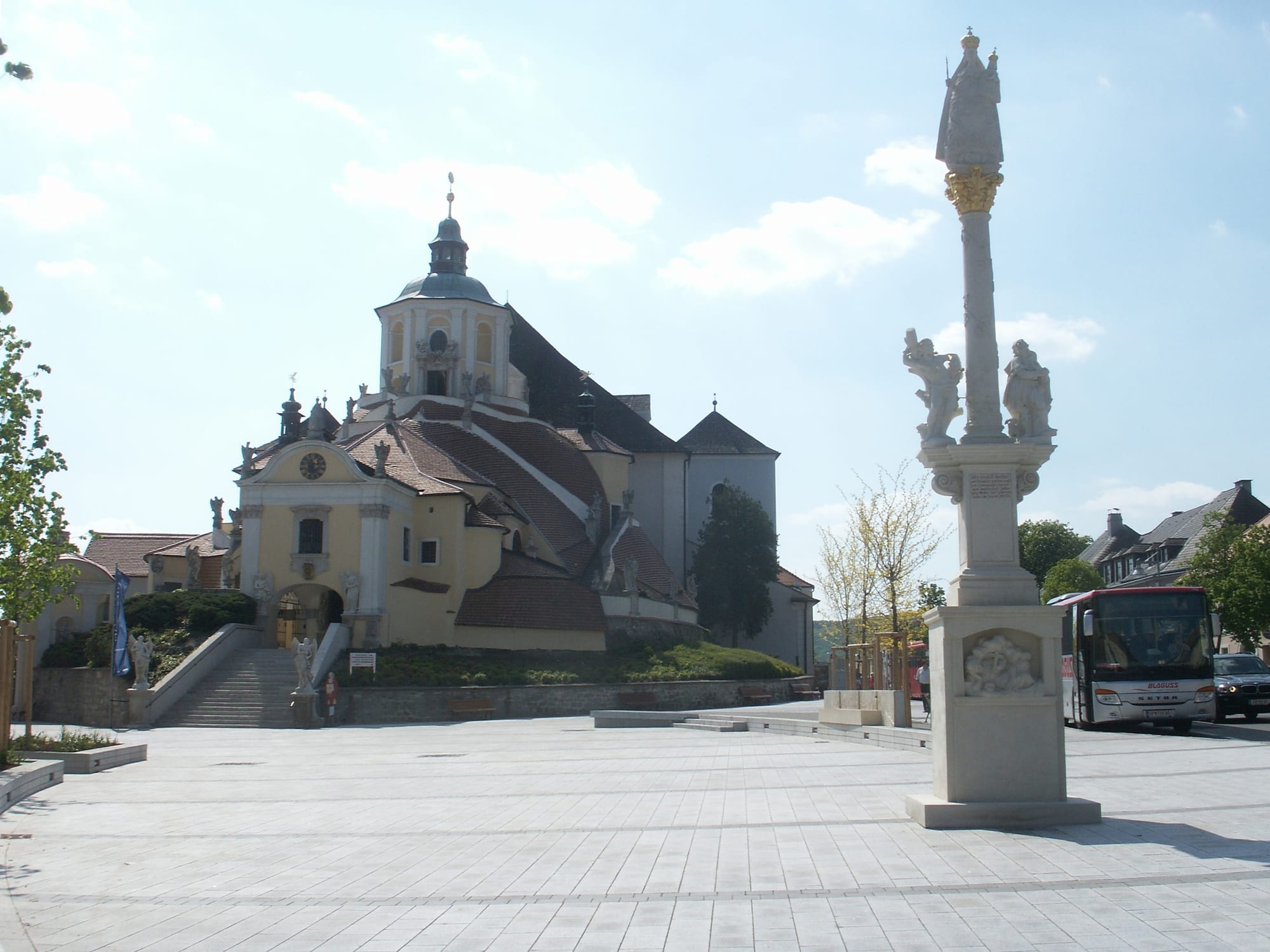
The yellow Baroque Bergkirche with its domed tower and stepped roofs above a paved square with a tall Marian column

Vienna, Lower Austria & Burgenland, Austria

Eisenstadt

The Bergkirche in Eisenstadt-Oberberg, where Joseph Haydn is buried, with the Marian column in front. (Welleschik / Wikimedia Commons · CC BY-SA 3.0)

The capital of Burgenland, at the foot of the Leitha Mountains about 12 kilometres from the Hungarian border, and Austria's smallest state capital. For nearly three centuries the seat of the Hungarian Esterházy princes, it is the town where Joseph Haydn worked as court musician and where he is buried, with a palace, a historic Jewish quarter and vineyards around it.

Neighbourhoods

  • The old town
    • First-time visitors
    • Historic district
    • Shopping

    The centre around the historic pedestrian zone and Schloss Esterházy, with town houses, cafés, shops and the cathedral of St. Martin. Most of the town's sights, offices and restaurants are within a few minutes' walk.

    Open in Maps
  • Oberberg
    • Music history
    • Views

    The northern part of town, a short walk from the palace, crowned by the Bergkirche with Haydn's tomb and the Kalvarienberg, a man-made hill of grottoes and stations of the cross with views over the town and countryside.

    Open in Maps
  • Unterberg and the Jewish quarter
    • History
    • Quiet and residential

    The southern part of town, which holds the former Jewish quarter, home to a Jewish community from the 17th century until 1938, with the Austrian Jewish Museum, its private synagogue and the old and new Jewish cemeteries.

    Open in Maps

Things to do

Palace and churches

  • Schloss Esterházylandmark

    The Esterházy princes' palace, converted to a Baroque residence in 1663–72, where Haydn worked; it offers guided tours, a wine museum and concerts in the Haydnsaal.

    Open in Maps
  • Bergkirchelandmark

    An early 18th-century church built by Prince Paul Esterházy, holding Haydn's marble tomb, the organ he played and the Kalvarienberg with its 24 stations of the cross.

    Open in Maps
  • Eisenstadt Cathedrallandmark

    A late Gothic church dedicated to St. Martin, the seat of the bishop of Eisenstadt since the diocese was created in 1960.

    Open in Maps
  • Schlossparkpark

    The palace park, with its lake and the Leopoldinentempel.

    Open in Maps

Museums

  • Haydn-Hausmuseum

    The house where Haydn lived from 1766 to 1778, now a museum of his life and work, which keeps the original console of the Bergkirche organ.

    Open in Maps
  • Austrian Jewish Museummuseum

    Founded in 1972 as the first Jewish museum to open in Austria after 1945, in the former Jewish quarter, with a private synagogue inside.

    Open in Maps
  • Landesmuseum Burgenlandmuseum

    The regional museum of Burgenland, in the state capital.

    Open in Maps

Short trips

  • Forchtenstein Castlelandmark

    A late medieval castle at 511 metres above sea level in the hills of northern Burgenland.

    Open in Maps
  • Sankt Margarethen im Burgenlandattraction

    A town near Eisenstadt with a large Roman quarry, where a passion play has been staged each summer for more than seventy years.

    Open in Maps
  • Rustattraction

    A small free town on the western shore of Lake Neusiedl, Austria's smallest statutory city, granted its rights by the Hungarian crown in 1681.

    Open in Maps
  • Lake Neusiedlattraction

    A large shallow steppe lake shared with Hungary, inscribed as a World Heritage landscape with its villages in 2001.

    Open in Maps

Seasonal events

  • Summer festivals at Mörbisch and St. MargarethenJuly and August

    Open-air summer seasons near Eisenstadt: operetta on the lake stage at Mörbisch, with performances through July and August, and opera in the Roman quarry of St. Margarethen.

  • St. Martin's Dayaround 11 November

    The feast of Burgenland's patron saint, Martin, also the patron of Eisenstadt's cathedral, when roast goose has a special tradition in the state; in Austria the day marks the end of the wine-growers' year, with wine tastings.

Eat and drink

Long-standing places and food districts in Eisenstadt. Hours, ratings and directions come from your maps app, always current.

Burgenland food and wine

  • Restaurants and cafés in the old townneighborhood

    The old town's historic pedestrian zone and the streets near it hold many of the town's cafés and restaurants.

    Open in Maps
  • Leithaberg wine tavernsneighborhood

    Vineyards on the slopes of the Leitha Mountains surround the town, and Heuriger taverns serve a grower's own wine with small homemade dishes for a few weeks at a time.

    Open in Maps
  • Wine museum at Schloss Esterházyneighborhood

    Schloss Esterházy includes a wine museum alongside its state rooms and gardens.

    Open in Maps

Experience Eisenstadt

History

The Eisenstadt area was settled in the Hallstatt period, and later by Celts, Romans and, around 800, Bavarians. The town's German name means iron city, recorded in 1118 as Castrum ferrum, after the iron mining and trade of the area; its Hungarian name, Kismarton, recalls St. Martin, patron of the main church, and first appears in 1264. Part of the Kingdom of Hungary from the 11th century, it was destroyed by the Mongols in 1241. The Kanizsai family rebuilt its walls and a fortress on the site of the present palace in 1388–92, and the town received market rights in 1388.

It passed back and forth between Hungarian kings and Habsburgs, was briefly taken by the Ottomans in 1529 and 1532 and burned in 1589. In 1622 the castle came into the ownership of the Hungarian Esterházy family, who made it their principal residence and centre of administration and converted it into a Baroque palace. In 1670 they settled some 3,000 Jews expelled from Vienna beside Eisenstadt and in six nearby villages, the Siebengemeinden, and the town's Jewish quarter lasted until 1938. Joseph Haydn's appointment as court music director began the great artistic period in the town's history.

Fire struck again in 1776, French troops occupied the town in 1809, and the railway arrived in 1897. After the First World War Burgenland was transferred from Hungary to Austria in 1921 without a plebiscite, and on 30 April 1925 Eisenstadt became its capital. The town was heavily bombed in the Second World War and captured by Soviet troops on 2 April 1945, staying under Soviet occupation until 1955. In 1960 it became the seat of a Catholic diocese.

Culture & Customs

Haydn is everywhere in Eisenstadt. He worked for the Esterházy princes for most of his career and lived in a house in the town from 1766 to 1778, now a museum. His late masses were mostly first performed in the Bergkirche, where the original 18th-century organ, played by Haydn, has been restored. His remains have lain in a marble tomb in the church since 1932, and his skull, separated from the body after his death, was reunited with them in 1954. Concerts are still given in the Haydnsaal of Schloss Esterházy. His pupils and musicians included the composer Ignaz Pleyel and Adam Liszt, father of Franz Liszt.

The town's Jewish history is the other deep thread. Eisenstadt was one of the Seven Communities, the Burgenland towns with a large and significant Jewish culture: Samson Wertheimer, chief rabbi of Hungary and Moravia, was its rabbi, and the surname Eisenstadt comes from the town. The community was destroyed after 1938. The Austrian Jewish Museum, founded in 1972, keeps its memory in the old quarter, beside the Jewish cemeteries.

Burgenland's mix of peoples shows in the town's names: Kismarton in Hungarian and Željezno in Croatian. Hungarian and Croatian speakers are small minorities today, the latter partly drawn from surrounding Croatian-speaking villages. St. Martin, patron saint of Burgenland and of the cathedral, is honoured in November, when roast goose has a special tradition in the state.

Daily Life

Eisenstadt had 16,118 inhabitants in 2025, making it Austria's smallest state capital. It is a statutory city, divided into Eisenstadt proper and the former villages of Kleinhöflein and St. Georgen, and it lies on a plain sloping down to the river Wulka at the southern foot of the Leitha Mountains, about 12 kilometres from the Hungarian border.

As the seat of the Burgenland state government, the town lives mainly from public administration and services. It is also the seat of three institutions of higher education: the FH Burgenland university of applied sciences, the PH Burgenland teacher-training college and the Joseph Haydn music conservatory. The working week is shaped by government offices and colleges.

Daily life combines the routines of a small administrative capital with the wine country around it. Vineyards climb the slopes of the Leitha Mountains above the town, and Lake Neusiedl and its wine villages are a short drive away. The ethnic make-up of the town changed after 1921, when many Hungarian civil servants and soldiers returned to Hungary.

Food

Eisenstadt shares Burgenland's cooking, which has a Hungarian accent. Typical dishes include fish soup, pike-perch fried in clarified butter, goulash variations with plenty of onion, garlic and paprika, Bohnenstrudel filled with beans, and Grammelpogatscherl, small yeast pastries made with pork crackling and often served with wine in the wine villages. Around St. Martin's Day on 11 November the Martinigansl, roast goose, is the dish of the season.

Wine is the region's great product. Vines cover the slopes of the Leitha Mountains around Eisenstadt, and Blaufränkisch, most of whose Austrian plantings are in Burgenland, grows in the hill country bordering Lake Neusiedl. Rust, on the lake, is famous for its wines, especially Ruster Ausbruch, and Schloss Esterházy keeps a wine museum.

Heuriger taverns serve only their own wine with small homemade dishes such as spreads, sausage and cheese boards, each opening for a few weeks at a time, and in Austria St. Martin's Day marks the end of the wine-growers' year with wine tastings. The cafés and restaurants of the old town also serve Austrian standards such as goulash and strudel.

Planning tools

Budget

Eisenstadt and Burgenland cost a good deal less than Vienna. Rooms at a winery or in a private house around Lake Neusiedl, and a tavern supper with local wine, cost less than their equivalents in the city.

Daily Budget Midrange
USD 170–300 (mid-range hotel, palace and museum tickets, restaurant and Heuriger dinners, a concert in the Haydnsaal)
Daily Budget Shoestring
USD 80–130 (private room or guesthouse, bakery and tavern food, regional buses and trains)

Buses run hourly between Eisenstadt and Neusiedl am See on the lake's northern shore.

Best Time to Visit

April to June and September to October are mild and good for the vineyards. July and August bring the open-air festivals at Mörbisch and St. Margarethen, and around 11 November St. Martin's Day brings roast goose and wine tastings. Winters are grey, windy and quiet.

Suggested Number of Days

Many visitors see Eisenstadt in a day from Vienna. Two or three days allow time for the lake, the wine villages and the castles of northern Burgenland; the festival season changes the number.

First Visit
1 day
With Surroundings
2–3 days

Transportation

The old town and Oberberg are easy on foot. Public transport within Burgenland is thin, especially north to south, and a car or bicycle is the easiest way to reach the wine villages and the lake shore.

Check bus times in advance outside the main towns, and consider a hire bicycle for the lake circuit.

Airport & Station Connections

Trains run hourly on workdays from Vienna by way of Wulkaprodersdorf, and by car Eisenstadt is about 50 minutes from Vienna in good traffic. Vienna International Airport and Bratislava Airport are both within about an hour by car.

Walkability

The centre is small and level, and the palace, the cathedral, the Jewish quarter and the Bergkirche are all within a short walk of each other. The Kalvarienberg has steps and narrow passages.

Safety

Austria is very safe, with low levels of violent crime. Eisenstadt is a quiet small town, and Lake Neusiedl, no more than 1.8 metres deep, is often windy, which suits sailors and windsurfers.

Check current official travel advice before travelling.

Climate

The Pannonian climate of Burgenland makes this one of the warmest, driest and sunniest parts of Austria, with hot summers, a steady wind and grey, cold winters.

Summer
warm to hot across Burgenland, typically 25–32°C, with heatwaves possible
Winter
cold and often overcast across Burgenland, typically -3 to 4°C, with a biting wind

Local Customs

Burgenland was Hungarian until 1921, and Croatian and Hungarian are still spoken in some nearby villages, many with bilingual place-name signs. The Bergkirche and the cathedral are places of worship. Most shops close on Sundays, and wine taverns open for a few weeks at a time.

Tipping at table, often by rounding up, is common, but not at counters. Dress modestly in churches and at the Haydn tomb.

Common Payment Methods

The currency is the euro. Cards and contactless are accepted in most places, but small taverns, bakeries and market stalls may prefer cash, so a little is useful. There are ATMs in the centre.