Culture & Customs · Slovakia
Slovakia: Honey on the Christmas Wafer
A Catholic calendar laced with older spring rites, a formal handshake and an eye held during every toast, a bonnet placed on the bride at midnight, and a shepherd's flute taller than the man who plays it
By Globeway Editorial · 30 September 2026
It is Christmas Eve, and the family has gathered late, so that nobody arrives after the meal has begun. In traditional households no one has eaten all day. Before anything else is served, the head of the family takes a thin, crisp wafer, the oblátka, spreads a little honey on it and hands it to each person at the table in turn, with a wish for health and good fortune in the year ahead. A place may be left empty for someone who could not come, and a prayer is said for relatives who have died. Later there may be carols, and for many families Midnight Mass. The ritual is brief, but it holds much of what Slovaks value: family first, a deep Christian calendar, and a quiet sense that sweetness is best shared.
Faith, identity and values
Slovakia is a predominantly Catholic country, though a less uniform one than it may appear. In the 2021 census, 55.8 per cent of people identified as Roman Catholic, about 5 per cent belonged to the Lutheran Evangelical Church of the Augsburg Confession and about 4 per cent to the Greek Catholic Church, which follows the Byzantine rite while remaining in communion with Rome. Nearly a quarter reported no religious affiliation, and the share of Catholics has been falling. Even so, the religious year still shapes the national one. Saints Cyril and Methodius, the ninth-century missionaries who brought a Slavonic liturgy, are honoured with a public holiday on 5 July, and 15 September, the feast of Our Lady of Seven Sorrows, the patroness of Slovakia, is also a state holiday, though it was made an ordinary working day in 2026 as a budget measure; it is marked by a national pilgrimage that draws tens of thousands of the faithful.
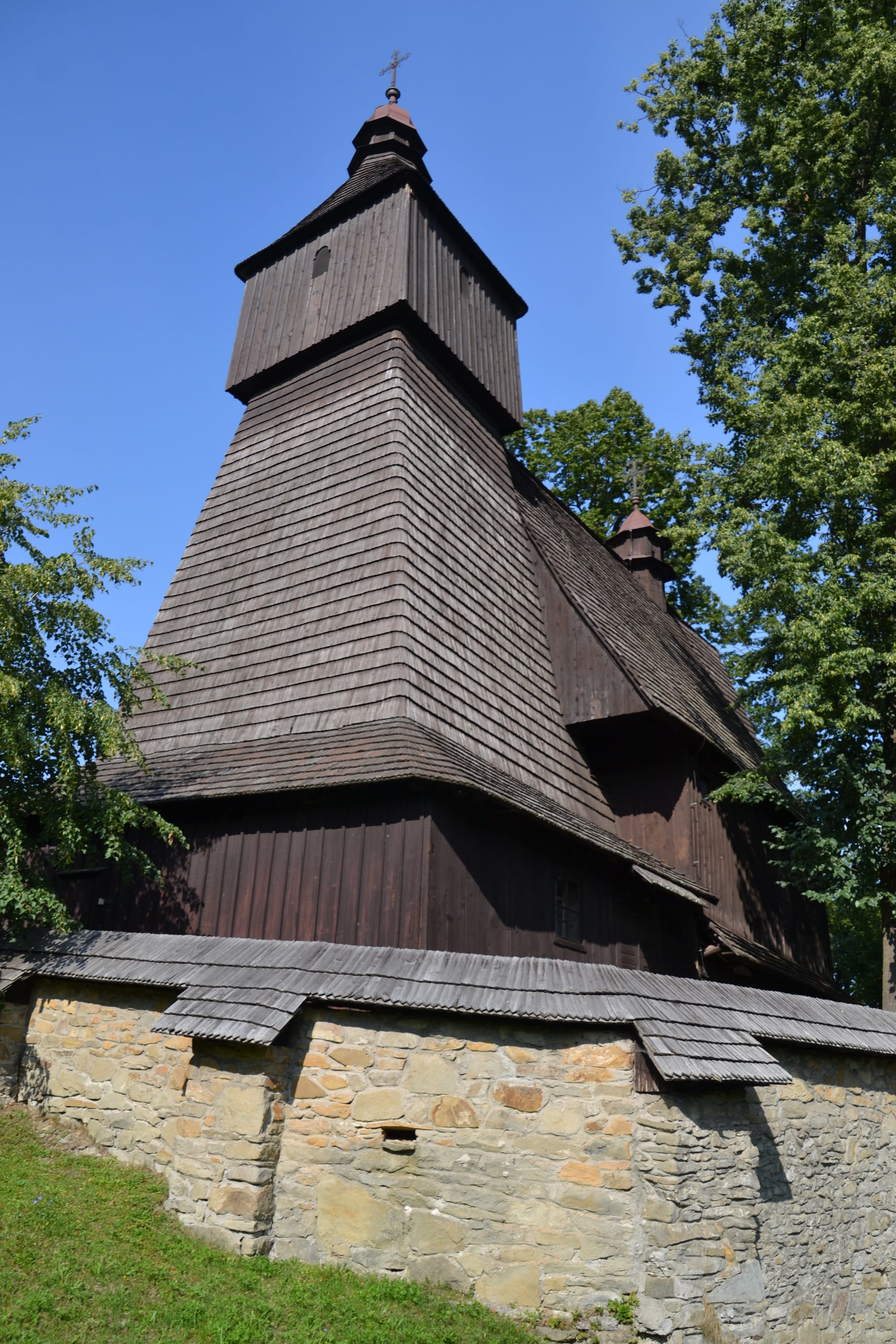
That meeting of traditions is written into the landscape. Eight wooden churches in the Carpathian north and east, built between the sixteenth and eighteenth centuries, are on UNESCO's World Heritage List as examples of a place where Latin and Byzantine Christianity meet. Two are Roman Catholic; three are Protestant "articular" churches, named after the articles under which the Habsburg emperor Leopold I allowed Protestants to build places of worship only on strict conditions; and three belong to the Eastern rite, their interiors dominated by the iconostasis, the screen of icons separating the sanctuary from the nave. About fifty more wooden churches survive in the region beyond the eight on the list.
Beyond religion, family sits at the centre of life. Personal trust tends to build slowly and through reliability rather than charm, and modesty is regarded as a virtue; quiet competence is admired more than self-promotion. One custom that surprises many visitors is the name day, or meniny. Each day of the calendar is linked to one or more first names, originally those of Catholic saints, and people celebrate their name day alongside, and sometimes as warmly as, their birthday, receiving flowers, small gifts and congratulations from family, friends and colleagues.
Greetings and meeting people
Greetings are polite and fairly formal. The standard phrase is "Dobrý deň" ("good day"), with "Dobré ráno" in the morning and "Dobrý večer" in the evening. A firm handshake with direct eye contact is usual when meeting and again when parting, and in a group the most senior person is greeted first. Beyond the handshake, physical contact between people who do not know each other well is limited.
People are addressed as pán (Mr) or pani (Mrs or Ms) followed by the surname, and academic and professional titles are respected in formal settings; they often appear on business cards and in correspondence. Slovak, like other Slavic languages, has a formal and an informal form of "you", and moving to first names and the familiar form is something offered by the older or more senior person, not assumed. Communication is direct but diplomatic once trust is established, and written follow-up after a meeting is appreciated.
Hospitality and being a guest
An invitation to a Slovak home is treated as a real occasion. Guests are expected to be punctual and neatly dressed, and to bring a small gift: wine, good chocolates or flowers are the usual choices. Flowers are given in odd numbers, since even numbers are associated with funerals, and chrysanthemums and calla lilies are avoided for the same reason. Shoes come off at the door, and hosts commonly offer slippers to wear indoors. A guest who has been entertained is expected, in time, to return the invitation.
At the table, Continental manners apply, with the fork in the left hand and the knife in the right. Before the meal, people wish one another "Dobrú chuť", the equivalent of "enjoy your meal", and guests follow the host's lead on when to start eating and drinking. Toasts are made with "Na zdravie" ("to health"), and the one rule that matters above all is to look each person in the eye while touching glasses. Politely declining alcohol is acceptable.
Festivals and life's big moments
The Slovak year blends Christian feasts with customs that are much older. Winter ends with fašiangy, the carnival season of masks and merrymaking before Lent. During Lent comes the carrying out of Morena, a straw figure dressed in women's clothes who stands for winter, and in the old form of the custom for death itself. Girls carried her out of the village singing, then burned her or threw her into a stream, so that spring could arrive.
Easter Monday brings the best known, and to outsiders the most startling, of these customs. Boys and young men visit the houses of girls and young women to switch them lightly with braided willow whips decorated with ribbons, a custom called šibačka, or to douse them with water, called oblievačka. Both were once believed to pass on the vitality of spring and to keep the women healthy and beautiful through the year. In return, the visitors receive decorated eggs, sweets or a little money, and adults are often offered a glass of spirit. Today the buckets are frequently replaced by a splash of perfume or a water pistol. The eggs, known as kraslice, are an art in themselves, decorated with melted wax, paint, wire or tiny drilled holes.
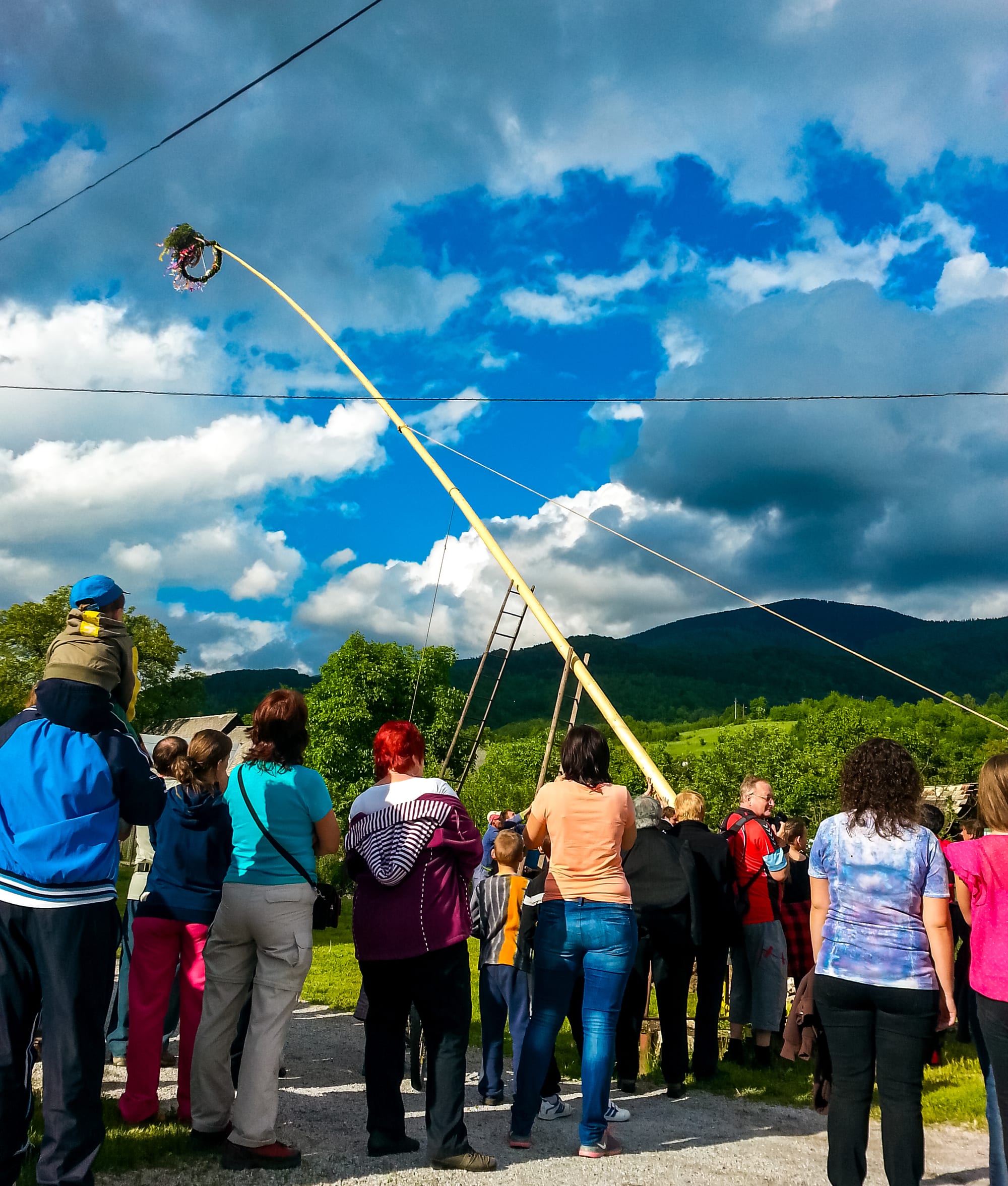
On the eve of 1 May, maypoles go up. In the older custom a young man secretly set a tall, carefully decorated tree in front of the house of the girl he admired; a wreath with long ribbons signalled that a wedding might follow, and rival suitors were known to sabotage one another's trees. Today many villages raise a communal maypole with singing and dancing. Bonfires light up midsummer night, the feasts of St Nicholas on 6 December and St Lucia on 13 December mark the approach of winter's holidays, and Christmas Eve, as the family gathers around the wafer and honey, is the emotional heart of the whole year.
At the other end of autumn comes Dušičky, the days of All Saints and All Souls on 1 and 2 November. Families travel to the graves of their relatives, decorate them with flowers and light candles, and as evening falls cemeteries across the country glow with thousands of small flames.
Weddings keep one ritual that many couples still choose. At midnight, the bride sits in the centre of a circle while married women sing and dance around her, then remove the floral headdress of her girlhood and replace it with a čepiec, the bonnet that once marked a married woman. The custom, known as čepčenie, recalls an old belief that a married woman should not appear in public with her head uncovered. The bonnets themselves were often richly decorated and prized.
Arts, crafts and music
Folk culture in Slovakia is not a museum piece but something performed and taught, and summer brings a long season of folklore festivals with music, dance, costume and craft. UNESCO's list of intangible cultural heritage reflects that range. It includes the fujara and its music, the music of the village of Terchová, bagpipe culture, the multipart singing of the Horehronie region, puppetry (shared with Czechia), indigo resist block printing, known in Slovak as modrotlač (shared with Austria, Czechia, Germany and Hungary), and drotárstvo, the wire craft of the tinkers. The work of the School of Crafts run by ÚĽUV, the national centre for folk art production, has also been recognised by UNESCO as a model for safeguarding such skills.
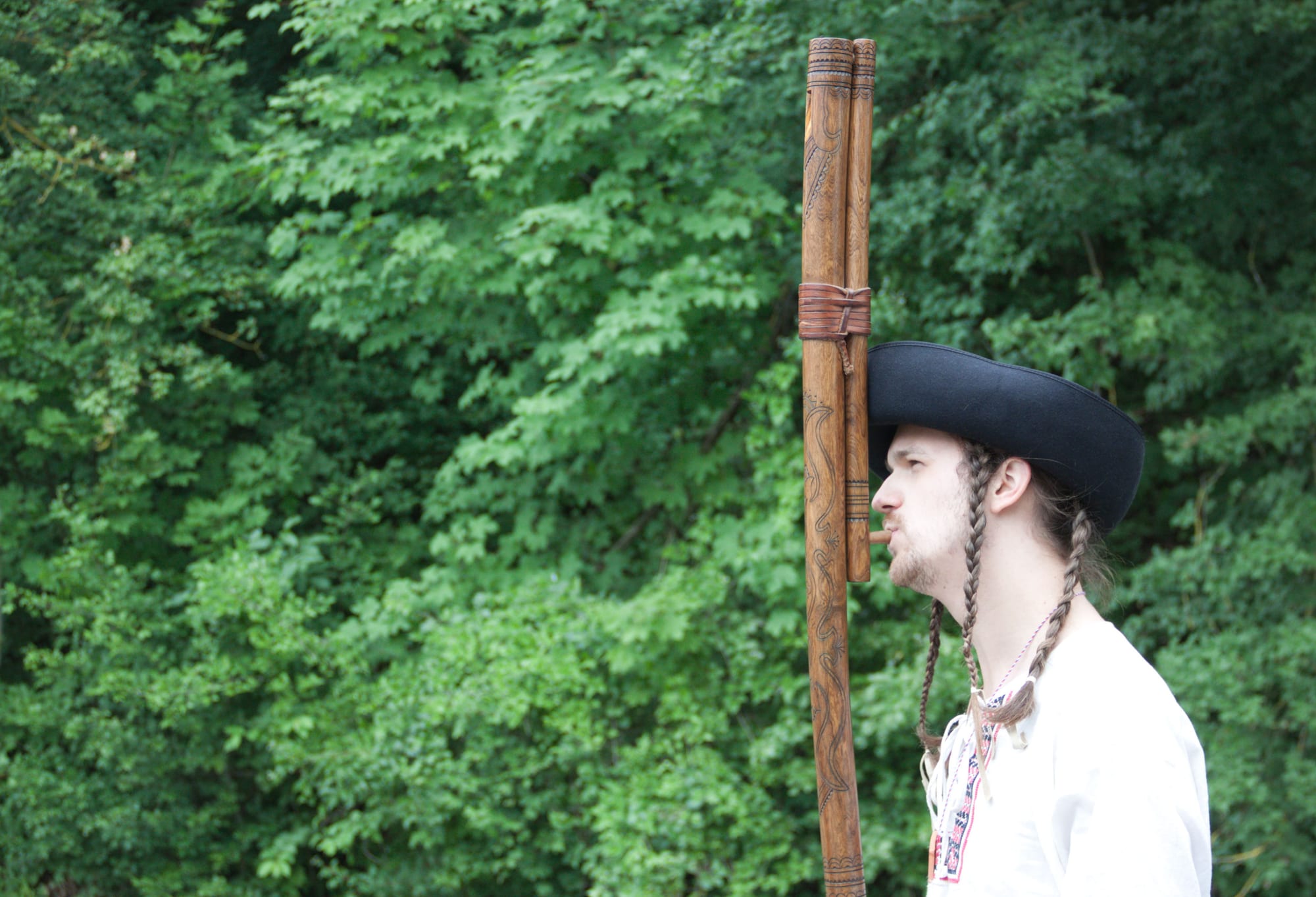
The fujara is the emblem of that heritage. A shepherd's flute from central Slovakia, its main tube is between 160 and 200 centimetres long, so that it often stands taller than its player, with a shorter pipe running alongside to carry the breath. It has only three finger holes, yet it produces a deep, murmuring low register and ringing high overtones, and its slow, melancholy melodies often imitate natural sounds such as the gurgle of a stream. Each instrument is individually carved and ornamented, making it as much a work of folk art as a musical instrument, and today it is played both by professional musicians and by the few remaining shepherds, especially at festivals between spring and autumn.
Crafts carry the same pride. Carved wood, embroidered costume, painted eggs and blue-printed cloth are made for use and for sale at fairs and festivals, and the tinkers' wire, once a humble repair material, is now bent into sculpture and decorative objects. Folk architecture, from shingled wooden houses to the Carpathian churches, completes a culture in which the handmade still carries real weight.
Dos and don'ts for visitors
- Do greet people with "Dobrý deň" and a firm handshake with eye contact, and use pán or pani with the surname until invited to first names.
- Do take shoes off when entering a home, and accept the slippers offered.
- Do bring a small gift when invited to a home, and give flowers in odd numbers, avoiding chrysanthemums and calla lilies, which are linked with funerals.
- Do look each person in the eye when touching glasses and saying "Na zdravie".
- Do wish others "Dobrú chuť" before a meal, and wait for the host to begin.
- Do be punctual for invitations and appointments; lateness is taken as a lack of respect.
- Don't be alarmed by water or willow switches on Easter Monday; the custom is good-natured, and a small reward is the traditional response.
- Don't treat cemeteries at All Saints and All Souls as a spectacle; they are places of family remembrance.
What to take away
Slovak customs can seem formal at first, but beneath the handshakes, titles and careful toasts lies a culture that keeps faith with its family, its saints and its seasons, and visitors who follow its courtesies will soon find themselves welcomed as warmly as a name-day guest.