Attractions & Natural Wonders · Belize
What made the giant blue hole in the sea off Belize?
The Great Blue Hole began as a limestone cave on dry land during the ice ages, then drowned when melting ice sheets raised the sea.
By Globeway Editorial · 2 November 2026
The short answer
The Great Blue Hole was made by rain, not by the sea. During the ice ages, so much water was locked up in ice sheets that sea level stood 330 to 390 feet (100 to 120 metres) lower than it does today, and the limestone platform now sitting under Lighthouse Reef was dry land. Rainwater, carrying dissolved carbon dioxide, slowly dissolved the rock and hollowed out a great cave and sinkhole, the same process that creates caves in limestone country everywhere.
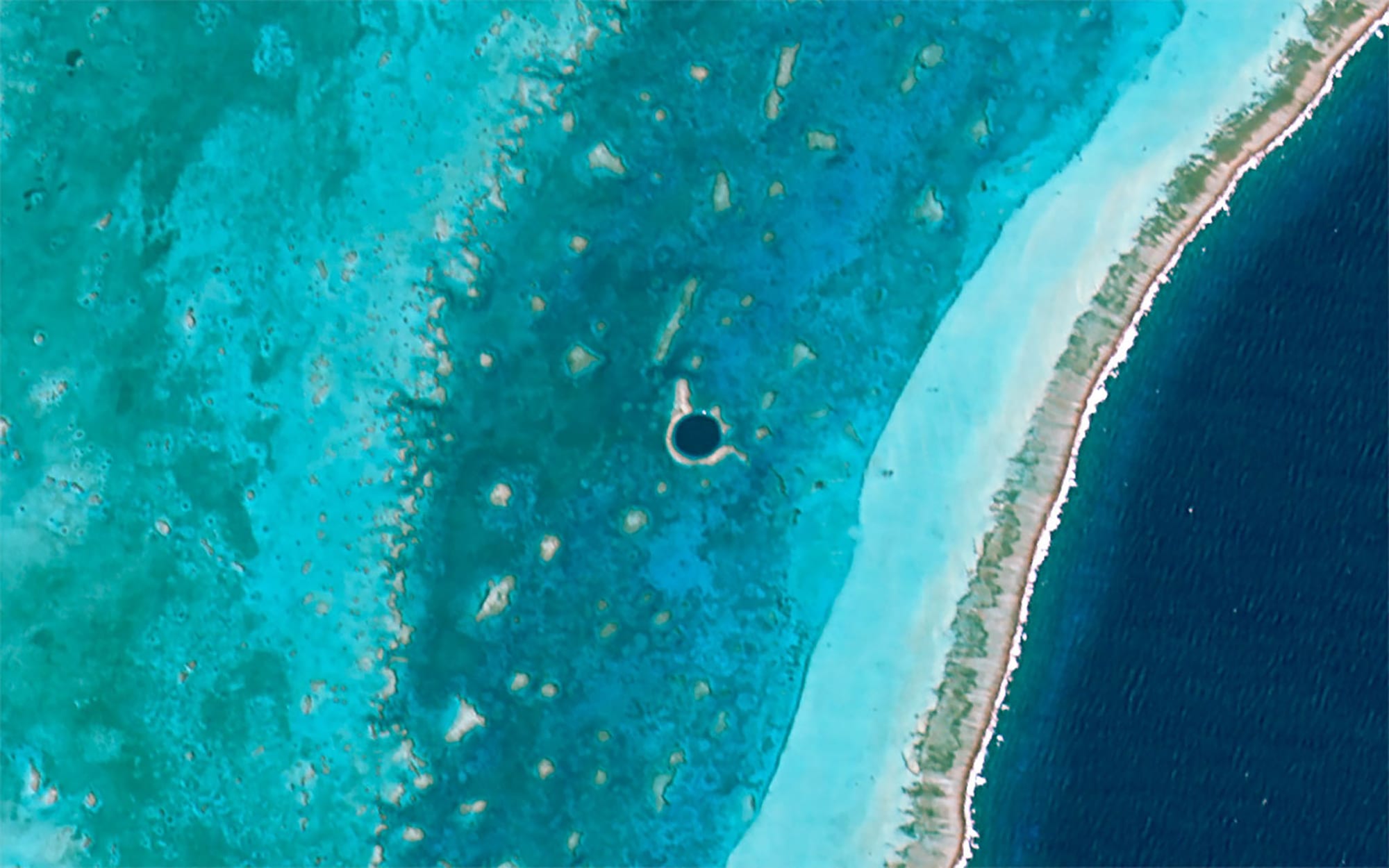
When the ice melted and the sea rose again, the ocean poured in and drowned it. What remains is a near-perfect circle about 1,043 feet across and 407 feet deep (318 by 124 metres), a dark blue eye in the pale turquoise shallows of an atoll about 43 miles from the Belize mainland. The proof is still down there: stalactites, which can form only in air, hang in its flooded caves.
A cave that formed in the open air
Lighthouse Reef sits on a platform of limestone, a rock made mostly of calcium carbonate. Limestone has a weakness: it dissolves in water carrying carbon dioxide. Over thousands of years, rain soaking into exposed limestone eats out passages and caves underground, a type of landscape known as karst. Where the surface rock dissolves away, or where the roof of an underground void collapses, the ground falls in to form a sinkhole.
That is what happened here. In 1971 the explorer Jacques Cousteau brought his ship, the Calypso, to the hole to chart its depths, and his expedition confirmed that it was a typical karst limestone formation, created before the sea rose. Divers on that expedition retrieved stalactites from the submerged caves.
Stalactites are the clinching evidence. They grow when water that has dissolved limestone drips from a cave ceiling and meets air, which makes the dissolved calcium carbonate settle out again, layer by layer. They cannot grow underwater. Finding them in caves that are now deep under the sea means the caves were once dry, and the sea arrived later.
Built in stages over 150,000 years
The hole did not form in a single episode. Sea level rose and fell several times during the Quaternary glaciation, the long series of ice ages, and each time the sea dropped, rain went back to work on the exposed rock. Analysis of the stalactites shows that they grew during dry phases around 153,000, 66,000, 60,000 and 15,000 years ago.
The walls record those stages too. Cousteau's team found ledges at depths of 69, 161 and 299 feet (21, 49 and 91 metres), shelves left as the cave grew in at least four steps before the water came back for good. The last flooding came as the great ice sheets melted at the end of the last ice age, when sea level rose and the cave filled with seawater.
The hole's colour has a simple explanation. Over the shallow lagoon, sunlight bounces off bright white carbonate sand through only a little water, so the sea looks pale turquoise. Over the hole, the water is clear and very deep. Water absorbs red, yellow and finally green light along the way, and only blue light travels far enough to reach the bottom and return, so the hole looks a deep, dark blue.
What lies at the bottom
The Great Blue Hole is now part of a world-famous dive site, but its depths are hostile. Blue holes have poor water circulation, and below a certain depth they run out of oxygen. In December 2018 two submarines descended into the hole and used sonar to nearly complete the first three-dimensional map of its interior. They found a layer of hydrogen sulphide, a toxic gas dissolved in the water, at about 300 feet (91 metres). Below it the water is dark and without oxygen, hostile to almost all life except bacteria.
That stillness makes blue holes useful to science. Sediment builds up in their centres, and the lack of oxygen preserves it, so blue holes can hold records of climate and life going back to the last glacial maximum. In 1997 an expedition of divers trained in cave diving and mixed gases collected core samples from the Great Blue Hole's floor.
It is not the deepest blue hole. That title belongs to Taam Ja' Blue Hole in Chetumal Bay, on the Caribbean coast, found in 2024 to reach more than 1,380 feet (420 metres), with the Dragon Hole in the South China Sea second. But taking width and depth together, the Great Blue Hole is the largest of them all.
Seeing the Great Blue Hole today
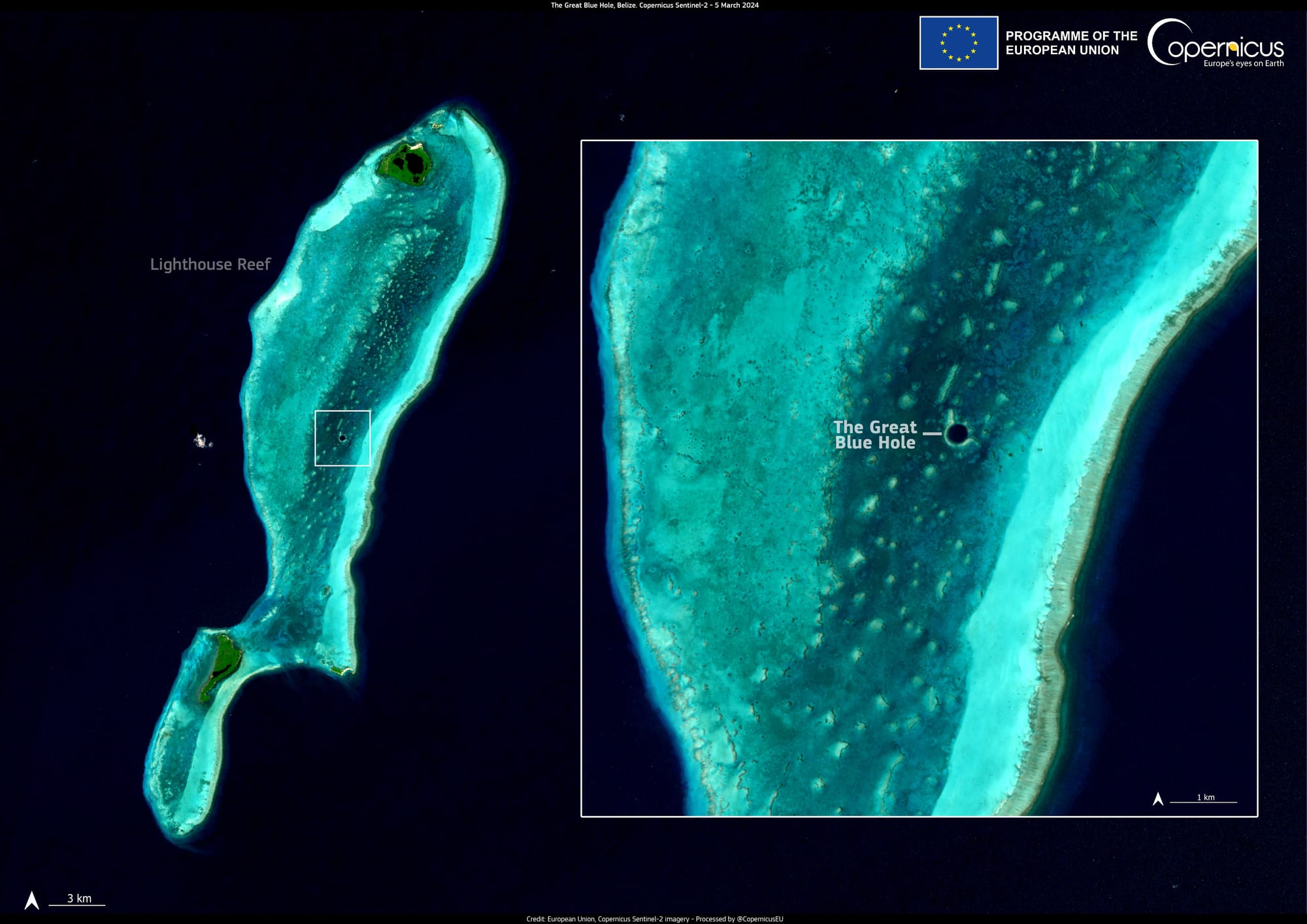
The hole lies near the centre of Lighthouse Reef, the easternmost of the three atolls of the Belize Barrier Reef. The atoll is about 22 miles long and 5 miles wide, a ring of reef around a shallow lagoon. The Belize Barrier Reef is part of the Mesoamerican Barrier Reef System, the second largest coral reef system in the world, and both the Great Blue Hole and nearby Half Moon Caye are protected as Natural Monuments within the Belize Barrier Reef Reserve System, a UNESCO World Heritage Site since 1996.
The living part of the hole is its rim. Coral and tropical fish crowd the shallow edge, which lies about 16 feet deep before sloping to 33 feet and then dropping away as a near-vertical cliff. Groupers, angelfish, butterflyfish and midnight parrotfish live here, along with nurse sharks, Caribbean reef sharks and blacktip sharks. Cousteau ranked it among the top five scuba diving sites in the world, though diving into its depths demands experience and equipment to match.
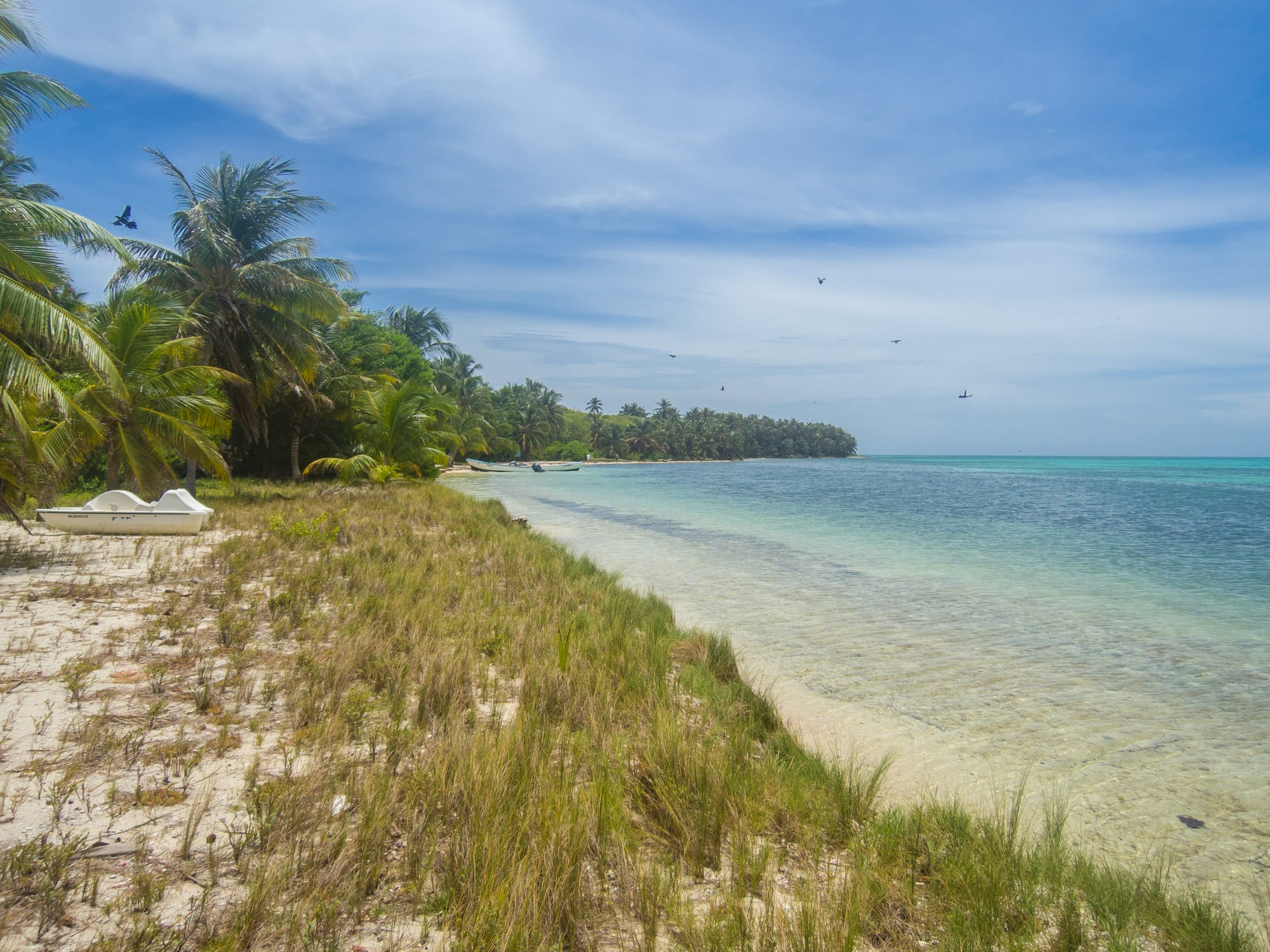
Half Moon Caye shelters a nesting colony of some 4,000 red-footed boobies and a rookery of magnificent frigatebirds, a reminder that the reef above the drowned cave is very much alive.