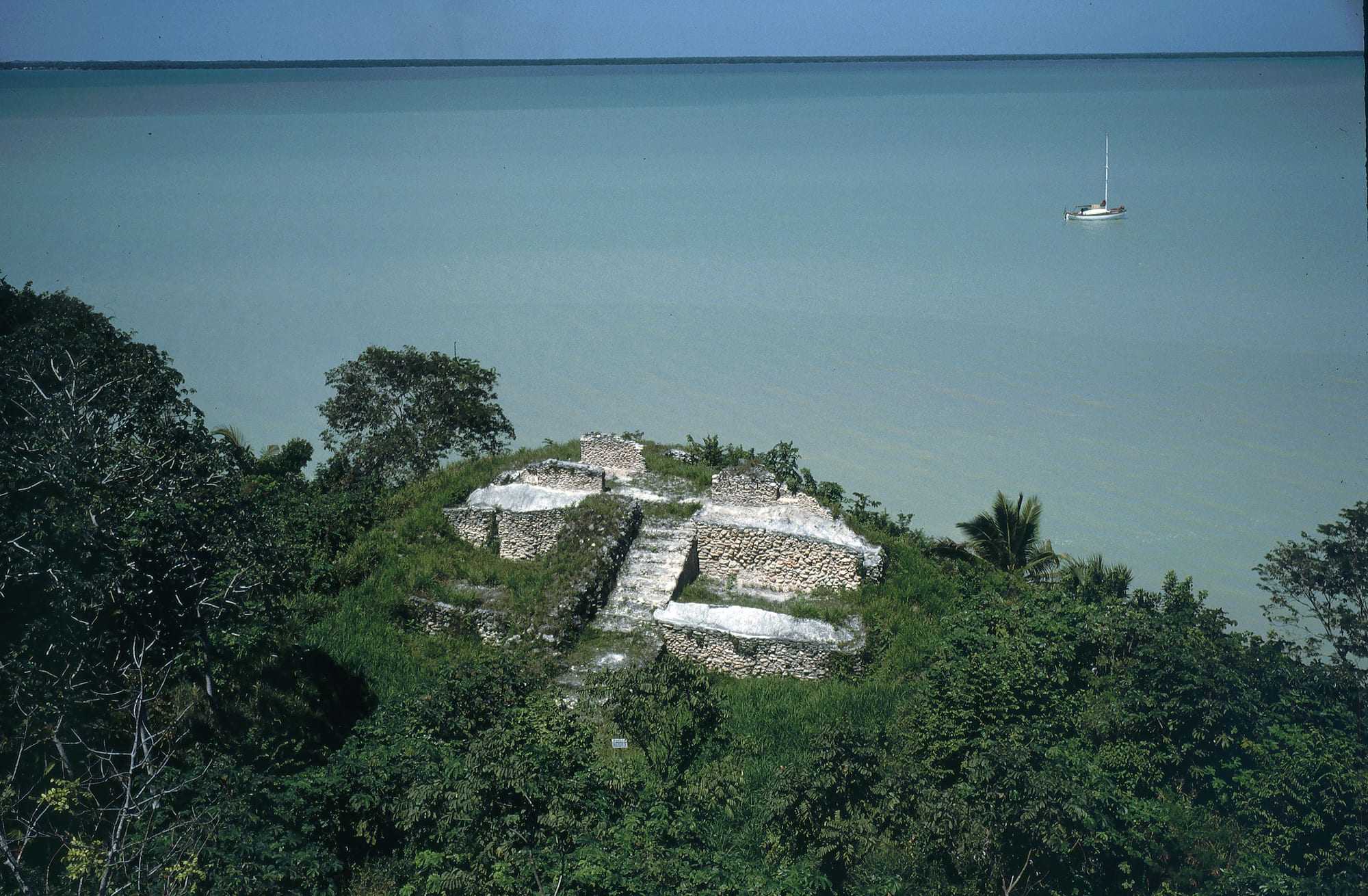
Low stone ruins of a Maya temple platform on a forested headland above calm turquoise water, with a sailing yacht anchored offshore

Belize

Belize City, the Cayes & the North

The Maya ruins of Cerros on the shore of Corozal Bay in the Corozal District. (HJPD / Wikimedia Commons · CC BY-SA 3.0)

Northern Belize, from the old port of Belize City and the reef islands of Ambergris Caye, Caye Caulker and the Lighthouse Reef atoll to the flat sugar-cane country of Orange Walk and Corozal on the Mexican border — the Creole heart of the country, its busiest tourist islands and a string of Maya ruins.

Explore Belize City, the Cayes & the North

History

The Maya settled the north early. Cuello, near Orange Walk, was a farming village with a long history, and Cerros, on Corozal Bay, was a Late Preclassic trading town with painted masks on its temples. Lamanai, on the New River Lagoon, was occupied for some 3,000 years, and Altun Ha flourished in the Classic period as a trading centre near the coast. Santa Rita, beneath modern Corozal, is thought to have been part of the Postclassic Maya province of Chetumal.

Spanish friars built mission churches at Lamanai in the 16th and 17th centuries, but the Maya resisted colonial control. From the 1600s British and Scottish Baymen cut logwood and later mahogany along the Belize River, using the labour of enslaved Africans, and made St George's Caye their first settlement before moving to the mouth of the river, where Belize City grew. In 1798 the Baymen repulsed a Spanish fleet at the Battle of St George's Caye.

From 1848 refugees from the Caste War of Yucatán crossed the Hondo River and founded or enlarged Corozal and Orange Walk, where sugar cane became the mainstay. In 1872 Icaiche Maya fighters attacked Orange Walk. A hurricane levelled Belize City in 1931 and Hurricane Hattie in 1961 led to the capital moving inland to Belmopan, though Belize City remained the commercial centre. Mennonite settlers founded Shipyard and Blue Creek in Orange Walk from 1958. Guatemala's long-standing claim to part or all of Belize is now before the International Court of Justice, to which both countries voted to send it.

Culture & Customs

Belize City is the heartland of the Creole community, and Kriol is spoken on every street. Creole music includes brukdown, played on guitar, banjo, accordion and percussion that can include a donkey's jawbone, and the city's clapboard houses on stilts, verandas and churches recall its colonial past. The September Celebrations, from St George's Caye Day on 10 September to Independence Day on 21 September, bring parades and a carnival road march through the city. Crooked Tree and Burrell Boom are old Creole villages inland.

Orange Walk and Corozal are largely Mestizo and Spanish-speaking, with close ties to neighbouring Mexico. Families cross the border to Chetumal for shopping, and Mexican music and food are part of daily life, alongside English at school and in government. San Pedro on Ambergris Caye began as a Mestizo fishing village, and its fiestas still reflect that heritage.

The Mennonite colonies of Shipyard, Blue Creek and Little Belize keep their own ways. The more conservative wear plain dress, speak Plautdietsch, a Low German dialect, and travel by horse and buggy, while more modern colonies run large mechanised farms, mills and businesses.

Daily Life

Belize City, with around 60,000 people, is the country's largest town, port and commercial centre, where cruise passengers come ashore and most businesses, banks and newspapers have their headquarters. Its canal-crossed centre and neighbourhoods contrast sharply, and poverty and gang violence weigh on parts of the Southside.

The cayes live from tourism. San Pedro has grown from a fishing village into the country's busiest resort town, and Caye Caulker keeps a smaller, backpacker scale. Fishing for lobster and conch continues under seasons and quotas.

Orange Walk Town and Corozal Town are the market towns of the sugar belt, where cane from small farms goes to the Tower Hill factory near Orange Walk for processing. The Corozal Free Zone, at the border near Santa Elena, draws shoppers and traders from Mexico. Mennonite farms supply much of the country's poultry, eggs, dairy and furniture. The pace is slow, with mornings starting early and many shops shutting at midday.

Food

Belize City's Creole kitchen is at its best at breakfast: fry jacks, puffed fried dough, and johnny cakes, small baked biscuits, served with beans, eggs and cheese, alongside fresh bread from the bakeries. Boil up, of fish or pig tail with boiled eggs and ground foods such as cassava and plantain, is the classic Creole dish. Coconut and cassava go into puddings and tarts sold on street corners. Across the region, rice and beans with stew chicken is the everyday midday meal, and Creole dinners add fish, conch, game meats such as gibnut and ground foods such as cassava and plantain.

The Mestizo north cooks the food of Yucatán. Chimole is a soup seasoned with recado, and salbutes, panades, garnaches and tamales are everyday food.

On the cayes, lobster, conch and snapper dominate, grilled, stewed or cooked into conch fritters and ceviche. Crooked Tree holds a cashew festival in May, where cashew wine and cashew fruit preserves are sold, and Mennonite cheese and bread appear in shops across the north.

Attractions & Natural Wonders

The reef is the region's great draw. Ambergris Caye has San Pedro, the Hol Chan Marine Reserve and Shark Ray Alley offshore, and Bacalar Chico National Park at its northern tip. Caye Caulker offers the Split and reef snorkelling. Further out lie the Turneffe atoll and Lighthouse Reef, where the Great Blue Hole, a marine sinkhole about 125 metres deep, and the seabird colony of Half Moon Caye Natural Monument are visited on long day trips.

Belize City has the hand-cranked Swing Bridge over Haulover Creek, St John's Cathedral, built by enslaved labour in the early 19th century, the Museum of Belize in the old colonial prison, and the Fort George lighthouse. Inland in Belize District are the Belize Zoo, the Community Baboon Sanctuary, where black howler monkeys live on private farms, and the Crooked Tree Wildlife Sanctuary, a wetland known for its jabiru storks.

The Maya ruins cover every period. Altun Ha lies north of Belize City; Lamanai is reached by boat up the New River from near Orange Walk, with the High Temple, the Mask Temple and a small museum; and the Corozal sites of Cerros and Santa Rita lie around Corozal Bay. Corozal Town, its bay and the fishing village of Sarteneja, known for its boat-builders and the Shipstern Nature Reserve, round off the north.

Cities in Belize City, the Cayes & the North

Planning basics

Budget

The cayes are the priciest part of Belize: Ambergris Caye's resorts, restaurants and dive trips are expensive by Central American standards, and Caye Caulker is cheaper but not cheap. Belize City, Orange Walk and Corozal cost much less, with simple hotels and inexpensive street food, and buses on the Northern Highway are cheap. The Blue Hole trip is the region's single biggest expense.

Daily Budget Midrange
USD 150–300 (beachfront hotel on the cayes, restaurants, snorkelling or diving trips)
Daily Budget Shoestring
USD 55–90 (Caye Caulker guesthouse or mainland hotel, street food, buses and water taxis)

Carry cash on Caye Caulker, where cash machines are few, and book Blue Hole trips directly with licensed operators on the islands.

Safety

Belize City has most of the country's gang violence, concentrated in parts of the Southside that visitors have little reason to enter; the historic centre is busy by day but best avoided on foot after dark. The cayes are generally calm, with petty theft, occasional robberies and drugs widely offered. Boat trips, strong sun and the long open-water Blue Hole run carry their own risks.

Use licensed taxis in Belize City at night, choose reputable dive and boat operators, and keep valuables locked away in beach accommodation. Check current official travel advice before travelling.

Climate

The north is the driest part of Belize, with rainfall increasing steadily towards the south. The cayes and Belize City are hot and humid, cooled by the trade winds off the sea, and Orange Walk and Corozal are hotter inland. The rains fall mainly from June to November, and the coast is exposed to hurricanes; Belize City was devastated in 1931 and 1961.

Summer
wet season: 82–91°F, humid, with heavy showers and a risk of tropical storms
Winter
dry season: 75–86°F with sea breezes; occasional cooler northerly winds bring grey days

Transportation

Philip Goldson International Airport is a short drive from Belize City. Water taxis run from the city to Caye Caulker and San Pedro in roughly an hour to an hour and a half, and small planes hop to San Pedro in minutes. Buses run the Philip Goldson Highway north to Orange Walk and Corozal and the Mexican border near Chetumal. Lamanai is reached by boat from near Orange Walk, and the Blue Hole by day boat or scenic flight from the cayes.

Golf carts, bicycles and walking are the way around Ambergris Caye and Caye Caulker; rent a golf cart only from a licensed outlet.

Best Time to Visit

Late November to May is dry and the best for the cayes, with calmer seas and good visibility for diving from about April; December to April is the peak season on Ambergris Caye. Belize City's September Celebrations fill the month with parades. September and October carry the highest hurricane risk.