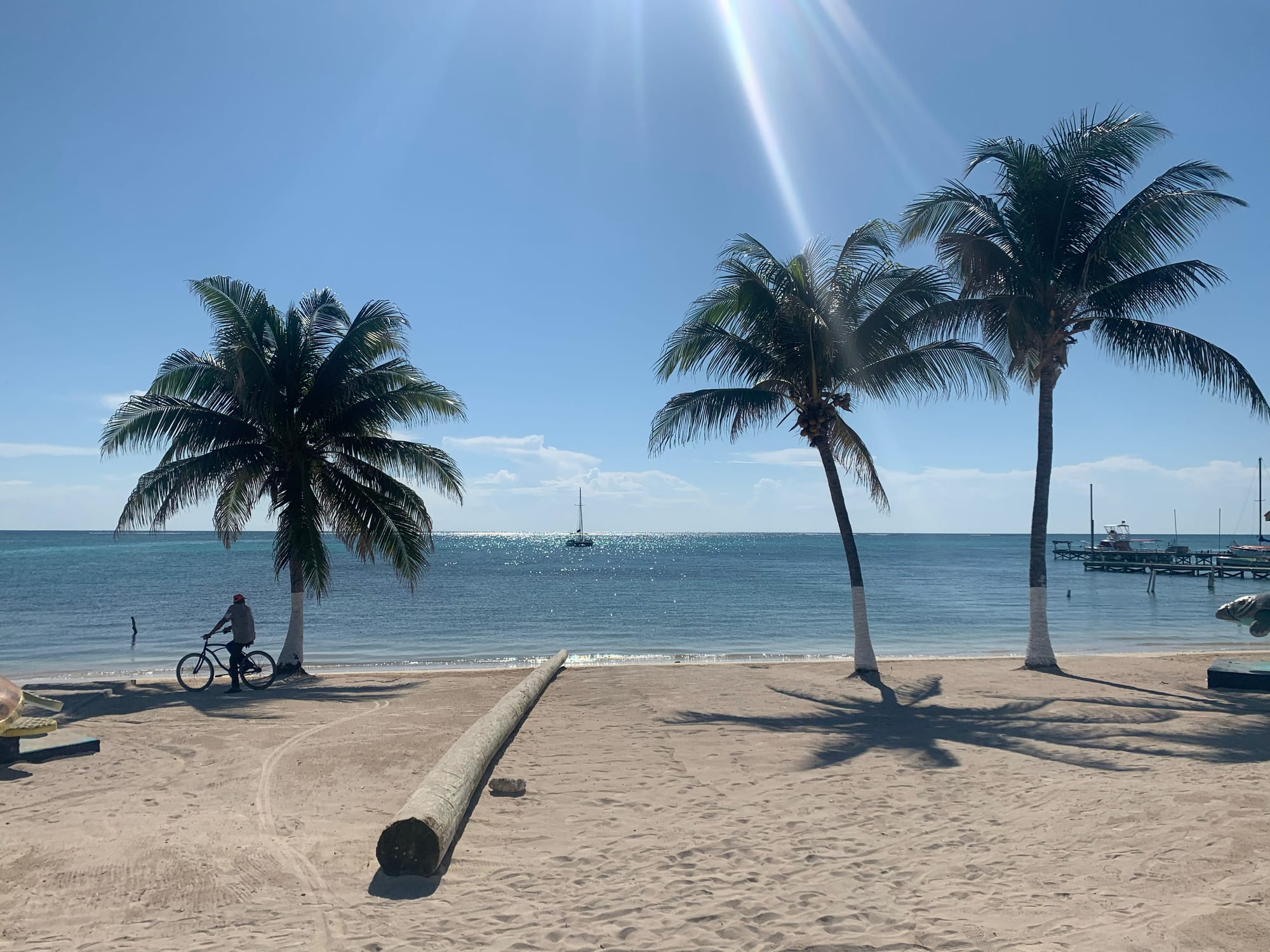
Palm trees with whitewashed trunks on a sandy beach, calm blue sea, a sailing boat offshore and piers on the right

Belize City, the Cayes & the North, Belize

Ambergris Caye

The beach beside Central Park on Barrier Reef Drive in San Pedro, Ambergris Caye. (Asdfjrjjj / Wikimedia Commons · CC BY-SA 4.0)

Belize's largest island, a strip of coral sand about 25 miles long off the country's northern coast, with the barrier reef running just offshore. Its only town, San Pedro, grew from a fishing village settled by Caste War refugees into one of Belize's most popular tourist destinations, where golf carts fill sandy streets and dive boats leave from every pier.

Neighbourhoods

  • San Pedro Town
    • First-time visitors
    • Best for food
    • Nightlife

    The island's only town, on its southern part, laid out along three main streets that run north to south parallel to the beach. Restaurants, bars, shops, dive operators, the water-taxi piers and the airstrip are all within walking distance, and the beachfront is lined with piers.

    Open in Maps
  • South of town
    • Quiet and residential
    • Beaches

    Beyond the airstrip the road continues south past condominiums, rental houses and resorts facing the reef. It is quieter than the town but close enough to reach it by bicycle or golf cart.

    Open in Maps
  • North of the bridge
    • Quiet stays
    • Beaches
    • Getting away

    North of the bridge over the channel above San Pedro, a road of more than 10 miles has opened up long stretches of resorts and beach houses that were once reached only by boat. Further up the island lie Secret Beach and the protected land and sea of Bacalar Chico.

    Open in Maps

Things to do

The reef and marine reserves

  • Hol Chan Marine Reservepark

    A marine reserve off the south of the island, established in 1987, covering about 7 square miles of coral reef, seagrass beds and mangroves; its name is Mayan for 'little channel', and it is the island's best-known snorkelling and diving trip.

    Open in Maps
  • Shark Ray Alleyattraction

    A snorkelling site off the south of Ambergris Caye, counted with Hol Chan among the island's protected areas and one of the classic easy snorkelling trips from San Pedro.

    Open in Maps
  • Mexico Rocksattraction

    A cluster of about 100 shallow patch reefs off the northern part of the island, built mainly of boulder star coral in water some 8 to 16 feet deep.

    Open in Maps

The island

  • Bacalar Chico National Park and Marine Reservepark

    A protected area and UNESCO World Heritage Site covering the north of the island, with mangroves and seagrass beds that shelter manatees and crocodiles, up to the channel that separates Ambergris Caye from Mexico.

    Open in Maps
  • Secret Beachbeach

    A beach area north of San Pedro, with cenotes, sinkholes and caves nearby, that has become increasingly popular with visitors and locals while staying little developed.

    Open in Maps
  • Marco Gonzalezlandmark

    A Maya archaeological site near the southern tip of the island, about 5 miles south of San Pedro, excavated between 1984 and 1994 and named after the local guide who showed it to the archaeologists.

    Open in Maps
  • Ambergris Museummuseum

    A museum in San Pedro town, listed among the town's attractions.

    Open in Maps

Short trips from the island

  • Caye Caulkerattraction

    The smaller, car-free island to the south, reached by water taxi, with a slower pace and a backpacker scale.

    Open in Maps
  • Turneffe Atollattraction

    The largest coral atoll in Belize, about 30 miles long, a marine reserve since 2012 and a well-known day trip for divers from the island.

    Open in Maps
  • Great Blue Holeattraction

    A circular marine sinkhole about 1,040 feet across and 407 feet deep in the Lighthouse Reef atoll, formed when sea levels were much lower during the ice ages and now a classic dive.

    Open in Maps

Seasonal events

  • El Gran Carnaval de San Pedrothe days before Ash Wednesday, February or March

    A Mestizo carnival tradition going back to the 1870s, with three days of music, comparsas (street dancers) and people painting one another in the streets, ending with the burning of the figure of Juan Carnaval.

  • San Pedro Daylate June

    The town's annual day of celebration, held on 27 June.

Eat and drink

Long-standing places and food districts in Ambergris Caye. Hours, ratings and directions come from your maps app, always current.

Ambergris Caye classics

  • San Pedro's seafood restaurantsneighborhood

    Lobster, conch and fresh fish, served in beach restaurants and simple places along the town's streets.

    Open in Maps
  • Breakfast with fry jackscafe

    Beachfront and town cafés serve the Belizean breakfast of fry jacks — deep-fried dough — with beans, eggs and cheese.

    Open in Maps

Street food and bars

  • Middle Street street foodneighborhood

    Hole-in-the-wall places on Middle Street sell burritos, and pupusas, a cheap Salvadoran street food, are made fresh on the street in the evening.

    Open in Maps
  • Pier barsneighborhood

    Many of the piers along the beach have bars, from thatched beach shacks in town to open-air bars at the end of docks north of the bridge, serving Belikin beer and rum drinks.

    Open in Maps

Experience Ambergris Caye

History

A Maya community lived on Ambergris Caye long before Europeans arrived, leaving behind distinctive polished red pottery. At the northern end, the channel of Boca Bacalar Chico separates the island from the Mexican mainland; it is widely believed the Maya themselves dug it so that canoe traders could avoid the outer reef between Chetumal Bay and the Caribbean coast, though it may be natural. Coastal settlements such as Marco Gonzalez, near the island's southern tip, grew along that trade route. The island's name comes from ambergris, the substance produced by sperm whales, recalling the whalers who worked from these islands in the 17th century, and many parts of the island have been modified since coconut plantations arrived in the same century.

San Pedro itself was founded by refugees from the Caste War of Yucatán. Its first permanent settlers arrived in 1848 and 1849 — at first only four families, soon joined by others from the Bacalar area — and the village grew to about 30 houses. They were farmers and fishermen in Yucatán and carried on fishing here, and for more than a century San Pedro remained a small fishing village.

Tourism began in the early 1970s and grew quickly towards the end of the century, driven by the reef and the diving. On 27 November 1984 San Pedro was granted the status of a town, with Gilberto Chico Gomez as its first mayor, and the Hol Chan Marine Reserve was created in 1987 after a campaign among fishermen, businesses and the government. The town is also said to have inspired Madonna's 1987 song "La Isla Bonita", which opens by dreaming of San Pedro.

Culture & Customs

San Pedranos, as the townspeople are called, mostly trace their roots to Mexico, and the town's culture is Mestizo at heart. Most speak both Spanish and English fluently, and the influence of Kriol has produced an in-between form of speech known locally as "Kitchen Spanish". It is said that nobody is a true San Pedrano without knowing how to fish, and the sea still shapes local identity even as most families now earn their living from visitors.

The great event of the year is El Gran Carnaval de San Pedro, a tradition dating back to the 1870s and held in the days before Lent. Over three days, comparsas dance through the streets and people paint one another — white powder at the start, traditionally for children, and black paint at the close — and a stuffed figure of Juan Carnaval is burnt as a symbol of cleansing the community's sins; his mock will is read on Ash Wednesday. Painting is governed by rules: no spray paint, oil paint or rotten eggs, and no painting of buildings or people who are not taking part. San Pedro Day, celebrated every year on 27 June, is the other big date.

The island is commonly called "Isla Bonita" after the Madonna song. An expatriate community lives alongside the San Pedranos, and English is heard alongside Spanish in the busy centre.

Daily Life

San Pedro had a population of about 20,000 according to the 2024 mid-year estimates, making it the second-largest town in the Belize District. Although the island belongs to the Belize District, the closest point of the mainland is in the Corozal District. Tourism is the main industry, and scuba diving above all: there are so many divers that the island has two hyperbaric decompression chambers.

Life runs along three main streets parallel to the beach, with piers every few hundred feet where boats leave for diving, fishing and sailing. Golf carts are the main form of powered transport, with relatively few cars licensed on the island, and the road north of the bridge — now more than 10 miles long — has spread resort and beach-house building far up the island. Most of the island is reserved for national park and wildlife protection, which limits where land can be developed.

The town has several small supermarkets and one large one, along with bakeries and butchers, but imported goods are expensive. Weekend football matches are played at the small stadium near the airstrip.

Food

Seafood comes first on Ambergris Caye. Lobster, conch and fresh fish fill the menus, and fishing for lobster and conch continues alongside tourism; some visitors catch and cook their own fish on fishing trips.

Breakfast is often Belizean: fry jacks, deep-fried dough, served with beans, eggs and cheese, or johnny cakes, round savoury biscuits made from flour. At midday, simple local lunch places serve rice and beans with stew chicken, a Belizean staple. Snacks that began in Mestizo cooking and are now eaten across Belize, such as garnaches, tamales and panades, are part of everyday eating too, and a Kriol dinner centres on rice and beans with meat and salad. Hole-in-the-wall places in town sell burritos, and pupusas, a cheap Salvadoran street food, are made fresh on the street in the evening.

Drink is part of the island's beach life. Many piers have bars, and Belikin, the local beer, is sold everywhere, alongside rum drinks. Imported groceries can be very expensive.

Planning tools

Budget

Ambergris Caye is among the pricier places in Belize. Resorts and dive trips cost more than on the mainland, and imported goods in the supermarkets can be very expensive. Street food, local lunch places and renting a house or condo with a kitchen keep costs down, while a Great Blue Hole or atoll trip is the biggest single expense.

Daily Budget Midrange
USD 160–320 (beachfront hotel or condo, restaurant dinners, a snorkelling trip, golf-cart hire)
Daily Budget Shoestring
USD 60–100 (guesthouse room in town, street food and local lunch places, walking and a bicycle)

Golf carts can be rented by the hour or the day — rent only from a licensed outlet and check that the lights and tyres work before driving north of the bridge.

Best Time to Visit

Late November to May is the dry season and the best time for the cayes, with calmer seas and good visibility for diving from about April. December to April is the peak season on the island, with the highest prices. The wet season runs from June to November, and September and October carry the highest hurricane risk.

Suggested Number of Days

Three or four days allow for the reef and the town at an easy pace. A week leaves room for a day out to the atolls, a visit to the north of the island and a spare day for weather, since rough seas can cancel boat trips.

First Visit
3–4 days
With Surroundings
5–7 days

Transportation

San Pedro is small enough to walk, and walking is the most common way of getting around town. Beyond it, golf carts are the main form of powered transport, with relatively few cars on the island; bicycles can be rented too, and some beachside resorts run their own water taxis. Roads outside the centre can be rough and potholed in the rainy season.

Drive golf carts with care at night on the northern road, and allow extra time after heavy rain.

Airport & Station Connections

John Greif II Airport, next to San Pedro town, has small-plane flights of about 20 minutes from Belize City, as well as flights from Caye Caulker, Corozal and Belmopan. Fast water taxis run from Belize City and Caye Caulker, and a ferry links the island with Chetumal in Mexico.

Walkability

The town centre is compact and easy on foot, with sandy and cobbled streets and the beach as a walkway; many resorts are less than a mile from it. The north of the island is too spread out to walk, and the beaches are coral sand where water shoes or sport sandals help.

Safety

Belize has a high overall homicide rate, but the violence is almost entirely gang-related and concentrated in specific parts of Belize City that visitors have no reason to enter. The cayes are generally calm, with petty theft, occasional robberies and drugs widely offered. Boat trips, strong sun and the long open-water Blue Hole run carry their own risks.

Choose reputable dive and boat operators, keep valuables locked away in beach accommodation, and remember that drugs carry real penalties in Belize. Check current official travel advice before travelling.

Climate

Hot and humid, cooled by the trade winds off the sea. Rain falls mainly from June to November, and the island is exposed to hurricanes. No source gives the island's own temperatures; the figures below are those for the wider northern region.

Summer
wet season: in the region 82–91°F, humid, with heavy showers and a risk of tropical storms
Winter
dry season: in the region 75–86°F with sea breezes; occasional cooler northerly winds bring grey days

Local Customs

Most San Pedranos speak both Spanish and English, along with an in-between form known locally as "Kitchen Spanish". Dress is relaxed and beachwear is normal by the sea, but covering up in shops, restaurants and churches is polite. Fishing is a matter of local pride.

Touch nothing on the reef and follow the guides' rules in the marine reserves.

Common Payment Methods

The Belize dollar is pegged to the US dollar at two to one, and US dollars are widely accepted, with change given in either currency or a mix of both. Hotels, dive operators and better restaurants take cards; street food, small shops and golf-cart hire may need cash.