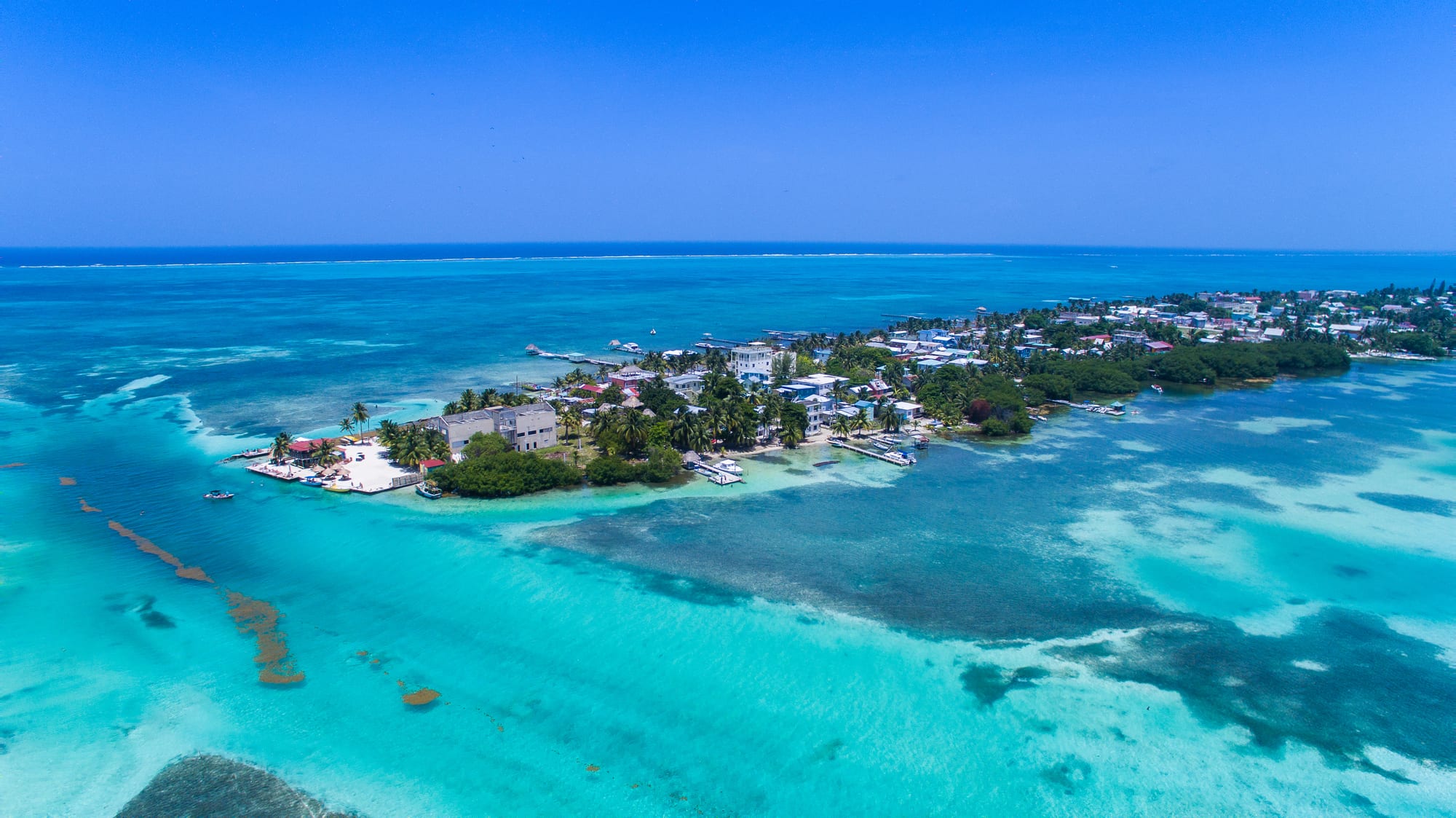
Aerial view of a low island of palms and pastel buildings ringed by turquoise shallows, with waves breaking on the reef beyond

Belize City, the Cayes & the North, Belize

Caye Caulker

Caye Caulker village and the shallows around the Split, seen from the air, with the barrier reef on the horizon. (dronepicr / Wikimedia Commons · CC BY 2.0)

A low coral island about 5 miles long, some 20 miles north-north-east of Belize City, settled by Mestizo refugees from the Caste War and long a village of fishermen and coconut growers. Today it is a car-free backpacker island of sandy streets, wooden houses and dive shops, with the barrier reef breaking just offshore and the motto 'Go Slow'.

Neighbourhoods

  • Front Street and the village centre
    • First-time visitors
    • Best for food
    • Close to the water taxis

    The easternmost of the island's three sandy streets, facing the reef, holds almost everything visitors need — guesthouses, restaurants, bars, tour operators, gift shops and craft vendors — within a short walk of the water-taxi pier.

    Open in Maps
  • Back Street and the south
    • Quiet and residential
    • Local life

    Back Street runs along the western side of the village, and the airstrip lies at the southern end of the island. It is quieter than Front Street and still only a short walk from it.

    Open in Maps
  • The Split and the north
    • Swimming
    • Sunsets
    • Kayaking

    At the northern end of the village the narrow channel called the Split cuts the island in two; it is the island's favourite swimming spot. Across it, the northern part of the island is mostly mangrove, with a forest reserve at its tip.

    Open in Maps

Things to do

On the island

  • The Splitattraction

    The channel dividing the island, opened a few inches deep by Hurricane Hattie in 1961 and then dredged by hand by villagers; the tide has since scoured it much deeper, and its concrete edges are the island's main place to swim and sunbathe.

    Open in Maps
  • Caye Caulker Forest Reservepark

    About 100 acres of mostly dense mangrove forest covering the northern end of the island, explored by sea kayak and on occasional birdwatching walks.

    Open in Maps

The reef

  • Caye Caulker Marine Reserveattraction

    The island's local reef, close enough that the waves can be seen breaking on it from the shore, and the first stop on many half-day snorkelling trips.

    Open in Maps
  • Coral Gardenattraction

    A shallow snorkelling site off the island, a regular stop on half-day and full-day snorkelling trips.

    Open in Maps
  • Hol Chan Marine Reservepark

    A marine reserve off southern Ambergris Caye, established in 1987, with coral reef, seagrass beds and mangroves; it has been protected longer than the local reef and has larger fish, and is the main stop on full-day snorkelling trips from the island.

    Open in Maps
  • Shark Ray Alleyattraction

    A snorkelling site off Ambergris Caye, visited with Hol Chan on full-day trips, where nurse sharks and rays gather around the boats; some operators feed them and others choose not to.

    Open in Maps

Short trips from the island

  • Ambergris Cayeattraction

    Belize's largest island, to the north, with the busier resort town of San Pedro, reached by water taxi.

    Open in Maps
  • Turneffe Atollattraction

    The largest coral atoll in Belize, a marine reserve since 2012, visited on longer dive trips from the island's dive shops.

    Open in Maps
  • Great Blue Holeattraction

    A circular marine sinkhole about 1,040 feet across and 407 feet deep in the Lighthouse Reef atoll, at least an hour's boat ride away and possibly the most famous dive site in Belize.

    Open in Maps

Seasonal events

  • Lobsterfestearly July

    The island's annual lobster festival, celebrating the catch with spiny lobster and coconut rice.

Eat and drink

Long-standing places and food districts in Caye Caulker. Hours, ratings and directions come from your maps app, always current.

Caye Caulker classics

  • Front Street seafood restaurantsneighborhood

    Oceanfront restaurants and grills along and near the main street serve fish, shrimp and lobster, and cheap take-outs offer Belizean stewed chicken with rice and beans.

    Open in Maps
  • Bars at the Splitneighborhood

    A bar beside the channel at the north end of the village is a popular place for a rum drink; most of the island's bars close before midnight.

    Open in Maps

Experience Caye Caulker

History

The island is thought to have been inhabited for hundreds of years, and the main settlement has probably stood on the same spot all that time, where the bay behind it shelters boats, the reef in front breaks the big waves and firm coral sand gives a good anchorage. On early British maps it appears as Cay Corker. Its Spanish name, Cayo Hicaco, means "island of the cocoplum", and "Caulker" may be an English rendering of it, though other stories link the name to sailors filling water bottles at a freshwater spring or caulking boats in the sheltered bay on the western side.

The modern population began with the Caste War of Yucatán in 1847, when Mestizo refugees fled south. Around 1870 the area of the village was granted to Luciano Reyes, and lots were sold to six or seven families, most of whom still have descendants on the island. Coconuts and fishing became the island's livelihood.

Hurricane Hattie struck in 1961. Its storm surge swept across the narrow part of the village and destroyed the wooden schoolhouse being used as a shelter, killing 13 people, most of them children; about 42 houses were rebuilt within weeks with help from the colonial government and the British Army. The storm also opened a shallow passage across the island, which villagers then dredged by hand — the origin of the Split. In modern times at least four major hurricanes have devastated the island, the most recent Hurricane Keith in 2000. In recent years the island has become a popular destination for backpackers, and it now has more than 50 hotels.

Culture & Customs

Caye Caulker's local culture is Mestizo, Creole and Garifuna. At the 2010 census Mestizos were the majority, followed by Creoles, with smaller numbers of Maya, Garifuna and others, and the descendants of the families who bought the first village lots remain a strong influence.

The island's motto, "Go Slow", sums up its character. There are no cars in normal use, the streets are sand, and life moves at the pace of walking and bicycles. Nightlife is low-key compared with Ambergris Caye, and most bars close before midnight; dances and events are held on holidays and long weekends, organised by island committees. Lobsterfest in early July is the island's annual lobster festival.

Conservation is part of local identity. The northern end of the island is a forest reserve, the local reef is a marine reserve, and a Caye Caulker islander's campaigning led to the creation of the Swallow Caye Wildlife Sanctuary, a manatee reserve near Belize City protected since 2002.

Daily Life

The 2010 census counted 1,763 people on Caye Caulker. Village life runs along Front Street, Middle Street and Back Street, none of them paved. Tourism dominates the economy, with about a dozen snorkelling and dive operators, guesthouses, restaurants and gift shops, while fishing continues and a few older women still make coconut oil for their own use and for sale. Gift shops along Front Street sell mainly T-shirts, hammocks and souvenirs, and vendors along the main street sell crafts and jewellery. There are no large supermarkets: convenience stores and small grocery shops with a limited selection serve the island.

The island's low elevation shapes life: the highest point is only about 8 feet above sea level, and the sandy banks of the Split are still eroding. Water taxis connect the island with Belize City and San Pedro several times a day. The shallow lagoon in front of the village, between a few inches and 14 feet deep, attracts windsurfers, and the bay behind it is where boats shelter.

Food

Seafood is the island's staple. Fish, shrimp and lobster fill the menus of the oceanfront grills, and cheap take-outs serve Belizean and Chinese food such as stewed chicken with rice and beans and cow foot soup. Lobsterfest in early July is celebrated with spiny lobster and coconut rice. Some trips let visitors fish for their own meal.

Coconut has been part of island life since the first settlers' plantations. As across Belize, grated coconut is pressed for its milk and baked into tarts and other sweets, and a few older women still make coconut oil for their own use and for sale. Breakfasts follow the Belizean pattern, with fry jacks — puffed fried dough — served with beans, eggs and cheese.

Drink is relaxed and mostly rum-based: some snorkelling trips end with rum punch on the way home, and the bars along Front Street and at the Split serve rum drinks, along with Belikin beer.

Planning tools

Budget

Caye Caulker is popular with backpackers for its relatively low prices, but it is cheaper than Ambergris Caye rather than cheap. Guesthouses and simple seafood places keep costs down; snorkelling tours, dive trips and above all a Blue Hole or atoll trip are the big expenses.

Daily Budget Midrange
USD 140–280 (seafront hotel or cabana, restaurant meals, a snorkelling or dive trip)
Daily Budget Shoestring
USD 55–90 (guesthouse or hostel bed, seafood and local food, walking and bicycles)

Carry cash: the island has only two cash machines, and they can run out of money on holiday weekends.

Best Time to Visit

Late November to May is the dry season and the best for the cayes, with calmer seas and good visibility for diving from about April; December to April is the busiest period. Lobsterfest comes in early July. The island is low-lying and exposed to storm surge, and September and October carry the highest hurricane risk.

Suggested Number of Days

Three or four days suit the island's slow pace and allow for a snorkelling trip with time to spare. Five or six leave room for longer boat trips and a neighbouring island, and spare days help when wind or rough seas cancel boat trips.

First Visit
3–4 days
With Surroundings
5–6 days

Transportation

There are no cars in normal use: people walk, cycle or ride golf carts along the three unpaved streets, and a slow walk from the main pier to almost anywhere in the village takes about 20 minutes. Bicycles are easy to rent, and a golf cart can go around the island in about half an hour. Boats are the way out to the reef.

Rent golf carts only from a licensed outlet, and check snorkelling equipment before a trip leaves.

Airport & Station Connections

High-speed water taxis from Belize City take about 45 minutes and continue to San Pedro on Ambergris Caye; on windy days the crossing can be rough. Caye Caulker Airport, at the southern end of the island, was renovated with a paved and lighted runway after airlines suspended flights in 2017; small planes between Belize City and San Pedro stop there when there is demand, a flight of 10 to 15 minutes.

Walkability

The whole village is walkable on flat, sandy streets, and almost all visitors get around on foot or by bicycle. There are no proper sand beaches; people swim and sunbathe from the docks and at the Split.

Safety

Belize has a high overall homicide rate, but the violence is almost entirely gang-related and concentrated in specific parts of Belize City that visitors have no reason to enter. The cayes are generally calm, with petty theft, occasional robberies and drugs widely offered. Boat trips and strong sun carry their own risks.

Choose reputable dive and boat operators, keep valuables locked away in beach accommodation, and remember that drugs carry real penalties in Belize. Check current official travel advice before travelling.

Climate

Hot and humid, cooled by the trade winds off the sea, with rain mainly from June to November. The island is only about 8 feet above sea level at its highest point, so a hurricane's storm surge can cover it, as happened in 1961 and 2000. No source gives the island's own temperatures; the figures below are those for the wider northern region.

Summer
wet season: in the region 82–91°F, humid, with heavy showers and a risk of tropical storms
Winter
dry season: in the region 75–86°F with sea breezes; occasional cooler northerly winds bring grey days

Local Customs

The island's motto is "Go Slow", and the pace is unhurried. Local culture mixes Mestizo, Creole and Garifuna influences. Dress is casual, but swimwear belongs by the water rather than in shops and restaurants.

Touch nothing on the reef, and choose snorkelling operators whose equipment is in good shape.

Common Payment Methods

Most shops accept US dollars at two Belize dollars to one US dollar; prices are usually posted in Belize dollars, so confirm which is meant. There are two cash machines on the island, which can run dry on holiday weekends, so many travellers bring cash from Belize City. Hotels and dive shops usually take cards.