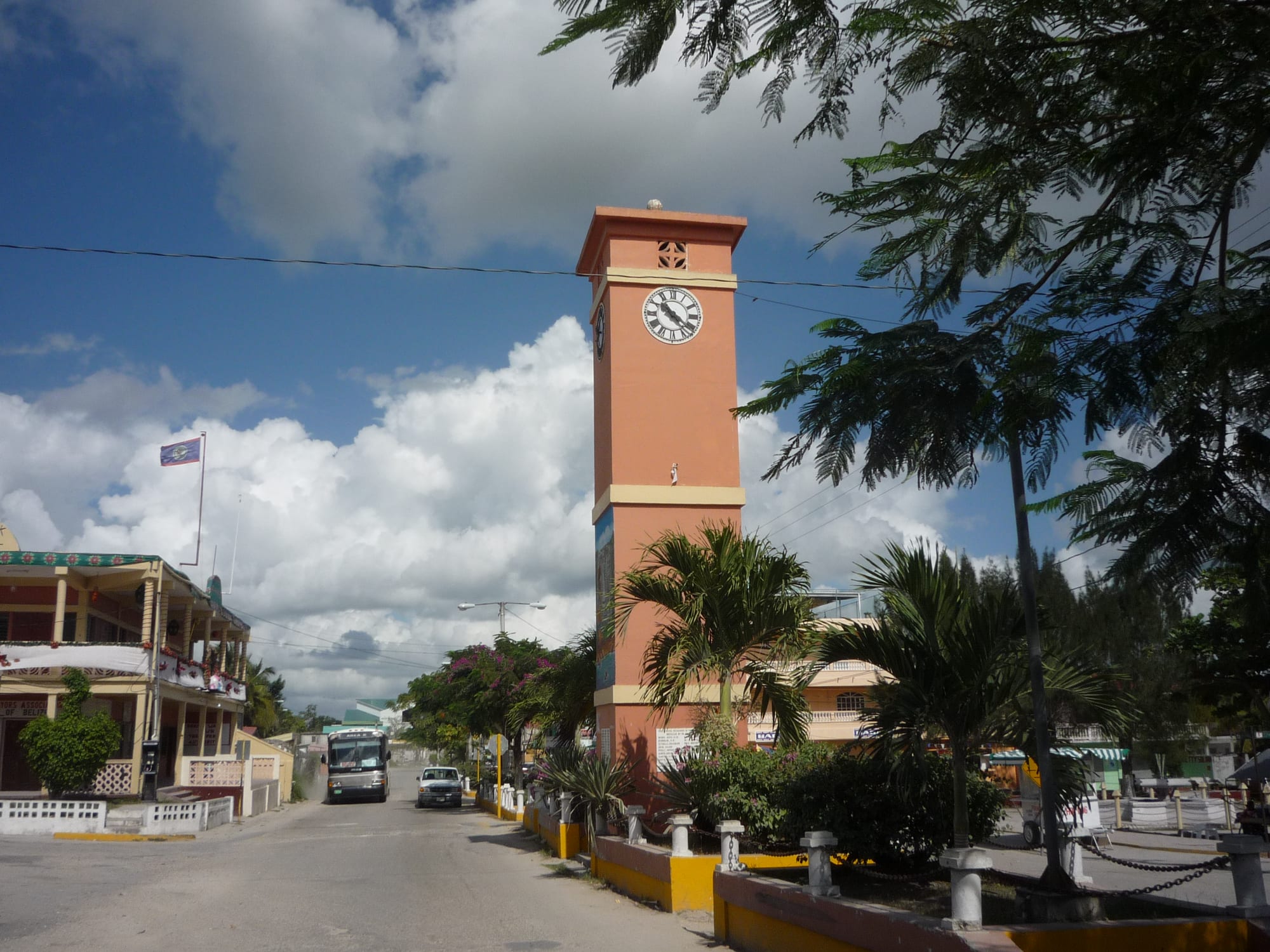
A salmon-pink clock tower beside a palm-planted park on a quiet street, with a bus approaching under a bright cloudy sky

Belize City, the Cayes & the North, Belize

Orange Walk Town

The clock tower and park in the centre of Orange Walk Town. (Pgbk87 / Wikimedia Commons · CC BY-SA 3.0)

The capital of the Orange Walk District, on the west bank of the New River about 53 miles north of Belize City. It grew from a logging stop and the arrival of Caste War refugees into 'Sugar City', the centre of the country's sugar industry. Today it is a mainly Spanish-speaking Mestizo market town and the starting point for boat trips up the river to Lamanai.

Neighbourhoods

  • Downtown and the market
    • First-time visitors
    • Best for food
    • Local life

    The market area lies between the Belize–Corozal road, which runs straight through town, and Main Street, with the main square and its clock tower nearby. It gets going early in the morning, with breakfast taco carts, small shops, banks and simple restaurants all within walking distance.

    Open in Maps
  • The New River front
    • Boat trips
    • Quiet stays

    The town sits on the west bank of the New River, and the riverside is where boats leave for Lamanai and where a few places to eat and stay look over the water. It is calmer than the busy main road.

    Open in Maps

Things to do

In town

  • Main square and clock towerlandmark

    The central square of the town, with its clock tower, the natural place to start a walk through the downtown streets.

    Open in Maps
  • Banquitas House of Culturemuseum

    A cultural centre for northern Belize, combining a museum and an art school.

    Open in Maps
  • La Inmaculada Churchlandmark

    The town's Catholic church, one of its listed historic sites, in a town where about two-thirds of residents are Catholic.

    Open in Maps

Maya sites near town

  • Cuellolandmark

    The remains of an early Maya farming village with a long history, now dated to around 1200 BC, where archaeologists found the oldest steam bath yet known in the Maya lowlands.

    Open in Maps
  • Nohmullandmark

    Considered the most important Maya site in northern Belize, whose large pyramid of about 250 BC was mostly torn down for road fill in 2013, leaving only its core.

    Open in Maps

Short trips from the town

  • New River boat tripattraction

    Belize's longest river lying wholly within the country; boat tours from the town follow it to the New River Lagoon, with chances to see crocodiles, fruit bats, spider monkeys and many herons and other birds.

    Open in Maps
  • Lamanailandmark

    A major Maya city on the New River Lagoon, occupied for some 3,000 years into the colonial era, with the Mask Temple's 13-foot stone mask, the Jaguar Temple, the High Temple's view over the forest and the ruins of Spanish mission churches.

    Open in Maps
  • Shipyardneighborhood

    A Mennonite settlement founded in 1958 by Old Colony Mennonites from Mexico, where most families still use horse and buggy and steel-wheeled tractors and work as farmers, carpenters and mechanics.

    Open in Maps

Eat and drink

Long-standing places and food districts in Orange Walk Town. Hours, ratings and directions come from your maps app, always current.

Orange Walk classics

  • Breakfast taco cartsmarket

    Street vendors in the market area between the Corozal road and Main Street sell tacos and similar snacks from early in the morning.

    Open in Maps
  • La Popular Bakerycafe

    A bakery supplying the town with fresh bread since 1955, best known for its wide choice of Mexican-style sweet breads and pastries.

    Open in Maps

Food streets and the river

  • Main Streetneighborhood

    A couple of places along Main Street serve salbutes — puffed fried tortillas topped with chicken and tomato — and Chinese restaurants and a restaurant of Maya dishes are found in town.

    Open in Maps
  • Riverside bars and restaurantsneighborhood

    A few bars and restaurants on the New River serve food, including seafood, and drinks by the water, and at least one can be reached by boat.

    Open in Maps

Experience Orange Walk Town

History

In Maya times the area was known as Holpatin, and the district holds some of the oldest Maya sites in Belize, among them Cuello, an early farming village, and Lamanai, upriver, occupied for some 3,000 years. The Maya here met Europeans in the 1530s and fought them over land for long afterwards; Spanish friars built churches at Lamanai, but a Maya revolt drove them out.

The modern town began as a stop on the New River for logwood, mahogany and chicle workers, who used the river to float their products to the sea and halted at a logging camp called Orange Walk. In the 19th century it was a small settlement of thatched and wooden houses, mostly on the west bank. From 1848 Maya and Mestizo refugees fleeing the Caste War of Yucatán arrived in large numbers and settled in the town and the villages around it, bringing sugar cane with them.

On 1 September 1872 a force of Icaiche Maya led by Marcos Canul crossed from Mexico and attacked the town in the Battle of Orange Walk, after long disputes with the British authorities over land and rent; Canul was mortally wounded and his men withdrew. The colonial authorities later dug trenches around the settlement, and a monument to Canul now stands beside the town barracks. In 1963 a sugar mill opened, drawing migrant workers from other districts and neighbouring countries, and the town grew into the centre of Belize's sugar industry.

Culture & Customs

Despite its English name, Orange Walk is overwhelmingly Mestizo and Spanish-speaking, the least ethnically diverse town in Belize. Its traditions came with the Maya and Mestizo refugees from Yucatán, and the town lies on the main road between Belize City and Chetumal in Mexico. English is the most used language, but almost everyone speaks Spanish to some extent.

Religion is important to most residents. About two-thirds are Roman Catholic, and the town's churches include La Inmaculada, one of its historic sites; evangelical congregations are numerous, with preachers often seen in the streets, and around fifty churches are registered in the Orange Walk area.

The Mennonite colonies of Shipyard, founded in 1958, and Blue Creek lie in the district and keep their own ways. Most speak Plautdietsch, a Low German dialect; the more traditional, as in Shipyard, wear distinctive clothing and travel by horse and buggy, while others, such as Blue Creek, have modernised to various degrees. At the 2010 census about one in ten of the town's residents spoke German.

Daily Life

Orange Walk had a population of about 13,400 at the 2010 census, making it the fourth-largest town in Belize. Nicknamed "Sugar City", it lives from cane: the Tower Hill sugar factory nearby handles all the country's sugar-cane output, and rum is distilled from local cane, mostly for the home market. Other farming and tourism, mainly ecotourism, add to one of Belize's strongest local economies, and the town's poverty rate is the second-lowest in the country.

Most people live in their own houses, many built in the 1990s of cement block, and the town's homes are among the best kept in Belize, though some plots lie abandoned. The streets are well paved, with traffic lights at the main junctions, and the town has parks, sports grounds, a regional hospital, several high schools and campuses of the University of Belize and Galen University.

The day starts early around the market, and during the cane season heavy trucks crowd the highway. Because the town sits midway between Belize City and Chetumal, buses and tour coaches pass through constantly. Its closeness to Mexico has also made the district a centre of drug trafficking.

Food

Orange Walk's food shows its Yucatán roots. Salbutes, puffed fried tortillas topped with chicken, tomato and other toppings and originally from the Yucatán Peninsula, are sold along Main Street, and tacos from street carts are the standard breakfast in the market area. Panades, garnaches and tamales are everyday snacks, and chimole, a soup, is among the midday dishes. Maya dishes have a restaurant of their own in town.

The Belizean staples are here too: chicken, barbecued or stewed, with rice and beans, flour tortillas and potato salad. Chinese restaurants are common across Belize, and La Popular Bakery has supplied the town with bread and Mexican-style sweet breads and pastries since 1955.

Sugar shapes what people drink as well. Rum is made from local cane by several refineries and is mostly drunk within Belize rather than exported, and a few riverside bars on the New River serve drinks beside the water.

Planning tools

Budget

Orange Walk is much cheaper than the cayes, with simple hotels, cheap street food and buses to Belize City and Corozal. The Lamanai boat trip, usually arranged through hotels with lunch, entry and a guide included, is the main extra cost.

Daily Budget Midrange
USD 100–200 (riverside hotel, restaurant meals, a guided Lamanai boat trip)
Daily Budget Shoestring
USD 35–65 (simple hotel, tacos and market food, local buses)

Banks on Main Street change US dollars and euros but not Mexican pesos, so bring Belize or US dollars.

Best Time to Visit

The dry season, from late November to May, is the most comfortable time and the best for river trips and the ruins. The rains fall mainly from June to November, though in Orange Walk storms are usually brief. The sugar-cane harvest fills the roads with cane trucks during its season.

Suggested Number of Days

A day or two is enough for the town and the river trip to the ruins. Two or three days allow time for the smaller Maya sites, the lagoons and the Mennonite farm country of the district.

First Visit
1–2 days
With Surroundings
2–3 days

Transportation

The downtown area is easiest on foot. Taxis and minibuses serve the town and the surrounding villages, and the streets are well paved, with traffic lights at the main junctions — rare in Belize. Lamanai is reached by boat or by bus tour; the boat is more comfortable, as the road is rough.

Watch for large cane trucks on the highway during the sugar harvest, and drive carefully in the wet season.

Airport & Station Connections

The town lies on the Philip Goldson Highway, the old Northern Highway, 53 miles north of Belize City and 30 miles south of Corozal Town, a little over an hour by road from the international airport. Buses to Belize City and Corozal run about every half-hour, and some continue to Chetumal in Mexico. A small paved airstrip lies about 2 miles south-west of town.

Walkability

The centre is compact and flat, with the market, the main square and the river within a short walk of each other. Most streets are paved, and the town has many parks.

Safety

Belize has a high overall homicide rate, but the violence is almost entirely gang-related and concentrated in specific parts of Belize City that visitors have no reason to enter. Orange Walk is generally a safe town, though its closeness to Mexico has made the district and the town centres of drug trafficking, and walking at night, especially alone, is not considered safe.

Take a taxi after dark rather than walking, keep valuables out of sight, and choose licensed guides for river trips. Check current official travel advice before travelling.

Climate

Generally drier than other parts of Belize and hotter inland than the coast, with brief rainstorms. No source gives the town's own temperatures; the figures below are those for the wider northern region.

Summer
wet season: in the region 82–91°F, humid, with heavy showers and a risk of tropical storms
Winter
dry season: in the region 75–86°F; occasional cooler northerly winds bring grey days

Local Customs

Most residents are Spanish-speaking Mestizos; English is the most used language, but almost everyone speaks some Spanish. Religion matters to many people: about two-thirds are Catholic, and there are many evangelical churches. Mennonite communities are spread through the surrounding district; ask before photographing anyone.

Dress modestly when visiting churches; townspeople are generally friendly and happy to chat.

Common Payment Methods

The Belize dollar is pegged at two to one with the US dollar, and US dollars are widely accepted. The town has several banks, including Atlantic Bank and Belize Bank. Markets, street food, buses and small shops take cash only.