History · Suriname
Why do people in Suriname speak Dutch?
In 1667 the Dutch kept Suriname and let England have New York. Three centuries of Dutch rule and Dutch schools did the rest.
By Globeway Editorial · 2 November 2026
The short answer
Suriname speaks Dutch because it was a Dutch colony for more than 300 years. Dutch forces captured it from the English in 1667, and in the peace treaty that year the Netherlands chose to keep it while England kept New Amsterdam, the town it renamed New York. The Dutch governed Suriname until 1954, when it became a self-governing part of the Kingdom of the Netherlands, and it became fully independent only on 25 November 1975.
What turned a colonial language into a national one was school. From 1876 education in Suriname was compulsory and modelled on the Dutch system, so generations of children, whatever language they spoke at home, learned Dutch. Today it is the country's sole official language and the language of government, education, business and the media. Over 60 per cent of Surinamese speak it as their mother tongue and another 20 to 30 per cent as a second language.
The swap that made Suriname Dutch
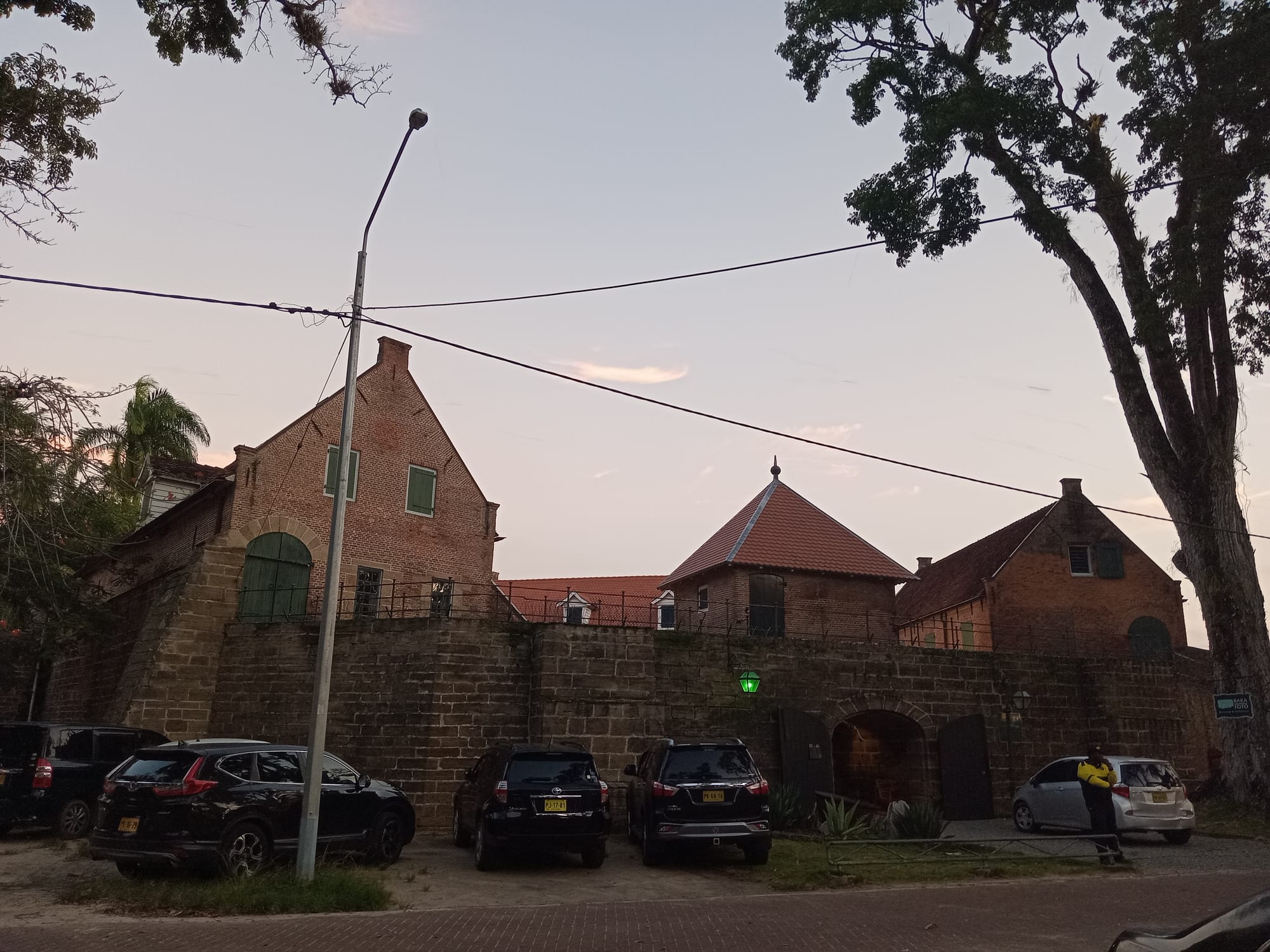
The English got there first. Lord Willoughby, the governor of Barbados, sent ships to found a colony on the Suriname River in 1650, and it grew into a settlement of plantations around Fort Willoughby. Then came the Second Anglo-Dutch War. On 25 February 1667 seven ships from the Dutch province of Zeeland, under Abraham Crijnssen, reached the colony; the fort fell the next day after a three-hour fight and was renamed Fort Zeelandia.
At the Treaty of Breda, signed on 31 July 1667, each side kept what it held. The Dutch decided to keep their young plantation colony of Surinam, and the English kept New Netherland in North America, with New Amsterdam, which they had conquered in 1664. The English briefly retook Suriname later in 1667, but the arrangement was confirmed in the Treaty of Westminster in 1674. Apart from two spells of British occupation, from 1799 to 1802 and from 1804 to 1816, Suriname stayed Dutch.
A plantation colony with two languages
For two centuries, Dutch was the language of the colony's masters, not of most of its people. Suriname became a lucrative plantation colony built on sugar, coffee, cocoa and cotton, and about 300,000 enslaved Africans were taken there between the mid-1600s and the early 1800s. Coming from many regions of Africa, they had no language in common, and in the English years they developed a new one from English and their own languages. That became Sranan Tongo, an English-based creole (a full language born from a mix of others). After 1667 the Dutch colonists adopted it as the colony's common language and it absorbed many Dutch words, but enslaved Africans and their descendants were for a long time forbidden to learn or speak Dutch itself.
Slavery was abolished in 1863, followed by ten years of compulsory plantation labour. To replace that labour, the Dutch recruited indentured workers from British India and the Dutch East Indies, now Indonesia, along with smaller numbers from China. Suriname became one of the most ethnically and culturally diverse countries in the world, home to people speaking Sarnami Hindustani, Javanese, Hakka, six Maroon languages and the languages of its Indigenous peoples.
- 1650
An English colony is founded on the Suriname River.
- 26 February 1667
Dutch forces under Abraham Crijnssen capture the colony.
- 31 July 1667
The Treaty of Breda leaves Suriname to the Dutch and New Amsterdam to England.
- 1863
Slavery is abolished in Suriname.
- 1876
Schooling becomes compulsory, with Dutch as the language of education.
- 1954
Suriname becomes a constituent country of the Kingdom of the Netherlands.
- 25 November 1975
Suriname becomes independent.
- 2004
Suriname joins the Dutch Language Union as an associate member.
How the classroom spread Dutch
After abolition, education became a responsibility of the state. In 1876 Suriname introduced compulsory schooling, and Dutch became the official language of its education system. From the start of colonisation until independence and beyond, the Netherlands served as the model for how schools were organised, and they played an important part in the vernederlandsing, or "Dutchification", of Surinamese society. The new immigrants from British India and the Dutch East Indies picked up the language too, although from 1878 some teaching was also given in Hindustani languages.
The same schools pushed other languages aside. Sranan Tongo was dismissed with the slur "Negro-English" and repressed by the Dutch-based school system, and it is still not taught in schools today. Dutch became the prestige language and Sranan the everyday vernacular. Only gradually did Sranan become accepted by the establishment and wider society.
This is what set Suriname apart from the far larger Dutch East Indies, where Dutch never spread beyond a small educated elite of around 2 per cent of the population. Suriname, by contrast, made schooling compulsory and taught it in Dutch, and there the language put down roots.
Why Dutch stayed after independence
Independence in 1975 came through negotiation rather than war, and Suriname kept close diplomatic, economic and cultural ties with the Netherlands. Dutch aid fuelled much of the economy in the first decade. Migration bound the two countries even more tightly: in the years around independence nearly a third of the population moved to the Netherlands, and by 2013 the Surinamese community there numbered 350,300, against about 566,000 people in Suriname itself.
Suriname is one of only three sovereign countries where Dutch is a national language, alongside the Netherlands and Belgium, and the only place in the Americas where most people speak it; in the Dutch Caribbean islands other languages are in the majority.
The Dutch of Paramaribo today
Surinamese Dutch is easily understood by other Dutch speakers, but it has its own accent and borrows words from the languages around it. In Paramaribo, home to almost half the country's people, Dutch is the main home language in two-thirds of households, and it is the most common language in the towns; only in parts of the interior do local languages outweigh it. Most Surinamese move easily between Dutch and Sranan Tongo, which remains the most widely used language of daily life. Suriname helps to regulate the language as an associate member of the Dutch Language Union, and many typically Surinamese words have been added to the official word list of Standard Dutch.