History · Bulgaria
Why does a giant concrete flying saucer sit on a mountain in Bulgaria?
The Buzludzha Monument was Communist Bulgaria's shrine to the birth of its ruling party, opened in 1981 and abandoned within a decade.
By Globeway Editorial · 2 November 2026
The short answer
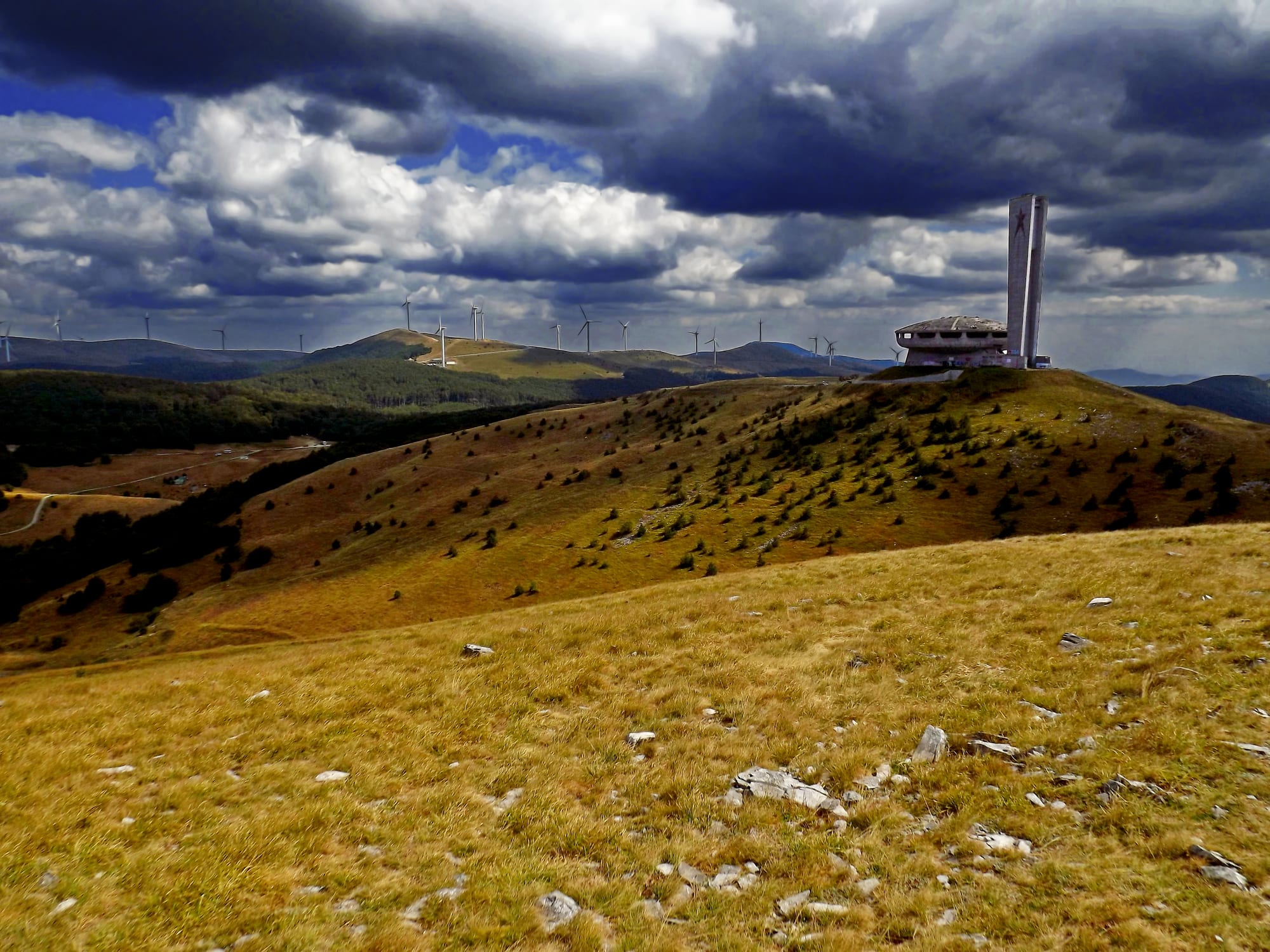
The "flying saucer" is the Buzludzha Monument, officially the Monument House of the Bulgarian Communist Party. Bulgaria's communist government built it between 1974 and 1981 on Buzludzha Peak, in the Balkan Mountains near Kazanlak, because this summit was sacred ground for the party: in 1891 a group of socialists led by Dimitar Blagoev met there in secret and founded the movement that became the Bulgarian Communist Party. The round, domed hall was designed as the party's ceremonial home, and its tall tower carried a giant red star.
It looks like a wreck from outer space because it is a ruin. The building was used for party celebrations only until the fall of communism in 1989; after that, all maintenance stopped, it was sealed, stripped by thieves and battered by mountain weather. Today it is closed to the public as unsafe, while a conservation effort tries to save what is left and turn it into a centre for Bulgarian history.
A peak with two revolutions
Buzludzha, whose name comes from a Turkish word meaning roughly "icy", had been a place of memory long before the communists arrived. In July 1868 the rebel leader Hadzhi Dimitar and his band made a last stand there against a far larger Ottoman force, and very few of the rebels survived. Their defeat inspired the struggle that ended Ottoman rule ten years later, and the decisive battle of that war was fought a few miles away at the Shipka Pass. The poet Hristo Botev wrote his poem "Hadzhi Dimitar" about the rebel leader, and in 1942 the peak was officially renamed after him, although almost everyone still calls it Buzludzha.
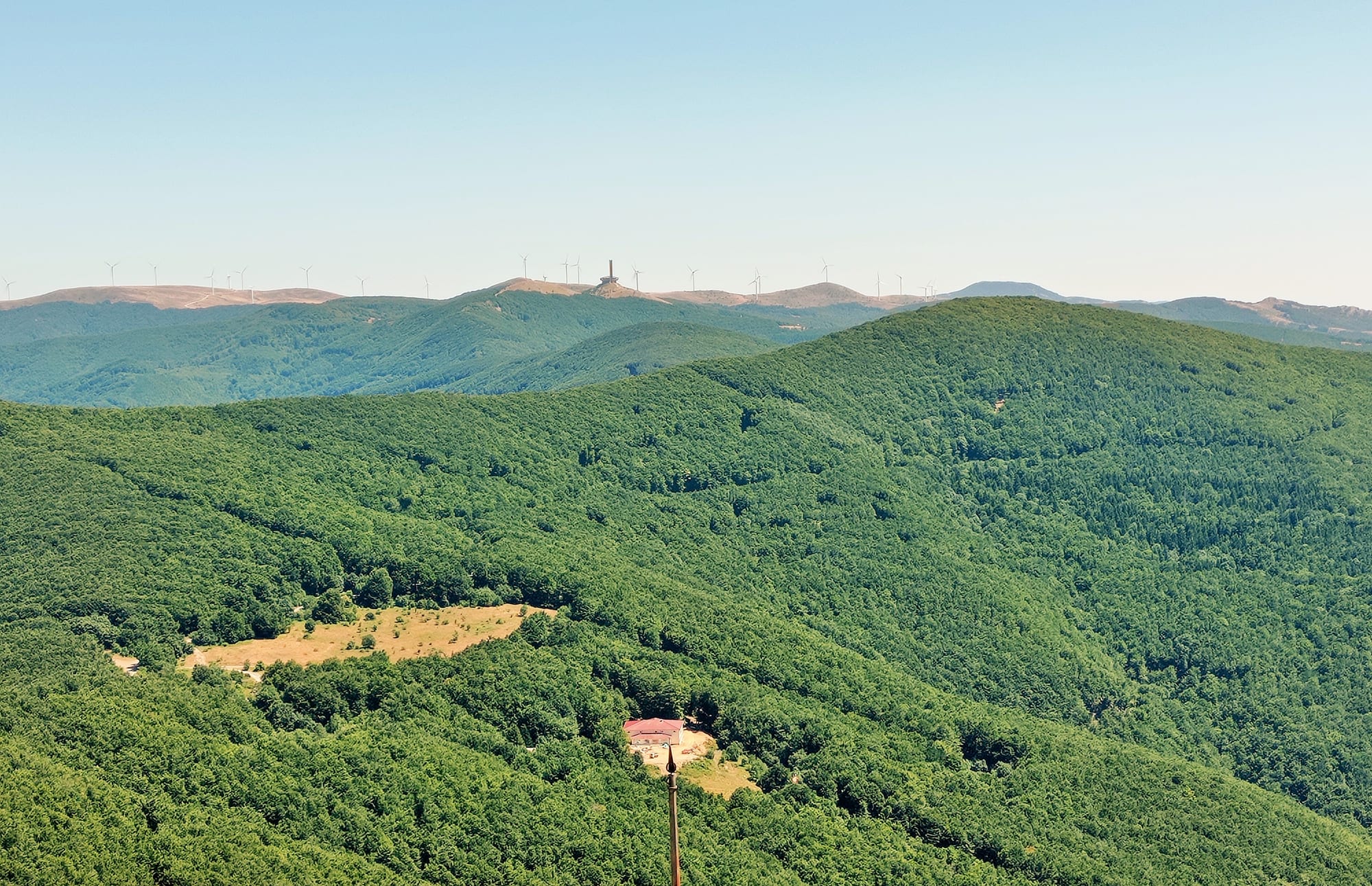
The monument stands on the skyline to the east of the pass.
The second event gave the summit its political meaning. In 1891 Blagoev, the founder of socialism in Bulgaria, chose the mountain for the first congress of the Bulgarian Social Democratic Party. That party was the forerunner of the Bulgarian Communist Party, which took power in 1944 and ruled until 1990, and of today's Bulgarian Socialist Party. In 1944 the peak saw fighting between communist partisans and the Bulgarian Army. A national monument on the summit had been proposed as early as 1898; the communist state finally built one to honour all of these events at once.
Blasting a mountain for a monument
Work began on 23 January 1974 under the architect Georgi Stoilov, a former partisan who had trained at the Moscow Architectural Institute and served as mayor of Sofia. To create a stable foundation, builders used TNT to remove more than 15,000 cubic metres of rock, lowering the summit by 9 metres, from 1,441 to 1,432 metres. The cost, 14,186,000 leva, equivalent to about US$35 million in 2020, was raised through donations from the public.
The design married a domed, circular building to a 70-metre double pylon, a tower formed of two slabs, with a red star mounted near its top on each broad side. The futurist shape, common in state-built communist architecture, has been compared to the Olympic Stadium in Montreal and to a church designed by Frank Lloyd Wright for a Greek Orthodox congregation in Wisconsin. The "flying saucer" is the ceremonial hall itself: 42 metres across and 14.5 metres high.
More than 60 artists spent 18 months decorating it. Mosaics of glass and gold ran around the hall telling the story of the party's struggles and victory, with the largest glorifying Marx and Lenin. A corridor held 14 mosaics of ordinary workers' labour, and a ring of mosaics outside was made from natural stones gathered from rivers across Bulgaria. In the centre of the ceiling, a mosaic 9 metres across showed the hammer and sickle encircled by the slogan "Proletarians of all countries, unite!"
Opened in 1981, abandoned by 1989
The monument opened on 23 August 1981, ninety years after Blagoev's congress. The communist leader Todor Zhivkov declared that the paths leading to the peak should "never fall into disrepair", and invited generation after generation of socialist Bulgarians to come and pay homage.
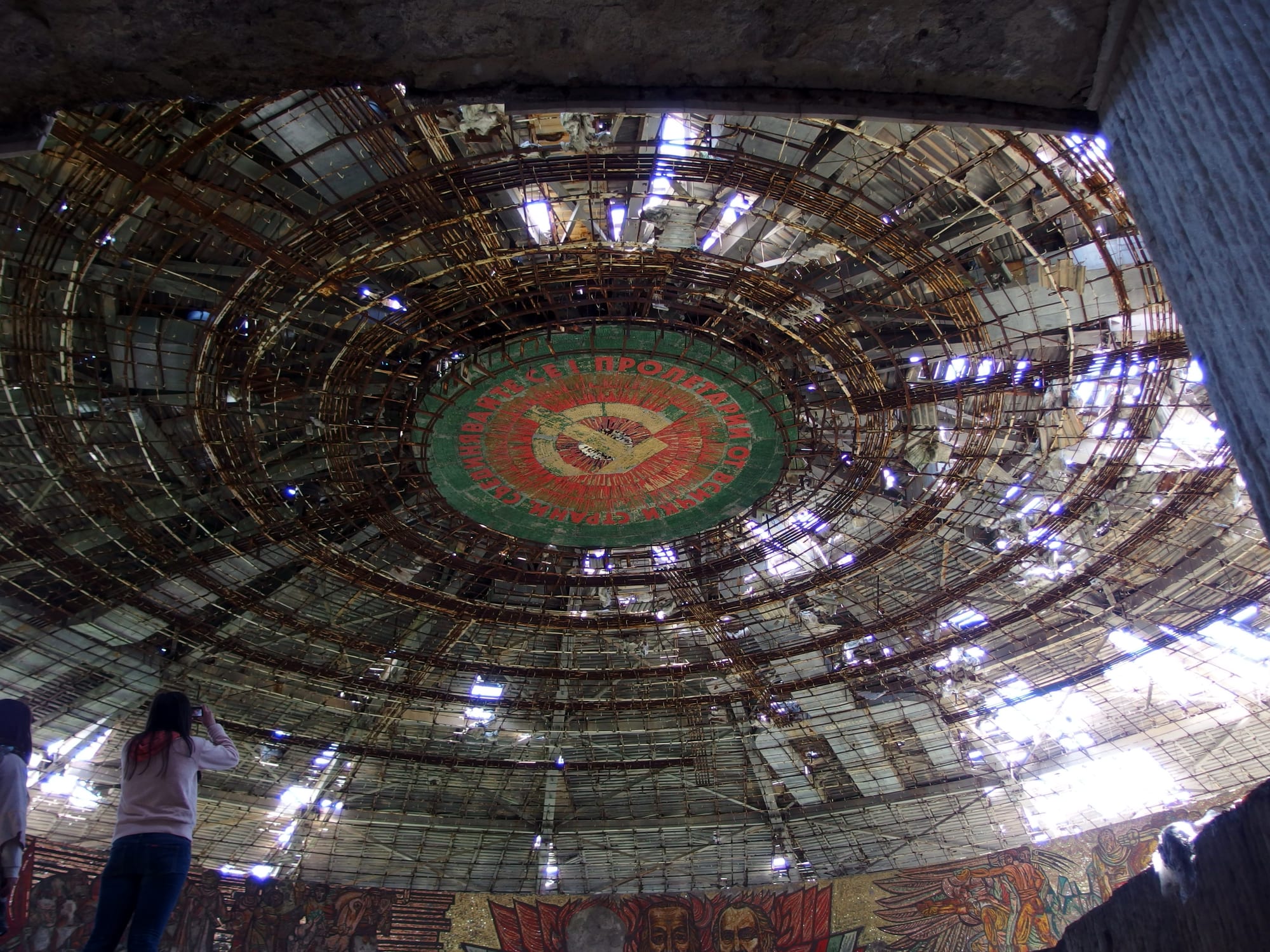
The slogan around the emblem reads "Proletarians of all countries, unite!"
That lasted eight years. After the political changes of 10 November 1989, which began the end of communist rule, all maintenance stopped and the building's condition worsened dramatically. In 1992 the state took over the former party's property and sealed the monument. Under the government of Ivan Kostov its guards were withdrawn, and thieves carried off everything of value, including the massive copper roof. Vandals smashed glass and prised mosaics from the walls; portraits of Zhivkov and his daughter Lyudmila Zhivkova were destroyed. Someone even shot at the great star, believing it was made of rubies. About a fifth of the mosaics have now been lost to age, weather and vandalism.
Ownership became a political argument. In 2011 the government decided to hand the complex to the Bulgarian Socialist Party, but a change in the law on state property in 2017 made that impossible, and the government refused the party's request later that year. The socialists still hold a gathering each summer in a meadow near the peak.
From eyesore to endangered heritage
Neglect gave the monument a second life. Its broken dome on a windswept summit drew urban explorers, photographers and film crews: the 2016 action film Mechanic: Resurrection used it as a location, digitally moving it to a shoreline and adding a helipad on the roof. Several music videos have been filmed there too.
Preservationists began to see it differently too. In 2018 Europa Nostra named it one of the seven most endangered heritage sites in Europe. From 2019 the Buzludzha Project Foundation, working with ICOMOS Germany and the municipality of Stara Zagora, secured a $185,000 grant from the Getty Foundation for a conservation management plan. Early results suggested the building could be saved and used, and a second Getty grant in July 2020 paid to stabilise the surviving mosaics. The long-term aim is an interpretation centre about Bulgarian history.
The building itself remains closed because its weakened structure is dangerous. The peak can be reached by side roads from the Shipka Pass: about 16 kilometres from Kazanlak in the south, or 12 kilometres from Gabrovo in the north. A statue of Hadzhi Dimitar and memorials to the 1891 congress and the 1944 partisans stand nearby.