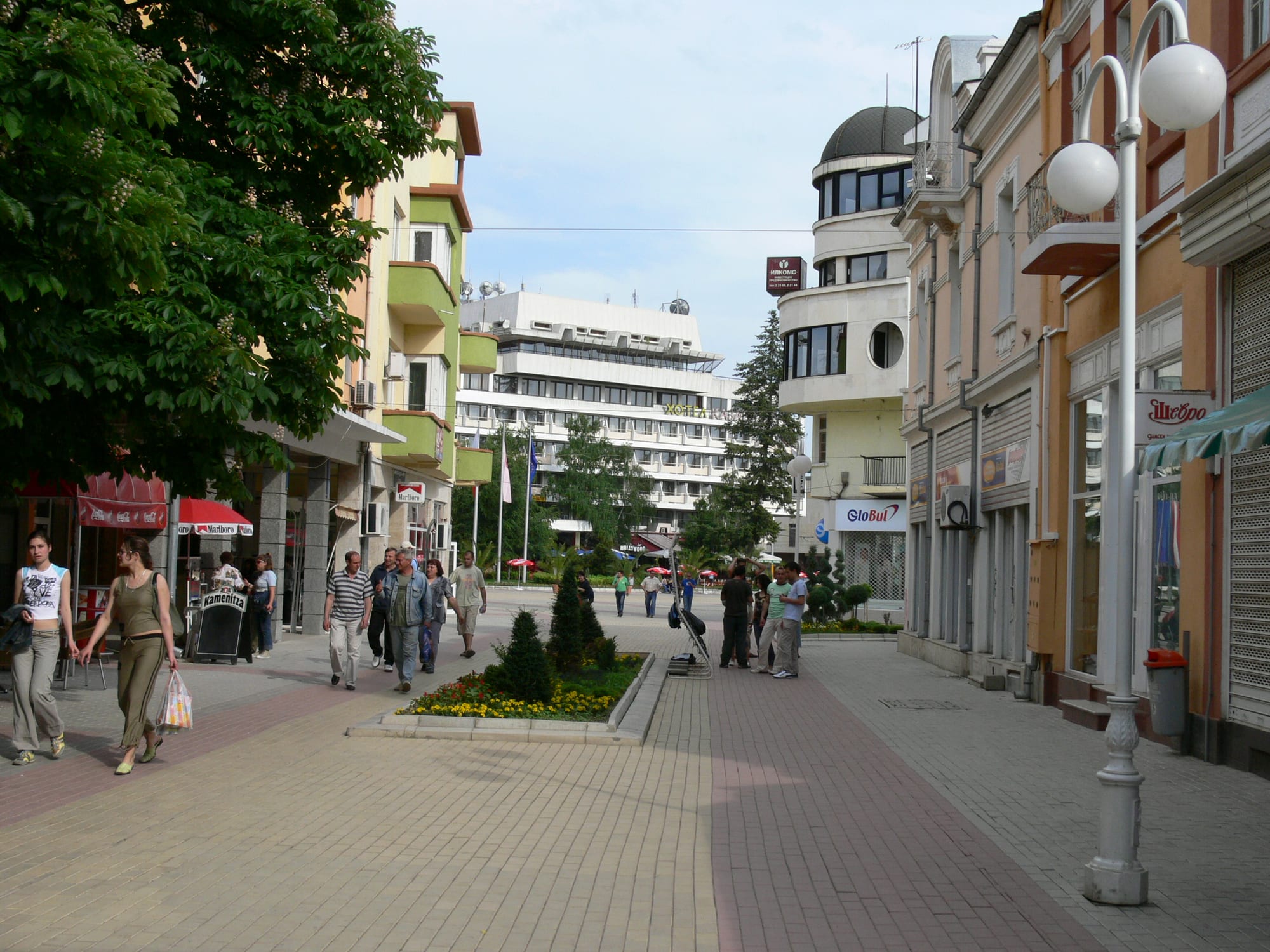
A paved pedestrian street in central Kazanlak with pastel shopfronts, globe street lamps and a flower bed

The Valley of the Roses & the Southeast, Bulgaria

Kazanlak

A pedestrian street in the centre of Kazanlak. (Nenko Lazarov / Wikimedia Commons · CC BY 2.5)

An industrial and rose-growing town in the middle of the Kazanlak Valley, at the foot of the Balkan Mountains in central Bulgaria. Founded as a military fortress guarding the Shipka Pass, it grew into a craft town and the centre of Bulgarian rose-oil production, and is now known for its painted Thracian tomb, its rose museum and its early-June Rose Festival.

Neighbourhoods

  • Town centre
    • First-time visitors
    • Close to public transport
    • Cafés

    The compact centre of paved pedestrian streets, shops and cafés around the main square and the city garden. The Iskra chitalishte, founded in 1860 and still the town's cultural centre with its library, theatre and museum, is here, and the railway station on the Sub-Balkan line is within reach.

    Open in Maps
  • Koulata
    • Historic district
    • Museums
    • Quiet streets

    The oldest part of the town, near the Thracian tomb, where cobbled Mirska Street is lined with houses of the National Revival period. Several of them form the Koulata Ethnographic Complex, open to visitors since 1976, with coppersmiths' and goldsmiths' workshops and a restored Balkan valley house.

    Open in Maps
  • Shipka
    • Mountain views
    • Historic sites
    • Quiet base

    A small town a short drive north, at about 650 metres on the slopes of the Balkan range facing the valley. The golden domes of the memorial church rise above it, the road climbs from here to the Shipka Pass, and the Golyama Kosmatka mound lies close by.

    Open in Maps

Things to do

Museums and the old quarter

  • Thracian Tomb of Kazanlaklandmark

    A 4th-century BC brick beehive tomb whose corridor and burial chamber are painted with a Thracian couple at a funeral feast, a UNESCO World Heritage Site since 1979; the original is closed to protect the murals, and a full-size replica stands nearby.

    Open in Maps
  • Iskra Town History Museummuseum

    One of the first provincial town museums in Bulgaria, founded in 1901, with finds from Seuthopolis in three halls and the treasure from the Golyama Kosmatka mound.

    Open in Maps
  • Rose Museummuseum

    A museum of rose growing and rose-oil production, a museum in its own right since 1969 and part of the Iskra museum, with a restored rose warehouse and a rose-oil vessel that still smells of roses.

    Open in Maps
  • Koulata Ethnographic Complexattraction

    Restored Revival-era houses and craft workshops on Mirska Street, where visitors can taste rose jam, rose liqueur and gyulovitsa, a rose brandy.

    Open in Maps
  • Chudomir Literary and Art Museummuseum

    The house of the writer and artist Dimitar Chorbadzhiiski, known as Chudomir, kept as a museum since 1968, with manuscripts, paintings and letters of his and of his wife, the artist Mara Chorbadzhiiska.

    Open in Maps
  • Rosarium Parkpark

    A town park with many spots for recreation, a green break from the centre.

    Open in Maps

The Valley of the Thracian Rulers

  • Valley of the Thracian Rulersattraction

    The name given to the dense scattering of Thracian burial mounds across the Kazanlak Valley, where more than 200 mounds were studied between 1992 and 2006.

    Open in Maps
  • Tomb of Seuthes IIIlandmark

    One of the most elaborate tombs in the valley, under the Golyama Kosmatka mound near Shipka, linked to the Odrysian king Seuthes III and opened by archaeologists in 2004.

    Open in Maps
  • Shushmanets tomblandmark

    A mound in the valley built as a temple in the 4th century BC and later used as a tomb, with a long entry corridor and an antechamber supported by a column.

    Open in Maps
  • Seuthopolis and the Koprinka Reservoirattraction

    The capital founded by Seuthes III between 325 and 315 BC, studied before the Koprinka dam was finished in 1956 and now lying beneath the reservoir just west of town.

    Open in Maps

Shipka and the Balkan range

  • Shipka Memorial Churchlandmark

    A Russian-style church with golden domes, built between 1885 and 1902 near the town of Shipka and dedicated to the Russian and Bulgarian soldiers who died in the Russo-Turkish War of 1877–78, with a 53-metre bell tower and 34 marble plates bearing the names of the regiments and volunteers.

    Open in Maps
  • Shipka Monumentlandmark

    The fortress-like Liberty Memorial on Shipka Peak, inaugurated in 1934 and paid for by donations from across Bulgaria; 890 steps lead up to it.

    Open in Maps
  • Shipka Passviewpoint

    The 1,150-metre pass over the Balkan range between Kazanlak and Gabrovo, scene of the battles of 1877, with a road leading on to Buzludzha.

    Open in Maps
  • Buzludzha monumentlandmark

    The concrete Monument House of the Bulgarian Communist Party, inaugurated on Buzludzha Peak in 1981 to commemorate the secret socialist congress of 1891.

    Open in Maps

Seasonal events

  • Rose Festivalfirst weekend of June

    Celebrated in Kazanlak since 1903 when the oil-bearing rose blooms, with ritual rose-picking, folklore performances, a parade and the crowning of the Rose Queen.

Eat and drink

Long-standing places and food districts in Kazanlak. Hours, ratings and directions come from your maps app, always current.

Kazanlak classics

  • Kazanlak doughnutscafe

    A particular type of doughnut named after the town and counted among the classic Bulgarian breakfast foods.

    Open in Maps
  • Rose jam, liqueur and gyulovitsamarket

    The rose-oil town's own products — rose jam, rose liqueur and gyulovitsa, a rose brandy — offered for tasting in the Koulata quarter.

    Open in Maps

Eating in town

  • Restaurants in the town centreneighborhood

    The pedestrian streets around the main square hold the town's cafés and restaurants serving Bulgarian dishes, from banitsa at breakfast to grilled meats in the evening.

    Open in Maps

Experience Kazanlak

History

People have lived on the site of Kazanlak since the Neolithic, in the sixth and fifth millennia BC. In the late 4th century BC the upper Tundzha valley belonged to the Thracian king Seuthes III, who founded Seuthopolis just to the west, and the valley filled with the burial mounds of the Thracian aristocracy — among them the painted beehive tomb that was discovered in 1944 and declared a UNESCO World Heritage Site in 1979. In the Middle Ages the valley was the centre of the Krun region, ruled by the boyar Aldimir, and after 1370 it fell to the Ottomans.

The modern town dates from the early 15th century, when it was founded as a military fortress to protect the Shipka Pass; its name comes from the Turkish Kazanlık. It grew into a town of craftsmen, with more than fifty trades, from tanning and coppersmithing to goldsmithing, weaving and shoemaking. Above all it took up the oil-bearing rose, which had come from central Asia by way of Persia, Syria and Turkey and found the valley's soils and moisture ideal; Kazanlak rose oil went on to win gold medals at exhibitions in Paris, London, Philadelphia and Milan.

The battles for the Shipka Pass in 1877 were fought in the mountains just above the town. After Bulgarian independence the old crafts declined with the loss of the Ottoman markets, and textile and military industries took their place. The population, about 9,000 in the 1880s, grew with migration from the countryside to more than 60,000 by 1985, then fell quickly in the hard years of the 1990s as people left for Sofia and abroad.

Culture & Customs

The rose is the town's emblem. Kazanlak has celebrated the Rose Festival since 1903, in the first week of June when the oil-bearing rose comes into bloom. The programme brings ritual rose-picking in the surrounding villages, folklore performances and traditional dances, and the crowning of the Rose Queen, and a parade lasting more than an hour on the Sunday ends the festivities. The festival has grown into an international event that draws thousands of visitors.

The town has a long tradition of education and culture. Early in the National Revival its people were already opening schools and reading centres, among them a teachers' college that trained teachers for the whole country. The Iskra chitalishte, founded in 1860, remains the cultural centre, with a library, theatre, cinema and museum, and it hosted the first Bulgarian opera, Siromahkinya. Kazanlak honours the writer and artist Chudomir with a literary and art museum in his house, and the composers Petko Staynov and Emanuil Manolov are among the many artists associated with the town. One of the country's largest musical-instrument factories has worked here for more than ninety years.

Religion is overwhelmingly Orthodox, and the memorial church and the monument on Shipka Peak make the surrounding mountains a place of national remembrance for the war of 1877–78.

Daily Life

About 41,000 people live in the town, according to the national statistics office's estimate for the end of 2025, down from a peak of more than 60,000 in the mid-1980s. It is the second-largest settlement in Stara Zagora Province and remains one of Bulgaria's leading industrial centres. Manufacturing dominates the local economy — metalworking, hydraulic components and machinery — and the defence manufacturer Arsenal, founded in 1924, provides work for a significant share of people in the town and nearby villages. Textile mills and the musical-instrument works add to the industrial base.

Farming is the other pillar. The fertile alluvial land around the town is planted mainly with roses and other perennial crops, and the harvest of rose blossom and the production of rose oil for perfumery matter greatly to the local economy, along with oilseeds and herbs. Tourism, centred on the tombs and the festival, is the third main sector.

Daily life follows the rhythm of a Bulgarian provincial town: coffee in the pedestrian streets of the centre, a hospital serving five municipalities of the valley, schools ranging from a national high school of plastic arts and design to technical colleges, and evenings in the parks. In late May and early June the rhythm changes, as pickers head into the fields early in the morning and the town fills for the festival.

Food

The rose flavours the town's specialities. The town's rose products include rose jam, rose liqueur and gyulovitsa, a rose brandy, and these can be tasted in the Koulata quarter. The Damask rose, sometimes called the Bulgarian rose, is harvested for rose oil and is also used to make rose water.

The town also has a breakfast of its own: Kazanlak doughnuts, a particular type of doughnut named after the town, count among the classic Bulgarian breakfast foods alongside banitsa, a pie of filo pastry layered with whisked eggs, yogurt and white brined cheese, served hot or cold with yogurt, ayran or boza. Lyutenitsa, a relish of peppers, aubergines, carrots, garlic and tomatoes, comes smooth or chunky, hot or mild, and is often served on bread topped with white cheese.

Rakia, the fruit brandy of south-eastern Europe, is the usual spirit, normally around 40 per cent alcohol and often much stronger when made at home, and wine holds a prominent place, as it does across Bulgarian cuisine.

Planning tools

Budget

Kazanlak is an inexpensive provincial town by European standards, with modest guesthouses and hotels and low prices for meals. Costs rise in early June, when the Rose Festival fills rooms. Seeing the tombs and the monuments of the pass is far easier with a car or a taxi, which adds to the daily bill.

Daily Budget Midrange
USD 65–110 (mid-range hotel, restaurant meals, museum and tomb tickets, a hire car or taxis to the valley sights)
Daily Budget Shoestring
USD 35–50 (guesthouse room, bakery breakfasts and mehana meals, trains and buses)

For the festival weekend, book well ahead or stay in Stara Zagora and travel in for the day.

Best Time to Visit

Mid-May to early June, when the rose fields of the valley are in bloom and the town holds the Rose Festival — the busiest time of the year. September and October are mild and good for the tombs and the Shipka Pass. July and August are warm, and winter is quiet, with snow and fog possible on the pass.

Suggested Number of Days

One or two days cover the town's museums and old quarter. Allow about three to reach the scattered Thracian tombs and the monuments along the Balkan range as well. Without a car the outlying sights take longer, and the festival crowds in early June slow everything down.

First Visit
1–2 days
With Surroundings
3 days

Transportation

The centre is small and walkable. Local buses and taxis serve the town, but the tombs of the valley, the Shipka Memorial Church, the Shipka Monument and Buzludzha are spread out along the foot of the mountains and up the pass, and are easiest to reach by car or taxi.

In winter, drive the Shipka Pass road in daylight and check conditions before setting out.

Airport & Station Connections

Kazanlak lies about 170 km east of Sofia, about 75 km north-east of Plovdiv and about 30 km north-west of Stara Zagora. It is a major station on the Sub-Balkan railway between Sofia and Burgas, with direct trains from Plovdiv as well; travellers from Stara Zagora usually change at Tulovo or take a bus. The road north over the Shipka Pass links the town with Gabrovo.

Walkability

The centre, the pedestrian streets, the Koulata quarter and the tomb replica are all within walking distance of each other on flat ground at about 350 metres. The valley tombs, the memorial church and the pass need transport.

Safety

Bulgaria is a safe country for visitors, with low levels of violent crime. Kazanlak is a quiet provincial town; the main concern is pickpocketing in the crowds of the Rose Festival, and the Balkan passes above the town can be icy and foggy in winter.

Watch bags in the festival crowds, use marked, metered taxis, and do not enter the Buzludzha monument unless it is officially open. Check current official travel advice before travelling.

Climate

Temperate. Spring comes comparatively early in the valley, which lies between the Balkan range and the Sredna Gora. Summers are moderate with rain early in the season, autumn is drier, and winters are mild, with fairly light snowfall that does not lie for long.

Summer
moderate — July averages about 21°C, with most rain early in the summer
Winter
mild — January averages around 0–1.5°C, with light snowfall

Local Customs

Bulgarians often shake the head for 'yes' and nod for 'no', which can confuse a first conversation; saying the words clears it up. Kazanlak is proud of its rose and of its Thracian past, and the Iskra chitalishte, founded in 1860, is at the heart of local cultural life. The town is overwhelmingly Orthodox.

Dress modestly in churches, including the Shipka Memorial Church, and respect the protective rules at the tombs, where the paintings are fragile.

Common Payment Methods

The currency is the euro, which replaced the lev on 1 January 2026 and has been the sole currency since 1 February 2026. Cards are widely accepted in town, but cash is useful for village stalls, small shops and the sights outside town.