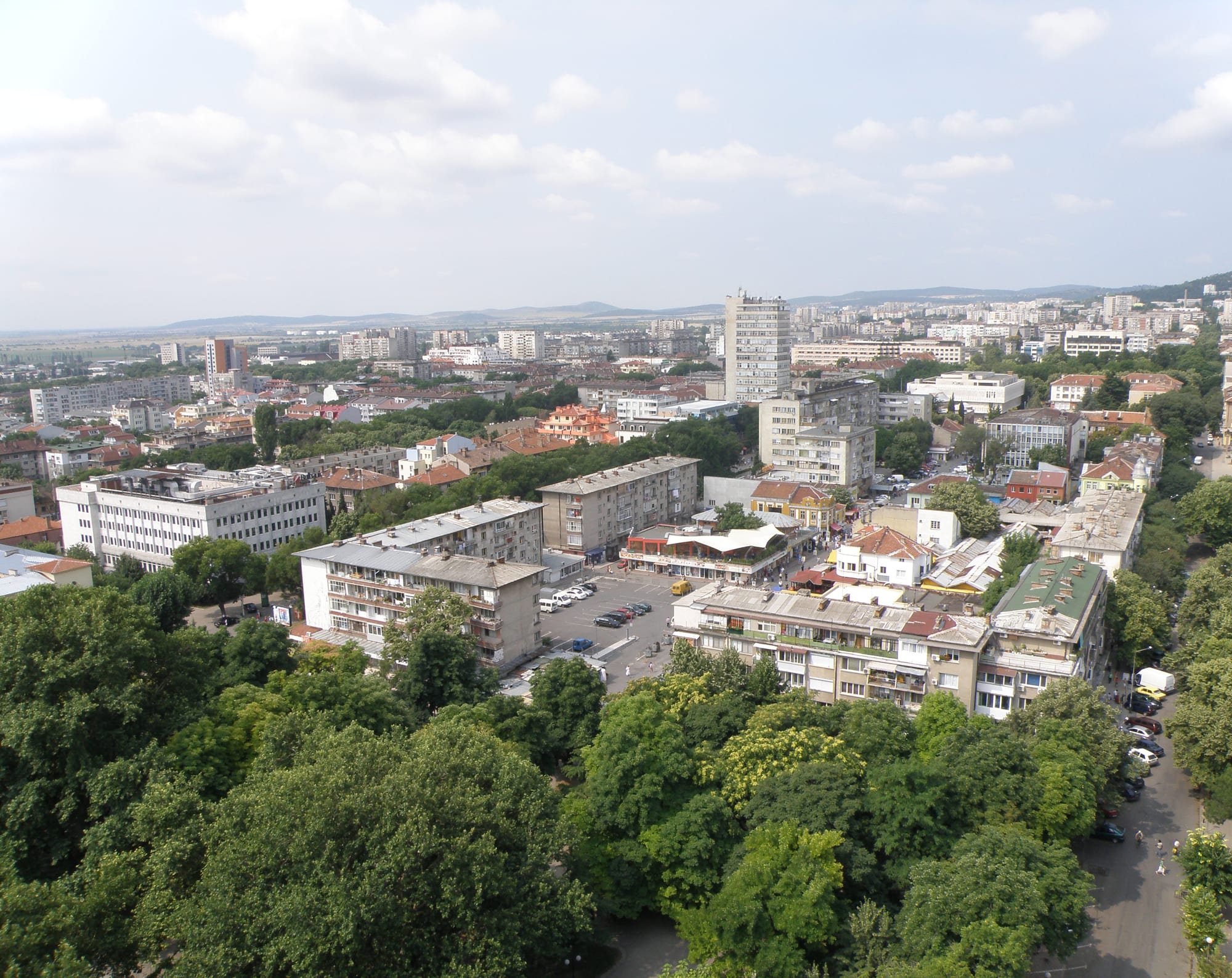
View over central Stara Zagora's tree-filled streets and apartment blocks towards low hills on the horizon

The Valley of the Roses & the Southeast, Bulgaria

Stara Zagora

Central Stara Zagora seen from above, with the plain and the hills beyond. (Balkanregion / Wikimedia Commons · CC BY-SA 3.0)

Bulgaria's fifth-largest city, on the northern edge of the Upper Thracian Plain below the Sredna Gora. Settled since the Neolithic and a leading Roman city as Augusta Traiana, it was burned in 1877 and rebuilt on a grid of linden-lined streets. Today it is a provincial capital of opera, a university, the Zagorka brewery and the coal power stations of the plain.

Neighbourhoods

  • City centre
    • First-time visitors
    • Historic district
    • Close to public transport

    The rectangular grid laid out after 1878 by the Austro-Hungarian architect Lubor Bayer, with long linden-shaded streets. The Roman forum, the Eski Mosque, the opera, the history museum and the main shopping street all lie within a few blocks.

    Open in Maps
  • Ayazmoto
    • Parks
    • Sport
    • Quiet and residential

    The north-western side of the city around Ayazmoto, its best-known park, which covers a wooded hillside with a zoo, a botanical garden, sports grounds and an astronomical observatory. Stadion Beroe, home of the city's football club, stands nearby.

    Open in Maps
  • Starozagorski bani
    • Spa
    • Mountain air
    • Quiet base

    A village and mineral-spring spa resort in the Sredna Gora, about 15 km north-west of the city. It offers a green, quiet alternative to staying in town.

    Open in Maps

Things to do

Ancient Stara Zagora

  • Neolithic Dwellings Museummuseum

    Opened in 1979 around two houses of the 6th millennium BC, the best-preserved Neolithic dwellings in Europe, with their kitchens, fireplaces, hand mills and pottery, and an exhibition of prehistoric art.

    Open in Maps
  • Forum of Augusta Traianalandmark

    The excavated forum of the Roman city in the centre, overlooked by a monumental auditorium built in the shape of a theatre, with Roman streets, baths and walls preserved in situ around the city.

    Open in Maps
  • Regional Museum of Historymuseum

    One of the richest museums in the Balkans, with Roman glass and bronzes, Thracian chariots and finds from Augusta Traiana.

    Open in Maps
  • Late Roman mosaics in the Central Post Officeattraction

    A late antique public building of the 4th to 6th centuries with floor mosaics, displayed on the ground floor of the post office's main hall.

    Open in Maps

Landmarks of the city

  • Eski Mosquelandmark

    The 15th-century mosque with old wall paintings that was the only public building to survive the burning of 1877, now a museum of religions.

    Open in Maps
  • Defenders of Stara Zagora Memoriallandmark

    The 50-metre memorial complex to the defenders of 1877, a concrete replica of the Samara flag raised over an ossuary on a pine-covered hill in a city park.

    Open in Maps
  • State Opera Stara Zagoraattraction

    Founded in 1925, the oldest opera house in Bulgaria outside Sofia, presenting opera, ballet, operetta and concerts and hosting a long-running opera and ballet festival.

    Open in Maps
  • State Puppet Theatre clockattraction

    A small automaton clock on the puppet theatre's facade that shows a parade of fairy-tale puppets every hour.

    Open in Maps

Parks, beer and sport

  • Ayazmoto Parkpark

    The city's largest and best-known park, covering about 350 hectares of hillside, with a zoo, a botanical garden, sports grounds and an observatory at the top.

    Open in Maps
  • Zagorka brewery museummuseum

    A small museum collection at the country's largest brewery, shown on guided tours of the brewery itself.

    Open in Maps
  • Stadion Beroeattraction

    The home ground of PFC Beroe, twice winners of the Bulgarian Cup, near Ayazmoto park; its record crowd of 42,000 was set in 1972.

    Open in Maps

Short trips from the city

  • Starozagorski baniattraction

    A mineral-spring spa village in the Sredna Gora north-west of the city.

    Open in Maps
  • Thracian Tomb of Kazanlaklandmark

    Across the Sredna Gora in Kazanlak, the painted 4th-century BC Thracian tomb listed as a UNESCO World Heritage Site, seen through a full-size replica.

    Open in Maps

Seasonal events

  • Linden festivitieslate May to mid-July

    The city's celebrations of the flowering of the linden trees that line its streets.

  • Festival of Opera and Ballet Artsannually

    A long-standing opera and ballet festival organised and hosted by the State Opera.

  • Zagorka beer festivalvaries

    A beer festival organised by the city's brewery since 2015.

Eat and drink

Long-standing places and food districts in Stara Zagora. Hours, ratings and directions come from your maps app, always current.

Stara Zagora classics

  • Zagorka beerneighborhood

    The city's own lager, brewed in Stara Zagora since a doctor back from Prague founded the company in 1902, and one of the most popular beers in Bulgaria.

    Open in Maps
  • Thracian Valley wineneighborhood

    Stara Zagora is the home of the Domaine Menada winery, which with the winery at nearby Oryahovitsa makes Cabernet Sauvignon, Merlot, Chardonnay and Dimiat wines.

    Open in Maps

Food districts

  • Zagorka Lakeneighborhood

    The lakeside on the edge of the city where many of its restaurants are gathered, from local taverns to smarter dining rooms.

    Open in Maps
  • The central streetsneighborhood

    Cafés and restaurants along the shopping streets of the grid, serving Bulgarian and international food under the linden trees.

    Open in Maps

Experience Stara Zagora

History

The site has been lived on almost without a break since the end of the 7th millennium BC. Four prehistoric settlements grew up on and around it, and in 1968 two houses of the mid-6th millennium BC were found in the town — the best preserved of their age in Europe. The town of Beroe followed in the 5th–4th centuries BC, and the Romans renamed it Ulpia Augusta Traiana after the emperor Trajan. Under Marcus Aurelius it gained straight streets, walls with some forty towers, a forum and a theatre-like auditorium, and became the most important city of the province of Thrace.

Through the Middle Ages the town changed hands between Byzantium and Bulgaria and changed names with them: Vereia, then Irenopolis after the empress Irene rebuilt it in 784, then Boruy to the Bulgarians. The Ottomans took it in 1371 and called it Eski Zagra, from which the present name, adopted in 1871, derives. It was the centre of a failed uprising in 1875.

On 31 July 1877, in the first major battle of the Russo-Turkish War, a small Russian force and Bulgarian volunteers lost the town to a much larger Ottoman army. Over the following days the town was burned to the ground and about 14,000 Bulgarian civilians from the town and villages to the south were killed; only the Eski Mosque survived among its public buildings. After 1878 the city became part of Eastern Rumelia, which joined Bulgaria in 1886, and was rebuilt on the rectangular plan of Lubor Bayer, with the first stone laid in 1879.

Culture & Customs

Stara Zagora has long been called the city of poets, and its linden trees and its opera are points of local pride. The lindens were planted along the new streets when the city was rebuilt, and their flowering is celebrated each year from late May to mid-July. Many Bulgarian poets lived and wrote here, among them Geo Milev, born nearby. The State Opera, founded in 1925, was the second opera company in the country and remains the oldest outside Sofia; its stage presents opera, ballet, operetta and children's shows, and it hosts a long-running festival of opera and ballet.

The memory of 1877 runs deep. Monuments around the city commemorate the massacre and the defence of the town, and the memorial complex on a hill in a city park, a concrete replica of the Samara flag, honours the defenders; torchlight processions mark the anniversary of the massacre each year. The city's Roman and prehistoric heritage is a second source of pride, shown in the regional history museum and the Neolithic dwellings.

Football follows PFC Beroe, founded in 1916 and named after the ancient town, which won the Bulgarian Cup in 2010 and 2013 and now plays in the Second League. Most people are Orthodox Christians; at the 2011 census about nine in ten declared themselves Bulgarian, with smaller Roma and Turkish communities.

Daily Life

About 121,000 people live in the city, according to the national statistics office's estimate for the end of 2025, making it the fifth-largest city in Bulgaria. Its population peaked above 160,000 around 1989–91 and has fallen since as people moved to Sofia or abroad. It is the administrative centre of Stara Zagora Province, and Trakia University, founded in 1995 in the west of the city, teaches medicine, veterinary medicine, economics, education and agriculture, with some degrees now taught in English.

The economy is among the strongest in provincial Bulgaria, with wages among the highest in the country. The largest employer is the Maritsa Iztok complex of coal mines and power stations on the plain, where many of the city's people work and which supplies a large share of the country's electricity. It is also politically contested: it is Bulgaria's largest source of carbon emissions and has badly polluted nearby towns, yet many families depend on it. Zagorka, the country's largest brewery, the electricity distributor for southern Bulgaria and engineering plants make up much of the rest, and the surrounding Zagore district grows wheat, vegetables, fruit and grapes.

Most people live in apartment districts built after the Second World War around the centre, several of them former villages absorbed by the city. Evenings centre on the pedestrian shopping streets and the parks, with two large shopping malls opened since 2008.

Food

Stara Zagora's own contribution to the Bulgarian table is drink. Zagorka beer has been brewed in the city since 1902, when a doctor who had returned from Prague founded the company in the Czech tradition; the present brewery opened in 1958, belongs to Heineken and holds a large share of the national market. The Domaine Menada winery, based in the city, and the winery at nearby Oryahovitsa make Cabernet Sauvignon, Merlot, Chardonnay and Dimiat wines.

Restaurants serve Bulgarian and international food, many of them clustered around Zagorka Lake on the edge of the city. The everyday Bulgarian staples are found everywhere: banitsa, a pie of filo pastry layered with whisked eggs, yogurt and white brined cheese, eaten for breakfast with yogurt, ayran or boza; and lyutenitsa, a relish of peppers, tomatoes, aubergines, carrots and garlic.

Rakia, the fruit brandy of south-eastern Europe, usually around 40 per cent alcohol, is the customary spirit, and the city's farmland — the Zagore district of wheat, vegetables and fruit — keeps its markets supplied with produce.

Planning tools

Budget

Stara Zagora is a working provincial city with few foreign visitors, and accommodation and meals cost well below Sofia or the coast. The main sights are compact and their tickets are modest. A hire car or taxis add to the bill only for trips into the Kazanlak valley.

Daily Budget Midrange
USD 65–110 (mid-range hotel, restaurant dinners, museum tickets, an opera seat or a day trip to Kazanlak)
Daily Budget Shoestring
USD 35–50 (guesthouse or simple hotel, bakery breakfasts and tavern meals, city buses and trolleybuses)

Rooms in Kazanlak fill up for the early-June Rose Festival, so the city makes a practical base for travelling in for the day.

Best Time to Visit

May, June, September and October. Late May to mid-July brings the linden blossom and the city's festivities, and early June the Rose Festival in Kazanlak nearby. July and August are the warmest months, and winter is cool.

Suggested Number of Days

One or two days cover the city's museums, Roman remains and parks. Allow three or four to add the Kazanlak valley and the spa villages of the Sredna Gora. The opera season and the festivals can add an evening or two.

First Visit
1–2 days
With Surroundings
3–4 days

Transportation

The grid-plan centre is easy to cover on foot. The city has four trolleybus routes, in service since 1987, and 34 bus lines, and taxis are widely used. The Kazanlak valley and the villages are easier with a car.

Use marked, metered taxis or a ride app rather than unofficial drivers.

Airport & Station Connections

The nearest airport with regular flights is at Plovdiv, a city about 80 km away. Stara Zagora is a major railway junction on the Sofia–Burgas line and the north–south line from Ruse, and buses run frequently to Sofia, Plovdiv, Burgas, Sliven, Veliko Tarnovo and Varna. The city is about 231 km from Sofia, and the Trakia motorway passes a few kilometres to the south.

Walkability

Very good in the centre: the straight, tree-shaded streets of the grid make the forum, the mosque, the museums and the opera an easy walk from one another. Ayazmoto park and the memorial on the hillside involve a climb.

Safety

Bulgaria is a safe country for visitors, with low levels of violent crime. Stara Zagora has a reputation as a very safe city, including for walking at night; ordinary care with bags and with taxis is enough.

Use marked, metered taxis and keep an eye on belongings in busy places. Check current official travel advice before travelling.

Climate

The city lies at the edge of the Upper Thracian Plain, below the Sredna Gora. The climate is transitional continental with a Mediterranean influence; the annual average is about 13°C, with around 600 mm of rain and snow a year.

Summer
warm — July averages about 24°C
Winter
cool — January averages about 1°C

Local Customs

Bulgarians often shake the head for 'yes' and nod for 'no', so saying the word avoids confusion. The city is proud of its linden trees, its poets and its opera, of its Roman past and of the memory of 1877, which is marked by monuments around the centre. Most people are Orthodox, and the city has small Roma and Turkish communities.

Dress modestly in churches and at the memorials, and keep a respectful tone at the monuments to the 1877 massacre.

Common Payment Methods

The currency is the euro, which replaced the lev on 1 January 2026 and has been the sole currency since 1 February 2026. Cards are widely accepted in the city's shops, malls and restaurants; keep some cash for markets and small shops.