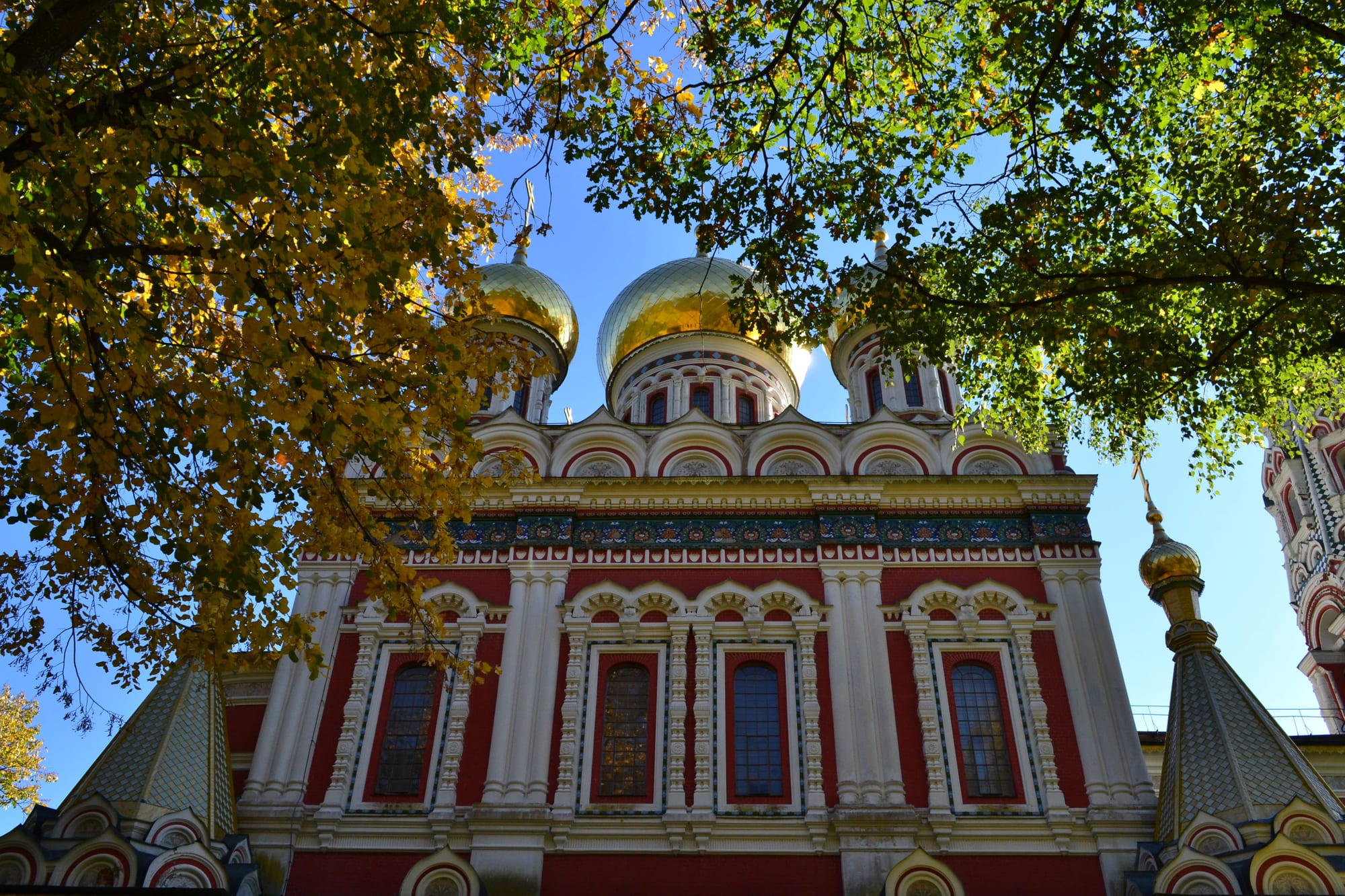
Gilded onion domes and a red-and-white church facade seen through autumn leaves against a clear blue sky

Bulgaria

The Valley of the Roses & the Southeast

The Shipka Memorial Church above the town of Shipka, at the northern edge of the Kazanlak valley. (Mralanorth / Wikimedia Commons · CC BY-SA 4.0)

The southeastern interior of Bulgaria, from the rose fields and Thracian burial mounds of the Kazanlak valley below the Balkan range to the plain around Stara Zagora and the Tundzha valley towns of Sliven and Yambol — a region of rose oil, royal Thracian tombs, Revival-era mountain villages and industrial power stations.

Explore The Valley of the Roses & the Southeast

History

The valley below the Balkan range was a heartland of the Thracian Odrysian kingdom. In the late 4th century BC King Seuthes III founded Seuthopolis near Kazanlak, and his people buried their rulers in the burial mounds that dot the valley; the town now lies under the Koprinka reservoir, and a bronze head of Seuthes was found in the Golyama Kosmatka mound in 2004. The painted Kazanlak tomb was discovered by soldiers digging a trench in 1944. Further east, Kabile near Yambol was a Thracian town and later a Roman garrison.

Rome built Augusta Traiana on the site of Stara Zagora, whose history as a settlement goes back to Neolithic villages of around 6000 BC. Under the Ottomans, the Kazanlak valley became a centre for growing the Damask rose and distilling its oil. Sliven and Kotel were strongholds of haiduks, the rebels of the Balkan range, and the Revival produced leaders such as Georgi Rakovski of Kotel and Hadzhi Dimitar of Sliven. In the 1830s Dobri Zhelyazkov opened a textile factory in Sliven, the first in Bulgaria.

In the Russo-Turkish war of 1877, Stara Zagora was burned, and the battles for the Shipka Pass were fought above Kazanlak. Rebuilt on a grid plan, Stara Zagora grew into a regional capital; under communism the Maritsa Iztok coal and power complex was developed on the plain, and the Buzludzha monument was built for the Communist Party in 1981.

Culture & Customs

The rose shapes the identity of Kazanlak. At harvest time pickers gather the blossoms early in the morning, when the oil content is highest, and the Rose Festival brings a queen of roses, parades, folk dance and ritual rose-picking into the town. Kazanlak also has a museum of the rose industry.

Stara Zagora calls itself a city of linden trees, poets and opera; it has a long-established opera house and theatre, and it honours poets such as Geo Milev, who was born nearby. Sliven has a tradition of textiles, and Kotel has long been a centre of carpet making, with a museum devoted to the craft. Villages across the Tundzha valley keep folk customs and costumes, and the region has a notable Roma community, especially in Sliven.

Religion is overwhelmingly Orthodox, and the memorial church at Shipka, with its golden Russian-style domes, is a place of remembrance for the soldiers of 1877.

Daily Life

Stara Zagora, with about 120,000 people, is the region's largest city and a university and medical centre. Sliven has around 80,000 people, Yambol about 60,000 and Kazanlak around 45,000. The towns are prosperous by the standards of provincial Bulgaria, thanks partly to industry: the Maritsa Iztok complex on the plain near Galabovo produces a large share of the country's electricity from lignite, while Kazanlak has engineering and defence plants and the rose-oil distilleries.

The coal plants face an uncertain future as the European Union's climate rules tighten, and their workers are a significant political concern. Farming on the plain produces wheat, sunflowers, vegetables and grapes, and the Tundzha valley around Yambol is an agricultural district.

Daily life follows the Bulgarian pattern: coffee on the main squares, long lunches, and evenings in parks and pedestrian streets such as Stara Zagora's leafy centre.

Food

The rose flavours the local table. Rose jam is made from fresh petals and sugar, and rose water, rose liqueur and rose-flavoured lokum, a soft jelly sweet, are sold in Kazanlak shops.

The everyday cooking is Thracian lowland food: grilled meat, kavarma stews baked in clay pots, peppers stuffed with rice and minced meat, and banitsa for breakfast. The Tundzha valley and the plain grow tomatoes, peppers and fruit for lyutenitsa and preserves, and lamb is roasted whole on the spit for village feasts.

Wine is important here. Vineyards around Stara Zagora, Sliven and Yambol produce reds such as Merlot, Cabernet Sauvignon and the local Pamid, and several wineries offer tastings. Stara Zagora is home to the Zagorka brewery, and rakia made from grapes or plums is distilled across the region.

Attractions & Natural Wonders

Kazanlak is the centre of the region's attractions: the Rose Museum, the replica of the Thracian tomb beside the original, and the Iskra historical museum with finds from the valley. The Valley of the Thracian Kings spreads across the surrounding fields, with the Golyama Kosmatka and Shushmanets tombs among them. To the north, the Shipka Memorial Church stands above the town of Shipka on the road to the Shipka Pass, and the flying-saucer shape of the Buzludzha monument sits on a nearby peak.

Stara Zagora has the remains of Augusta Traiana's forum and theatre, the Neolithic Dwellings museum with some of Europe's best-preserved prehistoric houses, and the Eski Mosque with its old wall paintings.

Sliven lies beneath the Sinite Kamani nature park, with a chairlift up to the Karandila plateau and paths among blue-grey rocks. In the hills to the east, Kotel and Zheravna have wooden Revival houses and craft traditions. Yambol has the Ottoman covered market, the Bezisten, and the ruins of Kabile a short drive away.

Cities in The Valley of the Roses & the Southeast

Planning basics

Budget

The region is among the cheapest in Bulgaria and sees few foreign visitors outside Kazanlak. Accommodation and meals in Stara Zagora, Sliven and Yambol cost well below Sofia or the coast; rooms in Kazanlak fill and rise in price during the Rose Festival, and village guesthouses in Zheravna and Kotel are simple and inexpensive.

Daily Budget Midrange
USD 65–110 (mid-range hotel, restaurants, a hire car for the tombs and villages)
Daily Budget Shoestring
USD 35–50 (guesthouse, mehana meals, buses and trains)

Book Kazanlak rooms well ahead for the festival weekend, or stay in Stara Zagora and travel in for the day.

Safety

The region is safe and low-key. Petty theft is uncommon, but crowds at the Rose Festival bring pickpocketing, and some rural roads are poorly surfaced. The Shipka and other Balkan passes can be icy and foggy in winter. The Buzludzha monument is an unstable building that should not be entered unless officially opened.

Drive the mountain passes in daylight in winter and respect closures at Buzludzha. Check current official travel advice before travelling.

Climate

The Kazanlak valley lies between the Balkan range and the lower Sredna Gora, which shelter it and give it the mild spring that suits the roses. The plain around Stara Zagora and Yambol is hot in summer, and Sliven is known for strong winds sweeping down from the mountains. Winters are cold, with snow in the foothills and on the Balkan passes.

Summer
hot, 30–35°C on the plain; slightly cooler in the Kazanlak valley
Winter
cold, around -3 to 5°C, with fog on the plain and snow in the mountains

Transportation

Stara Zagora lies close to the Trakia motorway, about three hours from Sofia by road, and on the main railway to Burgas. A second line runs along the foot of the Balkan range through Kazanlak and Sliven. Buses connect Kazanlak, Stara Zagora, Sliven and Yambol, and the road north from Kazanlak climbs over the Shipka Pass. The tombs, Buzludzha and villages such as Zheravna are easiest by car.

Pair Kazanlak with Veliko Tarnovo over the Shipka Pass, and allow a full day for the Thracian tombs and museums.

Best Time to Visit

Late May and early June for the rose harvest, when the fields are picked at dawn and Kazanlak holds its festival; this is the busiest time of the year. May, September and October are also good for the Thracian tombs and Stara Zagora, while July and August are hot on the plain. Winter is quiet, and snow can close the pass roads over the Balkan range.