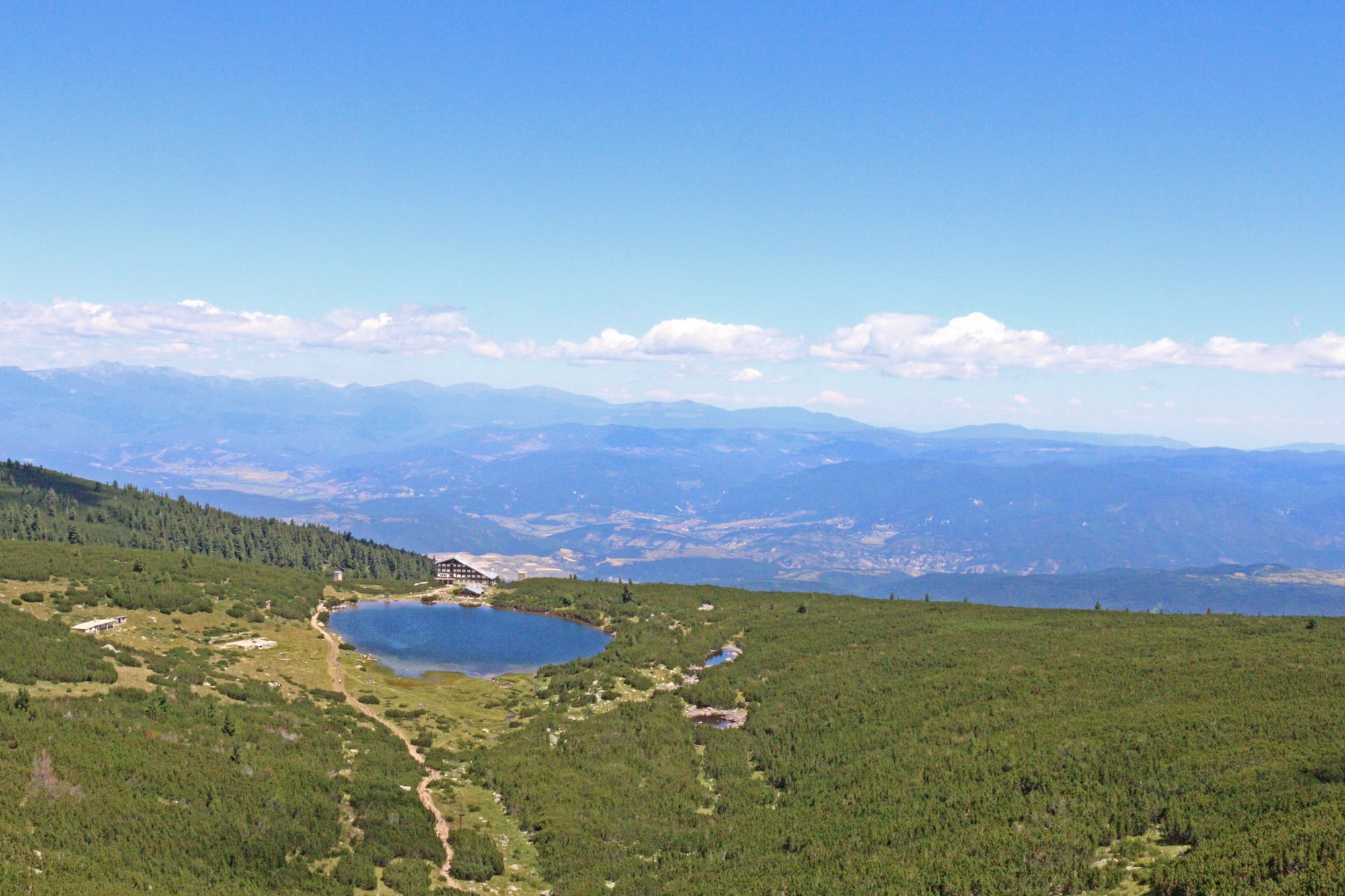
A small blue mountain lake with a hut beside it, set among dwarf pine slopes, with rows of hazy mountain ridges stretching to the horizon

Bulgaria

Sofia, Rila & the West

Bezbozhko Lake and its mountain hut in Pirin National Park, with the ranges of southwest Bulgaria beyond. (Charles J. Sharp / Wikimedia Commons · CC BY-SA 4.0)

Western Bulgaria, from the capital Sofia beneath Vitosha south through the Rila and Pirin mountains to the warm Struma valley, and north across the Balkan range to the Danube at Vidin — a region of monasteries, high glacial lakes, ski resorts, wine country and a thinly peopled northwest.

Explore Sofia, Rila & the West

History

Thracian tribes held these valleys before Rome made Serdica, at the foot of Vitosha, a major city of the province of Dacia. The Emperor Galerius issued his Edict of Toleration for Christians there in 311, and the Council of Serdica met in 343. Slavs settled the region from the 6th century, and the city, renamed Sredets, passed to the First Bulgarian Empire in 809. On the Danube, Vidin grew into a stronghold of the Second Empire and in the 14th century the capital of a separate Tsardom of Vidin under Ivan Sratsimir, the last Bulgarian state to fall to the Ottomans, in 1396. Near Kyustendil, the Serbs defeated the Bulgarians at the Battle of Velbazhd in 1330.

In the 10th century the hermit Ivan of Rila withdrew into the Rila mountains, and the monastery that grew around his memory became the country's spiritual centre; its Hrelyo Tower dates from 1335, but the rest was rebuilt after a fire in 1833. Under Ottoman rule Sofia was a provincial capital, while Bansko produced merchants and churchmen of the National Revival. In 1876 the poet Hristo Botev crossed the Danube with a band of rebels and was killed in the Vratsa Balkan.

Sofia became the capital of the new Bulgarian state in 1879 and grew from a small town into a city of boulevards and ministries. The Pirin area, around Blagoevgrad (then Gorna Dzhumaya), joined Bulgaria in the Balkan Wars of 1912–13. Communism brought coal and steel to Pernik and a nuclear power station to Kozloduy; since 1989 Sofia has boomed while the northwest has lost much of its population.

Culture & Customs

The countryside around Sofia, Pernik and Kyustendil is Shopluk, home of the Shopi, known across Bulgaria for their own dialect, dry humour and fast, stamping horo dances. The Pernik area holds the country's great masquerade tradition: each January the Surva festival brings kukeri and survakari in fur, masks and bells into the town, and the Surova folk feast of the Pernik region is inscribed as UNESCO intangible heritage.

The Pirin area has its own music, sung in a style closer to that of the wider Macedonian region, and Bansko keeps its heritage as a Revival-era town with stone houses behind high walls and a strong sense of its famous sons, among them the poet Nikola Vaptsarov. Rila Monastery remains a working community of monks and a place of pilgrimage, busiest on the feast of St Ivan of Rila in August and October.

Sofia itself is the country's intellectual and political centre: its university, theatres and galleries, a lively café culture and a growing restaurant and craft-beer scene set it apart from the rest of the region. In the northwest, Vlach communities along the Danube keep a Romanian-related speech and customs, and villages mark the old calendar feasts that have faded in the cities.

Daily Life

Sofia has roughly 1.3 million people and dominates everything: government, universities, most foreign investment and a large IT and outsourcing sector, with a metro that has grown since 1998 and suburbs spreading up the slopes of Vitosha. Pernik, once the coal town next door, is now partly a commuter satellite. Blagoevgrad, with about 65,000 people and two universities, is the young, lively centre of the southwest; Kyustendil, Dupnitsa, Sandanski and Petrich are smaller market and spa towns, and Bansko swells each winter with skiers and seasonal workers.

The northwest is the other extreme. Vidin, Vratsa and Montana have each shrunk since 1989, factories have closed, and incomes are low. The Kozloduy nuclear power plant, Bulgaria's only one, still operates on the Danube. Many villages are left with only elderly residents, and depopulation, not crime or politics, is the daily reality.

The rhythm in Sofia is urban and fast, with long commutes and weekend escapes to Vitosha or a village house; elsewhere mornings start early, lunch is substantial, and evenings are spent over coffee or a drink in the main square.

Food

Bulgaria's best-known dish, shopska salata, is named after the Shopi, and the cooking around Sofia is plain and hearty: bean soup (bob chorba), grilled kebapche and kyufte, and banitsa, the cheese-filled filo pastry, bought warm for breakfast with a cup of boza, a thick, slightly sour fermented grain drink.

The mountain towns eat for the cold. Bansko is known for kapama, meats, sausages and sauerkraut layered with rice and slow-cooked for hours in a sealed clay pot, and its mehanas serve roast lamb and pork from wood-fired ovens. Kyustendil, called the orchard of Bulgaria, is famous for cherries and apples, and Danube towns such as Vidin serve fish soup and fried carp and catfish.

Wine is the region's specialty in the far southwest. Around Melnik and Sandanski grows Shiroka Melnishka Loza, the broad-leaved Melnik vine, which gives dense, long-lived reds that are aged in cellars cut into the sandstone; newer estates along the Struma also make international varieties. In the northwest, Gamza is the traditional red grape. Rakia is distilled everywhere, and mountain honey and herbal teas from Rila and Pirin fill market stalls.

Attractions & Natural Wonders

Sofia's centre is compact: the gold-domed Alexander Nevsky Cathedral, the 4th-century Rotunda of St George in a courtyard of ministries, the excavated streets of Serdica around the Serdika metro station, the Banya Bashi Mosque and the Central Mineral Baths, and the National Archaeological Museum. At the foot of Vitosha, Boyana Church, a UNESCO World Heritage Site, holds frescoes painted in 1259, and the mountain above the city has trails and a small ski area.

South of the capital, Rila Monastery sits in a forested valley with its striped arcades and painted church. Higher in the Rila range are the Seven Rila Lakes, Musala, the highest peak in the Balkans, and the ski resort of Borovets. Further south, Bansko is the gateway to Pirin National Park, a UNESCO World Heritage Site of marble and granite peaks, glacial lakes and old pines, rising to Vihren. In the Struma valley, Melnik's wine cellars and houses stand among the eroded sand pyramids, with Rozhen Monastery nearby, and Sandanski is a spa town with a mild climate. Kyustendil has Roman baths and thermal springs.

In the northwest, the Belogradchik Rocks are towers of red sandstone up to around 200 metres tall, with a fortress built into them; nearby, Magura Cave holds prehistoric paintings in bat guano. Vidin's Baba Vida fortress guards the Danube, and the Vratsa Balkan has the Vratsata gorge and Ledenika Cave.

Cities in Sofia, Rila & the West

Planning basics

Budget

Sofia is the most expensive city in Bulgaria, though still cheap by Western European standards, and Bansko's hotels and lift passes rise sharply in the ski season. The northwest around Vidin, Vratsa and Montana, and the small towns of the Struma valley, are among the cheapest places in the European Union to stay and eat.

Daily Budget Midrange
USD 85–160 (mid-range hotel in Sofia or Bansko, restaurants, a hire car or day tours)
Daily Budget Shoestring
USD 40–65 (hostel or guesthouse, mehana meals, buses)

Visit Bansko outside the ski season for much lower prices, and use Sofia's metro rather than taxis for the airport and centre.

Safety

The region is safe. Pickpocketing is the main urban risk, around Sofia's central stations, markets and trams, along with overcharging taxis at the airport. In the mountains the hazards are weather, sudden summer storms and avalanches in winter, and the Rila and Pirin trails are long and high. Roads in the northwest are often poorly surfaced.

Use marked taxis or an app in Sofia, check mountain weather and hut availability before high walks, and stay on marked pistes in Bansko. Check current official travel advice before travelling.

Climate

Sofia sits on a high plain at about 550 metres, so its winters are colder and snowier than the lowland average and its summers rarely oppressive. The Rila and Pirin mountains hold snow from December to April and stay cool in summer. In the south the Struma valley around Sandanski and Melnik has a Mediterranean touch, with some of the warmest weather in the country, while the Danube plain in the northwest is continental, with hot summers and cold, windy winters.

Summer
warm in Sofia, 25–30°C; hotter on the Danube and in the Struma valley, often above 32°C; cool in the mountains
Winter
cold, around -4 to 3°C in Sofia and the northwest; heavy snow in Rila and Pirin; milder around Sandanski

Transportation

Sofia's airport and central stations are the hub for the whole region. Buses reach Bansko in about three hours and Blagoevgrad, Sandanski and Kyustendil in two or less; a narrow-gauge railway winds slowly up to Bansko from the Plovdiv side. Rila Monastery is about two hours from Sofia by road, with bus and tour connections from the capital. The northwest is reached by the slow train or bus to Vratsa, Montana and Vidin, where a road-and-rail bridge crosses the Danube to Romania. A car makes Melnik, Belogradchik and the mountain trailheads far easier.

Allow a full day for Rila Monastery from Sofia, and combine Belogradchik with Vidin rather than attempting it as a day trip from the capital.

Best Time to Visit

July to September for high walking in Rila and Pirin, when the Seven Rila Lakes and the Pirin huts are open and the trails snow-free. May, June, September and October suit Sofia, Rila Monastery and the northwest; September and October bring the grape harvest around Melnik. December to April is the ski season at Bansko and Borovets, and the Surva masquerade festival fills Pernik in late January.