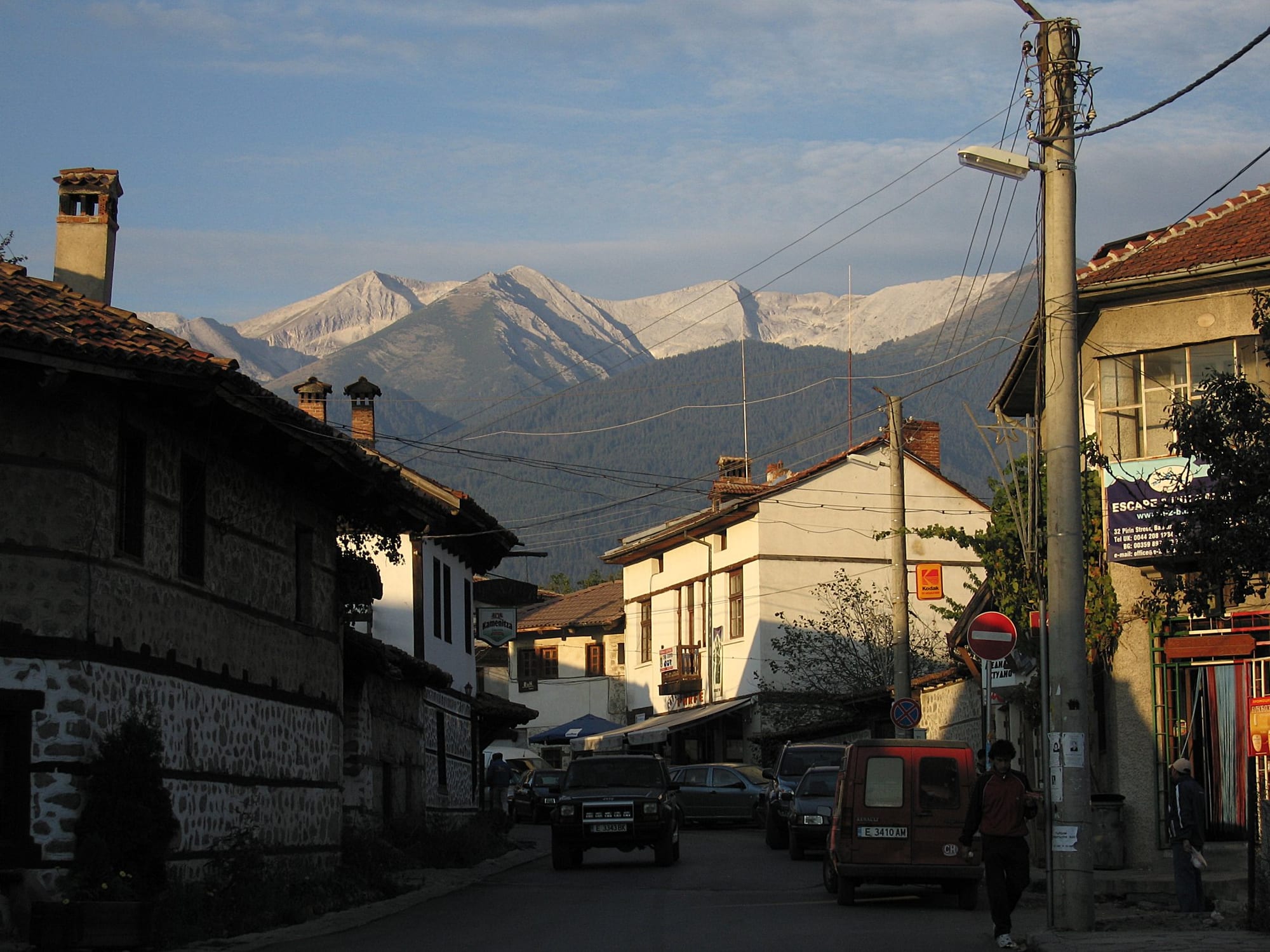
A street of old stone and whitewashed houses in Bansko leading towards snow-streaked Pirin peaks in evening light

Sofia, Rila & the West, Bulgaria

Bansko

Houses in Bansko with the Pirin Mountains behind. (Christian Koehn (fragwürdig) / Wikimedia Commons · CC BY-SA 3.0)

A small town at the foot of the Pirin Mountains in south-western Bulgaria, once a community of stockbreeders and travelling merchants and a centre of the 19th-century National Revival. Its stone-walled old quarter now sits beside the largest ski resort in the Balkans, reached by a gondola from town, and Bansko has also become a base for digital nomads.

Neighbourhoods

  • Old Town
    • Historic district
    • First-time visitors
    • Best for food

    Narrow cobbled streets of traditional stone houses, many behind high walls, around the Holy Trinity Church and the house museums. The town's mehanas, the traditional taverns, are concentrated here, and the free jazz festival takes over the central square each August.

    Open in Maps
  • Around the gondola
    • Skiing
    • Close to the slopes

    The newer, busier side of town around the lower station of the gondola, built in 2003 to carry skiers up to the base area at Banderishka Polyana. Cafés, ski hire shops and modern bars line the main roads, and the area fills in the ski season.

    Open in Maps

Things to do

The Revival-era town

  • Holy Trinity Churchlandmark

    The town's Orthodox church, consecrated in 1835 and built and painted with money and labour raised by the local community; its bell tower was added in 1850 and a clock in 1865.

    Open in Maps
  • Velyan's Housemuseum

    A historic house in the old quarter, open to visitors.

    Open in Maps
  • Neofit Rilski House-Museummuseum

    The house-museum of the monk, teacher and artist Neofit Rilski, one of the town's best-known names.

    Open in Maps
  • Nikola Vaptsarov House-Museummuseum

    The house of the poet and revolutionary Nikola Vaptsarov, now a museum to him.

    Open in Maps

Mountains and slopes

  • Bansko ski areaattraction

    The ski area on Todorka, reached by gondola from the town, with about 75 km of runs, a lift-served summit at about 2,600 metres and runs all the way back down to town.

    Open in Maps
  • Pirin National Parkpark

    A UNESCO World Heritage Site covering most of the Pirin Mountains, with 118 glacial lakes, the southernmost small glaciers in Europe and the summit of Vihren.

    Open in Maps
  • Vihrentrail

    At 2,914 metres the highest peak of Pirin and the second highest in Bulgaria, rising south-west of the town and reached on marked trails through the national park.

    Open in Maps

Short trips from the town

  • Septemvri–Dobrinishte narrow-gauge linetransit hub

    The only operating 760 mm narrow-gauge line in Bulgaria, known as the Alpine railway in the Balkans, winding through the mountains from Septemvri to Dobrinishte, with Bansko near the end of the line.

    Open in Maps
  • Banyaattraction

    A village about 5 km away known for its 27 thermal mineral springs.

    Open in Maps

Seasonal events

  • Bansko Jazz FestivalAugust

    An international jazz festival held since 1997 on an open-air stage in the town centre, free to the public.

  • Bansko Nomad Festlate June

    One of the largest gatherings of digital nomads, held in the last week of June each year.

  • Horizon FestivalMarch

    A British underground dance music festival staged in the town.

Eat and drink

Long-standing places and food districts in Bansko. Hours, ratings and directions come from your maps app, always current.

Bansko classics

  • Mehanas of the old townrestaurant

    Traditional taverns serving lamb specialities and Bansko kapama, meats and sauerkraut slow-baked with rice in a sealed clay pot.

    Open in Maps

Cafés and bars

  • Cafés and bars on the main roadsneighborhood

    Cafés and modern bars along the main roads between the old quarter and the gondola, busiest in the ski season.

    Open in Maps

Experience Bansko

History

People were living and worshipping here long before the town took shape: about 2 km south-west of Bansko, at a place called Shipotsko, lie the remains of a church built at the end of the 4th or start of the 5th century, probably over an earlier Thracian site, with a cemetery of more than 150 graves. The church was destroyed in the 6th century, rebuilt after the 12th and destroyed again by the Ottomans.

Under Ottoman rule Bansko grew into a community of stockbreeders and travelling merchants who traded far beyond the Razlog valley, kept close ties with Rila Monastery in the 18th and 19th centuries, and became, in the 19th century, the centre of Bulgarian national life in the district. The townspeople raised the money, materials and labour for the Holy Trinity Church, consecrated in 1835, and around 1850 founded a Bulgarian Orthodox community that led the struggle in the 1860s and 1870s for a church independent of the Greek hierarchy and for Bulgarian schools. The first Protestant church in Bulgaria was founded here on 6 August 1868. Statistics from 1873 count about 2,700 Bulgarian inhabitants.

Bansko stayed under Ottoman rule after 1878 and was taken by Bulgaria only on 5 October 1912, in the Balkan War, with the help of volunteer bands led by Yonko Vaptsarov, Peyo Yavorov and others; two days later the poet Peyo Yavorov told the townspeople to throw away their fezzes, for they were now free Bulgarians. Tourism remade the town in the late 20th century: a gondola from the streets to the slopes opened in 2003, women's World Cup ski races were held here in 2009, and since the 2010s remote workers have settled here in numbers.

Culture & Customs

Bansko keeps the look of a Revival-era town, its stone houses set behind high walls along narrow cobbled lanes, and a strong sense of its famous names. Neofit Rilski, monk, teacher and artist, and the poet and revolutionary Nikola Vaptsarov have house museums in the town, and its schools are named after Paisius of Hilendar, author of the Istoriya Slavyanobolgarskaya, Neofit Rilski and Vaptsarov, all counted among its notable people.

The town has made a name for itself as a jazz venue: the Bansko Jazz Festival has been held every August since 1997 on an open-air stage in the centre, free for anyone who comes. The Mountaineer film festival, an annual pop concert and, in March, the British dance festival Horizon fill out the calendar.

The town's identity now has two sides. In winter it is a busy international ski resort, with its own crowds and late nights; for the rest of the year it is a quieter mountain town, and each year in the last week of June the Bansko Nomad Fest celebrates the community of foreign remote workers that has grown up here, drawn by low costs and the mountains.

Daily Life

About 10,200 people lived in Bansko at the end of 2025. Tourism dominates the economy: hotels, restaurants, ski schools, hire shops and the ski area employ much of the town, and the population swells each winter with skiers and seasonal workers. The ski area on Todorka has been improved year after year to handle growing numbers, and the digital nomads, who come with less seasonal rhythm than the skiers, help fill the town outside the winter months.

The town lies at about 925 metres in the valley of the Mesta (Nestos) River, near the town of Razlog, with the spa village of Banya only about 5 km away. Daily life moves between the old quarter, where families still live in the stone houses, and the newer district of apartments and hotels near the gondola.

Mornings in the ski season start early and revolve around the gondola queue; in summer, life shifts to the mountain trails, the cafés of the main roads and the evening walk through the old town.

Food

Bansko eats for the cold. Its signature dish is Bansko kapama, meats, sausages and sauerkraut with rice, baked for several hours in a clay pot sealed with dough, and the town's mehanas, the traditional taverns, serve lamb specialities. Like the rest of Bulgaria, meals usually begin with a salad such as shopska, diced tomato, cucumber and pepper under grated white sirene cheese, and a glass of rakia, the fruit brandy.

Everyday Bulgarian dishes fill out the menus: banitsa, the layered filo pastry with cheese and egg, grilled minced-meat kebapche and kyufte, stuffed peppers, and vegetable stews cooked in clay pots, known as gyuvech. Yoghurt, eaten in great quantities across Bulgaria, is a staple.

The wider south-west supplies the wine list. The Struma valley around Melnik grows Shiroka Melnishka, the broad-leaved vine of Melnik, a red grape whose wines are often compared to Châteauneuf-du-Pape for their spice and power. In the ski season the cafés and modern bars along the main roads serve international food alongside the taverns.

Planning tools

Budget

Bansko is cheap outside the ski season, when rooms and meals cost much less than in Western European resorts. In winter prices rise, and the town is busiest during English school holidays.

Daily Budget Midrange
USD 85–160 (mid-range hotel, tavern dinners, a lift pass or day hikes)
Daily Budget Shoestring
USD 40–65 (guesthouse room, mehana meals, buses)

Visit outside the ski season for much lower prices, and avoid English school holidays and World Cup race weeks in winter.

Best Time to Visit

December to April is the ski season, when snow covers the Pirin and the town is at its busiest. July to September is the season for high walking in Pirin National Park, when the trails are free of snow. August brings the jazz festival; late spring and autumn are quiet and cheap.

Suggested Number of Days

The old town can be seen in a day or two. Most visitors stay longer, for a week of skiing in winter or several days of mountain walking in summer, and the weather in the mountains often decides how long.

First Visit
1–2 days
With Surroundings
4–7 days

Transportation

The old town and the gondola station are within walking distance of each other. Buses link Bansko with Razlog, Blagoevgrad, Gotse Delchev, Plovdiv and Sofia, and the narrow-gauge railway stops at the town.

In the ski season the morning gondola queue often takes about an hour, so join it early, especially before a lesson.

Airport & Station Connections

Bansko is about 160 km from Sofia, with many buses a day from the capital; Sofia Airport is the usual arrival point for foreign visitors. Thessaloniki in Greece is about 220 km away. The slow narrow-gauge railway from Septemvri, on the Sofia–Plovdiv line, is the scenic alternative.

Walkability

Compact and easy on foot. The cobbled lanes of the old town are made for walking, and the gondola, the shops and most places to stay are a short walk away; the cobbles are uneven and can be icy in winter.

Safety

Bulgaria is a safe country for visitors, with low levels of violent crime. In Bansko the main hazards are in the mountains: sudden summer storms, avalanches in winter, and long, high trails in Pirin.

Stay on marked pistes, check mountain weather and hut availability before high walks, and carry warm layers even in summer. Check current official travel advice before travelling.

Climate

At about 925 metres, Bansko is cooler than the lowlands. The Pirin and Rila mountains hold snow from December to April and stay cool in summer, when sudden afternoon storms can build over the peaks.

Summer
mild, with a continental mountain climate; on the high plain around Sofia summer days reach 25–30°C, while the Pirin slopes stay cool, with afternoon storms
Winter
snowy, with snow lying from December to April; around Sofia winter days run from about -4 to 3°C, and heavy snow falls on the Pirin slopes

Local Customs

Tips are not added to the bill, and 5–10 per cent is usual where service is good. Bulgarians often shake the head for 'yes' and nod for 'no'. The town is proud of its Revival-era figures, whose names are on its schools and museums.

Dress modestly in the Holy Trinity Church, and ask before photographing inside it.

Common Payment Methods

The currency is the euro, which replaced the lev on 1 January 2026. Cards are accepted in hotels, ski shops and most restaurants; carry some cash for small taverns, taxis and village shops.