History
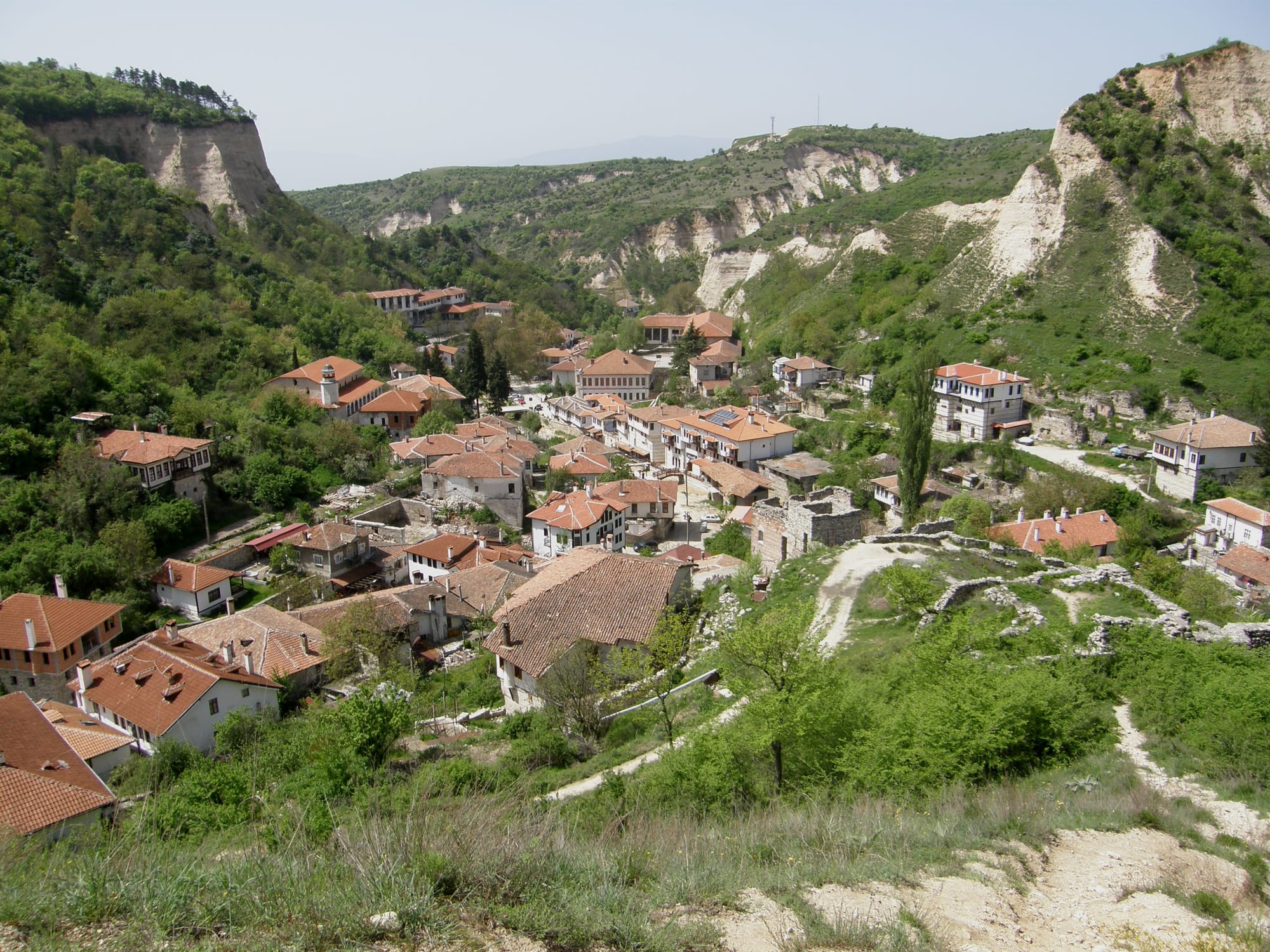
The first known settlers here were the Medi, the Thracian tribe to which Spartacus belonged, and the Romans left a bridge that still stands. The region took in Greek culture and became part of the Byzantine Empire, and the Slavs who arrived later named the place Melnik after the sand formations around it, from mel, 'white clay' or 'chalk'. It became part of the First Bulgarian Empire under Khan Presian I (836–852). In 1209 Melnik became the capital of an independent principality under Despot Alexius Slav, a descendant of the Asen dynasty, and prospered again under Tsar Ivan Asen II thanks to duty-free trade with Dubrovnik.
The Ottoman conquest brought a long decline, but in the 17th and 18th centuries Melnik grew rich on tobacco and wine, exporting wine to England and Austria, and became a centre of church decoration and woodcarving. In the late 18th century it had some 1,300 houses, seventy churches and about 20,000 people, but a fire destroyed much of it. Russian troops took it in the Russo-Turkish War of 1877–78, but the Treaty of Berlin returned it to Ottoman rule, and it remained the centre of a district of the Sanjak of Serres until 1912.
In 1900 most of its inhabitants were Greeks, alongside Turks, Bulgarians, Roma and Vlachs. The town joined Bulgaria during the Balkan Wars, and in 1913, when it was known that Melnik would be ceded to Bulgaria, the Greek population left on the orders of the Greek government, mostly for Sidirokastro. The town never recovered its numbers. It was declared a 'town-museum' for its architecture in 1968, and Yuri Trifonov made it the subject of his 1967 story 'The Smallest Town on Earth'.