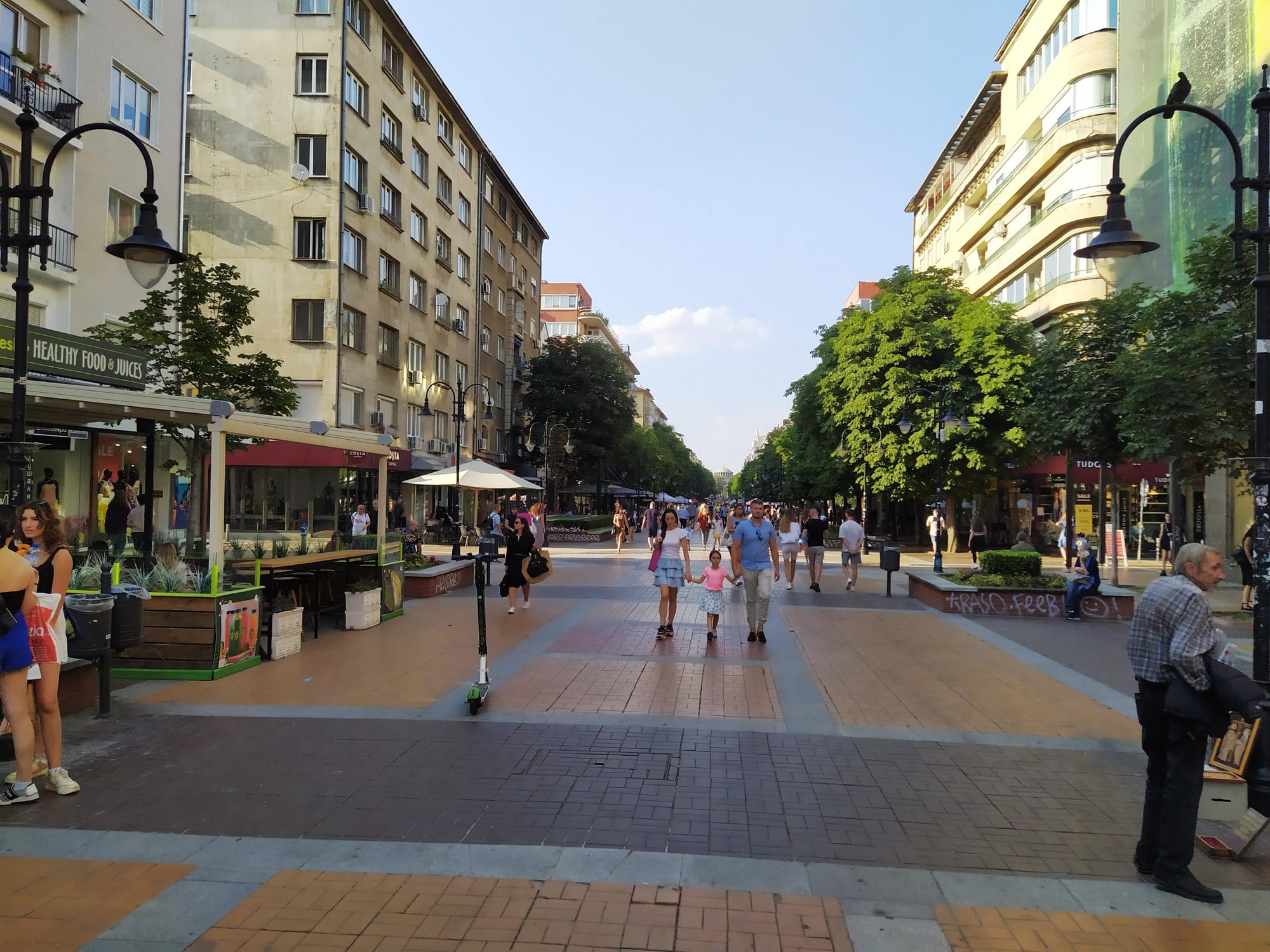
Pedestrians walking along paved, tree-lined Vitosha Boulevard between apartment blocks and café terraces on a sunny day

Sofia, Rila & the West, Bulgaria

Sofia

Vitosha Boulevard, the pedestrian shopping street in central Sofia. (Radosław Botev / Wikimedia Commons · CC BY 3.0 pl)

Bulgaria's capital and largest city, on a high plain at the northern foot of Vitosha mountain. Roman Serdica, medieval Sredets and an Ottoman provincial capital, it was chosen as the capital of the new Bulgarian state in 1879; today Roman ruins, Orthodox churches, a mosque and a synagogue stand among broad boulevards, communist-era estates and new glass office districts.

Neighbourhoods

  • City centre
    • First-time visitors
    • Historic district
    • Close to public transport

    The old core around the Largo and Nezavisimost Square, built over the Roman city, with the Rotunda of St George, the Serdika metro stations and the ministries, and streets paved in yellow bricks. Vitosha Boulevard runs south from here as a pedestrian street of cafés, restaurants and shops towards the National Palace of Culture.

    Open in Maps
  • Oborishte
    • Quiet and residential
    • Parks
    • Close to the sights

    The district east of the centre around the Alexander Nevsky Cathedral and the Doctors' Garden, with embassies and older apartment buildings on leafy streets.

    Open in Maps
  • Boyana
    • Museums
    • Mountain walks
    • Quiet and residential

    A district on the outskirts of Vitosha, 8 km south of the centre, home to the medieval Boyana Church and the National History Museum, and a starting point for walks up the mountain.

    Open in Maps
  • Mladost
    • Local life
    • Close to public transport

    One of the large residential estates built on the outskirts during the communist period, now also home to office developments such as Business Park Sofia, reached by the metro's southern branch.

    Open in Maps

Things to do

Churches, mosque and synagogue

  • Alexander Nevsky Cathedrallandmark

    The gold-domed cathedral, built mainly between 1904 and 1912 to honour the Russian soldiers who died in the Russo-Turkish War of 1877–78, one of the symbols of Bulgaria; its crypt holds a branch of the National Gallery.

    Open in Maps
  • Rotunda of St Georgelandmark

    A 4th-century brick rotunda standing in a courtyard among the government buildings of the centre, turned into a mosque under the Ottomans and now a church again.

    Open in Maps
  • Saint Sofia Churchlandmark

    The church that gave the city its name, first built in the 4th century; the Ottomans turned it into a mosque.

    Open in Maps
  • Sveta Nedelya Churchlandmark

    An Orthodox church on the square of the same name, one corner of the 'triangle of religious tolerance' formed with the nearby mosque and synagogue.

    Open in Maps
  • Banya Bashi Mosquelandmark

    An Ottoman mosque built by the architect Mimar Sinan, near the Central Mineral Baths.

    Open in Maps
  • Sofia Synagoguelandmark

    The synagogue a short walk from the mosque and Sveta Nedelya, completing the city's 'triangle of religious tolerance'.

    Open in Maps
  • Boyana Churchlandmark

    A small medieval church at the foot of Vitosha, a UNESCO World Heritage Site since 1979, whose frescoes show more than 240 human figures in 89 scenes.

    Open in Maps

Museums and landmarks

  • Sofia Central Mineral Bathsmuseum

    The former public baths over the city's mineral springs, now home to the Sofia History Museum.

    Open in Maps
  • National Archaeological Museummuseum

    Archaeological collections displayed in a former mosque between the National Bank and the Presidency.

    Open in Maps
  • National History Museummuseum

    In Boyana, a collection of more than 650,000 objects from prehistory to the modern era, about 10,000 of them on permanent display.

    Open in Maps
  • Museum of Socialist Artmuseum

    Sculptures and posters that show how life in communist Bulgaria was presented.

    Open in Maps
  • Earth and Man National Museummuseum

    One of the biggest mineralogical museums in the world, displaying minerals and rare materials.

    Open in Maps
  • National Palace of Culturelandmark

    The large congress and concert centre on Vitosha Boulevard, one of the major concert venues of the capital.

    Open in Maps

Parks and the mountain

  • Borisova Gradinapark

    The oldest and best-known park in Sofia, home to the national stadium.

    Open in Maps
  • Doctors' Gardenpark

    A park between Oborishte and Shipka streets, named after its monument to the medics who died in the Russo-Turkish War of 1877–78.

    Open in Maps
  • Vitoshatrail

    The mountain that rises straight above the city's southern districts, most of it within Vitosha Nature Park, the oldest national park in the Balkans, with hiking trails and skiing.

    Open in Maps

Markets

  • Central Sofia Market Hallmarket

    Halite, the covered market opened in 1911 on Maria Luiza Boulevard.

    Open in Maps
  • Women's Marketmarket

    A market near Pirotska Street, served by tram 3.

    Open in Maps

Music, sport and nights out

  • Ivan Vazov National Theatreattraction

    Bulgaria's national theatre, the oldest and most authoritative in the country, in the centre of the city facing the City Garden.

    Open in Maps
  • National Opera and Balletattraction

    The opera and ballet company founded in 1891, where singers such as Nicolai Ghiaurov and Ghena Dimitrova made their first appearances.

    Open in Maps
  • Vasil Levski National Stadiumattraction

    The 43,000-seat national stadium in Borisova Gradina, used for international football matches.

    Open in Maps

Short trips from the city

  • Rila Monasterylandmark

    Bulgaria's largest and most revered monastery, founded around the hermit Ivan of Rila in the 10th century, with a 14th-century tower and a 19th-century main church; a UNESCO World Heritage Site about 63 km south of the city.

    Open in Maps

Seasonal events

  • Sofia International Film FestivalMarch

    An annual film festival held in the city since 1997, the only one in Bulgaria recognised by the international film critics' federation FIPRESCI.

  • Baba Marta1 March

    On 1 March people exchange red-and-white martenitsa tokens for health and the coming of spring.

Eat and drink

Long-standing places and food districts in Sofia. Hours, ratings and directions come from your maps app, always current.

Sofia classics

  • Banitsa bakeriesrestaurant

    Bakeries all over the city sell banitsa, filo pastry layered with whisked eggs, yoghurt and white brined cheese, eaten for breakfast with yoghurt, ayran or boza.

    Open in Maps
  • Mehana diningrestaurant

    Traditional taverns serving shopska salad, bean soup, grilled kebapche and kyufte, with rakia to start the meal.

    Open in Maps

Food districts and markets

  • Central Sofia Market Hallmarket

    The covered market hall of 1911 on Maria Luiza Boulevard, known locally as Halite.

    Open in Maps
  • Women's Marketmarket

    A market near Pirotska Street, a short tram ride from the centre.

    Open in Maps
  • Vitosha Boulevardneighborhood

    The pedestrian street known as Vitoshka, lined with cafés, restaurants and terraces from the centre to the National Palace of Culture.

    Open in Maps

Experience Sofia

History

People have lived around the hot springs at the foot of Vitosha for about 7,000 years. The city takes its ancient name, Serdica, from the Serdi, a tribe of Thracian or Celtic origin, whom the Roman general Crassus subdued around 29 BC. Serdica became a municipium under the Emperor Trajan, a stop on the Via Militaris between Singidunum and Byzantium, and later the capital of the province of Dacia Mediterranea, with walls, baths, an amphitheatre and a large forum. The emperors Aurelian and Galerius were born here, and in 311 Galerius issued in Serdica the Edict of Toleration that ended the persecution of Christians.

Raided by Huns, Visigoths, Avars and Slavs as Roman power declined, the city was taken into the First Bulgarian Empire by Khan Krum in 809 and became Sredets. Byzantium ruled it from 1018 until 1194, and under the Second Bulgarian Empire it was a major administrative and literary centre. By the 14th century it was being called Sofia, after the Saint Sofia Church. The Ottomans took it after a siege in the 1380s, and from 1530 to 1836 it was the capital of Rumelia Eyalet, with Friday mosques, libraries and the largest covered market in the Balkans.

By the time Russian troops under Iosif Gurko entered on 4 January 1878, the population had fallen to 11,649. On 3 April 1879 Sofia was chosen as the capital of the new Bulgarian state, and it grew rapidly as migrants arrived from the countryside. Allied bombing in 1943–44 destroyed thousands of buildings, and from 1944 a communist government rebuilt the city and ringed it with large housing estates such as Druzhba, Mladost and Lyulin. After 1989 the old street names returned, and new business districts and glass office towers followed.

Culture & Customs

Sofia likes to call its centre the 'triangle of religious tolerance': Sveta Nedelya Church, the Banya Bashi Mosque and the Sofia Synagogue stand within a few minutes' walk of one another, and the gold domes of the Alexander Nevsky Cathedral rise nearby. The city is the seat of the government and of many of the country's universities and national institutions, and its cultural life is the busiest in Bulgaria. The Ivan Vazov National Theatre is the oldest and most authoritative theatre in the country, and the National Opera and Ballet, founded in 1891, launched singers such as Nicolai Ghiaurov and Ghena Dimitrova.

The National Gallery brings together the old royal palace, the foreign-art collection at Kvadrat 500 and a contemporary art space, while the Boyana Film studios, once the centre of the national film industry, now host international productions. The Sofia International Film Festival has filled the city's cinemas every March since 1997. Sofia was the European Capital of Sport in 2018, and football is followed with passion: CSKA, Levski, Lokomotiv and Slavia, clubs built up in the communist era, all play here, and their rivalries run through the city.

The countryside around the capital is Shopluk, home of the Shopi, who speak the Western Bulgarian dialects. On 1 March people pin red-and-white martenitsa tokens to one another's clothes for health and spring, and as elsewhere in Bulgaria a shake of the head often means 'yes' and a nod 'no'.

Daily Life

About 1.4 million people lived in the city in 2018, and about 1.5 million in the whole Sofia Capital Municipality. Sofia is the economic hub of Bulgaria, home to the National Bank, the stock exchange and most large Bulgarian and international companies, and it has the highest wages in the country. Its IT sector ranges from multinationals to startups, clustered in office parks such as Business Park Sofia and Sofia Tech Park. Sofia University, founded in 1888, the Technical University, New Bulgarian University and the Medical University make it the country's main student city.

Most residents live in apartment buildings: the older blocks of the centre and districts such as Oborishte, and the large estates of the communist decades on the outskirts. Car ownership grew rapidly in the 1990s, with more than a million cars registered in the city since 2002, traffic is heavy, and the metro, which opened in 1998 with five stations and now has four lines, has become the backbone of the daily commute.

Air pollution is the most discussed local problem: the mountains around the valley trap smog during winter inversions, and the European Commission has taken Bulgaria to court over it. At weekends many residents head up Vitosha, which rises straight above the southern districts, to walk in summer and ski in winter.

Food

Sofia eats much as the rest of western Bulgaria does, plainly and well. Breakfast is often banitsa from a neighbourhood bakery: filo pastry layered with whisked eggs, yoghurt and white brined cheese, baked and eaten hot or cold with yoghurt, ayran or boza, a thick, slightly sour fermented grain drink with very little alcohol. Shopska salad, diced tomato, cucumber and pepper under grated white sirene cheese, takes its name from Shopluk, the Shopi country around Sofia, and often starts a meal with a glass of rakia, the fruit brandy.

In the taverns known as mehanas the menu runs to bean soup (bob chorba), grilled minced-meat kebapche and kyufte, stuffed peppers and vegetable stews cooked in clay pots, with yoghurt on the side and Bulgarian red wine from the Thracian valley or the Struma valley around Melnik.

For produce, the Central Sofia Market Hall, opened in 1911 on Maria Luiza Boulevard and known simply as Halite, has stalls under one roof, while the Women's Market near Pirotska Street is its counterpart. Vitosha Boulevard, the main commercial street, is lined with shops, restaurants and bars.

Planning tools

Budget

Sofia is the most expensive city in Bulgaria, but still cheap by Western European standards. Hotels are the main cost; meals in bakeries and taverns, public transport and most museums cost little, and the metro makes the airport run inexpensive.

Daily Budget Midrange
USD 85–160 (mid-range hotel, restaurant dinners, museum tickets, taxis or a day tour)
Daily Budget Shoestring
USD 40–65 (hostel bed, banitsa and tavern meals, metro and trams)

Use the metro from the airport rather than a taxi, and note that the churches, parks, markets and the walk along Vitosha Boulevard cost nothing.

Best Time to Visit

May, June, September and October are the most comfortable months, warm but rarely oppressive. July and August bring occasional heatwaves and summer thunderstorms, and are the season for walks high on Vitosha. Winters are cold and snowy, with smog on still days, but the ski area on Vitosha is close at hand.

Suggested Number of Days

Two or three days cover the compact centre and the museums of a first visit. Four or five allow time for the mountains around the city and a longer trip south. Bad winter weather or a love of hiking adds a day.

First Visit
2–3 days
With Surroundings
4–5 days

Transportation

The Sofia Metro opened in 1998 and now has four lines and 47 stations, reaching the airport and the business districts; trams and buses cover the rest of the city. Taxis are yellow and plentiful, with around 13,000 in the city, and can be ordered by phone or app. Car ownership is high and traffic is heavy at rush hour.

Order taxis by phone or app, check that the driver's card is displayed, and never accept a ride from a driver who approaches first.

Airport & Station Connections

Sofia Airport, the country's main international airport, is 10 km east of the centre and is linked to it by metro line 4; regulated taxis also run from the official rank. Intercity buses and trains arrive at the central bus and railway stations, which stand side by side, and Plovdiv is 2½–3 hours away by train.

Walkability

The historic centre is compact and easy on foot: the cathedral, the Rotunda, the mosque, the synagogue, the market hall and Vitosha Boulevard are all within a short walk of one another. The communist-era estates and business districts are spread out and best reached by metro.

Safety

Bulgaria is a safe country for visitors, with low levels of violent crime. In Sofia the main nuisance is taxis imitating the main companies and charging outrageous fares, around hotels and tourist spots and outside the airport terminal. Dark parts of the city parks, Borisova Gradina in particular, are best avoided at night.

Use the official airport taxi rank or the metro, watch bags on crowded trams, and keep to lit streets after dark. Check current official travel advice before travelling.

Climate

A humid continental climate on a valley floor at about 550 metres, cooler than the rest of Bulgaria in summer, with relatively cold, snowy winters. Snow covers the ground on about 56 days a year, rain peaks in late spring and early summer with thunderstorms, and temperature inversions trap smog over the city on still winter days.

Summer
warm and mostly sunny, 25–30°C in Sofia, with heatwaves reaching 35°C on the hottest days of July and August
Winter
cold, around -4 to 3°C in Sofia, with regular snow

Local Customs

Tips are not added to the bill, and 5–10 per cent is usual where service is good. Bulgarians often shake the head for 'yes' and nod for 'no', which can cause genuine confusion. Sofia is an Orthodox city with a mosque and synagogue in the centre, and modest dress is expected in all three. On 1 March people exchange red-and-white martenitsa tokens.

Cover shoulders and knees in churches, the mosque and the synagogue, and ask before photographing services or icons.

Common Payment Methods

The currency is the euro, which replaced the lev on 1 January 2026. Cards and contactless payment are widely accepted in shops, restaurants and hotels, and ATMs are easy to find; cash is useful for markets, bakeries and taxis, whose drivers often have little change.