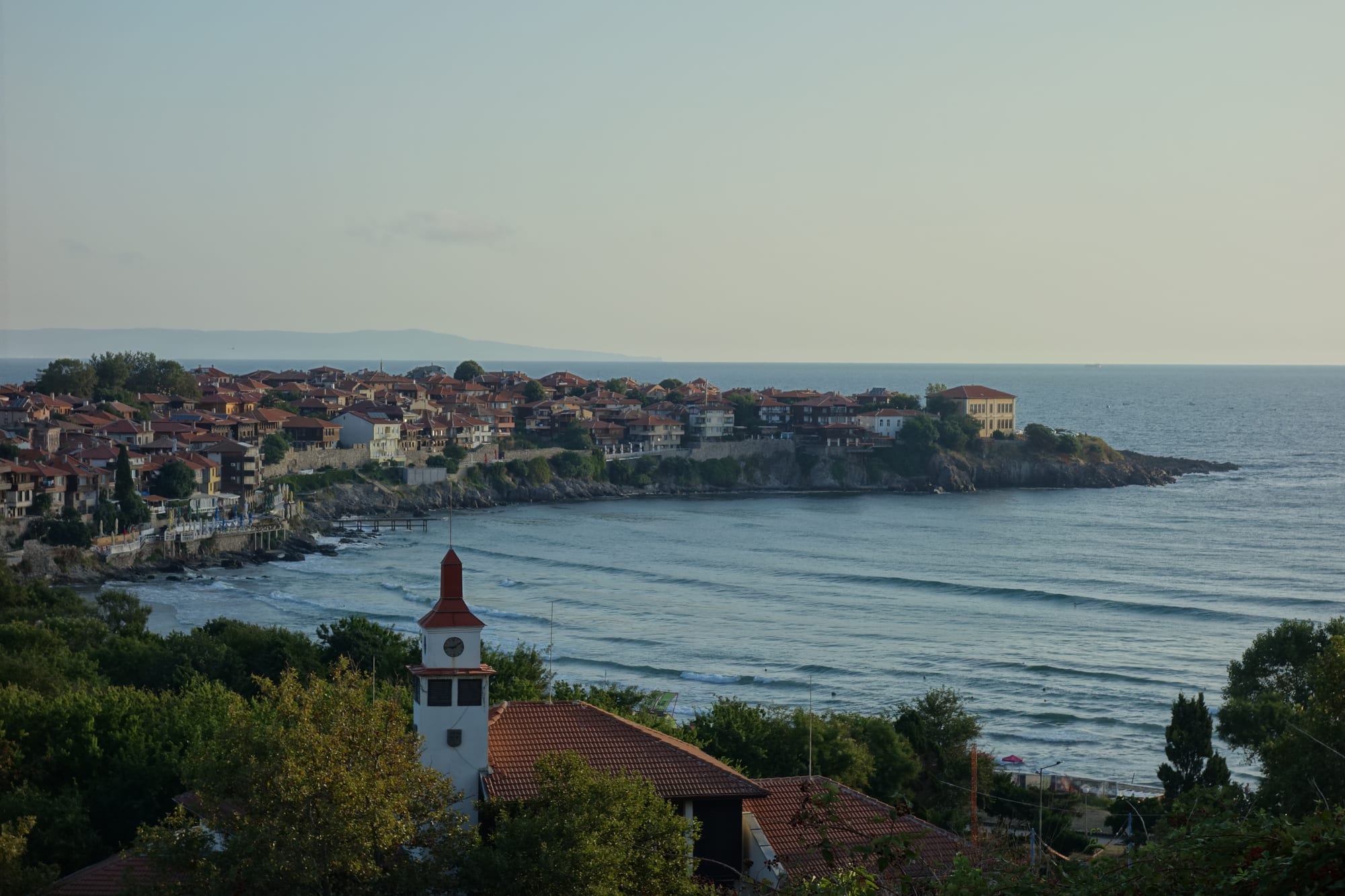
Red-roofed houses of an old town on a rocky peninsula above a calm bay, with a clock tower among trees in the foreground

Bulgaria

The Black Sea Coast

The old town of Sozopol on its peninsula, seen across the bay south of Burgas. (Daniel Albrecht / Wikimedia Commons · CC BY 2.0)

Bulgaria's eastern seaboard, from the wheatfields and cliffs of Dobruja in the north through the port cities of Varna and Burgas to the forested Strandzha hills on the Turkish border — a coast of ancient Greek colonies, Byzantine churches, lagoons and the country's largest beach resorts.

Explore The Black Sea Coast

History

The coast has some of the earliest traces of wealth in Europe: the Varna Necropolis, found in 1972, held gold objects from around 4500 BC, the oldest worked gold known. Thracian tribes lived here when Greek colonists arrived in the 7th and 6th centuries BC and founded Odessos (Varna), Apollonia (Sozopol) and Messembria (Nesebar), with Anchialos (Pomorie) following later, trading wine and pottery for grain.

Rome and then Byzantium held the coast, and Messembria filled with churches. The Bulgarian state fought Byzantium for the ports for centuries; Kaliakra, on the northern cape, was the seat of the 14th-century Dobrujan ruler Dobrotitsa. In 1444 a crusader army was destroyed outside Varna and the Polish-Hungarian king Władysław III was killed there, sealing Ottoman control. In 1791 a Russian fleet defeated the Ottomans off Cape Kaliakra.

After 1878 Varna became the country's main port and a seaside resort, with the royal palace of Euxinograd. Southern Dobruja, including Balchik and Dobrich, was part of Romania from 1913 to 1940, when it returned to Bulgaria. In the 1950s the communist state built Golden Sands and Sunny Beach as holiday complexes, and after 1989 the coast was developed intensively, often with little planning, turning fishing villages into resort towns.

Culture & Customs

The coast has always been more mixed and outward-looking than the interior. Greek communities lived in Nesebar, Sozopol and Pomorie into the early 20th century, and their churches, houses and names remain; Dobruja has Turkish, Tatar and Romanian traces, and the Gagauz, Orthodox Turkic-speakers, have villages near Varna. Varna is a cultural centre in its own right, hosting summer festivals and a long-running international ballet competition.

In the Strandzha hills, the village of Bulgari keeps nestinarstvo, a fire-dancing rite in which dancers carry icons barefoot across glowing embers on the feast of Saints Constantine and Helena on 21 May; it is recognised by UNESCO as intangible heritage. Fishing traditions survive in Sozopol and in the villages around Cape Kaliakra, and St Nicholas's Day, 6 December, is the fishermen's feast, marked with a meal of carp.

Summer transforms the culture: from June, students and workers from across Bulgaria arrive for seasonal jobs, and the coast becomes the country's playground, with beach clubs and festivals alongside quieter old towns.

Daily Life

Varna, with about 310,000 people, is Bulgaria's third city, a naval and commercial port with several universities. Burgas, with around 200,000, is a major port and home to its main oil refinery, at Neftochimic. Dobrich, inland, is the market centre of the Dobruja plain, often called the granary of Bulgaria for its wheat and sunflowers.

Tourism dominates the economy of the resort towns, and many residents earn most of their income in the summer months. In winter, Sunny Beach and Golden Sands empty, and the small towns fall quiet. Overdevelopment, pressure on protected dunes and coastline, and seasonal work are local concerns.

In summer life runs late: evenings on the promenade, dinners after dark, and crowds on the beaches from morning. The rest of the year the cities keep the usual Bulgarian rhythm of coffee, work and family meals.

Food

The coast eats from the sea. Tsatsa, sprats fried whole and eaten with a beer, and fried safrid, horse mackerel, are the classic summer snacks; turbot, kalkan, is the prized fish, and Black Sea mussels, midi, are steamed or cooked in rice pilaf. Rapana, a large sea snail, is also eaten, and fish soup is on most tavern menus.

Dobruja grows wheat, maize and sunflowers. Pomorie is known for its sea salt from the lagoon pans, still produced today.

Wine from the northern coast is mostly white: Dimyat, a native grape, and Traminer are among the grapes of the coast. Rakia and beer are the everyday drinks, and a glass of mastika, a strong spirit, is common with meze on summer evenings.

Attractions & Natural Wonders

In the north, Cape Kaliakra runs into the sea as a long headland of sheer cliffs with fortress walls, and dolphins can sometimes be seen offshore. Nearby are the Yailata archaeological reserve and the lakes of Shabla and Durankulak. Balchik has the palace and botanical garden of Queen Marie of Romania, and Albena is a resort on a long sandy beach.

Around Varna, Golden Sands lines a long beach north of the city, with the rock monastery of Aladzha in the woods behind it. Varna has the Sea Garden park along the shore, the Roman baths, the Archaeological Museum with the Varna gold, and the cathedral; to the west, the Pobiti Kamani, a field of stone columns, rise from the sand.

South of the Balkan range, Sunny Beach is the largest resort on the coast, next to Nesebar's old town with its ruined and restored churches of the Byzantine and medieval era. Burgas has a sea garden and its lakes, rich in birdlife, and Pomorie its salt pans and lagoon. Sozopol's old town and islands lie further south, followed by the Ropotamo river reserve and the Strandzha villages near the Turkish border.

Cities in The Black Sea Coast

Planning basics

Budget

Prices on the coast depend on season and place. In July and August, Sunny Beach, Golden Sands, Nesebar and Sozopol charge the highest rates in Bulgaria for rooms and beach loungers, while Varna and Burgas stay closer to city prices. Out of season many resort hotels close, and the towns become cheap and quiet. Dobruja villages and the far south cost least.

Daily Budget Midrange
USD 90–180 (resort or city hotel, seafood restaurants, a hire car or boat trips)
Daily Budget Shoestring
USD 40–70 (guesthouse or private room, fish and grill taverns, local buses)

Book summer accommodation early and bring a towel and parasol to use the free sections of beaches rather than paying for loungers.

Safety

The coast is generally safe, but the big resorts bring their own problems: pickpocketing, bar and taxi overcharging, and drink-fuelled trouble in Sunny Beach at night. The Black Sea has strong currents in places, and lifeguards cover only the main beaches in summer.

Swim on guarded beaches, check bills in resort bars, and use metered taxis or apps. Check current official travel advice before travelling.

Climate

The sea tempers the continental climate, so summers are warm rather than scorching and winters milder than inland, though cold, damp and windy. The northern coast in Dobruja is drier, with steppe-like summers, while the southern coast below Burgas is greener and a little warmer. The sea is warm enough for swimming from about June to September.

Summer
warm and sunny, 26–30°C, with a sea breeze; sea temperatures of about 22–26°C
Winter
cool and damp, around 0 to 8°C, with strong winds and occasional snow

Transportation

Varna and Burgas have airports with many summer flights. Trains and buses link both cities with Sofia, the train taking most of a day and the bus around six or seven hours. Frequent buses run between Burgas and Nesebar, Sunny Beach, Pomorie and Sozopol, and between Varna and Golden Sands; Varna to Burgas takes about two hours by road. A car helps for Cape Kaliakra, Balchik and the Strandzha villages.

Fly into Varna for the north and Burgas for the south; allow longer on the coast road in summer traffic.

Best Time to Visit

June and September offer warm sea, open resorts and fewer people; July and August are hot, crowded and at peak prices, especially in Sunny Beach and Golden Sands. May and October suit the old towns, Varna's museums and birdwatching on the Burgas lakes, when spring and autumn migration pass along the coast. In winter most resorts shut, and Varna and Burgas are the places to go.