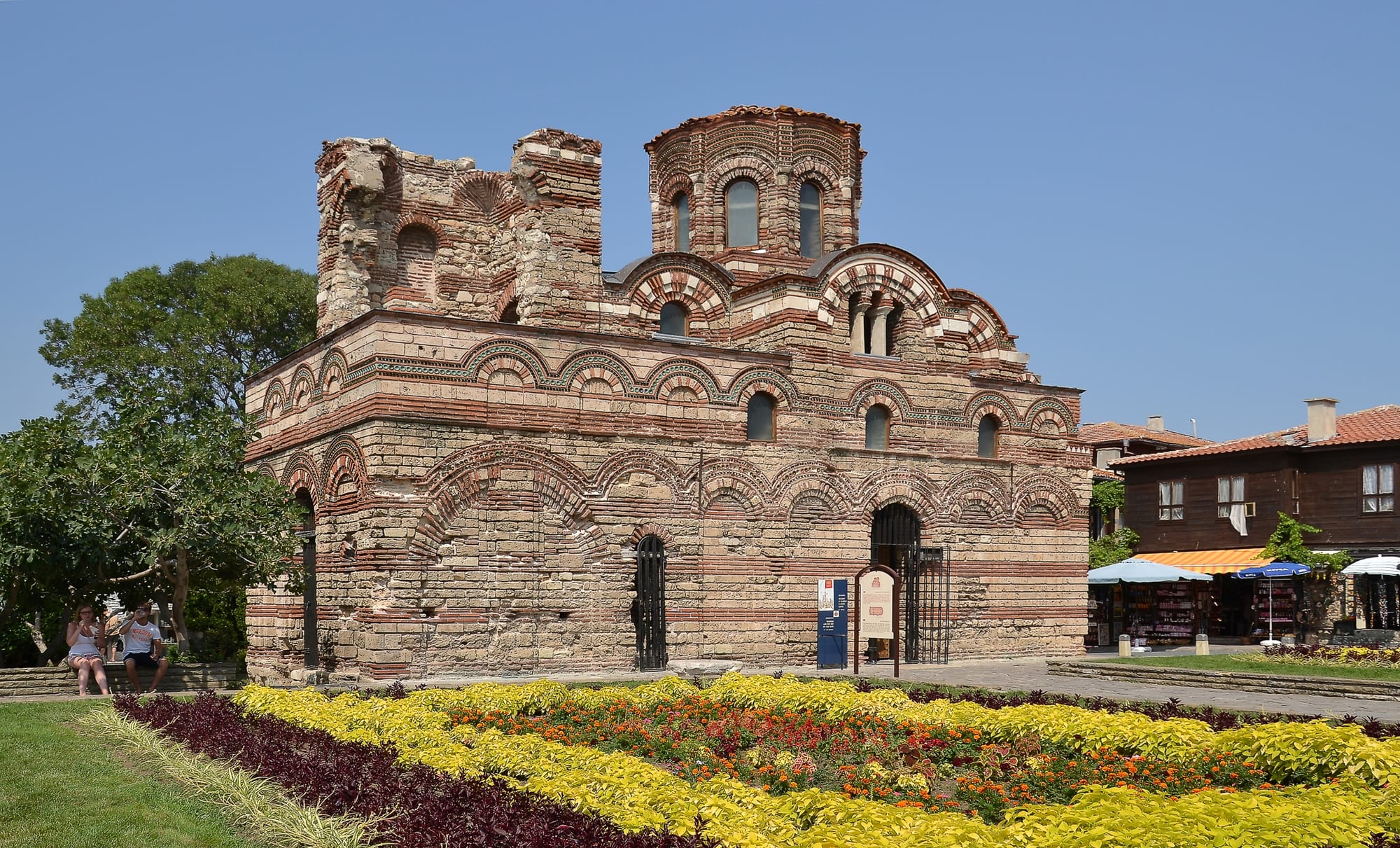
A medieval church of banded brick and stone with blind arches and a domed tower, behind a bed of flowers

The Black Sea Coast, Bulgaria

Nesebar

The Church of Christ Pantocrator in the old town of Nesebar. (Pudelek (Marcin Szala) / Wikimedia Commons · CC BY-SA 3.0)

A small town on the southern Black Sea coast in two parts: an old town on a rocky peninsula, once an island, joined by a narrow isthmus to a newer town on the mainland. Its churches were built under Byzantine, Bulgarian and Ottoman rule, and the old town has been a UNESCO World Heritage Site since 1983, with Sunny Beach just to the north.

Neighbourhoods

  • The old town
    • First-time visitors
    • Historic district
    • Churches

    The peninsula itself, reached through the old town gates at the end of the isthmus. Cobbled lanes wind between medieval churches, ruins of the Hellenistic and Byzantine city and 19th-century wooden houses, with small beaches on its southern side. It is packed with visitors and souvenir stalls by day in summer.

    Open in Maps
  • The new town
    • Quiet and residential
    • Beaches
    • Close to public transport

    The mainland part of Nesebar, built after 1925. Hotels, apartments and shops line its streets, and buses to Sunny Beach, Pomorie and Burgas pass through.

    Open in Maps
  • Sunny Beach
    • Beaches
    • Nightlife
    • Resorts

    The largest resort on the Black Sea, created in 1958 and now merged with Nesebar to the south. It is a long strip of hotels, bars, clubs and water sports along a broad bay, crowded in July and August, with a very small permanent population.

    Open in Maps

Things to do

Churches of the old town

  • Church of Christ Pantocratorlandmark

    A medieval church of the old town, built in the 13th–14th century, its walls banded in brick and stone and decorated with blind arches.

    Open in Maps
  • Hagia Sophia Churchlandmark

    The Old Bishopric, a large roofless basilica of the 5th–6th century in the middle of the old town.

    Open in Maps
  • Church of St John the Baptistlandmark

    An 11th-century domed cruciform church of undressed stone, one of the best preserved churches in Nesebar.

    Open in Maps
  • Basilica of the Holy Mother of God Eleusalandmark

    A 6th-century monastery church on the north side of the peninsula, partly sunk into the sea and excavated from 1920.

    Open in Maps
  • Church of St Stephenlandmark

    The New Bishopric, an 11th-century church reconstructed between the 16th and 18th centuries, its interior covered with hundreds of murals.

    Open in Maps
  • Church of St John Aliturgetoslandmark

    A 14th-century domed cruciform church that was never consecrated, badly damaged in an earthquake in 1913, its walls patterned in brick and stone.

    Open in Maps

Museums and the old walls

  • Nesebar Archaeological Museummuseum

    The town's archaeological museum, covering the long history of the peninsula from the Thracians onwards.

    Open in Maps
  • The old town gates and wallslandmark

    The fortified gateway at the end of the isthmus, a popular photo spot, and a stretch of the ancient fortifications still visible on the north side of the peninsula.

    Open in Maps

Short trips from the town

  • Ravdabeach

    A small seaside resort and village about 3 km from Nesebar.

    Open in Maps
  • Sveti Vlasbeach

    A resort town just north of Sunny Beach.

    Open in Maps
  • Pomorieattraction

    A coastal town on a peninsula to the south, beside the ultrasaline Lake Pomorie, the northernmost of the Burgas lakes.

    Open in Maps

Seasonal events

  • Town Day15 August

    The feast of the Dormition of the Mother of God is celebrated as the day of the town of Nesebar.

  • International Honey Festivallate August to early September

    An international honey festival, one of several festivals the town hosts each year.

Eat and drink

Long-standing places and food districts in Nesebar. Hours, ratings and directions come from your maps app, always current.

Nesebar classics

  • Fish restaurants of the old townneighborhood

    The old town is full of restaurants serving grilled fish, mussels and Bulgarian dishes, many with terraces over the bay; places with touts outside tend to be the most expensive.

    Open in Maps
  • The new townneighborhood

    The mainland streets have restaurants and grills used by residents as well as visitors.

    Open in Maps

Cafés and bars

  • Bars of Sunny Beachneighborhood

    The resort next door is the coast's busiest place for bars and clubs in summer.

    Open in Maps

Experience Nesebar

History

The peninsula was a Thracian settlement before Dorian Greeks from Megara settled it at the beginning of the 6th century BC. Mesembria, as it was known, was the only Dorian colony on the Black Sea coast, an important trading centre and a rival of Apollonia, today's Sozopol. It joined the Athenian-led Delian League in 425–424 BC and minted its own coins in bronze and silver from the 5th century BC and in gold from the 3rd. Its surviving ancient remains are mostly Hellenistic — an acropolis, a temple of Apollo and an agora — along with a stretch of Thracian wall on the north side. Rome took the town in 71 BC.

From the 5th century AD Mesembria was one of the most important strongholds of the Byzantine Empire, and Bulgarians and Byzantines fought over it for centuries; Khan Krum captured it in 812 after a two-week siege. The Bulgarian form of the name, Nesebar, is recorded from the 11th century. The town prospered under Tsar Ivan Alexander in the 14th century, when a remarkable series of churches was built, until crusaders under Amadeus VI of Savoy took it in 1366. It passed back to Byzantium in 1403 and fell to the Ottomans in 1453, which began its decline.

In the 19th century the wooden houses typical of the coast were added to the old town. After 1878 Nesebar belonged to Eastern Rumelia, which united with Bulgaria in 1885; in 1900 it was a small town of about 1,900 people, mostly Greek fishermen and vine-growers. It grew into a seaside resort in the 20th century, a new town was built on the mainland after 1925, and UNESCO listed the old town in 1983.

Culture & Customs

Nesebar is sometimes said to have more churches per head than any other town: forty survive wholly or in part, from Early Christian basilicas of the 5th and 6th centuries to the cross-domed churches of the Middle Ages. Together they trace the development of Eastern Orthodox architecture under Byzantine, Bulgarian and Ottoman rule, and the brick-and-stone walls and blind arches of churches such as Christ Pantocrator are among the peninsula's best-known sights. Several are now museums or ruins, and some lie partly underwater.

The town's Greek past runs deep. Its old name was Mesemvriya until it was replaced by the current form in 1934, and in the early 19th century many local men joined the Greek patriotic society Filiki Eteria, some fighting in the Greek War of Independence in 1821.

Each year brings a run of festivals, among them international art and children's festivals and a honey festival from late August into early September, and the town celebrates its own day on 15 August, the feast of the Dormition. The town has a football club with a 6,000-seat stadium.

Daily Life

About 14,500 people lived in Nesebar together with Sunny Beach at the end of 2021, making it one of the larger towns of Burgas Province, and the municipality had about 30,700. The town has grown well beyond the peninsula, and the new town on the mainland has merged with Sunny Beach.

Tourism dominates everything. Sunny Beach, which has grown to merge with Nesebar, is the largest resort on the Black Sea and contributes a significant part of the province's economy, and the old town draws large numbers of day visitors from the resorts along the bay. Many residents earn most of their income in the summer months, letting rooms, running restaurants and shops or working in hotels.

The year divides sharply. From June to September the town is crowded from morning until late at night, and the buses to Sunny Beach run constantly. In winter much of the resort closes, museums close at weekends, and Nesebar returns to the rhythm of a small coastal town.

Food

As everywhere on the coast, the sea supplies much of the menu. Grilled fish, both saltwater and freshwater, is a staple of the restaurants on the peninsula, and fisherman's soup, ribena chorba, is a spicy fish soup made with thyme and fresh lovage. Mussels in butter with onion and fresh herbs are traditionally from nearby Sozopol.

The rest of the table follows the national cuisine. Tarator, a cold soup of cucumbers, garlic, yogurt and dill, suits the summer heat, and shopska salad — cucumbers, onions, peppers and tomatoes with white cheese — is a common salad. Banitsa, a filo pastry with egg, sirene cheese and yogurt, and mekitsi, deep-fried dough served with jam, honey or cheese, are breakfast foods sold in bakeries. Sirene, a white brine cheese similar to feta, turns up in salads and many pastries.

Zagorka and Kamenitza are popular national lagers, and Burgasko is the local beer. Rakia is the everyday spirit.

Planning tools

Budget

Rooms and beach loungers in Nesebar and Sunny Beach cost most in July and August, and old-town restaurants are likely to cost more than most in the country. Prices drop sharply outside July and August, and in winter many hotels and restaurants close. Local buses are cheap.

Daily Budget Midrange
USD 90–180 (hotel near the old town or in Sunny Beach, seafood dinners, museum and church tickets, boat trips)
Daily Budget Shoestring
USD 40–70 (private room in the new town, grills and bakeries, local buses)

Stay in the new town or out of season for better value, and use the free parts of the beaches rather than paying for loungers.

Best Time to Visit

June and September offer warm sea, open restaurants and fewer people. July and August are hot, crowded and at peak prices, with the old town full of day-trippers. May and October suit those who come for the churches rather than the beach. In winter the town is very quiet and museums close at weekends.

Suggested Number of Days

The old town can be seen in a long day or two. Three to five days allow time for the beaches and the neighbouring resorts and towns; many visitors stay a week or more for the sea alone, often in Sunny Beach.

First Visit
1–2 days
With Surroundings
3–5 days

Transportation

The old town is small and walkable. Local buses run every 15 minutes or so between Nesebar and the surrounding resorts, and other lines continue to Ravda, Aheloy, Pomorie and Burgas. Tourist boats also run between Sunny Beach and the old town, less often than the buses.

Take the Nesebar–Sunny Beach bus to the old town; not every Burgas bus runs all the way to the old town.

Airport & Station Connections

Burgas Airport, near the Sarafovo district on the northern edge of Burgas, is the nearest airport, with many summer flights. Buses run roughly hourly between Burgas and Nesebar, and the Old Nesebar bus station is right at the entrance to the old town. Sunny Beach, which adjoins Nesebar, is about 35 km north of Burgas.

Walkability

The peninsula is small and easily walked, though the cobbles are uneven and the lanes crowded in summer. The isthmus links it to the new town on foot, and Sunny Beach's promenade continues north from there.

Safety

Bulgaria is a safe country for visitors, with low levels of violent crime. Nesebar itself is very safe; the main nuisances are persistent sellers and shopkeepers in the old town and heavy drinking at night in neighbouring Sunny Beach.

A polite but firm 'no' deals with touts; check bills in resort bars, use metered taxis and swim on guarded beaches. Check current official travel advice before travelling.

Climate

The coastal position gives a Mediterranean climate with continental and maritime influences: summers are warm and sunny, and winters are cool and windy, with moderate rainfall.

Summer
warm and sunny, with average summer temperatures of 28–30°C
Winter
cool and windy, with moderate rainfall; in nearby Burgas, winter temperatures average 4–5°C and drop below 0°C at night

Local Customs

Tips are not added to bills; leaving 5–10 per cent in restaurants is usual if the service was good. Bulgarians often shake the head for 'yes' and nod for 'no'. Several of the old town's churches are ruins or museums, but others are places of worship.

Cover shoulders and swimwear when entering churches that are in use, and ask before photographing inside them.

Common Payment Methods

The currency is the euro (EUR). Bulgaria adopted the euro on 1 January 2026, replacing the lev, and the euro has been the sole currency since 1 February 2026. Cards are widely accepted in hotels and restaurants, and there are ATMs in both parts of town; cash is useful for stalls and small kiosks.