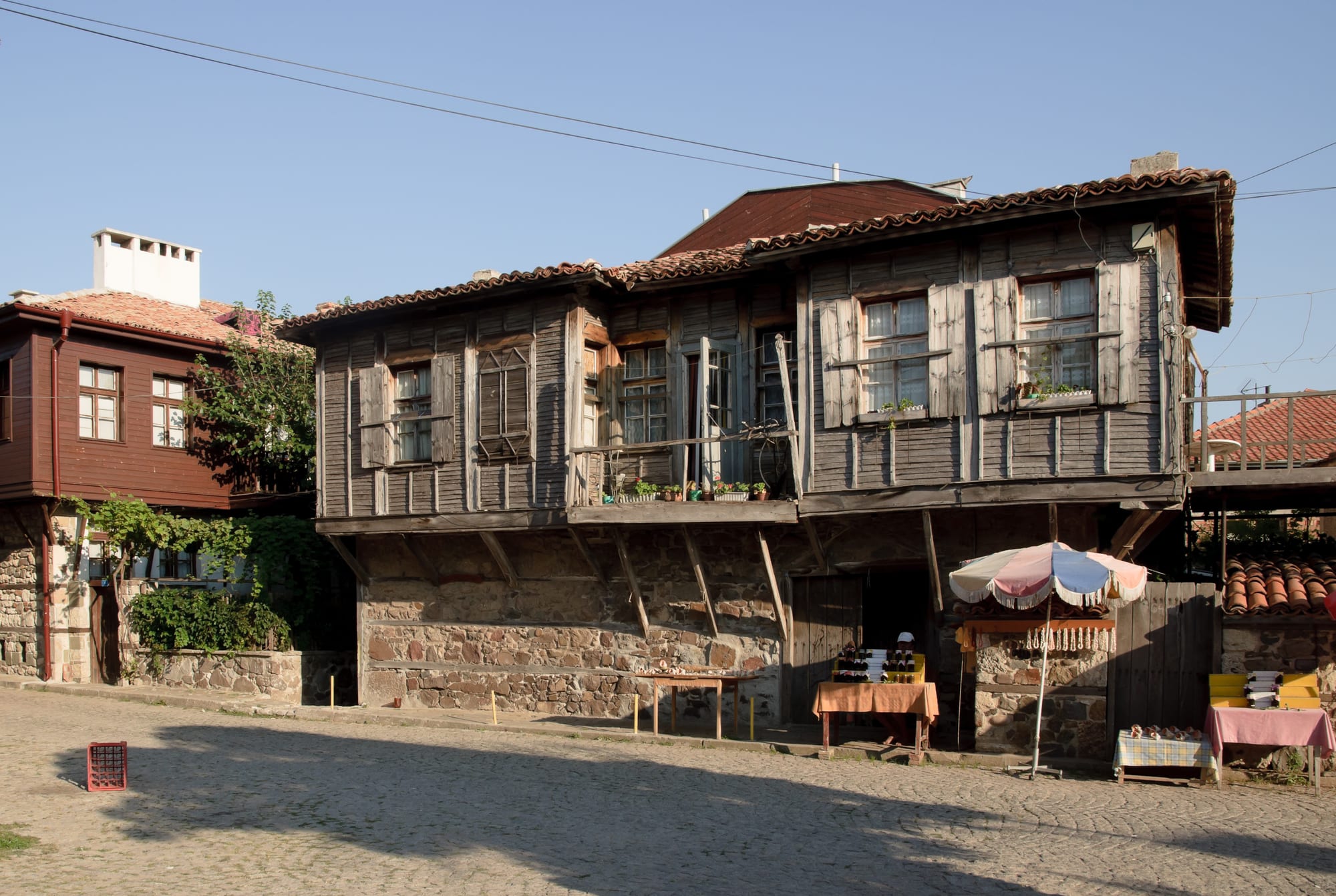
A weathered two-storey wooden house on a stone ground floor, facing a cobbled square with souvenir stalls

The Black Sea Coast, Bulgaria

Sozopol

A wooden house in the old town of Sozopol. (MrPanyGoff / Wikimedia Commons · CC BY-SA 3.0)

A seaside town 35 km south of Burgas, built over the ancient Greek colony of Apollonia. Its old town of 18th- and 19th-century wooden houses fills the small Skamni peninsula, a newer town and sandy beaches spread along the bays on either side, and every September it hosts the Apollonia arts festival.

Neighbourhoods

  • The old town
    • First-time visitors
    • Historic district
    • Best for food

    The Skamni peninsula between Sozopol Bay and the bay of Koreniya, with lanes of wooden houses on stone ground floors, restored stretches of the ancient walls, old churches and many restaurants. A causeway and breakwater link its tip to the small island of St Kirik.

    Open in Maps
  • The new town and the Sea Garden
    • Beaches
    • Close to public transport

    The newer part of town on the mainland, with the Sea Garden park and the Central or Northern beach, one of the town's two larger beaches, along with shops, cafés and much of the town's accommodation.

    Open in Maps
  • Harmanite
    • Beaches
    • Quiet and residential

    The newest quarter, stretching along the bay of Koreniya towards the Kolokita peninsula, beside Harmanite beach, nearly a third of which is covered by sand dunes.

    Open in Maps

Things to do

The old town

  • Ancient fortress wallslandmark

    Stretches of the town's eastern and southern walls, uncovered and restored during large excavations in the old town since 2010.

    Open in Maps
  • Church of the Holy Mother of Godlandmark

    A three-naved 15th-century church in the old town.

    Open in Maps
  • Church of St Georgelandmark

    A church that keeps particles said to come from the Holy Cross and relics attributed to the apostle Andrew.

    Open in Maps
  • St Apostles Monasterylandmark

    The excavated remains of a medieval monastery at the north-eastern point of Cape Skamni, built where a sanctuary of Demeter and Persephone once stood.

    Open in Maps
  • Archaeological museummuseum

    The museum of the town's archaeological finds, which span ancient Apollonia and the Middle Ages.

    Open in Maps

Beaches and islands

  • Central beachbeach

    The Central or Northern beach, one of the two larger beaches within the town.

    Open in Maps
  • Harmanite beachbeach

    The town's other large beach, along the bay of Koreniya, nearly a third of it covered by sand dunes.

    Open in Maps
  • St Ivan Islandattraction

    The largest Bulgarian island in the Black Sea, about 0.66 square km, lying just off Sozopol.

    Open in Maps

Short trips from the town

  • St Anastasia Islandattraction

    A small island in the Gulf of Burgas off Chernomorets, with a monastery church, a lighthouse and a museum, reached by boat in summer.

    Open in Maps
  • Chernomoretsbeach

    A seaside resort town to the north, part of Sozopol municipality.

    Open in Maps
  • Ropotamopark

    A river whose lower course, protected since 1940 as part of the Ropotamo Reserve, ends in a mouth home to over 100 plant species endangered in Bulgaria, near a liman navigable by small boats.

    Open in Maps
  • Primorskobeach

    A seaside resort town further south along the coast, declared a national sea resort in 1953.

    Open in Maps

Seasonal events

  • Apollonia arts festivalearly September

    Held since 1984 and named after the town's ancient name, with theatre, exhibitions, films, music and dance, and book presentations.

  • St Nicholas's Day6 December

    The feast of St Nicholas, patron saint of sailors, traditionally marked in Bulgaria with a meal of fish, usually carp; Sozopol has long been a fishing centre.

Eat and drink

Long-standing places and food districts in Sozopol. Hours, ratings and directions come from your maps app, always current.

Sozopol classics

  • Restaurants of the old townneighborhood

    There are many places to eat in the old town, with seafood such as marinated fish, roasted mackerel and octopus salad; many restaurants double as nightclubs later in the evening.

    Open in Maps
  • The harbourneighborhood

    The town's port north of the old town, with a yacht harbour and piers for fishing boats, close to the old town's restaurants.

    Open in Maps

Cafés and bars

  • New town caféscafe

    Cafés and bars around the Sea Garden and the central beach.

    Open in Maps

Experience Sozopol

History

People lived here in the Bronze Age, and the anchors found in the bay show that ships used it from the second millennium BC. In the 7th century BC Greek colonists from Miletus founded a town called Antheia, soon renamed Apollonia after its temple of Apollo. It grew into one of the largest and richest Greek colonies on the Black Sea, trading with the Odrysian kingdom of the Thracians and with Athens, Corinth and the Aegean islands, and a famous rival of Mesembria, today's Nesebar. In the 5th century BC the city raised a colossal statue of Apollo, 13 m tall, by the sculptor Calamis, and its coins carried an anchor as the city's symbol.

Apollonia kept its independence under Philip II and Alexander the Great, but in 72 BC Roman legions under Marcus Lucullus sacked it and carried the statue off to Rome. The town never fully recovered. By the 1st century AD the name Sozopolis appears; bishops are recorded from 431, and the town passed in turn between Byzantine, Bulgarian and Ottoman rule, the Ottomans taking it in 1453.

Into the early 20th century the population was almost entirely Greek. After anti-Greek violence in Bulgaria in 1906, Greek institutions were closed, and after the Balkan Wars nearly all remaining Greeks were exchanged for Bulgarians from Eastern Thrace; many settled in Chalkidiki, founding a new Sozopolis there. The town became a large fishing centre with its own fishing school, and later one of the country's main seaside resorts.

Culture & Customs

The Apollonia arts festival, held every September since 1984 and named after the ancient city, is Sozopol's best-known event: a programme of theatre, exhibitions, films, music, dance and book presentations. The old town's houses, built of timber over stone ground floors in the 18th and 19th centuries, give the place a character of its own, and the woodcarving of its church iconostases is a remarkable accomplishment of its craftsmen.

Archaeology is part of local life. Excavations in the old town since 2010 have uncovered the ancient walls, temples and shrines, and in 2012 they found the grave of a medieval man with an iron bar driven through his chest — a precaution against his return as a vampire, of a kind found in more than 100 medieval burials across Bulgaria. A proposal to rebuild the colossal statue of Apollo was revived in 2016 but criticised by the Orthodox Church and has not gone ahead.

The Church of St George keeps particles said to come from the Holy Cross and relics attributed to the apostle Andrew, and around twenty small chapels were raised on the foundations of the town's destroyed medieval churches, several of which survive. Fishing traditions survive around the harbour, and on St Nicholas's Day the traditional Bulgarian meal is fish, usually carp. The local football club is FC Sozopol.

Daily Life

About 6,400 people lived in Sozopol at the end of 2019, making it the eighth-largest settlement in Burgas Province and the centre of a municipality of the same name. The population swells in summer, when visitors fill guesthouses and campsites around the town.

Tourism is the main source of income, and the busiest months run from May to September. Many residents let rooms, run restaurants, cafés and shops, or work in hotels, and taxi drivers rely largely on visitors for their trade. Besides the yacht harbour, the town has piers for fishing boats, and its port, north of the old town, is of regional importance. Sozopol has no railway and only limited access to the national road network. It has a secondary school, and besides the football club, a rowing club.

Out of season the town returns to the slower pace of a small fishing port. Stretches of sand dunes and the Kolokita peninsula are protected areas within the town's bounds.

Food

Sozopol's kitchen is built on fish. Restaurants such as Kirik, named after the island, serve marinated fish, mackerel roasted with lemon and fennel, octopus salad and clams, and grilled fish, both saltwater and freshwater, belongs to the Bulgarian grill. Mussels in butter, cooked with onion and fresh herbs, are a dish traditionally associated with Sozopol, and fisherman's soup, ribena chorba, is spiced with thyme and fresh lovage.

The town was known as a fishing and wine centre and played an important part in the grain trade from Thrace, and the national table fills out the rest of the menu: tarator, a cold soup of cucumbers, garlic, yogurt and dill; shopska salad of cucumbers, onions, peppers and tomatoes with white cheese; and from the bakeries banitsa, filo pastry with egg and sirene cheese, and mekitsi, deep-fried dough with jam, honey or cheese.

Rakia is the everyday spirit, and Zagorka and Kamenitza are national lagers. On St Nicholas's Day the traditional dish is fish, usually carp.

Planning tools

Budget

Rooms cost most in July and August, at the height of a busy season that runs from May to September. Outside the season the town is much quieter. Camping around the town is popular with young people and backpackers.

Daily Budget Midrange
USD 90–170 (guesthouse in the old town, seafood dinners, boat trips)
Daily Budget Shoestring
USD 40–70 (private room or campsite, grills and bakeries, local buses)

Book rooms early for August and the festival; bring a towel and parasol to use the free parts of the beaches.

Best Time to Visit

June and September give warm sea and fewer people, and early September brings the Apollonia festival. July and August are hot, crowded and at peak prices, with the busiest season running from May to September. Winters are relatively warm but windy.

Suggested Number of Days

The old town can be seen in a day or two. Three to five days leave time for the beaches, the islands and the reserves to the south; beach holidays here usually last a week or more.

First Visit
1–2 days
With Surroundings
3–5 days

Transportation

Sozopol is small, and walking is the best way to get around. Taxis wait near the beaches, and local buses connect the town with Burgas; there is no railway. A car helps for the Ropotamo reserve and the Strandzha villages.

Agree the taxi fare before setting off — fares quoted to visitors are often marked up two or three times.

Airport & Station Connections

Burgas, about 35 km to the north by road, is the gateway. Burgas Airport, near the Sarafovo district on the city's northern edge, has many summer flights, and Burgas has trains and buses from Sofia and the rest of the country. Local buses link Burgas with Sozopol, and in summer numerous bus services come from all around Bulgaria.

Walkability

Very good. The old town, the Sea Garden, the central beach and the new town are all within easy walking distance, and Harmanite is a longer walk along the bay. The old town's cobbles are uneven.

Safety

Bulgaria is a safe country for visitors, with low levels of violent crime. The main risks in Sozopol are taxi overcharging and the sea itself: at some rocky spots around the old town the water is deep and can be rough.

Swim on guarded beaches, take care when jumping or diving from the rocks, and agree taxi fares in advance. Check current official travel advice before travelling.

Climate

Sozopol's climate lies between the humid subtropical and the Mediterranean, with relatively warm but windy winters and long, warm summers; a night breeze from the land to the sea is typical.

Summer
long and warm, with an average July temperature of 27°C
Winter
relatively warm but windy, with an average January temperature of 6°C

Local Customs

Tips are not added to bills; leaving 5–10 per cent in restaurants is usual if the service was good. Bulgarians often shake the head for 'yes' and nod for 'no'. The old town's churches are active places of worship as well as sights, and some hold relics venerated by believers.

Dress modestly and cover swimwear in churches, and ask before photographing inside them.

Common Payment Methods

The currency is the euro (EUR). Bulgaria adopted the euro on 1 January 2026, replacing the lev, and the euro has been the sole currency since 1 February 2026. Cards are widely accepted in hotels and restaurants, and there are ATMs in town; cash is useful for stalls and small cafés.