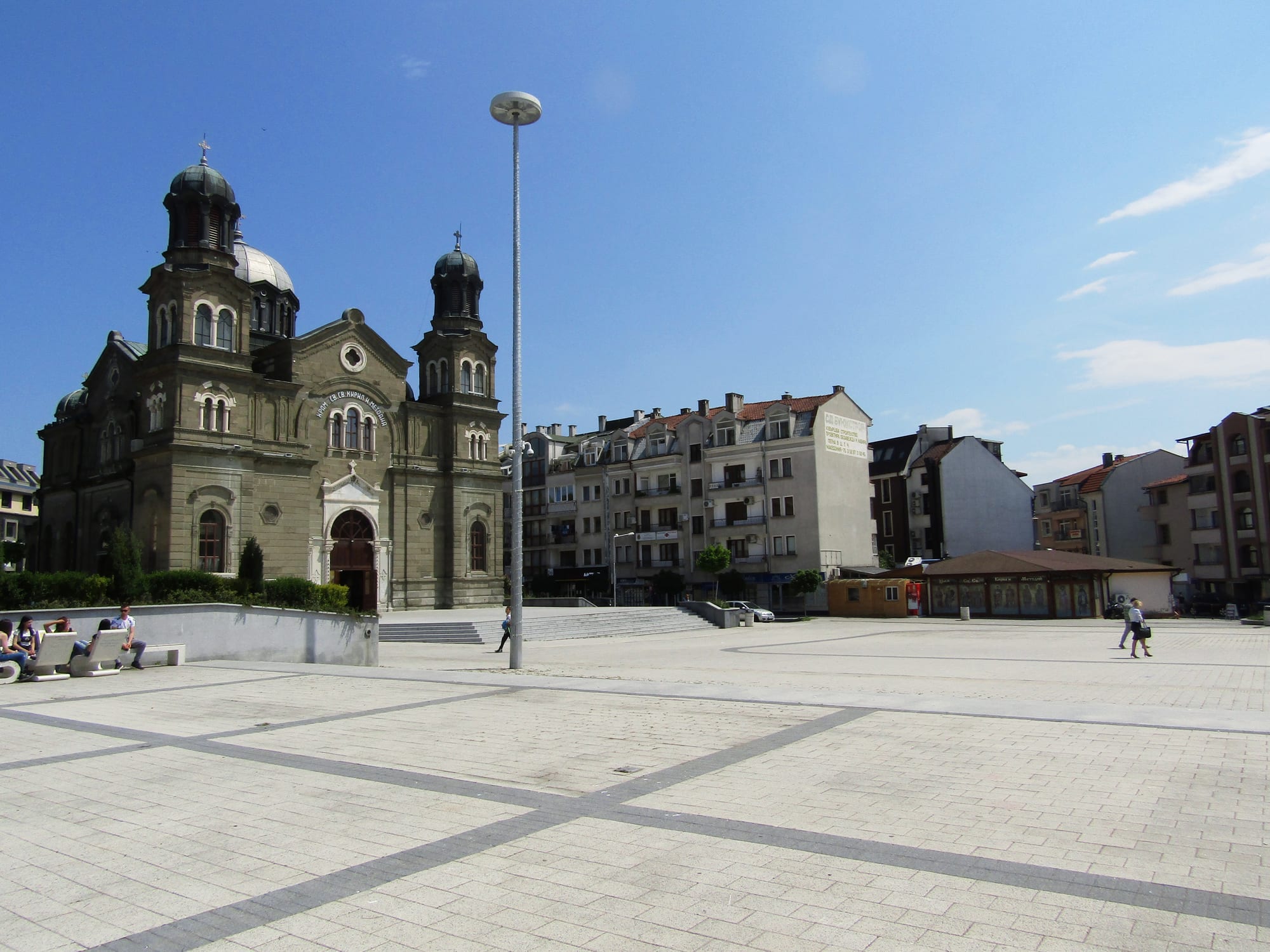
A domed stone cathedral with twin bell towers beside a wide paved square and blocks of flats under a blue sky

The Black Sea Coast, Bulgaria

Burgas

The Church of Saints Cyril and Methodius on its square in central Burgas. (Alicia Fagerving / Wikimedia Commons · CC BY-SA 3.0)

Bulgaria's fourth-largest city, at the westernmost point of the Black Sea on Burgas Bay, ringed by three large coastal lakes. A grain port under the Ottomans and an industrial city after 1878, it has the country's largest oil refinery and its second port and airport, along with a long seaside park, city beaches and the wetlands of the Burgas lakes.

Neighbourhoods

  • The centre
    • First-time visitors
    • Nightlife
    • Close to public transport

    The heart of the city between the port and the Sea Garden, with the cathedral square, the main shopping streets, the museums, many hotels, and the railway and bus stations. Most of the nightlife is here.

    Open in Maps
  • Lazur
    • Beaches
    • Parks
    • Quiet and residential

    A residential district north-east of the centre, with a number of hotels close to the Sea Garden. The Lake Park lies to its north on the shore of Lake Atanasovsko.

    Open in Maps
  • Izgrev and Zornitsa
    • Local life
    • Quiet and residential

    Large communist-era housing districts to the north, on the western side of Lake Atanasovsko, where many of the city's residents live.

    Open in Maps
  • Sarafovo
    • Beaches
    • Close to the airport

    A seaside neighbourhood about 8 km north-east of the centre, across Lake Atanasovsko, home to the airport and its own beaches. It has become one of the more expensive parts of the city.

    Open in Maps

Things to do

Landmarks and museums

  • Church of Saints Cyril and Methodiuslandmark

    The city's 33-m cathedral church, built in 1897–1907 to a design by the Italian architect Riccardo Toscani, on the site of a small wooden church.

    Open in Maps
  • Armenian Church of the Holy Crosslandmark

    Surp Hach, built in 1853, one of the oldest churches in the city and a listed monument of culture.

    Open in Maps
  • Archaeological Museummuseum

    The city's oldest museum, founded in 1912, with finds from ancient Thrace, the Greek colonies of the coast and the Roman period, including the oldest statue found in Bulgarian lands.

    Open in Maps
  • Ethnographic Museummuseum

    The city's ethnographic museum, one of its main museums alongside the archaeological and natural science collections.

    Open in Maps

The Sea Garden and the waterfront

  • Sea Gardenpark

    The city's largest and best-known park, created in 1891, covering about 80 hectares along the shore, with trees, many sculptures and a monument to Alexander Pushkin.

    Open in Maps
  • The Bridgeviewpoint

    Mosta, a T-shaped pier off the Sea Garden with a viewing platform, from which local boys dive and boats leave for St Anastasia Island.

    Open in Maps
  • Central Beachbeach

    The sandy city beach below the Sea Garden, reached by small stairs, lined in summer with cafés and night bars.

    Open in Maps

The Burgas lakes

  • Lake Burgaspark

    Also called Lake Vaya, the largest natural lake in Bulgaria, west of the city, home to more than 250 bird species and popular for carp fishing.

    Open in Maps
  • Lake Atanasovskopark

    A salt lake north of the city, where sea salt has been produced since 1906 and the northern part has been a nature reserve since 1980.

    Open in Maps
  • Poda Protected Areapark

    A wetland reserve south of the city, the first in Bulgaria run entirely by a non-governmental organisation, with a visitor centre and views over pelicans, cormorants and other waterbirds.

    Open in Maps
  • Lake Mandrenskopark

    The southernmost of the Burgas lakes, once brackish and now a reservoir, with protected areas for endangered fish and birds.

    Open in Maps

Short trips from the city

  • St Anastasia Islandattraction

    A small island in the Gulf of Burgas with a monastery church, a lighthouse and a museum, reached by boat from Burgas in summer.

    Open in Maps
  • Develtoslandmark

    The site of Deultum, a Roman colony for army veterans founded by Vespasian in AD 70 on the shore of Lake Mandrensko, now an open-air museum.

    Open in Maps
  • Pomorieattraction

    A coastal town on a peninsula north of Burgas, beside the ultrasaline Lake Pomorie, the northernmost of the Burgas lakes.

    Open in Maps
  • Sozopolattraction

    The ancient Greek town of Apollonia, with an old town of wooden houses on a small peninsula south of Burgas.

    Open in Maps
  • Nesebarattraction

    A UNESCO-listed old town of medieval churches on a peninsula north of the bay, next to Sunny Beach.

    Open in Maps

Seasonal events

  • Floralate April to early May

    An international flower exhibition held every year since 1985, whose displays in the Sea Garden often stay up until late summer.

  • Sand sculpture festivalsummer

    Artists from many countries create large sculptures on more than 4 hectares of sand.

  • International Folklore Festivallate August

    A festival of folk dance and music begun in 1965 for Balkan dances and music, which has since drawn more than 18,000 dancers from around the world.

  • St Nicholas's Day6 December

    The city honours its patron saint, the protector of sailors and fishermen, on his feast day.

Eat and drink

Long-standing places and food districts in Burgas. Hours, ratings and directions come from your maps app, always current.

Burgas classics

  • Fish restaurants of the centre and seafrontneighborhood

    Burgas has an abundance of places to eat, and restaurants near the port and the Sea Garden serve Black Sea fish, mussels and fish soup.

    Open in Maps
  • Restaurants in the centreneighborhood

    The streets around the cathedral and the main shopping streets have grills, mehanas and cafés serving Bulgarian food.

    Open in Maps

Cafés and bars

  • Beach barsneighborhood

    In summer the sandy line below the Sea Garden fills with night bars and discos playing every kind of music.

    Open in Maps

Experience Burgas

History

Thracians lived around the bay — their sanctuary at Beglik Tash on the south coast is one trace of them — and in AD 70 the emperor Vespasian founded Deultum near today's city as a colony for Roman veterans, the second most important city of its province. In the Middle Ages the area had fortresses and the hot baths of Aquae Calidae, used by Byzantine, Bulgarian and Ottoman rulers, and a small fortress called Pyrgos, Greek for "tower", is thought to have given Burgas its name. Its growth was slow, overshadowed by the older trading towns of Nesebar and Sozopol.

Under the Ottomans it was a small town of about 3,000 people, which later revived on crafts and the export of grain; in the 17th and 18th centuries it was an important cereal port with its own grain measure, the Burgas kile, and by 1865 it was the second port of the Ottoman Black Sea after Trabzon. After 1878 it became an economic and industrial centre. The city library was founded in 1888, the Sea Garden laid out in 1891, and the cathedral begun in 1897; the railway to Plovdiv opened in 1890 and the deep-water port in 1903, and factories followed — mills, a sugar refinery and, from 1924, the first pencil factory in south-eastern Europe. By 1934 the city had about 34,000 people.

After 1945 the communist government nationalised more than 160 businesses, and repression followed; emigration convoys allowed some 12,000 people, among them the city's Jews, to emigrate. In July 2012 a suicide bomber attacked a bus carrying Israeli tourists at the airport. Today the port and refinery remain central to the city's economy.

Culture & Customs

Burgas has built its reputation on festivals. The Flora flower exhibition has been held every spring since 1985, sand sculptors from many countries gather each summer, and the International Folklore Festival, started in 1965 for Balkan dance and music, has since brought more than 18,000 dancers from around the world. Burgas will host the Eurovision Song Contest 2027, the first held in Bulgaria. The city also hosts a sailing week, a theatre festival, a season of opera and classical music, and an annual pop music festival, Burgas and the Sea.

The Sea Garden is the centre of civic life — a national monument of landscape architecture, full of sculptures, where people walk, meet and watch the sea. The lakes around the city give it a second identity: they lie on the Via Pontica, the second-largest bird migration route in Europe, and draw birdwatchers from all over the world to see pelicans, pygmy cormorants and red-breasted geese.

The city's past as a trading port left a mixed heritage, including the Armenian Church of the Holy Cross of 1853, one of its oldest churches. On 6 December Burgas honours its patron saint, St Nicholas, protector of sailors and fishermen. Galleries are numerous, and the university and the Burgas Free University give the city a student population of more than 6,000.

Daily Life

The official estimate put the population at about 189,000 at the end of 2025, while about 210,000 people are registered as living in Burgas, making it the fourth-largest city in Bulgaria and the second on the coast after Varna. Most live in the large housing districts to the north and west, such as Izgrev and Zornitsa, built in the communist era, while seaside Sarafovo has become an expensive neighbourhood. The industrial districts of Akatsiite and Pobeda lie south of the centre on the strip between Lake Burgas and the sea.

The economy rests on industry and transport. The Neftochim refinery is the largest oil refinery in south-eastern Europe and the city's largest industrial enterprise, the Port of Burgas is the second-largest in Bulgaria, and the airport is the country's second most important. In 2023 Bulgaria took back the concession it had granted to Lukoil to run the Rosenets oil terminal. Tourism adds a summer economy, as the city serves as the gateway to Sunny Beach, Nesebar, Sozopol and the southern resorts.

Life follows the familiar Bulgarian rhythm of coffee, work and family meals, with evenings spent along the pedestrian streets and in the Sea Garden. In summer the beach fills by day and the bars below the park by night, and many people fish on Lake Burgas.

Food

Burgas eats from the sea and the lakes. Black Sea fish and mussels feature on menus across the city, grilled fish, both saltwater and freshwater, is a staple, and fisherman's soup, ribena chorba, is spiced with thyme and fresh lovage. Carp fishing is popular on Lake Burgas, and on St Nicholas's Day, 6 December, the traditional meal is fish, usually carp. Mussels in butter with onion and fresh herbs are a dish traditionally associated with nearby Sozopol.

Everyday food is the national cuisine. Tarator, a cold soup of cucumbers, garlic, yogurt and dill, is the summer starter; shopska salad, with cucumbers, onions, peppers and tomatoes and white cheese, is a common salad; and the grill supplies kebapche, cumin-seasoned minced meat shaped into a stick. Breakfast is banitsa, filo pastry filled with egg and sirene cheese, or mekitsi, deep-fried dough with jam, honey or cheese.

National lagers such as Zagorka and Kamenitza are widely sold, and rakia is the everyday spirit. Sea salt from the pans of Lake Atanasovsko, produced there since 1906, is a local product.

Planning tools

Budget

Burgas is a working port city, and its prices stay closer to those of ordinary Bulgarian cities than to the resorts along the bay. It is a cheaper base than Sunny Beach, Nesebar or Sozopol in July and August, with buses to all of them. Taxis are convenient but pricier than the buses and trolleybuses.

Daily Budget Midrange
USD 85–160 (city hotel, seafood dinners, museum tickets, boat or bus trips along the coast)
Daily Budget Shoestring
USD 40–65 (hostel or private room, grills and bakeries, city buses)

Use Burgas as a base for the southern coast in high summer; the Sea Garden, the beach and the lake shores cost nothing.

Best Time to Visit

June and September offer warm sea and fewer crowds. July and August are hot and busy, with the sand sculptures and summer festivals. Spring and autumn bring the bird migrations over the lakes, and the Flora exhibition opens at the end of April. Burgas remains a working city all year.

Suggested Number of Days

One or two days are enough for the city itself. Allow four to six to add the lakes and the old towns and resorts along the bay, which are easily reached by bus; birdwatchers may want longer during migration.

First Visit
1–2 days
With Surroundings
4–6 days

Transportation

Burgas has a well-developed network of buses and trolleybuses, with tickets sold on board by conductors, and minibuses that are paid to the driver on getting off. Buses also run to the resorts and towns along the coast. Cycling along the promenade and north to the salt pans is one of the best ways to explore.

Pay the conductor on city buses and the driver when leaving a minibus; use metered taxis or apps.

Airport & Station Connections

Burgas Airport, the second most important in Bulgaria, is in the Sarafovo district about 10 km from the centre, with many flights from across Europe in summer; bus 15 runs to it from the railway station roughly every 20 minutes. Regular trains run to Sofia and other major cities, the line to Plovdiv having opened in 1890, and buses arrive from every part of the country and from Turkey and Greece.

Walkability

The centre is compact: the cathedral, the shopping streets, the museums, the stations and the Sea Garden are all within walking distance. The lakes, Sarafovo and the outer housing districts need a bus, a bicycle or a taxi.

Safety

Bulgaria is a safe country for visitors, with low levels of violent crime. Pickpocketing is more common in summer, when the Sea Garden and the beach fill with cafés and bars and some people drink too much; watch the meter in taxis.

Swim on guarded beaches, use metered taxis or apps, and check bills in seaside bars. Check current official travel advice before travelling.

Climate

Burgas has a humid subtropical climate: summer lasts about five months, from mid-May until late September, and winters are milder than inland.

Summer
warm, with average temperatures of about 24°C in the high season
Winter
milder than inland, averaging 4–5°C and below 0°C at night, with snow possible from December to February

Local Customs

Tips are not added to bills; leaving 5–10 per cent in restaurants is usual if the service was good. Bulgarians often shake the head for 'yes' and nod for 'no'. Burgas is proud of its Sea Garden and its festivals, and the city's Armenian church reflects an old trading community.

Dress modestly in churches and ask before photographing services; keep to marked paths in the lake reserves.

Common Payment Methods

The currency is the euro (EUR). Bulgaria adopted the euro on 1 January 2026, replacing the lev, and the euro has been the sole currency since 1 February 2026. Cards are widely accepted, there are plenty of ATMs, and cash is useful for small kiosks and bus tickets.