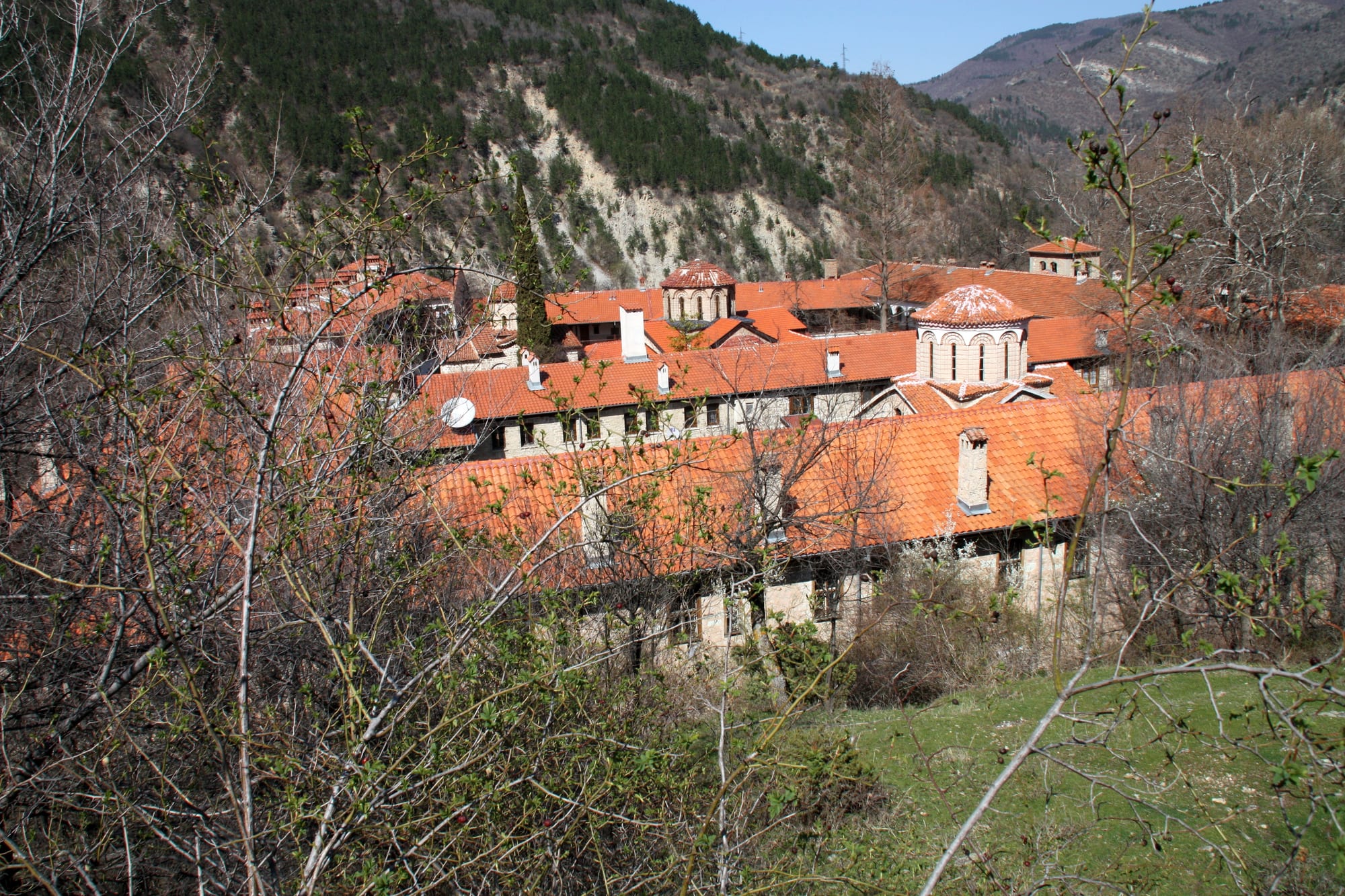
Red-tiled roofs and a small domed chapel of a monastery in a wooded valley, with rocky mountain slopes behind

Bulgaria

Plovdiv & the Rhodopes

Bachkovo Monastery in its valley in the northern Rhodope Mountains, south of Asenovgrad. (Reneman / Wikimedia Commons · CC BY 2.0 de)

South-central Bulgaria, from Plovdiv and the Upper Thracian Plain south into the forested Rhodope Mountains and east to Haskovo and the Turkish and Greek borders — a region of Roman ruins, Thracian sanctuaries, Revival-era towns, Pomak and Turkish villages, and the country's wine and vegetable heartland.

Explore Plovdiv & the Rhodopes

History

Plovdiv is among the oldest continuously inhabited cities in Europe. A Thracian settlement stood on its hills before Philip II of Macedon took it in the 4th century BC and gave it the name Philippopolis. Under Rome, as Trimontium, it became a leading city of Thrace, with the theatre, stadium and forum that survive today. The Rhodopes were Thracian heartland: the Bessi and other tribes kept sanctuaries such as Perperikon near Kardzhali, and the Thracian treasure of Panagyurishte, nine gold vessels found in 1949, came from the north of the plain.

Byzantines and Bulgarians fought over the plain for centuries. In 1083 the Byzantine commander Gregory Pakourianos, of Georgian origin, founded Bachkovo Monastery south of Asenovgrad, and Asen's Fortress guarded the same valley. The Ottomans took Plovdiv in the 1360s, and as Filibe it became a major trading city. Many Rhodope Slavs converted to Islam over the following centuries, the origin of today's Pomak communities, and Turks settled the eastern Rhodopes and the plain.

The 19th-century revival made Plovdiv rich, and its merchants built the painted houses of the Old Town. Karlovo, Kalofer and Sopot produced the revolutionaries Vasil Levski and Hristo Botev and the writer Ivan Vazov. The April Uprising of 1876 was centred on Panagyurishte and Batak, where the massacre of villagers drew European outrage. Plovdiv joined Bulgaria in 1885, when Eastern Rumelia united with the principality, and in 2019 it was a European Capital of Culture.

Culture & Customs

This is one of the most religiously mixed parts of Bulgaria. Plovdiv has Orthodox churches, the 15th-century Dzhumaya Mosque, and old Armenian and Jewish communities. In the Rhodopes, Smolyan province is home to many Pomaks, Bulgarian-speaking Muslims, while Kardzhali province has a Turkish majority; minarets and church domes stand in neighbouring villages, and mixed festivals and weddings are common.

The Rhodopes have their own music, carried by the kaba gaida, a deep-voiced bagpipe played in groups at festivals such as the Rozhen gathering. The Rhodope song "Izlel e Delyo Haydutin", sung by Valya Balkanska, travelled into space on the Voyager Golden Record in 1977. Villages such as Shiroka Laka keep carnival customs with masked kukeri, and weaving, woodwork and copper-working survive as local crafts.

Plovdiv regards itself as Bulgaria's cultural rival to Sofia: artists, galleries and bars fill the Kapana district, the Roman theatre hosts opera in summer, and Plovdiv people take pride in a slower, more relaxed pace than the capital's. Rhodope hospitality is proverbial, and a guest is usually offered rakia, coffee or home-made jam.

Daily Life

Plovdiv, with about 340,000 people, is Bulgaria's second city and the economic centre of the south. Its outskirts have become one of the country's largest industrial zones, with car-parts, electronics and food factories, alongside a university, the international trade fair and a growing tourism trade. Haskovo has about 65,000 people and Pazardzhik about 55,000; Asenovgrad, Velingrad, Kardzhali and Smolyan are smaller.

The Upper Thracian Plain is Bulgaria's market garden, growing vegetables, fruit, tobacco and grapes, and Haskovo sits on the transit route to Turkey. In the Rhodopes, work comes from forestry, tobacco, small farms, the Pamporovo ski resort and guesthouse tourism, and many families in Kardzhali and Smolyan provinces have members working in Turkey or Western Europe; depopulation is steep in the mountain villages.

Plovdiv's daily rhythm centres on the long pedestrian Main Street, crowded from morning coffee to evening walks. In the mountains life is slower, with village squares, mosques and churches, and markets selling mountain produce.

Food

The plain supplies tomatoes, peppers and fruit, and Plovdiv's markets are among the best in the country; summer tables are heavy with salads, lyutenitsa, a pepper-and-tomato relish, and roasted peppers. Wine is the region's pride. Mavrud, a dark, tannic red grape, is traditionally grown around Asenovgrad and Perushtitsa, and many wineries along the foot of the Rhodopes and around the plain make reds, rosés and whites for tasting.

Rhodope cooking is mountain food made from potatoes, beans, cheese and lamb. Patatnik is grated potato and onion cooked slowly with mild mint; klin is a pie filled with rice, cheese and eggs; and Smilyan beans, large white beans from the village of Smilyan, are stewed with peppers and herbs. Cheverme, a whole lamb or pig roasted on a spit over coals, is served at festivals and weddings. Rhodope yoghurt, sheep's cheese and mountain honey are sold in every village.

The Turkish communities of the eastern Rhodopes bring börek-style pastries, stuffed vine leaves and sweets such as baklava, and rakia and home-made syrups made from wild fruit finish most meals.

Attractions & Natural Wonders

Plovdiv's Old Town climbs three hills above the city with painted Revival houses, museums and churches, among them the Balabanov and Hindliyan houses. Below them lies the Roman theatre, with the Rhodopes as its backdrop, while the Roman stadium lies partly under the Main Street near the Dzhumaya Mosque. The Kapana district, the Nebet Tepe hill, and the ruins of the Roman forum complete the centre.

South of Plovdiv, Asenovgrad is the gateway to Asen's Fortress and Bachkovo Monastery, with its 17th-century church and refectory frescoes. Further into the Rhodopes, the Rhodope villages of Shiroka Laka, Momchilovtsi and Zlatograd keep white-walled stone houses, and the Wonderful Bridges are natural rock arches over a stream. Pamporovo has ski runs and forest walks, the Trigrad Gorge and the Devil's Throat cave lie to its southwest, and Yagodina Cave is a short drive away.

In the east, Perperikon sits on a rocky hill northeast of Kardzhali, and the Stone Mushrooms of Beli Plast are natural rock formations; near Haskovo, the Aleksandrovo Thracian tomb has painted scenes of hunters. North and west of Plovdiv are the Roman walls and spa of Hisarya, Karlovo and Kalofer at the foot of the Balkan range, Batak's memorial church, and the spa town of Velingrad.

Cities in Plovdiv & the Rhodopes

Planning basics

Budget

Prices are close to the national average in Plovdiv and a little lower than in Sofia. The Rhodope villages are among the best-value places in the country, with family guesthouses serving home cooking, while Pamporovo's hotels and lift passes are the main expense in winter. Kardzhali and Haskovo see few foreign visitors and are cheap.

Daily Budget Midrange
USD 75–140 (boutique hotel in Plovdiv, restaurants and wine tastings, a hire car)
Daily Budget Shoestring
USD 35–55 (hostel or village guesthouse, mehana meals, buses)

Stay a night or two in a Rhodope guesthouse rather than day-tripping from Plovdiv; dinner is often included and the villages are best in the evening.

Safety

The region is safe. Plovdiv's risks are ordinary pickpocketing in the centre and at the stations. In the Rhodopes the concerns are winding roads, fog, winter ice, and wet, slippery paths in the caves and gorges. Traffic heading for the Turkish border can make the Haskovo roads busy with lorries.

Drive mountain roads in daylight, carry chains or winter tyres from December to March, and follow guides in the show caves. Check current official travel advice before travelling.

Climate

The Upper Thracian Plain around Plovdiv and Haskovo is one of the hottest parts of Bulgaria in summer, sheltered by mountains to north and south. The Rhodopes are cooler and wetter, with snow from December to March around Pamporovo and Smolyan, while the eastern Rhodopes around Kardzhali are low, dry and warm, with a slight Mediterranean influence from the Aegean.

Summer
hot on the plain, 30–35°C and sometimes more; pleasant in the Rhodopes, 20–27°C
Winter
cold and foggy on the plain, around -2 to 5°C; snow and frost in the mountains

Transportation

Plovdiv is about two hours from Sofia by the Trakia motorway or bus, longer by train, and has a small airport. Buses run from Plovdiv to Asenovgrad, Smolyan, Pamporovo, Kardzhali and Haskovo, but services into the smaller Rhodope villages are sparse. Mountain roads are winding and slow, so a car makes the most sense for Perperikon, Trigrad and the villages. Haskovo province holds the main road crossing into Turkey at Kapitan Andreevo.

Allow extra time on Rhodope roads, which are narrow and twisting; Bachkovo is an easy half-day from Plovdiv via Asenovgrad.

Best Time to Visit

May, June, September and October for Plovdiv, the monasteries and the wineries, when the plain is warm rather than baking; the grape harvest runs through September. July and August suit the Rhodope villages and walking, as the mountains stay cool. December to March is the ski season at Pamporovo, and the Rozhen folk festival brings bagpipers and singers to the mountains in some summers.