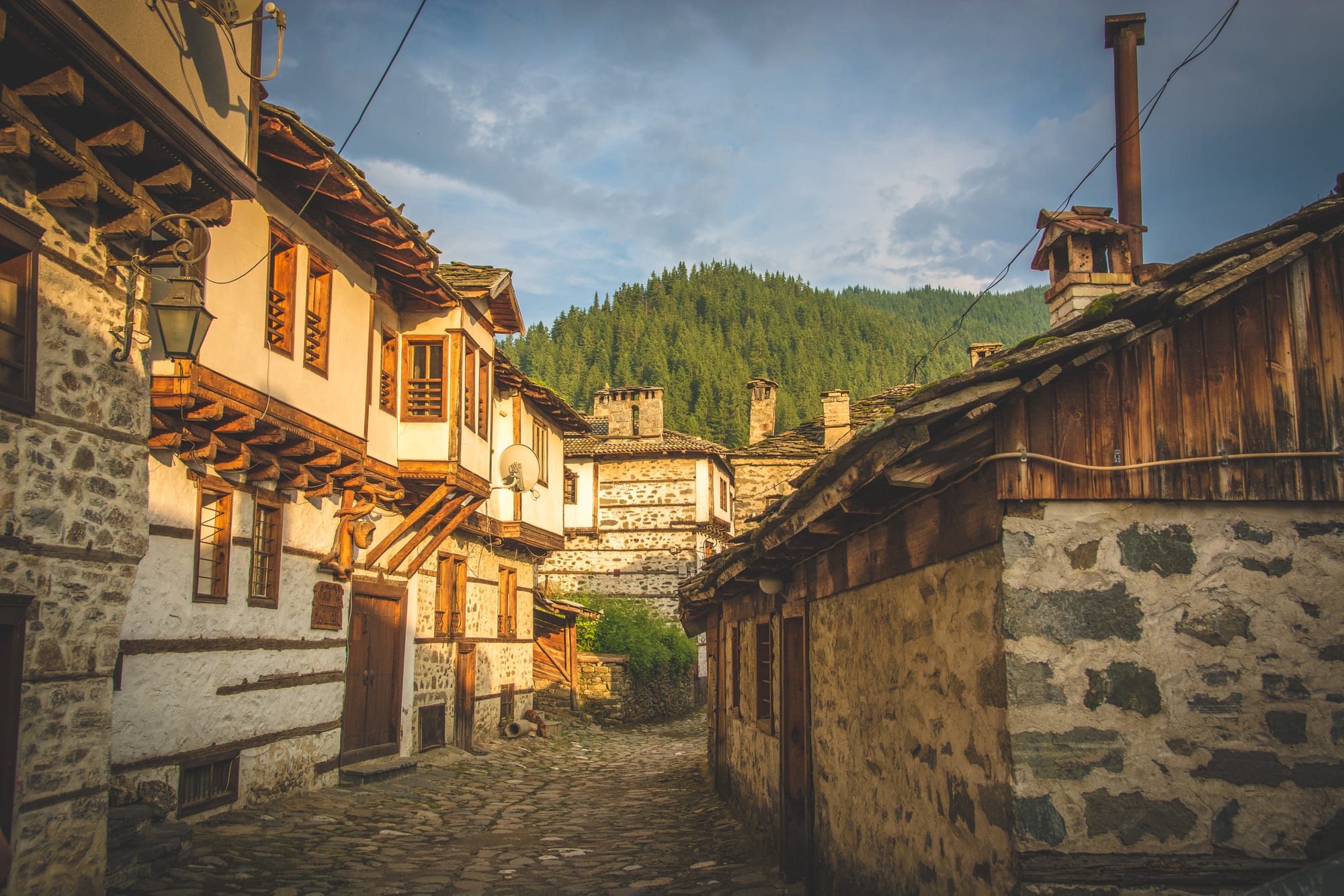
A cobbled lane between white-walled stone houses with wooden balconies and slate roofs, a forested hill behind

Plovdiv & the Rhodopes, Bulgaria

Shiroka Laka

A cobbled lane of traditional Rhodope houses in Shiroka Laka. (Artkostov / Wikimedia Commons · CC BY-SA 4.0)

A small village in the central Rhodope Mountains of southern Bulgaria, west of Pamporovo, protected as an architectural and folklore reserve. Two-storey Rhodope houses with thick white walls rise in tiers on both banks of its river, and the village is known for its singers, its kaba gaida bagpipers, a national folk-music school and a kukeri carnival every March.

Neighbourhoods

  • The old village by the river
    • First-time visitors
    • Historic district
    • Architecture

    The heart of the reserve, where the old Rhodope houses stand in tiers on both banks of the village river. Thick white walls hide small slab-paved yards with stone fountains, and the houses of the Zgurov, Uchikov and Grigorov families are the best known.

    Open in Maps
  • Around the church and the old school
    • Churches
    • Quiet and residential

    The quarter around the Church of the Holy Mother of God, built in 1834, with the old cell school of 1835 in its yard. The second church, St Nicholas, and the folk-music school give the village its daily life outside the tourist season.

    Open in Maps

Things to do

Village landmarks

  • Church of the Holy Mother of Godlandmark

    The village church of 1834, said in legend to have been built in 38 days, with an unusual iconostasis possibly painted by the Zograf brothers of Samokov or their apprentices.

    Open in Maps
  • St Panteleimon cell schoollandmark

    The old village school, built in 1835 in the church yard with the help of the whole village, which taught pupils until 1936.

    Open in Maps
  • Zgurov, Uchikov and Grigorov houseslandmark

    The best-known of the village's two-storey Rhodope houses, with oriels, built-in cupboards and a small cellar holding a hiding place.

    Open in Maps
  • Ethnographic museummuseum

    The village museum of Rhodope life, one of the places where visitors collect the stamp of the Hundred National Tourist Sites, alongside the information centre in the community hall.

    Open in Maps
  • Church of St Nicholaslandmark

    The village's second Orthodox church.

    Open in Maps

Walks and rock formations

  • Glavataviewpoint

    A seven-metre rock block beside the forest road to Kukuvitsa, about 100 metres off the main road; its name means 'the Head'.

    Open in Maps
  • Momataviewpoint

    A lone rock about a kilometre along the road to Varbovo, worn by erosion into the shape of a girl holding a distaff.

    Open in Maps

Short trips from the village

  • Pamporovo and Snezhanka Towerviewpoint

    The ski resort of Pamporovo lies to the east, crowned by a 156-metre television tower with an observation café on Snezhanka Peak.

    Open in Maps
  • Smolyanattraction

    The provincial capital to the south-east, built along the narrow valleys of the Cherna and Byala rivers below Golyam Perelik.

    Open in Maps
  • Devinattraction

    A spa town to the north-west, the centre of its own municipality in Smolyan Province.

    Open in Maps
  • Trigrad Gorgepark

    A canyon of vertical marble walls up to about 300 metres high, where the Trigradska River plunges into the Devil's Throat Cave.

    Open in Maps

Seasonal events

  • Pesponedelnik kukeri carnivalfirst Sunday of March

    One of the best-known kukeri celebrations in Bulgaria: figures dressed as folk monsters, painted red, carrying wooden swords and belts of Rhodope bells, with costumes hung with garlic, beans and peppers, dance through the village to drive out evil spirits.

  • Rozhen National Folklore Fairevery four years

    The largest folk song festival in Bulgaria, first held in 1898 and staged on the Rozhen meadows east of the village.

Eat and drink

Long-standing places and food districts in Shiroka Laka. Hours, ratings and directions come from your maps app, always current.

Shiroka Laka classics

  • Guesthouse kitchensrestaurant

    Family guesthouses serving Rhodope home cooking, where dinner is often part of the stay and the village is at its best in the evening.

    Open in Maps
  • Village mehanasrestaurant

    Tavern-style restaurants in the old village serving Rhodope and Bulgarian dishes.

    Open in Maps

Food districts

  • Smolyanneighborhood

    The provincial capital, the nearest town with a wide choice of restaurants and food shops.

    Open in Maps

Experience Shiroka Laka

History

The village takes its name from the Old Bulgarian word lǫka, meaning a bend or curve; it lies in the valley of the Shirokolashka River, between the Perelik section of the Rhodopes and the Chernatitsa ridge. Shiroka Laka was an Orthodox Christian village under Ottoman rule. Local master builders designed its two-storey houses in the characteristic style of the Rhodopes, and in 1834 the villagers raised the Church of the Holy Mother of God, built, according to legend, in only 38 days. A year later the whole village helped to build the St Panteleimon cell school in the church yard; it taught pupils until 1936.

Stefan I, born here in 1878 as Stoyan Shokov, became Metropolitan of Sofia and, from 1945, Exarch of the Bulgarian Orthodox Church; he worked to save the Bulgarian Jews in the Second World War, and a bust of him was unveiled in the village in 2003. In October 1899 a society of the Macedonian Organisation was founded in Shiroka Laka, taking in the villages of Stoykite, Mahmutitsa, Solishta and Gela, and the house of the revolutionary Captain Petko Voivode served as his headquarters after the Liberation. The area was taken by Bulgaria in 1912, during the First Balkan War.

The village has since been proclaimed an architectural and folklore reserve, and in 1972 a secondary school for folk songs and instruments opened here, today the National School for Folklore Arts.

Culture & Customs

Shiroka Laka is one of the villages where Rhodope song was born and still develops, and many of the best-known singers and bagpipers of the region were born here. The Kushlevi Sisters come from the village, and Radka Kushleva, remembered as the first Rhodope singer and nicknamed the Rhodope nightingale, is among its best-known names. The songs are accompanied by the kaba gaida, the deep-voiced bagpipe of the central Rhodopes, lower-pitched than the ordinary gaida and usually with a larger bag. It is played at weddings and celebrations, and a central Rhodope song, "Izlel e Delyo Haydutin", sung by Valya Balkanska, was included on the Voyager Golden Record.

The folk school founded in 1972 trains young singers and instrumentalists from across Bulgaria. Among its graduates are Neli Andreeva, a soloist with the Filip Kutev Folklore Ensemble, and the composer Georgi Andreev.

On the first Sunday of March the village holds Pesponedelnik, one of the best-known kukeri carnivals in the country. People dressed as folk monsters, painted red and carrying wooden swords, wear belts hung with Rhodope bells and costumes decorated with garlic, beans and peppers, and dance through the streets to drive evil spirits out of homes and souls. The village is Orthodox, with two churches, and the village is among the Hundred National Tourist Sites of the Bulgarian Tourist Union.

Daily Life

Shiroka Laka is small: about 570 people lived here at the last count given, in 2005. It lies 23 km north-west of Smolyan and 22 km south-east of Devin. The village belongs to Smolyan Municipality and lies at roughly 1,000 to 1,200 metres in the valley of the Shirokolashka River, surrounded by the smaller villages of Gela, Stikal, Solishta and Stoykite.

Across Smolyan Province the economy rests on tourism, mining, timber and machine industries and livestock raising, and in the village the folk school and the guesthouses are prominent. Until 2012 the village also had a state home for children, which has since closed.

Daily life follows the slow rhythm of a mountain village, with Smolyan the nearest town for larger shops and services. Visitors come in the largest numbers for the March carnival and in summer, when walkers and families stay in the guesthouses and the cool of the mountains draws people from the hot plain around Plovdiv.

Food

Food in Shiroka Laka is Rhodope mountain cooking, served mostly in guesthouses and a few mehanas, tavern-style restaurants. Patatnik is the dish most associated with the Rhodopes: grated potatoes, onions, salt and gyosum, a very mild mint, mixed together and cooked on a slow fire, in one method turned over once the bottom is well cooked. Smilyanski fasul is a stew of the beans of Smilyan, a village in Smolyan Municipality known for its premium beans.

For weddings and celebrations a whole animal, traditionally a pig but also a lamb, may be roasted as cheverme, turned by hand on a wooden spit over an open fire for four to seven hours. Everyday tables carry the national staples: shopska salad under grated sirene cheese, grilled kebapche and kyufte, banitsa pastry and clay-pot gyuvech.

Rakia, the fruit brandy, is the usual spirit. Guesthouse dinners of home cooking are one reason to stay overnight rather than pass through.

Planning tools

Budget

The Rhodope villages are among the best-value places in Bulgaria. Family guesthouses with home cooking are the usual places to stay, and meals in the village cost little by Western European standards. A hire car is the largest extra cost, as buses into the smaller villages are sparse.

Daily Budget Midrange
USD 70–130 (comfortable guesthouse, restaurant meals, a hire car for the caves and gorges)
Daily Budget Shoestring
USD 35–55 (village guesthouse with dinner, mehana meals, local transport)

Stay a night in a guesthouse rather than day-tripping; dinner is often included and the village is at its best in the evening.

Best Time to Visit

July and August suit the village and walks in the hills, as the mountains stay cool when the plain is hot. Late spring and early autumn are quieter and green. The first Sunday of March brings the kukeri carnival, and the Rozhen folk fair is held nearby every four years.

Suggested Number of Days

A night or two is enough for the village itself. Three or four days allow time for the gorges, caves and resort towns of the surrounding Rhodopes, which are slow to reach on winding roads.

First Visit
1–2 days
With Surroundings
3–4 days

Transportation

The village is small enough to cover on foot. Buses into the smaller Rhodope villages are sparse, and the roads are narrow and winding, so a car is the practical way to reach the gorges, caves and other villages around Shiroka Laka.

Allow extra time on Rhodope roads and drive them in daylight, with chains or winter tyres from December to March.

Airport & Station Connections

The nearest airport is Plovdiv, which mainly handles winter charter flights for the ski resorts; Sofia Airport has far more connections. Shiroka Laka lies 16 km west of Pamporovo, 23 km north-west of Smolyan and 22 km south-east of Devin. Most visitors arrive by car.

Walkability

The village can be walked end to end in a short time, but its lanes are steep and cobbled, and the houses climb the slopes on both sides of the river. Sturdy shoes help, especially when cobbles are wet or icy. Forest roads lead out to the rock formations nearby.

Safety

Bulgaria is a safe country for visitors, with low levels of violent crime. In Shiroka Laka the practical risks are slippery cobbles, winding mountain roads, fog and winter ice.

Wear good shoes on the cobbled lanes and avoid driving the mountain roads after dark in winter. Check current official travel advice before travelling.

Climate

A mountain climate at roughly 1,000 to 1,200 metres. Summers are mild and pleasant, and winters bring snow and frost, as across the higher Rhodopes.

Summer
mild, cooler than the lowlands; Pamporovo, higher up to the east, averages about 5.5°C over the year
Winter
cold, with snow and frost; at Pamporovo, higher up to the east, January averages about −3°C

Local Customs

Shiroka Laka is an Orthodox Christian village. Bulgarians often shake the head for 'yes' and nod for 'no'.

Dress modestly in the churches, ask before photographing people or entering yards, and keep a respectful distance from the kukeri on carnival day.

Common Payment Methods

The currency is the euro, which replaced the lev on 1 January 2026. Cards are widely accepted in Bulgaria, but small village guesthouses, shops and mehanas may prefer cash, so carry enough; Smolyan has more banks.