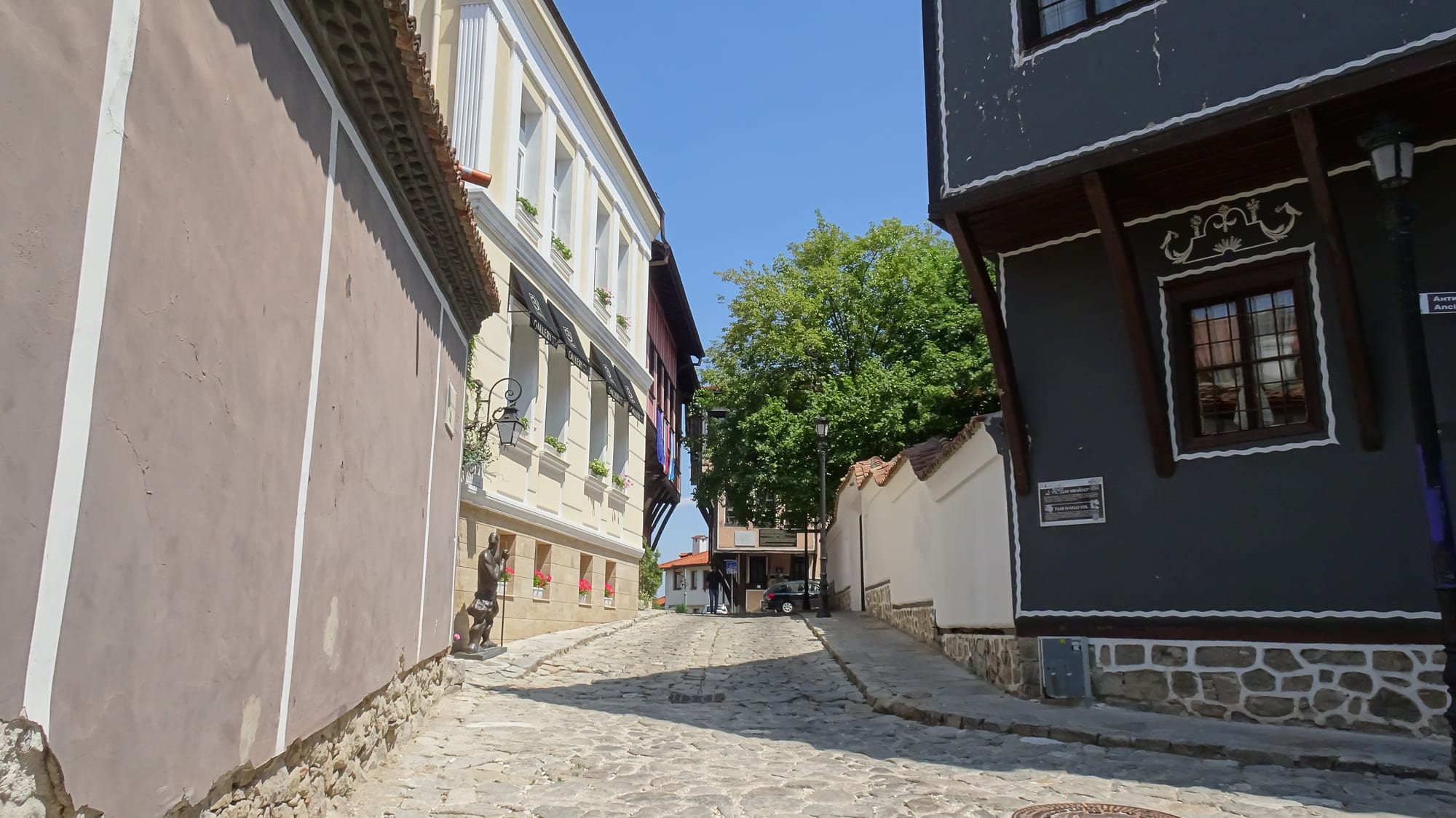
A cobbled lane in Plovdiv's Old Town between pastel Revival-era houses, one with dark painted walls and decorated eaves

Plovdiv & the Rhodopes, Bulgaria

Plovdiv

A pedestrian street in the Old Town of Plovdiv. (Νικόλαος Κυριακάκης / Wikimedia Commons · CC BY-SA 4.0)

Bulgaria's second city, built on syenite hills on both banks of the Maritsa River in the Upper Thracian Plain. Thracian Eumolpias, Philip II's Philippopolis and Roman Trimontium, it keeps a Roman theatre and stadium, a hilltop Old Town of 19th-century merchant houses and the Kapana arts quarter, and was a European Capital of Culture in 2019.

Neighbourhoods

  • Old Town
    • First-time visitors
    • Historic district
    • Museums

    The historic quarter spread over the Three Hills, a preservation site of 19th-century Revival houses, almost every one with its own decorated exterior. Cobbled lanes free of cars lead past house museums, galleries and churches to the Roman theatre and the Hisar Kapia gate, with views over the city from Nebet Tepe.

    Open in Maps
  • Kapana
    • Nightlife
    • Best for food
    • Arts and culture

    The small streets of the centre, known to locals as Kapana, 'the Trap', now the city's creative district of cafés, bars, craft workshops and galleries, and the liveliest area of Plovdiv after dark.

    Open in Maps
  • The centre and Main Street
    • Shopping
    • Close to public transport
    • Roman ruins

    Knyaz Alexander I Street, the pedestrian main street, runs through the centre past Dzhumaya Square, with part of the Roman stadium beneath it, and is lined with shops, cafés and restaurants; the Roman forum and Odeon are by the post office.

    Open in Maps
  • Trakiya
    • Local life
    • Quiet and residential

    A large residential district with apartment blocks, shopping centres and a railway station of its own.

    Open in Maps
  • North of the Maritsa
    • Local life
    • Parks

    The districts across the river, where the city has spread only within the last hundred years, linked to the centre by six bridges, among them a covered bridge.

    Open in Maps

Things to do

Roman Plovdiv

  • Roman theatrelandmark

    Probably the best-known ancient monument in Bulgaria, set in the saddle between two of the Three Hills; built with around 7,000 seats, it is in use again for plays, concerts and opera.

    Open in Maps
  • Roman stadiumlandmark

    A stadium modelled on the one at Delphi, most of it under the main street; 14 rows of seats at its northern end can be seen below Dzhumaya Square.

    Open in Maps
  • Roman Odeon and Forumlandmark

    The forum begun under Vespasian in the 1st century, and beside it the Odeon, built as the city council's chamber and later turned into a small theatre of 350 seats, restored in 2004.

    Open in Maps
  • Small Basilicalandmark

    The excavated remains of a 5th-century early Christian basilica on Knyaginya Maria Luiza Boulevard, found during building works in 1988.

    Open in Maps

The Old Town

  • Hisar Kapialandmark

    The famous gateway into the walled upper town, the entrance to the Old Town's lanes of Revival houses.

    Open in Maps
  • Nebet Tepeviewpoint

    The hill where the first settlement stood, which grew by the 12th century BC into the Thracian city of Eumolpias; its ruins look out over the city and the river.

    Open in Maps
  • Balabanov Housemuseum

    One of the best-known painted 19th-century merchant houses of the Old Town.

    Open in Maps
  • Regional Ethnographic Museummuseum

    The region's ethnographic museum, inaugurated in 1917 and housed in a Revival-era house in the Old Town.

    Open in Maps
  • Church of Saints Constantine and Helenalandmark

    One of the city's 19th-century Orthodox churches, standing in the Old Town.

    Open in Maps

Mosque, synagogue and museums

  • Dzhumaya Mosquelandmark

    A nine-domed Friday mosque on the square above the Roman stadium, first built in 1363–1364 after the Ottoman conquest and later replaced by the present building.

    Open in Maps
  • Plovdiv Synagoguelandmark

    A 19th-century Sephardic synagogue in what was once a large Jewish quarter, one of the best-preserved Ottoman-style synagogues in the Balkans, with a painted dome and a Venetian glass chandelier.

    Open in Maps
  • Cathedral of St Louislandmark

    The largest of Plovdiv's Roman Catholic churches.

    Open in Maps
  • Regional Archaeological Museummuseum

    Founded in 1882 as the People's Museum of Eastern Rumelia, with collections from prehistory to the early Ottoman period.

    Open in Maps

Parks and sport

  • Tsar Simeon Gardenpark

    One of the first parks in Bulgaria, the city garden in the centre, where the first work of the Italian sculptor Arnoldo Zocchi could be seen.

    Open in Maps
  • Plovdiv Sports Complex and rowing canalpark

    A large park in the west of the city around a 2 km rowing channel and the 55,000-seat Plovdiv Stadium, the largest football ground in Bulgaria, popular for jogging and walking.

    Open in Maps
  • Stadion Hristo Botevattraction

    Home of Botev Plovdiv, founded in 1912, whose Plovdiv derby with Lokomotiv Plovdiv is considered the second fiercest rivalry in Bulgarian football, after Sofia's Eternal derby.

    Open in Maps

Short trips from the city

  • Bachkovo Monasterylandmark

    About 30 km to the south, 10 km beyond Asenovgrad on the Chepelare River, a monastery founded in 1083 by Gregory Pakourianos, with old frescoes in its ossuary and an 1850 Doomsday fresco by Zahari Zograf.

    Open in Maps
  • Asen's Fortresslandmark

    A medieval fortress in the Rhodopes 2 to 3 km south of Asenovgrad, the town that takes its modern name from it.

    Open in Maps
  • Pamporovoattraction

    The Rhodopes' main ski resort, about 90 km to the south, set among spruce forest below the Snezhanka peak.

    Open in Maps

Seasonal events

  • Opera Opensummer

    Opera performances staged in the Roman theatre, with the Rhodopes as a backdrop.

  • Night/PlovdivSeptember

    One of the newer festivals in the city's cultural calendar, held each September.

  • Plovdiv International Fairannually

    The oldest and largest trade fair in south-eastern Europe, held since 1892 and drawing more than 600,000 visitors.

Eat and drink

Long-standing places and food districts in Plovdiv. Hours, ratings and directions come from your maps app, always current.

Plovdiv classics

  • Lyutenitsa and summer saladsrestaurant

    Summer tables are heavy with salads, roasted peppers and lyutenitsa, a relish of peppers and tomatoes.

    Open in Maps
  • Mavrud winerestaurant

    A late-ripening red grape that gives tannic, spicy wine, grown mainly around Asenovgrad and Perushtitsa.

    Open in Maps

Food districts and cafés

  • Kapananeighborhood

    The creative district of small streets in the centre, packed with cafés, bars and craft workshops.

    Open in Maps
  • Main Streetneighborhood

    The pedestrian main street, 1.8 km long and lined with cafés and restaurants.

    Open in Maps
  • Old Town restaurantsneighborhood

    Restaurants in and around the Revival houses on top of the hill, the most expensive places to eat in the city.

    Open in Maps

Experience Plovdiv

History

Plovdiv is among the oldest continuously inhabited cities in Europe. Pottery found on Nebet Tepe shows a settlement there by the end of the 4th millennium BC, which grew by the 12th century BC into the Thracian city of Eumolpias, later called Pulpudeva. In 342 BC Philip II of Macedon refounded it as Philippopolis, settling Thracians and 2,000 Macedonians there. Under Rome it was Trimontium, 'the three hills', capital of the province of Thracia, with a theatre for 7,000, a stadium modelled on Delphi's, a forum and baths. The Goths under Cniva sacked it in 250, but its walls were rebuilt and new basilicas went up in the 4th century.

The Bulgars took the city in the 9th century, and Byzantines and Bulgarians fought over it for centuries; in 969 Sviatoslav of Kiev sacked it. Geoffrey of Villehardouin described it as the third city of the Byzantine Empire, and after 1204 it was the capital of a Crusader duchy. The Ottomans conquered it in 1363 or 1364, and as Filibe it was the capital of Rumelia until Sofia replaced it in 1443, then a provincial centre and a rich trading city.

The Russians took it in January 1878, and the Congress of Berlin made it the capital of autonomous Eastern Rumelia. In 1885, after a campaign organised from the city by Zahari Stoyanov, Eastern Rumelia joined Bulgaria. The first Bulgarian fair was held here in 1892, and in the 20th century food processing, tobacco, brewing and textiles made Plovdiv an industrial city. The Old Town was restored and its Roman remains excavated in the 1970s and 1980s, and in 2019 Plovdiv was a European Capital of Culture, together with Matera.

Culture & Customs

Plovdiv is one of Bulgaria's main cultural and literary centres. Its Drama Theatre is the successor of the first professional theatre company in Bulgaria, founded in 1881; the Puppet Theatre, founded in 1948, is among the leading in its field; and the Trakiya Folklore Ensemble, founded in 1974, has toured more than 42 countries, while the Trakiya Traditional Choir has been nominated for a Grammy. The Roman theatre stages opera and concerts in summer, and the year's festivals include the theatre festival 'A Stage on a Crossroad', Night/Plovdiv in September and Kapana Fest.

The city has long been religiously mixed. Orthodox churches of the 19th century stand in the Old Town, the nine-domed Dzhumaya Mosque stands in the centre, the Sephardic synagogue survives from a once large Jewish quarter, and Catholic and Protestant churches serve smaller communities. In 1885 Bulgarians were half the population, beside Turks, Greeks, Jews and Armenians.

Football divides the city: Botev Plovdiv, founded in 1912, and Lokomotiv, founded in 1926, contest the Plovdiv derby, considered the second fiercest rivalry in Bulgarian football after Sofia's Eternal derby. The pedestrian main street, which runs for 1.8 km through the centre over the track of the Roman stadium, is the city's main shopping area, lined with shops, cafés and restaurants.

Daily Life

About 329,000 people lived in Plovdiv in 2024, and some 540,000 in the wider metropolitan area, which makes it Bulgaria's second city and its most densely populated. It is also the economic centre of the south: industry has expanded since the late 1990s, much of it in factories on the outskirts and in the Trakia Economic Zone, one of the largest industrial zones in Eastern Europe, alongside a fast-growing IT and outsourcing sector and rising tourism. The International Fair, held every year since 1892, draws hundreds of thousands of visitors.

Six universities, among them Plovdiv University and the Medical University, bring a large student population. Many live in blocks of flats: Trakiya, in the south-east, is the city's largest neighbourhood and one of the largest areas of blocks of flats in Bulgaria. Stolipinovo is the largest Roma neighbourhood in the Balkans, with around 20,000 people.

The car is common, with some 658 per 1,000 inhabitants, but the city also has an extensive network of cycle routes. Daily life centres on the pedestrian main street and the café terraces of Kapana, and on the park and rowing canal in the west, popular for jogging and walking.

Food

Plovdiv sits in a fertile part of the Upper Thracian Plain, and its food follows the produce. Summer tables are heavy with tomatoes, peppers and fruit: salads, roasted peppers and lyutenitsa, a relish of peppers and tomatoes. Shopska salad, diced tomato, cucumber and pepper under grated white sirene cheese, is often eaten as an appetiser with a glass of rakia, before grilled kebapche and kyufte, stuffed peppers or banitsa, the layered filo pastry with cheese and egg.

Wine is the region's pride. Mavrud, a late-ripening red grape that gives tannic, spicy wine, is grown mainly around Asenovgrad and Perushtitsa. From the mountains to the south come Rhodope dishes such as patatnik, grated potato and onion cooked slowly with mild mint, and the prized beans of the village of Smilyan.

The cafés, bars and small restaurants of Kapana make it the city's busiest place to eat and drink, the main street is lined with cafés, and the restaurants of the Old Town, at the top of the hill, are the city's priciest.

Planning tools

Budget

Prices in Plovdiv are close to the national average and a little lower than in Sofia. Meals, public transport and most museums cost little; the restaurants of the Old Town are the priciest in the city, and taxis are cheap if ordered by phone rather than taken from a rank.

Daily Budget Midrange
USD 75–140 (boutique hotel, restaurants and wine tastings, taxis or a hire car)
Daily Budget Shoestring
USD 35–55 (hostel bed, bakery and tavern meals, buses)

Order taxis by phone or app rather than taking one already waiting, which can cost several times more, and stay a night or two in the Rhodopes rather than only day-tripping.

Best Time to Visit

May, June, September and October, when the plain is warm rather than baking. July and August are hot, with highs averaging 33°C, but the Roman theatre hosts open-air opera and concerts. September brings the Night/Plovdiv festival; winters are cold and often misty along the river.

Suggested Number of Days

Two or three days suit a first visit to the city. Four to six allow time for the monasteries, wineries and villages of the Rhodopes to the south; winter roads in the mountains and the distances involved can add a day.

First Visit
2–3 days
With Surroundings
4–6 days

Transportation

The Old Town, Kapana and the centre are best on foot. Around 30 bus lines cover the rest of the city, which has no trams and closed its trolleybuses in 2012, and a network of cycle routes covers almost every district. Taxis are plentiful and cheap when ordered by phone.

Watch bags on crowded city buses, a favourite with pickpockets, and agree a price before taking a waiting taxi.

Airport & Station Connections

Plovdiv Airport, near the village of Krumovo south-east of the city, has a few low-cost flights. Sofia Airport is almost 150 km away, about an hour and a half by the Trakia motorway. Trains arrive at Plovdiv Central station, with the Yug and Rodopi bus stations a few minutes' walk away; buses run daily to Istanbul and to the Rhodope towns.

Walkability

Very walkable at its core: the main street, Kapana, the Roman ruins and the Old Town are all close together, and the Old Town is free of cars. The Old Town lanes are steep and cobbled, so comfortable shoes help; the outer districts are spread out and best reached by bus or bike.

Safety

Bulgaria is a safe country for visitors, with low levels of violent crime. The Old Town and main street are busy but safe; the main risks are pickpockets on crowded buses, and taxis waiting at ranks that overcharge.

Order taxis by phone, keep valuables close on crowded buses, and wear sturdy shoes on the Old Town's cobbles. Check current official travel advice before travelling.

Climate

Humid subtropical with strong continental influences, and four distinct seasons. Summer runs from mid-May to late September and is hot, moderately dry and sunny, with mild nights. Winter is cold, snow lies on about 15 days a year, and mist gathers along the Maritsa on about 33 days a year.

Summer
hot, moderately dry and sunny — July and August highs average 33°C, and nights are mild
Winter
cold, with a January average of about -0.4°C, frequent mist and some snow

Local Customs

Tips are not added to the bill, and 5–10 per cent is usual where service is good. Bulgarians often shake the head for 'yes' and nod for 'no'. Plovdiv has Orthodox and Catholic churches, an Ottoman mosque and a synagogue.

Dress modestly in churches and the Dzhumaya Mosque, remove shoes in the mosque, and ask before photographing services.

Common Payment Methods

The currency is the euro, which replaced the lev on 1 January 2026. Cards are widely accepted in shops, restaurants and hotels, and ATMs are easy to find, including at the Yug bus station; carry cash for small cafés, markets and taxis.