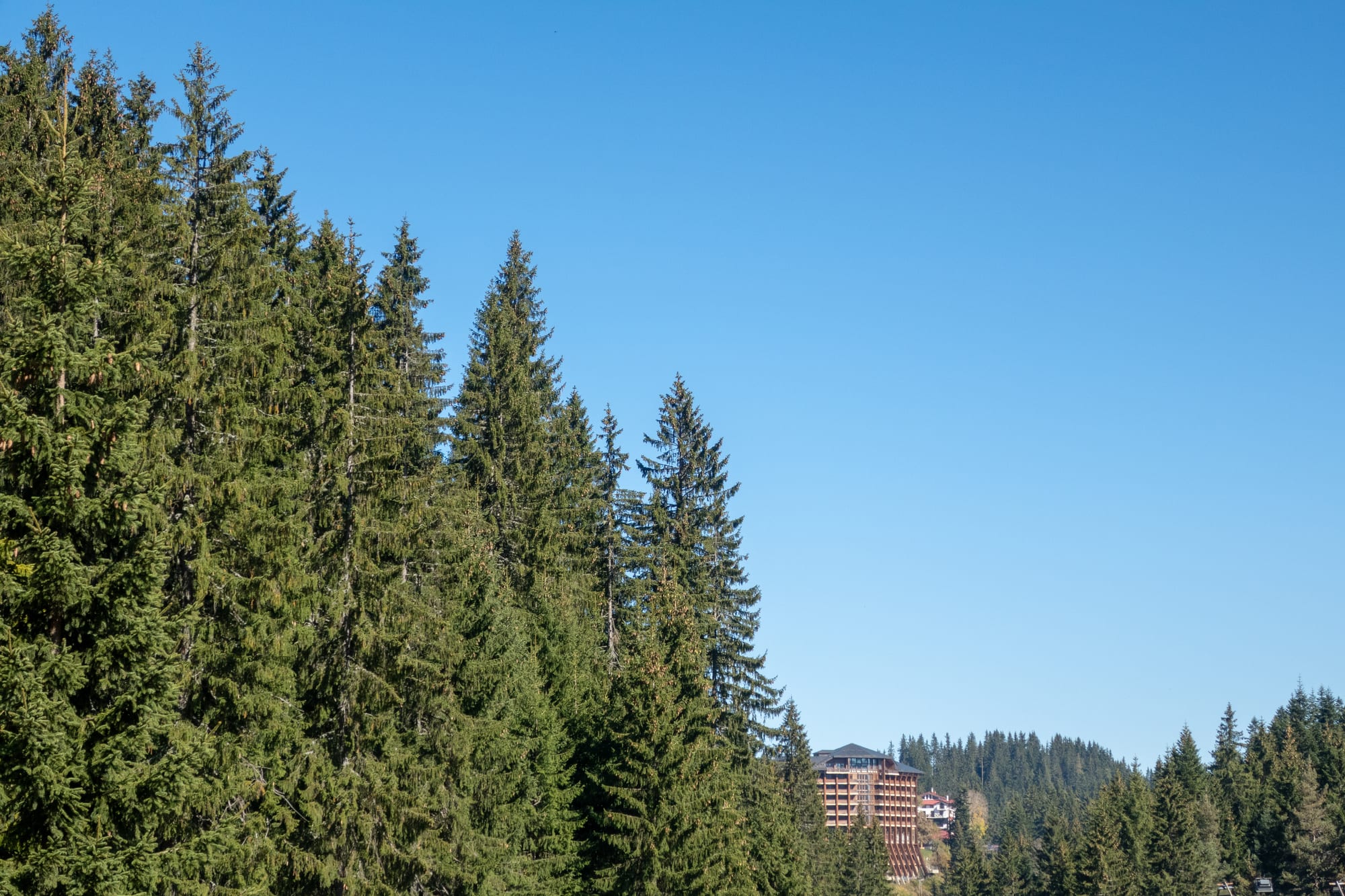
Tall dark-green spruce trees under a clear blue sky, with a multi-storey resort building among the forest

Plovdiv & the Rhodopes, Bulgaria

Pamporovo

Spruce forest around the resort buildings of Pamporovo in the Rhodope Mountains. (Vislupus / Wikimedia Commons · CC BY-SA 4.0)

A ski resort at about 1,650 metres in the Rhodope Mountains of southern Bulgaria, spread through spruce forest below Snezhanka Peak and its television tower. Established in the 1930s and known for gentle, sunny slopes suited to beginners and families, it fills with skiers from December to April and draws walkers and mountain bikers in summer.

Neighbourhoods

  • Resort centre
    • First-time visitors
    • Close to the lifts
    • Nightlife

    The older heart of the resort, north-east of Snezhanka, where most hotels, bars, restaurants, ski-hire shops and a small supermarket are gathered within walking distance of one another. Hotel minibuses run up to the ski centre in winter.

    Open in Maps
  • Snezhanka and the ski area
    • Skiing
    • Viewpoints

    The slopes that run down from Snezhanka Peak, at about 1,926 metres, where almost all the pistes begin. The television tower on the summit has a café and a view over the Rhodopes, Rila and Pirin, and in summer the same slopes carry mountain-bike trails.

    Open in Maps
  • Smolyan Lakes side
    • Quiet and residential
    • Skiing

    The southern side of the resort, around the Smolyan Lakes ski lift, faces south towards the Greek border. Newer residential development has grown up here, and over the ridge lies Ezerovo, a suburb of Smolyan.

    Open in Maps

Things to do

Landmarks and viewpoints

  • Snezhanka Towerviewpoint

    A 156-metre concrete television tower on Snezhanka Peak, completed in 1978, with an observation deck and café looking over the Rhodope, Rila and Pirin mountains and, on a clear day, the Aegean.

    Open in Maps
  • Dormition of the Mother of God Churchlandmark

    An Orthodox church built between 1993 and 1999 with donations from a campaign run on Bulgarian National Television, an unusual, almost futuristic take on neo-Byzantine architecture.

    Open in Maps

Mountain sports and walks

  • Pamporovo ski areaattraction

    About 55 km of pistes and 38 km of cross-country tracks served by 18 lifts, with most runs starting from Snezhanka; the gentle slopes have made the resort a favourite for beginners and intermediate skiers.

    Open in Maps
  • Pamporovo bike parktrail

    A mountain-bike park opened in 2012 that, with the Mechi Chal zone, offers more than 50 km of trails and has hosted European downhill and 4X championships.

    Open in Maps
  • Rozhen Observatoryattraction

    Bulgaria's National Astronomical Observatory, opened in 1981 on the Rozhen heights north-east of the resort, whose largest telescope has a two-metre mirror.

    Open in Maps

Short trips from the resort

  • Chepelareattraction

    A small town on the Chepelare River to the north, with its own ski run, among the longest in south-eastern Europe, and a ski and snowboard factory.

    Open in Maps
  • Smolyanattraction

    The provincial capital to the south, strung along the narrow valleys of the Cherna and Byala rivers below Golyam Perelik, the highest peak of the Rhodopes.

    Open in Maps
  • Marvelous Bridgespark

    Natural rock arches over the karst valley of the Erkyupriya River in the western Rhodopes, at about 1,450 metres.

    Open in Maps
  • Trigrad Gorgepark

    A canyon of vertical marble walls up to about 300 metres high, protected since the early 1960s, where the Trigradska River vanishes underground.

    Open in Maps
  • Devil's Throat Caveattraction

    A cave branching from the Trigrad Gorge, where a powerful waterfall plunges into the mountain and the river disappears into an underground system.

    Open in Maps
  • Yagodinska Caveattraction

    The longest cave in the Rhodopes, about 10.5 km in all, named after the nearby village of Yagodina and home to eleven species of bat.

    Open in Maps

Seasonal events

  • Ski seasonDecember to April

    The main season, when nearly all the resort's visitors come for skiing and snowboarding; it opens in December and runs almost to the end of April.

  • Rozhen National Folklore Fairevery four years

    A great gathering of folk singers, dancers and bagpipers on the Rozhen meadows nearby, first held in 1898 and now the largest folk song festival in Bulgaria.

Eat and drink

Long-standing places and food districts in Pamporovo. Hours, ratings and directions come from your maps app, always current.

Pamporovo classics

  • Mehanas and folk eveningsrestaurant

    Tavern-style restaurants serving Rhodope and Bulgarian dishes; folk-feast evenings offer spit-roasted lamb with traditional music and dancing.

    Open in Maps
  • Snezhanka Tower cafécafe

    The café in the disc at the top of the television tower, known for its panorama across three mountain ranges.

    Open in Maps

Food districts

  • Resort centre restaurantsneighborhood

    Restaurants and bars clustered around the resort centre, with cafés and snack places on the slopes for lunch between runs.

    Open in Maps
  • Chepelareneighborhood

    The nearest town to the north, with everyday Bulgarian restaurants away from the resort.

    Open in Maps

Experience Pamporovo

History

Pamporovo was established as a mountain resort in the 1930s, on the northern side of a ridge of the Rhodopes below Snezhanka Peak, among spruce forest between the town of Chepelare to the north and Smolyan to the south. Its gentle slopes and sunny winters made it a natural place for skiing, and it grew into one of the best-known resorts in the country.

Under communism the resort was renamed. From 14 March 1950 it officially bore the name of Vasil Kolarov, and the old name, Pamporovo, came back into use only after 1989. Bulgarian television began broadcasting from Snezhanka Peak in 1971, and construction of the present 156-metre tower began in 1973. It opened to the public in 1978 and became the resort's symbol.

Since the end of communism Pamporovo has been extended with new lifts, runs and residential development on its southern side towards the Smolyan Lakes. In 2010 a new border crossing to Greece opened about half an hour away, bringing attention to a resort where skiing and the sea lie unusually close together. A mountain-bike park followed in 2012, and in 2013 the resort hosted European championships in downhill and 4X racing. Larger plans to link Pamporovo with the slopes of Mechi Chal near Chepelare and with Perelik have been discussed since the 1990s.

Culture & Customs

Pamporovo itself is a resort rather than a historic settlement, but it sits in the middle of one of the most distinctive musical regions of Bulgaria. The Rhodopes are the home of the kaba gaida, a deep-voiced bagpipe, and the nearby village of Stoykite has held a national gathering of bagpipers since 2018 and has a small bagpipe museum, created in 2022. Every four years the meadows of Rozhen, a short way north-east of the resort, host the Rozhen National Folklore Fair, first held in 1898, when the border with the Ottoman Empire ran across the peak. It opens with "Bela Sam Bela Yunache", the unofficial anthem of the Rhodopes, and reaches its climax with an evening of the best-known Rhodope songs sung under the stars.

The surrounding province is religiously mixed. Smolyan Province has both Christian and Muslim communities; unlike in neighbouring Kardzhali Province, most of its Muslims are Muslim Bulgarians, known as Pomaks, who mainly live in the Rhodope Mountains.

In the resort, culture is the culture of a ski holiday: ski schools with more than a hundred instructors working in several languages, families on the nursery slopes, and folk evenings where spit-roasted lamb is served to live traditional music and dancing. The Orthodox church in the resort, was built between 1993 and 1999 with donations from a campaign popularised by Bulgarian National Television.

Daily Life

Pamporovo has no permanent town population to speak of; it is a resort complex that lies partly in Smolyan Municipality and partly in Chepelare Municipality. In 2020 it had about 6,100 beds in 60 places to stay, and recorded about 410,000 overnight stays by about 120,000 guests, which places it among the largest mountain resorts in Bulgaria.

Work follows the seasons. From December to almost the end of April the resort is busy with ski instructors, lift staff, hire shops, hotel and restaurant workers. In summer a smaller crowd of walkers, families and mountain bikers keeps part of the resort open. Across Smolyan Province, the economy rests on tourism, mining, timber and machine industries, and livestock raising.

A winter day starts early, with hotel minibuses carrying skiers to the lifts, and ends with the bars and restaurants of the resort centre filling after the slopes close. Off season the resort is quiet. Long-discussed plans to link Pamporovo with neighbouring ski areas, and the expansion of residential building, are the main questions about its future.

Food

Pamporovo's restaurants serve Bulgarian and Rhodope cooking alongside the international dishes of any ski resort. Patatnik, the best-known local dish, is made of grated potatoes, onions, salt and gyosum, a very mild mint, all mixed and cooked slowly; it is traditional across the Rhodopes, from Bansko to Smolyan and Zlatograd. Smilyanski fasul is a stew of the beans of Smilyan, a village in Smolyan Municipality known for its premium beans, produced in limited quantities.

Cheverme is the dish of celebrations: a whole animal, traditionally a pig but also a lamb, slowly cooked over an open fire and turned by hand on a wooden spit for four to seven hours. Folk evenings in and around the resort serve spit-roasted lamb with traditional music and dancing.

Elsewhere the menus follow the national pattern of shopska salad under grated sirene cheese, grilled kebapche and kyufte, banitsa pastry and clay-pot gyuvech, and plenty of yoghurt, of which Bulgarians eat a great deal. Rakia, the fruit brandy, is the usual spirit. On the slopes, cafés and snack places serve lunch between runs, and the café at the top of Snezhanka Tower adds a view of three mountain ranges.

Planning tools

Budget

Pamporovo costs more than the surrounding Rhodope villages, above all in winter, when hotel rooms, lift passes and ski hire make up most of the bill. Summer is cheaper and quieter. Apartments can be rented all year, and meals in the mehanas stay good value by Western European standards.

Daily Budget Midrange
USD 110–200 (resort hotel, lift pass and ski hire in winter, restaurant dinners, a hire car)
Daily Budget Shoestring
USD 45–75 (apartment or guesthouse room, mehana meals, local transport)

Prices peak over the Christmas and New Year holidays; the walking trails and the views from Snezhanka are free in summer.

Best Time to Visit

December to March for skiing, when snow cover is most reliable; the season can run almost to the end of April. The resort is known for its sunny winters. July and August suit walking and mountain biking, as the mountains stay cooler than the plain around Plovdiv. Late autumn and spring are the quietest months.

Suggested Number of Days

Two or three days give time for the resort and the mountain around it. A ski week of five to seven days is usual in winter, and a similar stay in summer leaves time for the caves, gorges and villages of the surrounding Rhodopes, which are slow to reach by road.

First Visit
2–3 days
With Surroundings
5–7 days

Transportation

The resort is small, and many places are within walking distance of one another. In winter, hotels run minibuses to and from the ski centre several times each morning and evening, buses link the centre and the ski area through the afternoon, and taxis are plentiful at night. A car is the practical way to reach the caves, gorges and villages around.

Mountain roads around the resort are narrow and winding; carry chains or fit winter tyres from December to March.

Airport & Station Connections

The nearest airport is Plovdiv, which serves the Rhodope ski resorts mainly with winter charter flights; Sofia Airport has far more connections. Pamporovo is about 85 km south of Plovdiv, roughly two hours on winding mountain roads, and about 260 km from Sofia. The resort road meets the road between Smolyan and the Plovdiv area at Stoykite, about 8 km west, and a border crossing into Greece opened in 2010 about half an hour's drive away.

Walkability

The resort centre is compact and easy to walk, with shops, bars and restaurants close together. The ski area and the outlying parts of the resort are spread across a forested mountainside, so most people use the hotel minibuses or a car between them. Paths through the spruce forest make good walking in summer; in winter roads and pavements can be icy.

Safety

Bulgaria is a safe country for visitors, with low levels of violent crime. In Pamporovo the main risks are those of the mountains: icy roads, fog, falls on the slopes, and sudden changes of weather on Snezhanka. Off-piste and ski-touring routes need local knowledge.

Ski within marked pistes, use the resort's instructors when learning, and drive mountain roads in daylight. Check current official travel advice before travelling.

Climate

A mountain climate with a mild winter for the altitude: the resort records more than 100 sunny days in winter, more than any other Bulgarian mountain resort, and the average annual temperature is about 5.5°C. Snow covers the slopes from December into spring.

Summer
cool to mild for the altitude, with an annual average of about 5.5°C
Winter
moderately cold — January averages about −3°C, with regular snow and many sunny days

Local Customs

Bulgarians often shake the head for 'yes' and nod for 'no'. Smolyan Province has both Christian and Muslim communities, the Muslims mostly Muslim Bulgarians (Pomaks).

Dress modestly and keep quiet in churches and mosques, and ask before photographing people in the villages.

Common Payment Methods

The currency is the euro, which replaced the lev on 1 January 2026. Cards are widely accepted in Bulgaria, but cash is useful for small cafés, village shops and markets in the Rhodopes.