Attractions & Natural Wonders · Democratic Republic of the Congo
Why does Congo's Mount Nyiragongo so often hold the biggest lava lake on Earth?
A huge summit crater, an Africa-splitting rift and some of the runniest lava known have often made Nyiragongo's lake the largest of its kind, though not always.
By Globeway Editorial · 2 November 2026
The short answer
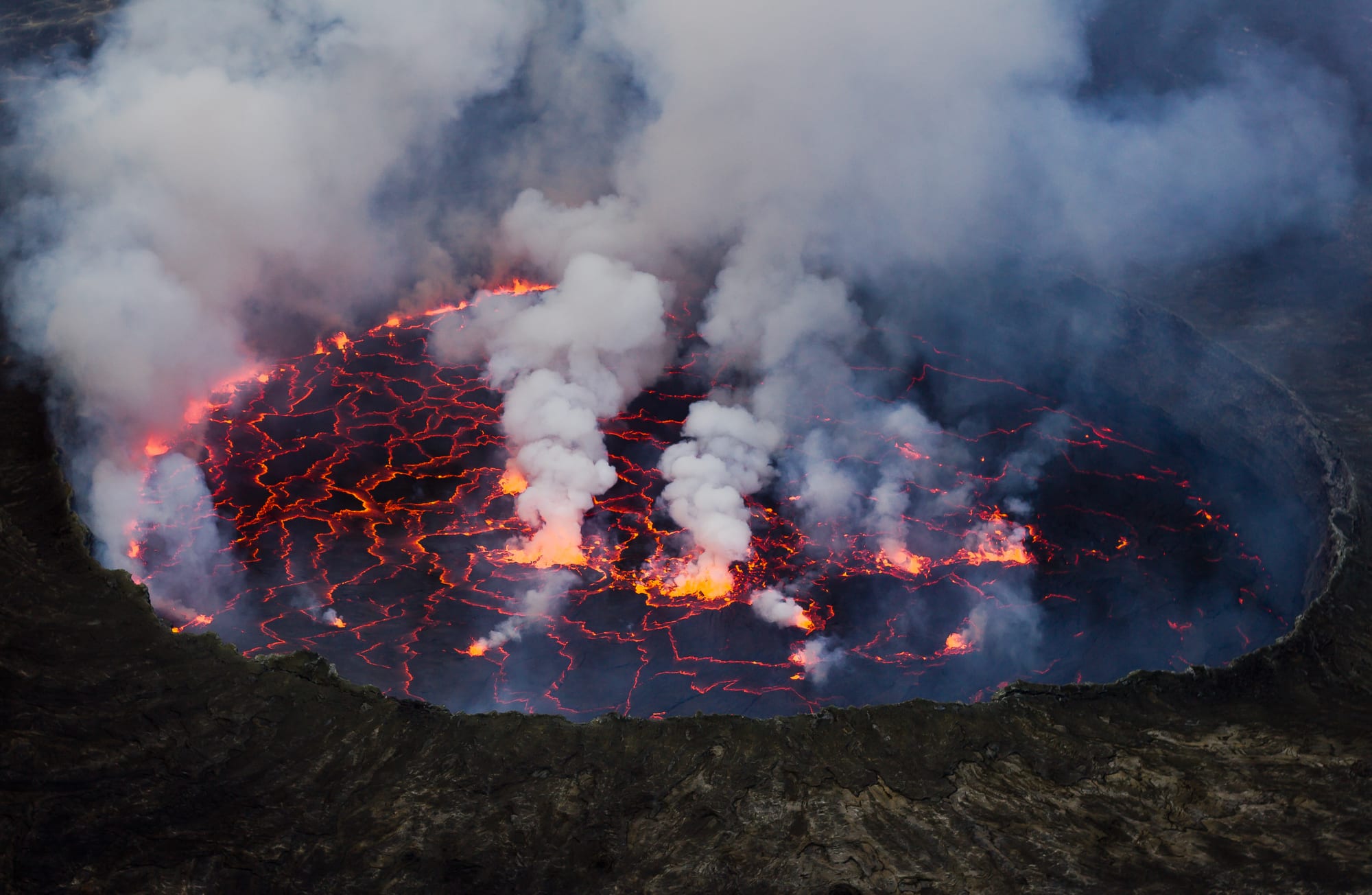
Mount Nyiragongo, a 3,470-metre volcano about 12 kilometres north of the city of Goma, sits on the western branch of the East African Rift, where the African continent is slowly pulling apart. Its summit crater is about two kilometres wide, and the lava that feeds it is unusually poor in silica, which makes it extraordinarily runny. A wide basin, a steady supply of magma from below and lava fluid enough to stay open and churning together allow a true lake of molten rock to collect at the top of the mountain. In 1982 it reached 700 metres across, and before the eruption of 1977 it was around 600 metres deep.
The title "biggest on Earth" needs a qualifier. Nyiragongo's lake has usually been the largest and most voluminous known in recent history, but not permanently and not in every age: it has drained completely several times, and Masaya in Nicaragua is believed to have held an even wider lake, about 1,000 metres across, in 1670. Nyiragongo's lake is best described as the record-holder of modern times, and a lake that comes and goes.
A crack in a continent
The volcano belongs to the Virunga Mountains, a branch of the Albertine Rift, which is itself the western arm of the East African Rift. Along this rift the African plate is in the process of splitting in two, into the Somali and Nubian plates, at a rate of 8 to 9 millimetres a year. Where the crust stretches and thins, molten rock rises towards the surface, and the Virunga range is one result. Nyiragongo and its neighbour Nyamuragira are together responsible for 40 per cent of Africa's historical volcanic eruptions.
That constant supply of magma is the first ingredient of a lava lake. Lakes like this are rare: they need a vent that stays open to a magma reservoir for years, so that molten rock keeps circulating at the surface instead of cooling into a plug. Only a handful of volcanoes have held persistent or near-persistent lakes in recent decades, among them Erta Ale in Ethiopia, Mount Erebus in Antarctica, Kīlauea in Hawaiʻi and Masaya in Nicaragua.
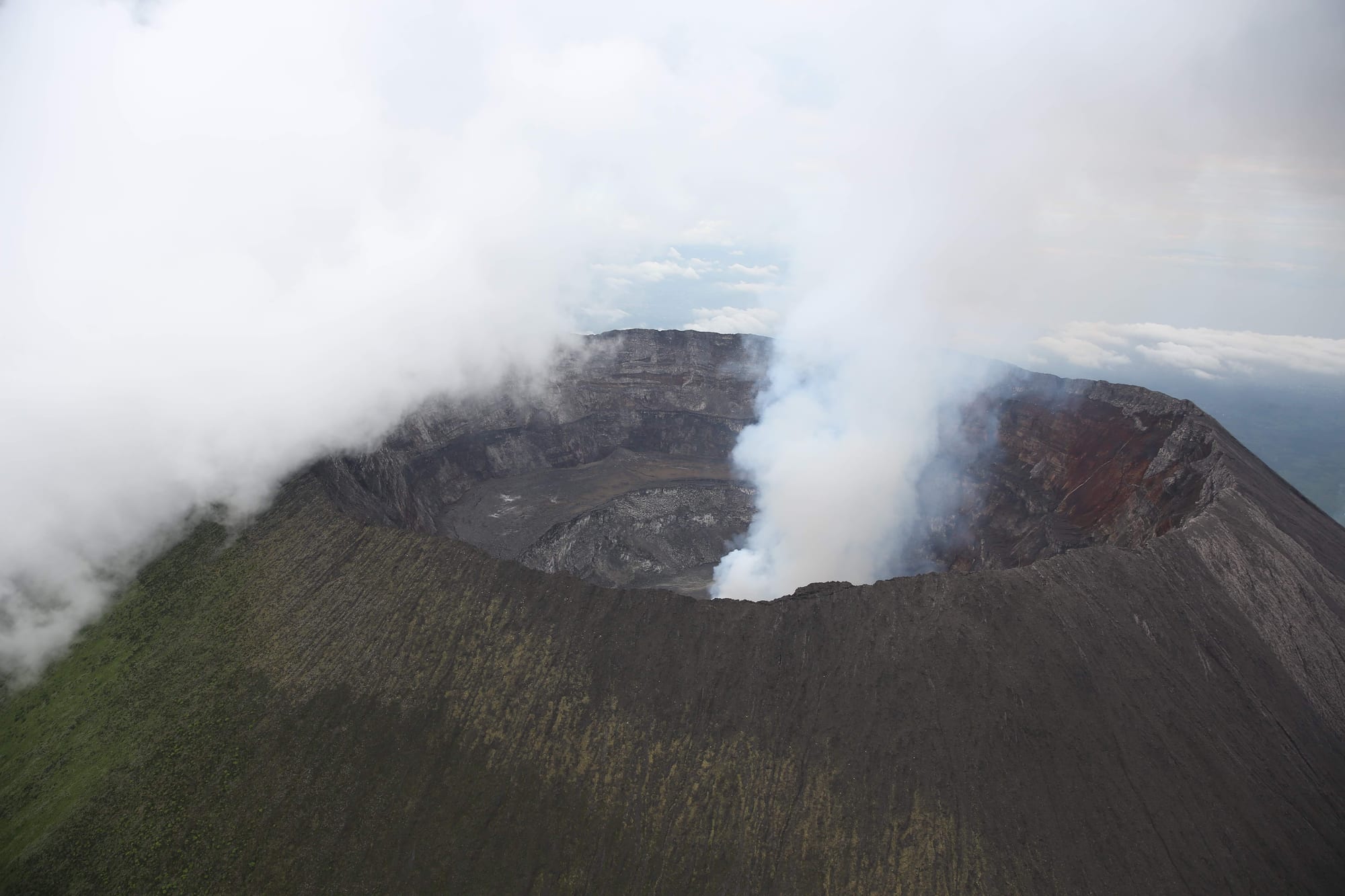
The steps inside the crater are cooled lava benches, left at about 3,175 and 2,975 metres as the lake rose and fell.
Some of the runniest lava on the planet
The second ingredient is the lava itself. Silica, the oxide of silicon, links up into chains inside molten rock and makes it thick and sticky: lava high in silica is far more viscous, or resistant to flow, than lava low in it. Nyiragongo's lavas are ultramafic, the lowest-silica class of all, and rich in alkali elements. They are essentially free of feldspars, the minerals that make up about 60 per cent of the Earth's crust, and are built instead from rarer minerals such as nepheline, leucite and melilite. Even neighbouring Nyamuragira erupts a more silica-rich lava.
This chemistry produces flows of unusual fluidity. Most lava moves slowly and rarely threatens human life, but Nyiragongo's has been reported racing downhill at up to 100 km/h (60 mph). In a crater, the same runniness lets a broad pool stay liquid while gas bubbles rise through it and burst at the surface. The top cools into a dark crust that cracks into glowing plates as the hotter lava beneath keeps moving.
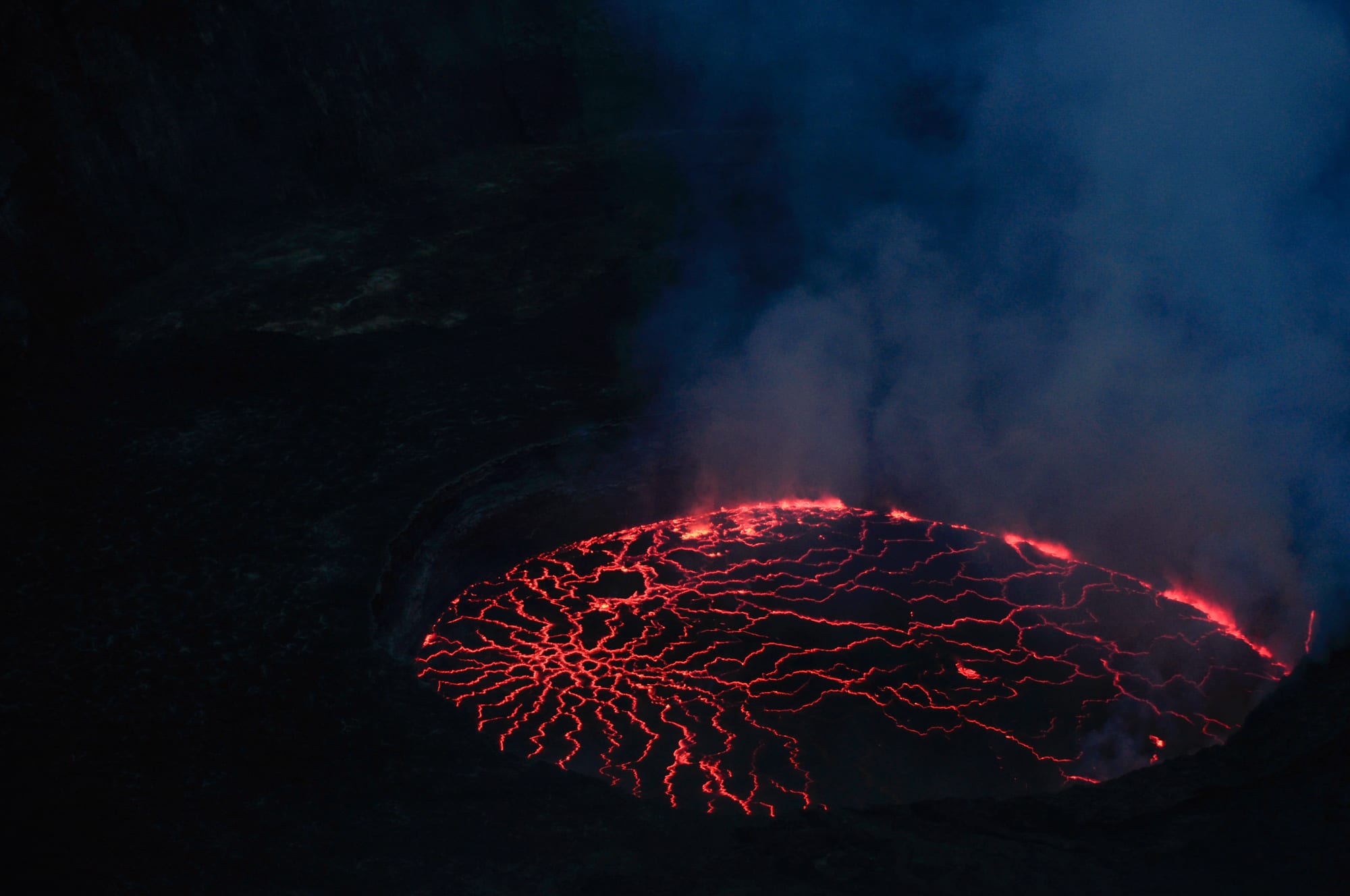
By 2020 the lake was largely contained within a steep-sided cone about 18 metres high and 180 metres wide on the crater floor.
A lake that fills and empties
The size of the lake has never been fixed. Its existence had long been suspected, but it was not confirmed scientifically until 1948, when it measured nearly 120,000 square metres. Later expeditions found it constantly changing in size, depth and temperature.
- 1894
An active lava lake occupies the crater, and remains for more than eighty years.
- 1948
The lake is scientifically confirmed for the first time.
- 10 January 1977
The crater walls fracture and the lake drains in under an hour; lava kills at least 50 people in nearby villages.
- 1982
The lake re-forms and reaches 700 metres across.
- 17 January 2002
A 13-kilometre fissure opens on the southern flank and lava flows through Goma.
- 22 May 2021
A new flank eruption sends lava towards the northern outskirts of Goma.
That is the dark side of the very fluidity that builds the lake. When the crater walls or the volcano's flanks crack, the lake can empty in minutes. In 1977 the lava ran down the upper slopes at up to 60 km/h, the fastest lava flow recorded. In 2002 around 400,000 people were evacuated from Goma, lava covered 13 per cent of the city and about 245 people died. After that eruption the lake's surface stood at about 2,600 metres, some 900 metres below the rim, before slowly rising again. Because of this danger, Nyiragongo was named a Decade Volcano in 1991, one of a group singled out for particular study.
Living beneath it
Goma, the capital of North Kivu province, lies only 13 to 18 kilometres south of the summit, on the northern shore of Lake Kivu. The lava is only part of the hazard. Carbon dioxide seeps from the ground across the volcanic field and gathers in low, windless hollows that local people call mazuku, where it has killed livestock and children. Volcanologists also watch Lake Kivu, whose deep waters hold dissolved gas, after lava reached its shore in 2002.
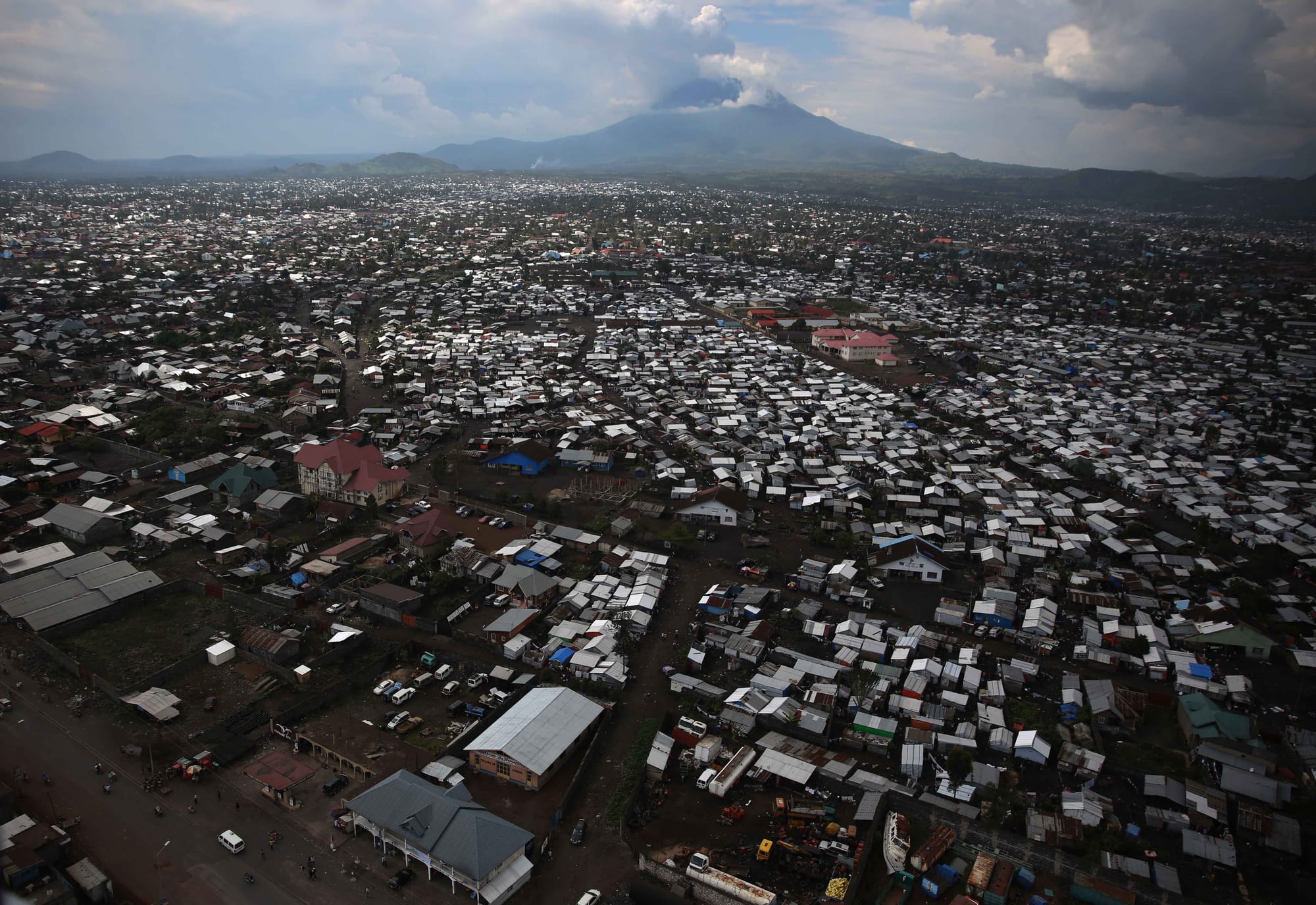
After the 2021 eruption, authorities considered moving parts of Goma to the town of Sake, a costly plan that would be hard to sell to long-time residents.
Seeing the lake today
Nyiragongo lies inside Virunga National Park, created in 1925 as the Congo's first national park, and the classic visit is an overnight climb to the crater rim to watch the lake glow in the dark. Access depends on security. The M23 rebel movement seized Goma in early 2025, and as of 2026 it holds the volcano deep within the territory it controls; fighting in the east has continued despite peace agreements signed in 2025. Whenever the climb reopens, what waits at the top will depend on how far the lake has refilled since its last eruption.