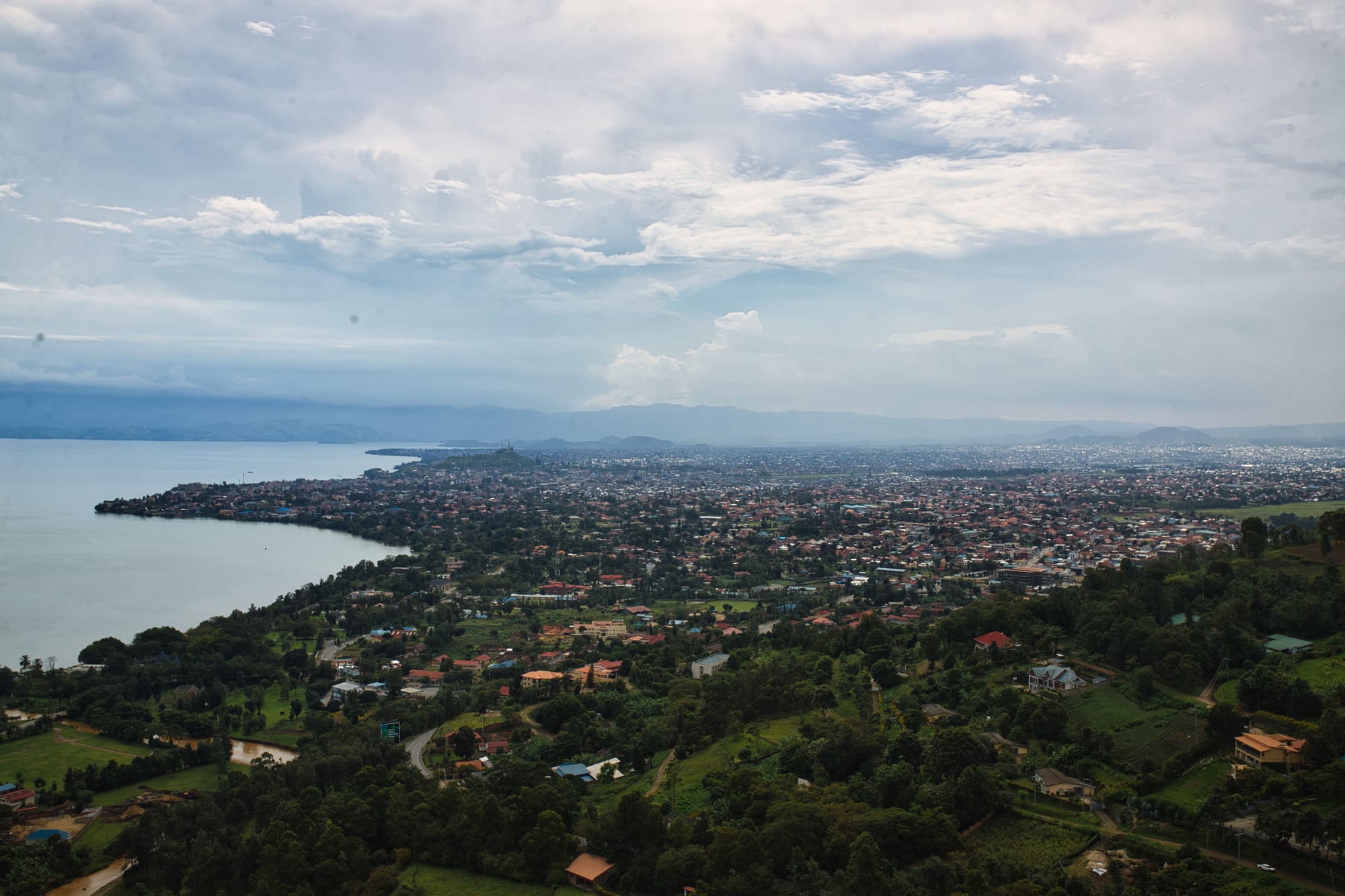
A wide town of red and silver roofs spreading along the shore of a grey-blue lake, with green hills and cloud above

Goma, Bukavu & the Kivus, Democratic Republic of the Congo

Goma

Goma spread along the northern shore of Lake Kivu, seen from the hills on the Rwandan side of the border. (Ericnkurunziza / Wikimedia Commons · CC BY-SA 4.0)

The capital of North Kivu province, built on old lava flows between the northern shore of Lake Kivu and the Nyiragongo volcano, beside the Rwandan border. Long the gateway to Virunga National Park and its gorillas, it has also been at the centre of the eastern conflict, and was taken by the M23 in January 2025. This page is written to explain the city, not to encourage travel.

Neighbourhoods

  • Le centre-ville and the Boulevard Kanyamuhanga
    • First-time visitors
    • Offices and banks

    The administrative and commercial core of Goma commune, with provincial offices, banks, churches and the headquarters of aid organisations along wide avenues laid out in the colonial period. Much of it was rebuilt after the 2002 lava flow cut through the town.

    Open in Maps
  • Birere
    • Markets
    • Local life

    The dense trading quarter beside the Grande Barrière crossing to Rwanda, a grid of narrow lanes packed with stalls, small workshops, bars and money changers. It is the busiest and noisiest part of the city and the first thing many arrivals see.

    Open in Maps
  • Himbi and the lakeshore
    • Quiet and residential
    • Lake views

    The western lakeside quarter of villas, compounds and hotel gardens running down to Lake Kivu, home to much of the expatriate and business population. Boats for the lake leave from jetties along this shore.

    Open in Maps
  • Katindo and Mabanga
    • Local life
    • Quiet and residential

    Residential quarters north-west of the centre, mixing brick and volcanic-stone houses, small churches, schools and street-corner shops. They stand on the lava fields, and black rock shows through gardens and unpaved roads.

    Open in Maps
  • Karisimbi
    • Local life
    • Markets

    The larger and poorer of Goma's two communes, spreading north towards the volcano with crowded neighbourhoods such as Majengo and Ndosho. Its population has grown enormously with people displaced from the countryside.

    Open in Maps
  • Mugunga and the western edge
    • Local life

    The far western approach to the city on the Sake road, where large displacement camps have stood at various times and traffic to and from Masisi passes. It is residential, informal and closely tied to the movement of people in North Kivu.

    Open in Maps

Things to do

The lake and the city

  • Lake Kivuattraction

    The deep rift lake that Goma is built beside, shared with Rwanda, known for its clear water, its fishing pirogues and the dissolved gases held in its depths.

    Open in Maps
  • Goma International Airporttransit hub

    The city's airport, built on the plain east of the centre, where the 2002 lava flow covered part of the runway; its operating status follows the security situation.

    Open in Maps
  • Gisenyiattraction

    The Rwandan lakeside city in Rubavu district, a short distance from central Goma across the border, with a resort on the shore of Lake Kivu, several hotels and three sandy beaches.

    Open in Maps

Volcanoes and Virunga

  • Mount Nyiragongolandmark

    The steep-sided volcano that rises directly north of the city, whose crater holds one of the world's few long-lived lava lakes and whose eruptions in 1977, 2002 and 2021 sent lava towards Goma.

    Open in Maps
  • Virunga National Parkpark

    Created in 1925 as the Congo's first national park, a UNESCO World Heritage Site since 1979 and on the List of World Heritage in Danger since 1994, reaching from the volcanoes above Goma to Lake Edward and the Rwenzori; Goma has long been its main gateway.

    Open in Maps
  • Mount Nyamuragiralandmark

    The shield volcano north-west of Nyiragongo, among the most frequently active volcanoes in Africa, whose lava fields cover much of the plain behind the city.

    Open in Maps
  • Virunga Mountainslandmark

    The chain of eight volcanoes along the Congo–Rwanda–Uganda borders, visible from Goma on clear days and the habitat of the mountain gorilla.

    Open in Maps

Short trips from the city

  • Rumangaboattraction

    A military base on the road north from Goma, a few kilometres from Virunga National Park's headquarters, on the way towards the Mikeno sector.

    Open in Maps
  • Mount Mikenolandmark

    The jagged extinct volcano on the Congolese side of the Virungas whose forested slopes hold the country's mountain gorilla families, reached when the park allows visits.

    Open in Maps
  • Sakeattraction

    A small town west of Goma at the north-western corner of Lake Kivu, the junction for the roads into Masisi and a place repeatedly caught up in the fighting.

    Open in Maps
  • Idjwiattraction

    The long inhabited island in the middle of Lake Kivu, belonging to South Kivu, with hills of banana groves and coffee and a reputation for calm.

    Open in Maps

Eat and drink

Long-standing places and food districts in Goma. Hours, ratings and directions come from your maps app, always current.

Goma classics

  • Sambaza and grilled tilapiarestaurant

    Tiny sardine-like sambaza from Lake Kivu, fried whole by the handful and eaten as a bar snack, and lake tilapia grilled or stewed, are the dishes the city is known for.

    Open in Maps
  • Brochettes and chipsrestaurant

    Skewers of goat or beef grilled over charcoal with fried potatoes or fried plantain, the standard evening meal in the bars along the main avenues.

    Open in Maps

Markets and food streets

  • Birere market streetsneighborhood

    The trading quarter by the border crossing, where produce from the Masisi hills, imported goods from Rwanda and Uganda and cooked street food are sold from stalls and shopfronts.

    Open in Maps
  • Kituku lakeside marketmarket

    The fishing and produce landing on the western lakeshore, where boats bring in fish and sacks of beans, potatoes and bananas from around the lake.

    Open in Maps
  • Lakeside cafés in Himbicafe

    The hotel terraces and cafés on the western shore serve Kivu arabica coffee, grilled fish and bottled beer with a view over the water.

    Open in Maps

Experience Goma

History

Goma grew from a small settlement on the lava plain at the north end of Lake Kivu into a colonial-era border and trading post, laid out opposite Gisenyi on the Rwandan side and serving the coffee, tea and quinine estates of the Belgian-ruled highlands. Its position at the foot of the volcanoes and on the lake made it the administrative centre of the Kivu highlands, and after independence it became the capital of North Kivu province.

The city's modern history has been dominated by what has arrived from across the border. In 1994, after the genocide in Rwanda, hundreds of thousands of refugees poured into camps on the lava fields around Goma, and a cholera epidemic killed thousands within weeks; the camps also sheltered soldiers and militiamen who had taken part in the killing, and their presence drew the rebellion that swept the country in 1996. The Second Congo War began from Goma in 1998, and for years the city was held by rebel movements rather than by Kinshasa.

Nature has been almost as disruptive. Nyiragongo erupted in 1977 and again in January 2002, when lava poured through the centre of the city, destroyed a large part of the built-up area and covered the northern end of the airport runway; a further eruption in May 2021 destroyed houses on the northern edge and prompted a mass evacuation. The M23 briefly took Goma in November 2012, and in January 2025 the group captured the city again after heavy fighting. Goma today is far larger than its infrastructure was ever designed for.

Culture & Customs

Goma is a young, crowded and unusually mixed city. Congolese Swahili is the language of the street, French is used in offices and schools, and Kinyarwanda, Kinande, Kihunde and Mashi are heard in the markets, reflecting communities from across the Kivus and from over the border. Questions of land, origin and belonging run through social life here as they do through the wider region.

Churches are at the centre of the week — Catholic and Protestant congregations above all, alongside fast-growing Pentecostal churches whose choirs and all-night services are a familiar part of the soundscape — and they also run many of the schools and hospitals. Aid agencies and the United Nations mission have had a large presence for decades, which has shaped the city's economy, its rents and its social divides.

For all that, Goma has one of the liveliest creative scenes in the country. Musicians, rappers, dancers, painters and photographers work in studios and cultural centres around the centre, the annual Festival Amani has brought performers each February from across the region to the city, and film and theatre collectives have documented life in the Kivus for audiences elsewhere. Football is followed intensely, bars along the main avenues fill in the evenings, and residents speak of their city with a defiant pride that sits alongside a long and clear-eyed familiarity with crisis.

Daily Life

Goma has grown from a town of tens of thousands at independence to a city of some 782,000 people in 2024, swollen repeatedly by arrivals from the countryside; the displaced live in camps on the western and northern edges and with host families across the two communes, Goma and Karisimbi. The result is a city of unpaved lava streets, dense quarters of small plots, and a handful of lakeside avenues of villas and hotels.

The economy runs on trade, transport and services. Goods cross the Rwandan border at the Grande Barrière and Petite Barrière in both directions all day, produce comes down from the Masisi and Rutshuru hills, minerals from artisanal sites in North Kivu pass through traders' offices, and aid organisations, banks, schools and small workshops employ much of the formal workforce. A great many people live by daily trade, portering and motorbike taxi work.

Days start early, with markets open at first light and motorbikes crowding the roundabouts. Electricity and water supplies are intermittent, and generators and jerrycans are part of every household's arrangements. Since the events of early 2025 the city's administration, banks, flights and border traffic have all been affected, and the humanitarian situation in and around Goma — displacement, shortages and disease outbreaks — remains the defining feature of daily life for a large part of the population.

Food

Goma eats what the Kivu highlands grow. Beans, potatoes, sweet potatoes, cooking bananas and maize come down from Masisi and Rutshuru, and the staple plate is ugali, a stiff dough of maize or cassava flour, eaten with a sauce. Sombe — cassava leaves pounded and simmered long with palm oil, groundnut or small dried fish — appears at most meals, as does a thick bean stew, and matoke, steamed cooking banana, is common.

The lake supplies the city's best-known dishes. Sambaza, small sardine-like fish found in Lake Kivu, are fried whole and eaten by the handful with a squeeze of lime as a bar snack, and tilapia is grilled over charcoal or cooked in a tomato sauce. Goat and beef brochettes grilled at roadside braziers, served with fried potatoes or plantain, are the standard evening street food, and everything is seasoned with pili-pili, the fierce local chilli.

The hills above the lake grow respected arabica coffee, some of it washed at cooperatives in South Kivu and around the lake shore, though much of the crop leaves the country to be sold elsewhere. Banana beer is brewed at home in the surrounding countryside, bottled Congolese lager is the usual drink in the city's bars, and strong sweet tea, sometimes made with milk, is drunk through the day.

Planning tools

Budget

Goma is expensive for what it offers. Hotels are priced for aid agencies, mining and business visitors and are quoted in US dollars, vehicles and drivers cost more than elsewhere in the country, and imported goods carry a long supply chain from Rwanda and Uganda. Market food and local transport are cheap by comparison.

Daily Budget Midrange
USD 200–500+ (city hotel or park package, driver, meals), before permits and flights
Daily Budget Shoestring
USD 60–110 (simple guesthouse, market food, motorbike taxis) — very limited in practice

Costs rise sharply whenever fighting disrupts the roads and the border, and clean, recent US dollar notes are needed for almost every significant payment.

Best Time to Visit

The drier windows of June to August and December to February bring the best road and trail conditions in the highlands around the city. Security rather than season decides whether a visit is possible at all, and Virunga National Park sets its own opening status.

Suggested Number of Days

The city itself is small enough to see in a day or two. Visits have historically been longer because of the volcano and the park, which take several days with travel and rest, and because movement in North Kivu is slow and weather-dependent.

First Visit
1–2 days
With Surroundings
3–5 days

Transportation

Movement inside Goma is by motorbike taxi, shared minibus and hired four-wheel-drive. Many roads are rough volcanic rock and dust, unlit at night and flooded in the rains. Boats cross Lake Kivu to Bukavu and Idjwi from the lakeside jetties, and the road west to Sake and north to Rutshuru is exposed to checkpoints and fighting.

Road travel outside the city needs current security guidance from organisations working in North Kivu, and routes can close at no notice.

Airport & Station Connections

Goma International Airport lies a few kilometres east of the centre and has handled flights from Kinshasa and other Congolese cities, with its operating status depending on the security situation. Most visitors have historically arrived overland from Rwanda, crossing at the Grande Barrière or the Petite Barrière from Rubavu, a short walk or ride from the city centre, after flying into Kigali. Boats along Lake Kivu connect the city with Bukavu.

Walkability

The centre, the border quarter of Birere and the nearer lakeshore are walkable and flat, since the city sits on a lava plain. Pavements are patchy, volcanic dust is constant and the outer communes spread for kilometres, so most journeys beyond the middle of town are made by motorbike taxi. Walking after dark is not usual.

Safety

Goma is in an active conflict zone. The city was taken by M23 forces in January 2025 after heavy fighting, having also been briefly held by the group in November 2012, and armed groups, the Congolese army and militias operate across North Kivu. Civilians face violence, kidnapping and displacement, and camps surround the city. Nyiragongo's eruptions and the gases dissolved in Lake Kivu are natural hazards, and outbreaks of cholera and other diseases recur; an Ebola outbreak of the Bundibugyo strain reported in the country in 2026 identified Goma as an area of concern. Most governments advise against all travel to North Kivu.

Globeway covers the DR Congo so it can be understood, not to encourage travel there now. Virunga National Park sets its own opening status and closes to visitors when conditions demand. Check current official travel advice before travelling.

Climate

High in the western rift, Goma is mild all year rather than hot, with daytime temperatures usually in the mid-twenties Celsius and cool nights. Rain falls in two main seasons, roughly March to May and September to December, often as heavy afternoon storms that flood the lava-rock streets.

Summer
mild and often wet, around 16–27°C, with heavy afternoon rain in the wetter months
Winter
drier spells from June to August and around January to February, with cool nights near 15°C

Local Customs

Swahili in its Congolese form is the everyday language, with French for official business and some English near the border. Greetings matter and are unhurried. Dress is modest and neat, churches are central to social life, and Sunday mornings are quiet. Photography is sensitive: soldiers, police, the airport, the border crossing and camps must never be photographed, and people should always be asked first.

Tipping is not obligatory but small amounts are appreciated in hotels and restaurants; alcohol is widely available; and any camera pointed at uniforms or official buildings can cause serious trouble.

Common Payment Methods

The Congolese franc is the official currency, but the US dollar is used for hotels, vehicles, rents and most larger payments, and prices are often quoted in dollars. Only clean, unmarked and recent notes are accepted. Cards work in a small number of hotels, cash machines are few and unreliable, and mobile money is widely used locally.