Attractions & Natural Wonders · Dominica
Why does Dominica have a lake that boils?
Dominica's Boiling Lake is a flooded volcanic vent, a rain-filled basin heated from below by steam and gas rising from magma deep under the island.
By Globeway Editorial · 2 November 2026
The short answer
Dominica's Boiling Lake is not an ordinary lake that happens to be hot. It is a flooded fumarole: a vent in the ground through which steam and volcanic gases escape from molten rock, or magma, below. Rain and two small streams fill the basin around the vent, the water seeps down towards the heat, and a steady stream of steam and gas rising from beneath drives it back up into the lake. The result is a pool of greyish-blue water, roughly 60 to 75 metres (200 to 250 feet) across, that churns at a rolling boil in the middle and is usually hidden in a cloud of its own vapour.
The deeper reason is that Dominica is still a young, volcanically active island. It sits on the Lesser Antilles volcanic arc, where one plate of the Earth's crust is sliding beneath another, and the heat that built the island has not gone away. The Boiling Lake is the second-largest hot lake in the world, after Frying Pan Lake in New Zealand.
An island built by volcanoes
Dominica first rose from the sea about 26 million years ago, making it the last of the Caribbean islands formed by volcanic activity along the Lesser Antilles arc. That arc marks the eastern edge of the Caribbean Plate, where oceanic crust of the North American Plate is being forced down, or subducted, beneath it. This subduction has built a chain of volcanic islands from the Virgin Islands south to the islands off Venezuela, with active volcanoes on Montserrat, Martinique and Saint Vincent among others.
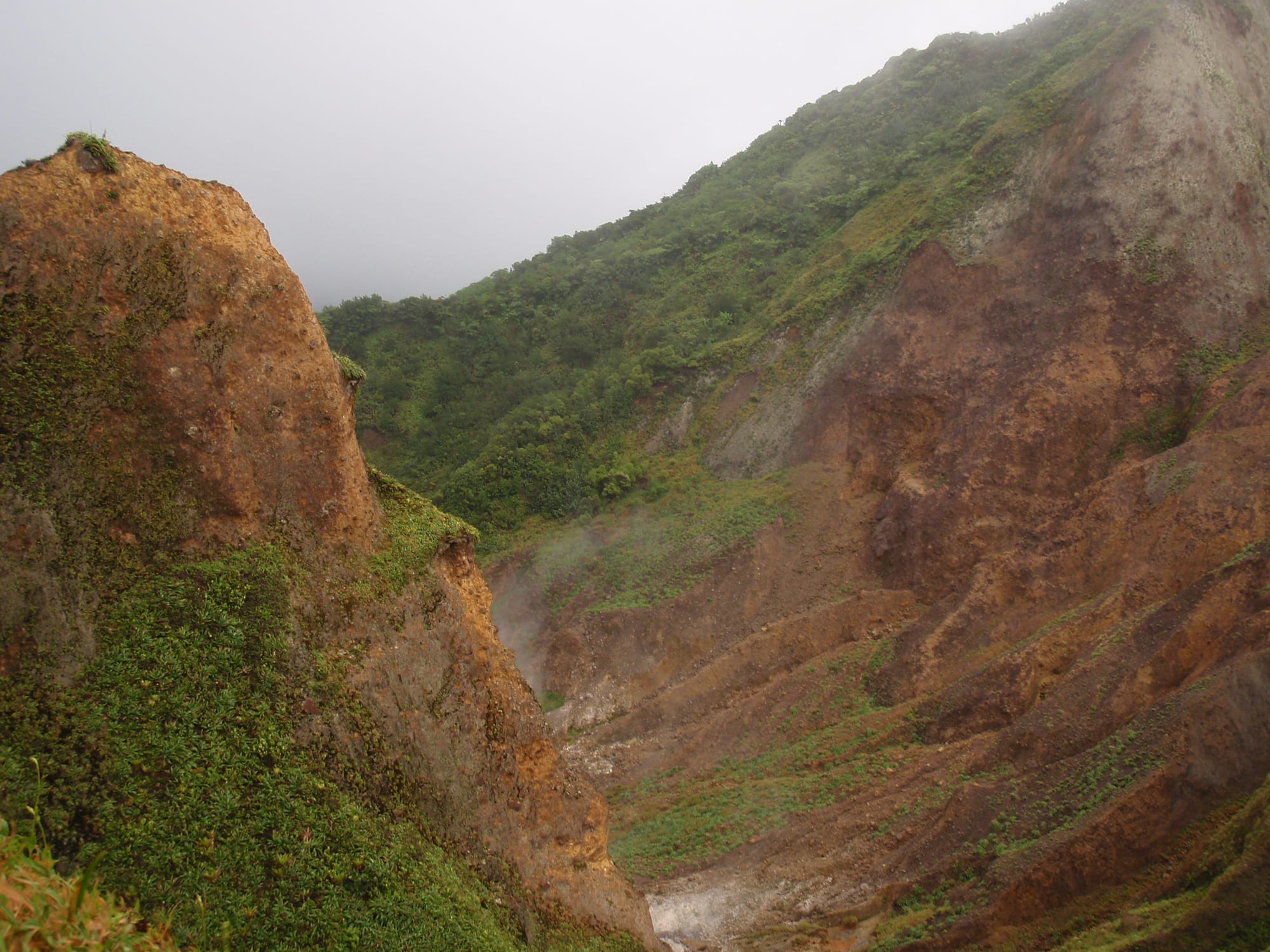
Dominica is the most mountainous of the Lesser Antilles, its central spine a line of steep volcanic peaks and deep gorges. The Boiling Lake lies on the slopes of Morne Watt, a volcanic mountain of 1,224 metres at the southern end of the island, about 6.5 miles east of the capital, Roseau. Morne Watt produced a major eruption with pyroclastic flows, fast-moving avalanches of hot ash and gas, about 1,300 years ago. The only eruptions confirmed in historical times were two steam-driven blasts, in 1880 and 1997, both in the Valley of Desolation next door to the lake.
How a vent becomes a boiling lake
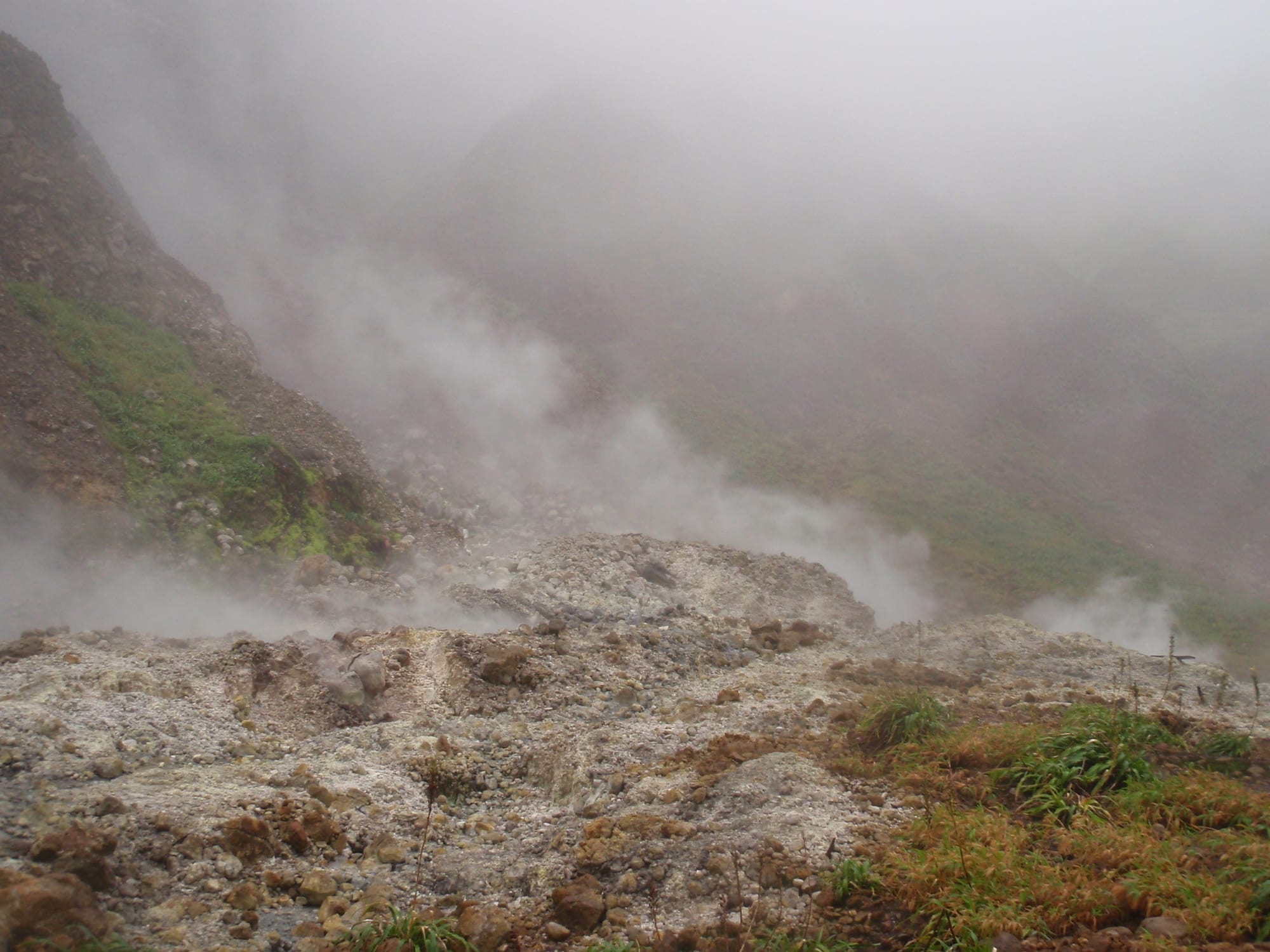
A fumarole on dry ground simply hisses steam into the air. The steam forms when groundwater circulates through hot rock, and it carries volcanic gases, including sulphur compounds such as hydrogen sulphide, given off by magma cooling deep below. Dominica's twist is that this particular vent sits at the bottom of a large, sinkhole-like basin enclosed by high rock walls. Rainfall and two small streams keep that basin topped up with water.
The rain and stream water seeps down towards the heat and is warmed to boiling point. Studies of the lake's behaviour suggest that it is perched well above the local water table, held in place by a continuous flow of steam or gas from an underlying body of magma that pushes water up into the basin. The same porous channel that lets steam rise through the lake bed can also let the water drain away if that supply of gas is disturbed.
When investigators measured the lake in 1875, they found the water along the edges at 82 to 92 °C, but they could not take readings in the centre, where it was actively boiling. That pattern holds today: the margins are scalding and the middle bubbles like a vast pan of water left on a stove.
A lake that comes and goes
Because it depends on that underground supply of heat and gas, the Boiling Lake is restless. Two Englishmen working on the island, Edmund Watt and Henry Nicholls, made the first recorded sighting in 1870, when the lake was deep. After the steam-driven eruption of 1880 nearby, it vanished entirely and became a fountain of hot water and steam.
It has drained since. Between December 2004 and April 2005 another steam-driven event lowered the water by about 10 metres; later the level recovered, and the lake refilled in a single day. Such sudden draining and refilling is the best evidence that the water is held up by gas from below rather than resting in an ordinary basin.
- 1870
Edmund Watt and Henry Nicholls make the first recorded sighting of the lake.
- 1875
Investigators measure 82 to 92 °C at the edges, but cannot reach the boiling centre.
- 1880
A steam-driven eruption nearby empties the lake, leaving a fountain of hot water and steam.
- 1900
A hiker and a Dominican guide die at the lake after a sudden release of volcanic gas.
- 1975
Morne Trois Pitons National Park is established, Dominica's first.
- 1997
The park becomes a UNESCO World Heritage Site; a small steam-driven eruption hits the Valley of Desolation.
- 2004–2005
The water level falls by about 10 metres, then the lake refills in a single day.
Not the only lake that seems to boil
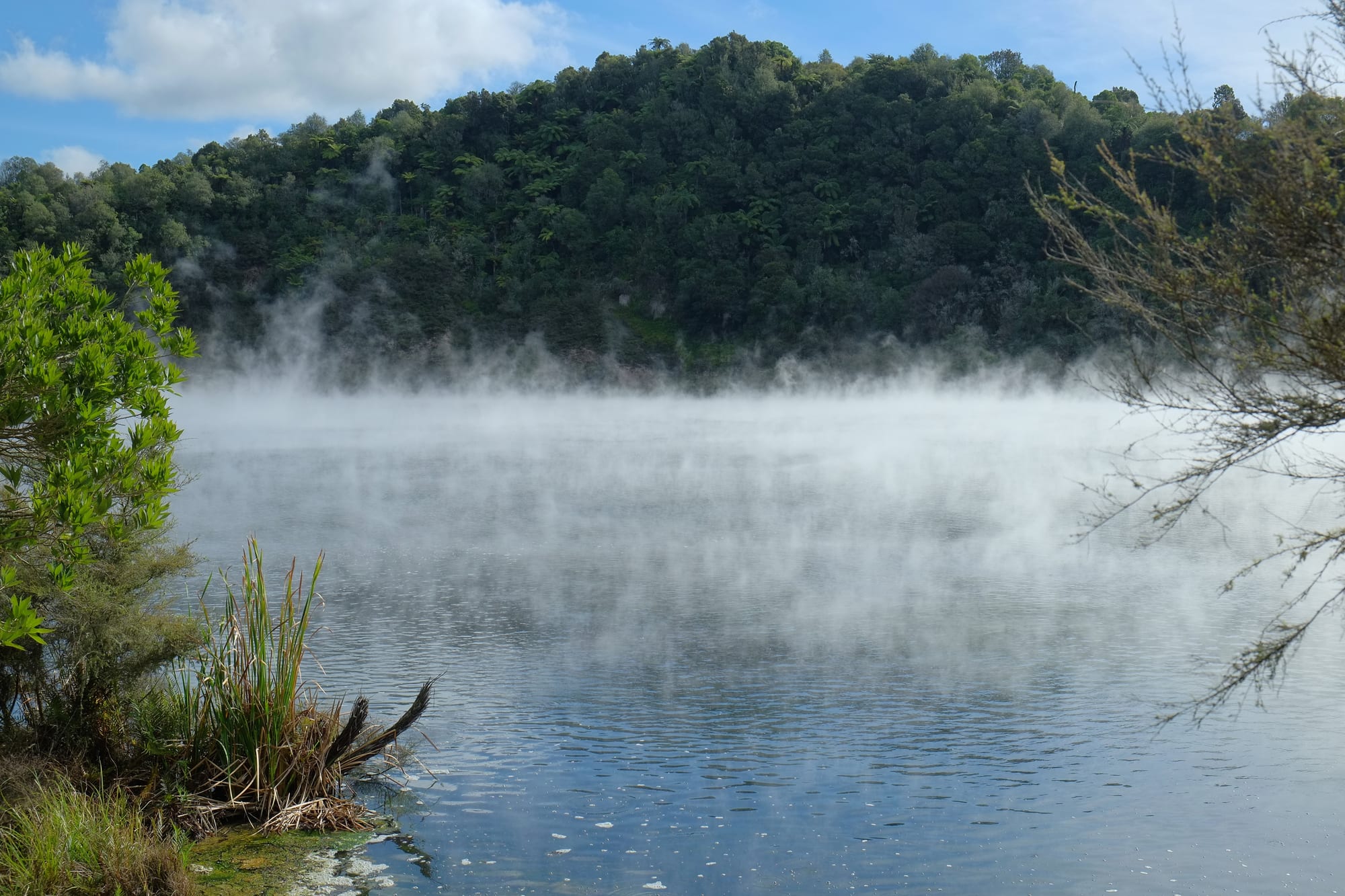
The world's largest hot lake, Frying Pan Lake in New Zealand's Waimangu Volcanic Valley, makes an instructive comparison. It covers about 38,000 square metres and often looks as if it is boiling, but its water averages around 55 °C. The bubbling there is carbon dioxide and hydrogen sulphide escaping through the water. Dominica's lake is smaller but genuinely boils at its heart, because it sits directly over a vent pouring steam into it.
Seeing it today
The lake lies inside Morne Trois Pitons National Park, set up in 1975 as Dominica's first national park and named a UNESCO World Heritage Site in 1997. No road reaches it. The Boiling Lake Trail from the village of Laudat, near Titou Gorge, takes about six hours and covers 8.1 miles, in three stages: through forest to Breakfast River, up Morne Nicholls at 966 metres, then down into the Valley of Desolation, a bare, sulphur-smelling expanse of bubbling pools, small hissing geysers and hot streams where even small jets of steam can scald an ankle.
The trail ends on a broad cliff-top ledge about 30 metres above the shore, the viewpoint over the lake. The danger is real: in 1900 two members of a three-person party, a hiker and a Dominican guide, died at the lake after being overcome by a sudden release of volcanic gas and falling. The park is also an Important Bird Area, home to Dominica's two endemic parrots, the imperial amazon and the red-necked amazon.