History · North Korea
Why does North Korea have a 105-storey hotel that has never opened?
The Ryugyong Hotel was a Cold War trophy timed for Kim Il Sung's 80th birthday; the money ran out in 1992, and no one has ever found a way to fill it.
By Globeway Editorial · 2 November 2026
The short answer
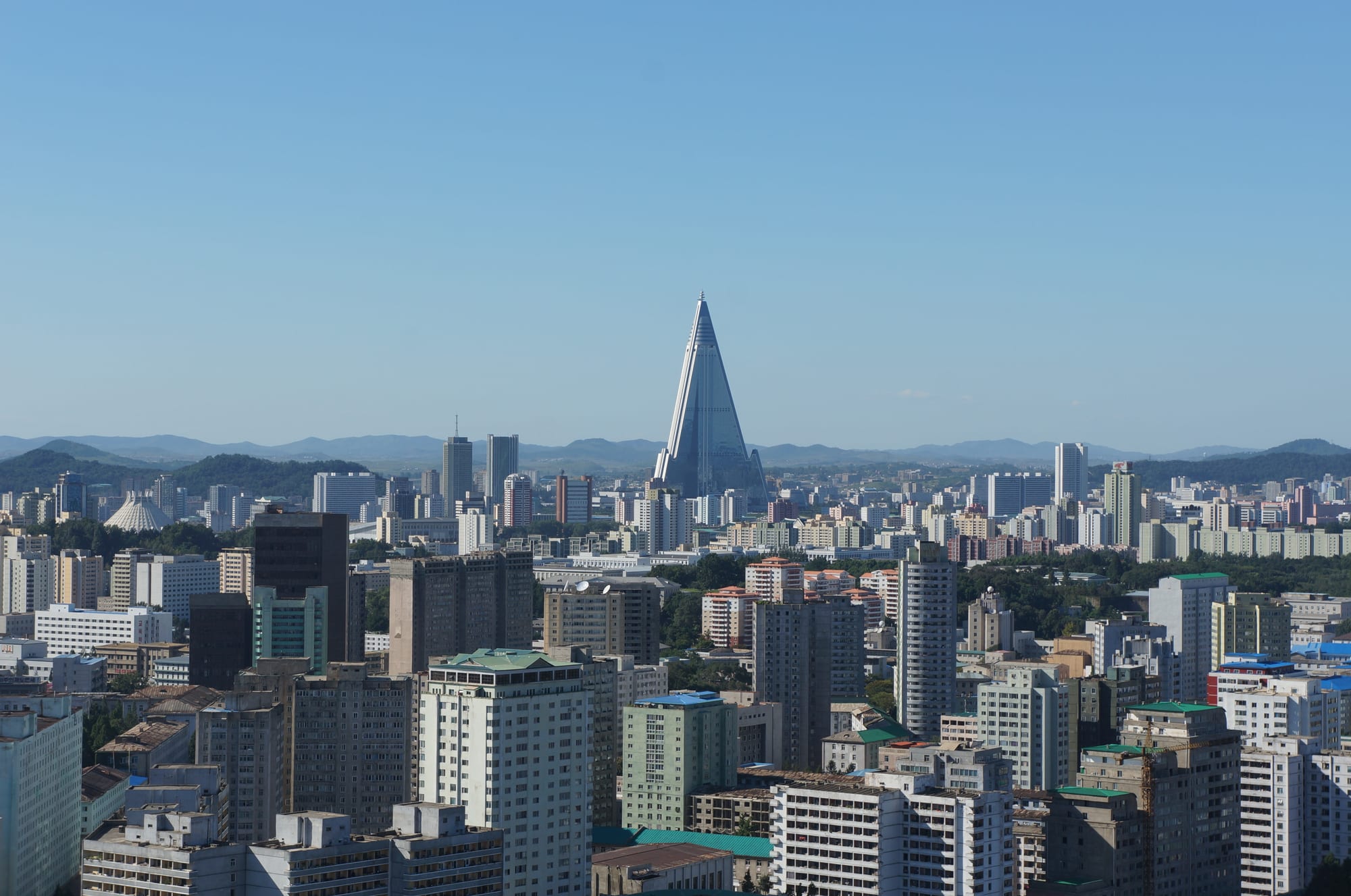
The Ryugyong Hotel was born of rivalry. In 1986 a South Korean company finished the world's tallest hotel, the Westin Stamford in Singapore, and the North Korean leadership answered with a pyramid of its own: 105 floors above ground, 330 metres (1,080 ft) to the tip, due to open in April 1992 for the 80th birthday of the country's founder, Kim Il Sung. Had it opened on time it would have been the tallest hotel on Earth.
It never did, because the money ran out. The Soviet Union, North Korea's chief backer, collapsed in 1991, and work stopped in 1992 with the frame at full height but no windows or fittings. An Egyptian company clad the outside in glass between 2008 and 2011, yet the interior was left bare, a European hotel group walked away in 2013, and with almost no foreign tourists or investors the building has had no one to serve. It remains unfinished in 2026.
A pyramid to beat Singapore
The hotel was, by most accounts, a Cold War gesture. The Westin Stamford was 226 metres (741 ft) tall and had been built by South Korea's SsangYong Group; North Korea's leadership wanted something higher, in its own capital. The name chosen was Ryugyong, "capital of willows", one of Pyongyang's historical names.
The state firm Baikdoosan Architects & Engineers began building in 1987. The design was extraordinary: three wings, each 100 metres long and 18 metres wide, rising at 75 degrees to meet in a single point. On top sat a cone 40 metres across, with eight floors meant to revolve and six fixed floors above them. Plans spoke of five revolving restaurants and either 3,000 or 7,665 guest rooms, depending on the source. Finished, it would have been the seventh-tallest building in the world and the tallest on the Korean Peninsula, overtaking Seoul's 63 Building of 1985.
Prestige was only half the purpose. A company was set up to attract a hoped-for $230 million of foreign investment, and a government representative promised investors a light touch, saying they could run casinos, nightclubs or Japanese lounges inside.
The rivalry ran through Pyongyang's building programme at the time. Seoul hosted the 1988 Summer Olympics, which the North boycotted, and the following year Pyongyang staged the World Festival of Youth and Students, building the vast Rungrado May Day Stadium as its main venue.
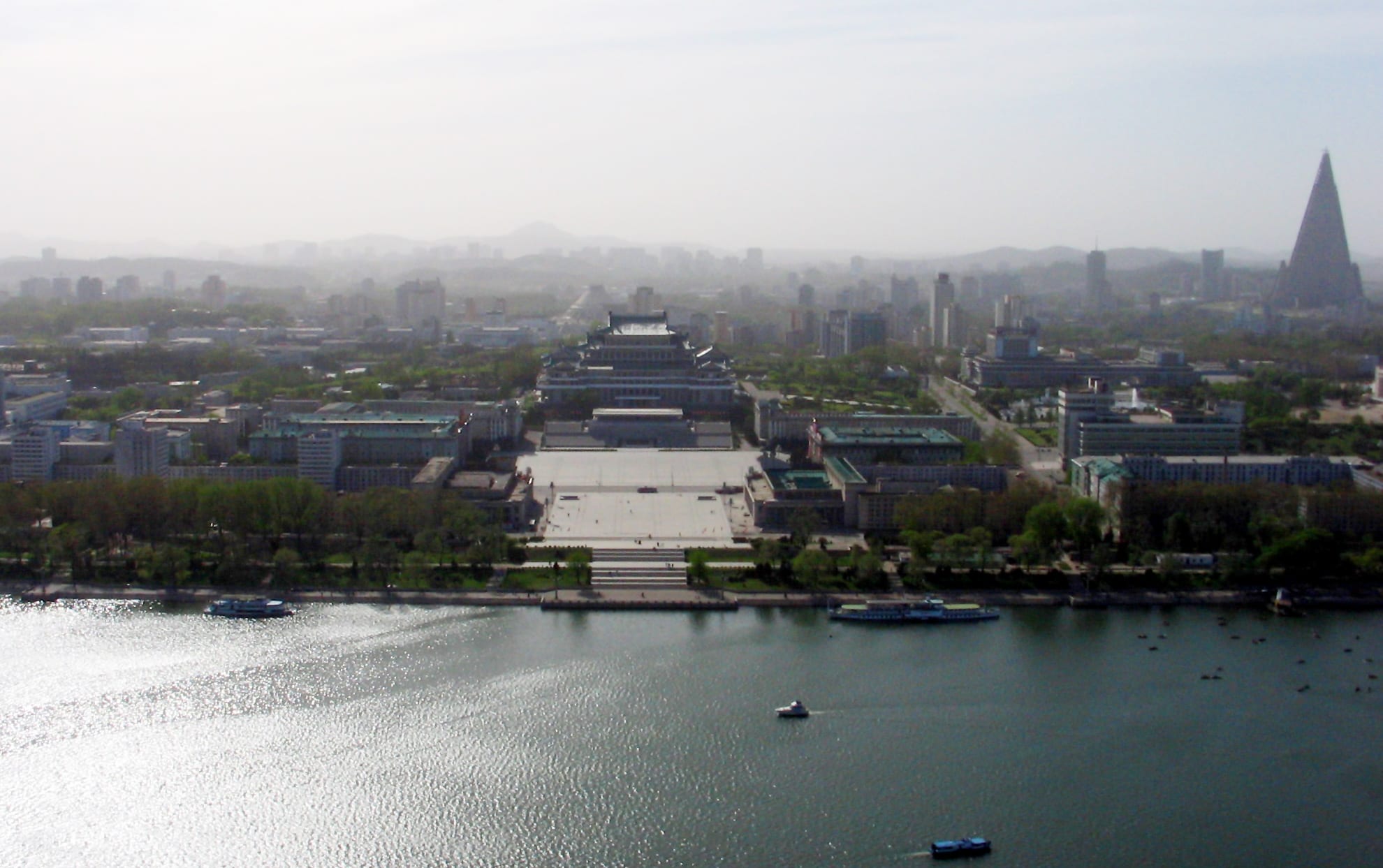
For 16 years the tower stood like this, the tallest structure in the city and visibly unfinished.
The money runs out
The schedule began to slip before the money vanished. Problems with building methods and materials delayed the work, and in December 1990 the foreign technical teams on the site withdrew. Then North Korea's economic world fell apart. The collapse of the Eastern Bloc between 1989 and 1992 cost the country its principal source of support, the Soviet Union, and in 1992, with the structure topped out at its full height, construction stopped.
Japanese newspapers estimated that the project had already cost $750 million, about 2 per cent of North Korea's gross domestic product. Worse was to come. Between 1994 and 1999 the country suffered a devastating famine, officially called the Arduous March. Estimates of the death toll vary enormously, from 240,000 to 3.5 million people out of a population of about 22 million. A luxury hotel for foreign businessmen had no place in that country.
For more than a decade the building stood as a windowless concrete shell with a rusting crane on top. In the late 1990s, according to the economist Marcus Noland, the European Chamber of Commerce in Korea inspected it and concluded the structure could not be repaired. Questions were raised about the quality of the concrete and the alignment of the lift shafts, which some reports called crooked. Foreign journalists called it "the worst building in the world", the "Hotel of Doom" and the "Phantom Hotel". A North Korean official put it more simply in 2008: the country had run out of money.
A glass skin and an empty inside
In April 2008, after 16 years of silence, work restarted. The Egyptian firm Orascom, which had just signed a $400 million deal to build and run a mobile telephone network in North Korea, took on the job, though it said the two projects were not directly related. The new goal was 2012, the centenary of Kim Il Sung's birth. By July 2011 the exterior was finished, with glass panels and telecommunications antennas fitted, and the grey shell had become a glittering blue-grey pyramid.
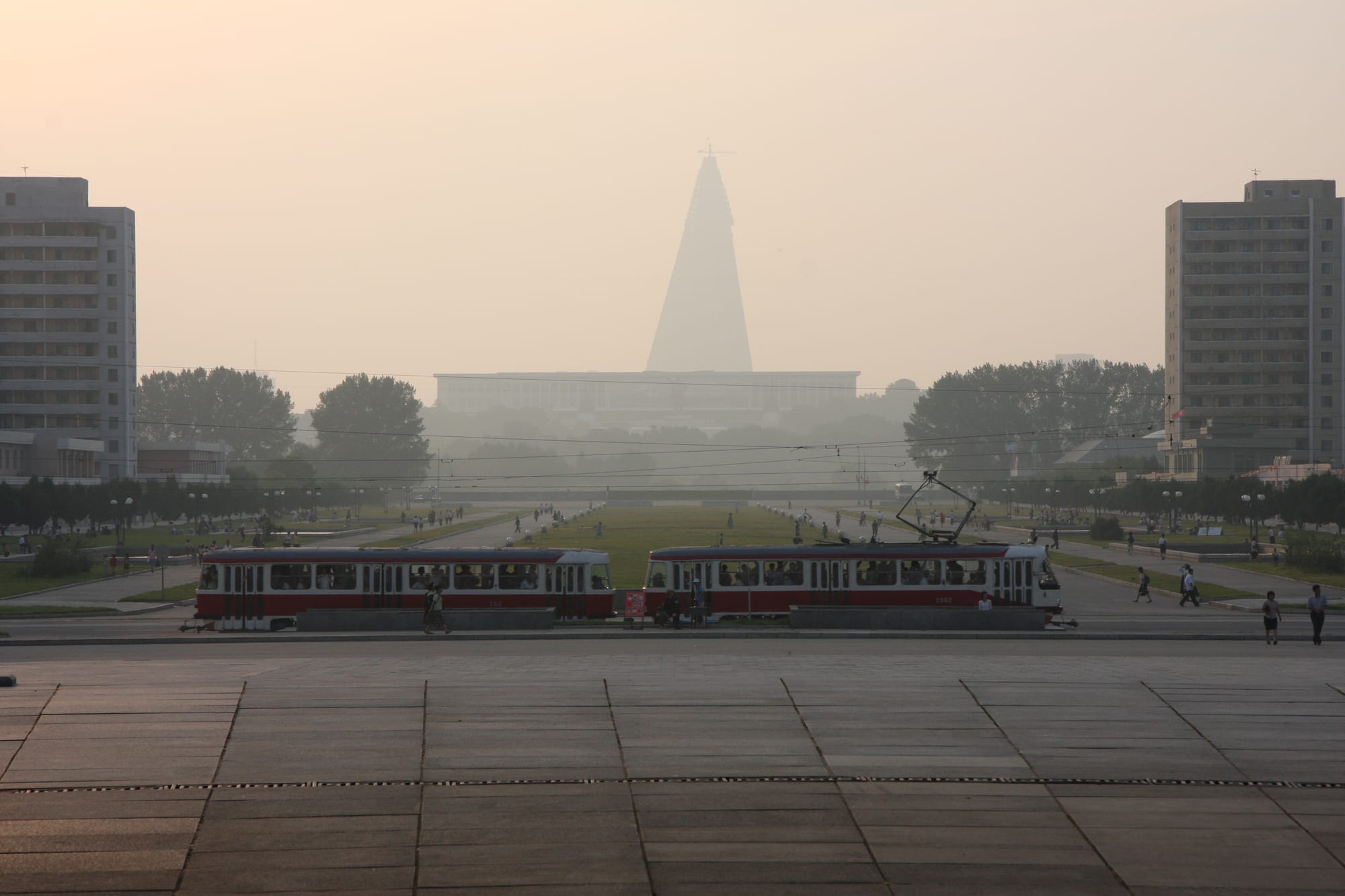
The three sloping wings meet at a single point some 330 metres above the ground.
The skin hid how little had been done inside. When photographs of the interior were released for the first time in September 2012, they showed no wiring, no cables and no pipes: just a bare, unfurnished structure. In November 2012 the international hotel operator Kempinski announced it would run the hotel, with a partial opening expected in mid-2013. By March 2013 the plan was suspended. Kempinski said only "initial discussions" had taken place and no agreement had been signed, because "market entry is not currently possible". Commentators pointed to the tensions surrounding North Korea's nuclear test of February 2013, to economic risk and to the construction delays.
Why it is still empty
The problem has never been only the building. A hotel of thousands of rooms needs guests, and North Korea receives very few. Foreigners can enter only on tightly controlled group tours, and even those have barely run since the border closed in January 2020; a brief reopening in February 2025 left Pyongyang off limits, and the border shut again a month later.
So the tower has found other work. Signs of activity returned in late 2016, with new access roads by 2018. In April 2018 a giant LED display showing the national flag appeared near the top, and by May lights covered one entire side of the building. Since then the facade has shown propaganda animations and film scenes; in September 2018 it marked the state's 70th anniversary with the dates 1948 and 2018. In June 2019 the hotel's name and logo, in Korean and English, went up over the main entrance. In 2024 the government was reported to be looking for a casino operator willing to complete the building in return for the casino's profits.
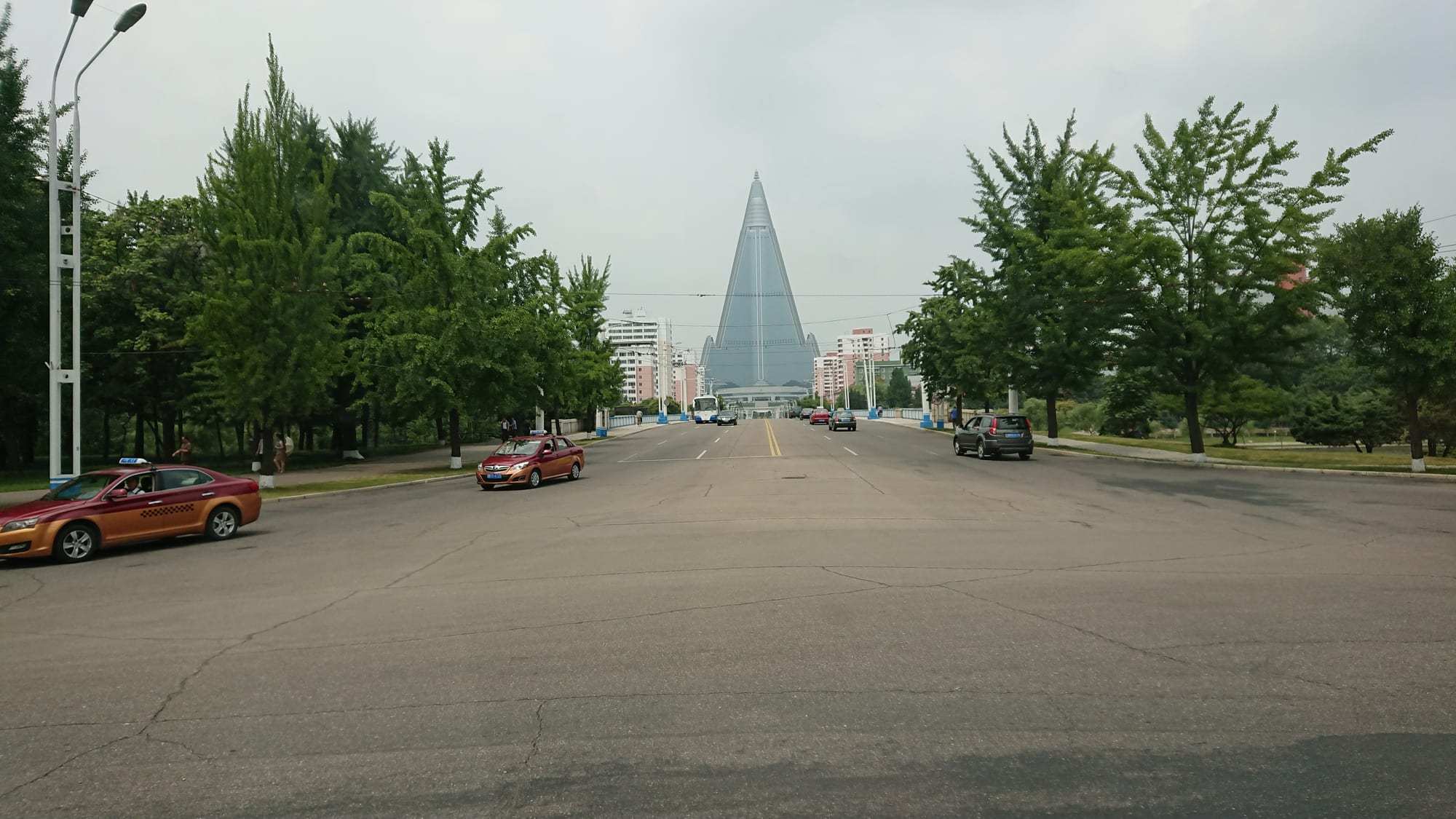
The building also has four floors below ground, and was the first in North Korea to pass 100 storeys.
A landmark that cannot be missed
For the few visitors who reach Pyongyang, the Ryugyong Hotel is impossible to avoid. It is the tallest building in North Korea and the most prominent feature of the capital's skyline, visible down long avenues and from the top of the Juche Tower across the Taedong River.
It has also outlived its own records. The Westin Stamford's title passed to a Bangkok tower in 1997, and several hotels completed since then stand taller than the Ryugyong would. For years the Ryugyong was considered the tallest unoccupied building in the world, until China's Goldin Finance 117 took that grim title too. What remains is a building that explains a great deal about the country around it: ambition on an enormous scale, a sudden collapse of the money behind it, and a door that, almost 40 years after the first concrete was poured, has still not opened to guests.