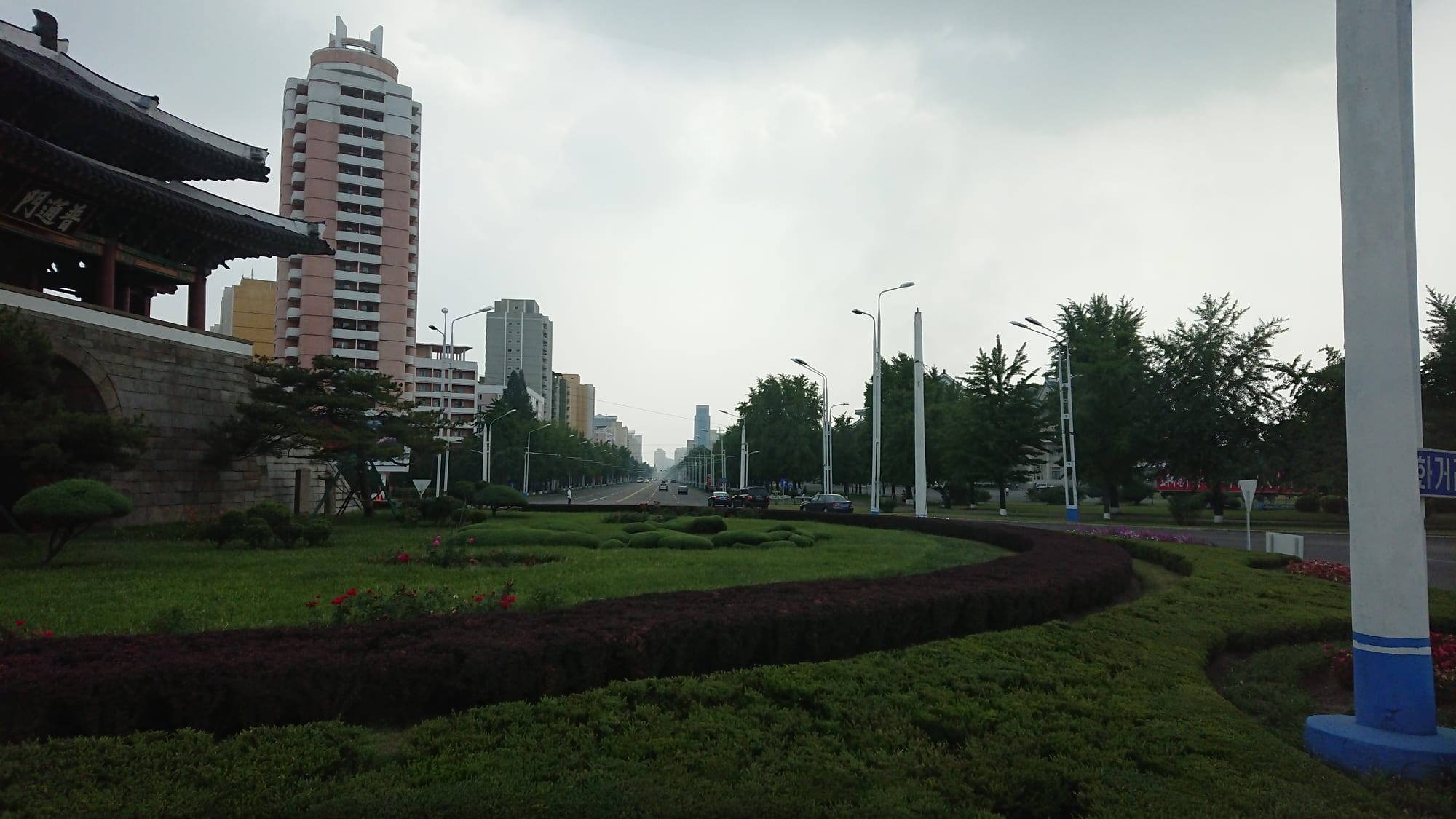
A wide, nearly empty avenue lined with tower blocks and clipped hedges, with the tiled roof of an old city gate pavilion at the left

Pyongyang & the West, North Korea

Pyongyang

Chollima Street in Pyongyang, seen from beside the Potong Gate. (Jan Engelhardt / Wikimedia Commons · CC BY-SA 4.0)

North Korea's capital, on the Taedong River in the western lowlands, and one of the oldest settlements in Korea. Almost destroyed in the Korean War, it was rebuilt from the 1950s on a plan of wide avenues, monuments and apartment blocks, and functions as the state's formal stage. This page is written to explain the city, not to encourage travel.

Neighbourhoods

  • Central District
    • First-time visitors
    • Monuments
    • Museums

    The formal centre on the west bank of the Taedong, holding Kim Il-sung Square, the Grand People's Study House and the main government and cultural buildings. Tour groups spend much of their time in these few blocks, which are also where the city's older gates survive.

    Open in Maps
  • Moranbong and the northern centre
    • Parks
    • Historic district
    • Walks

    The district around Moran Hill, the wooded rise above the river that holds pavilions, the Arch of Triumph and the Kaeson area. It is the greenest part of the inner city and the place residents use for walking and picnics on holidays.

    Open in Maps
  • The east bank and Taedonggang
    • Views
    • Monuments

    Across the river from the centre, with the Juche Tower on the embankment, the brewery that gives the district its name and long riverside walks looking back at the skyline. Apartment blocks built in recent decades line the main avenues.

    Open in Maps
  • Mangyongdae
    • Historic district
    • Local life

    The south-western district on the Taedong, treated as a political shrine because Kim Il-sung was born there, and preserved around a thatched cottage and a memorial park. Away from the shrine it is an ordinary residential and industrial part of the city.

    Open in Maps
  • Rungra and Yanggak islands
    • Sport and events
    • Quiet and residential

    Two islands in the Taedong. Rungra holds the May Day Stadium and a funfair; Yanggak, further south, is largely occupied by the hotel that has housed most foreign visitors, which is one reason groups rarely leave it unaccompanied in the evening.

    Open in Maps
  • The newer avenues
    • Architecture
    • Modern city

    Ryomyong Street and Mirae Scientists Street are the showpiece residential avenues built in the 2010s, lined with tall, brightly coloured apartment towers allocated to scientists, teachers and officials. They are the clearest expression of how the state wants the capital to look.

    Open in Maps

Things to do

Monuments and squares

  • Kim Il-sung Squarelandmark

    The granite-paved ceremonial square on the west bank, used for parades and mass rallies, with the Grand People's Study House on one side and the Juche Tower directly opposite across the river.

    Open in Maps
  • Mansudae Grand Monumentlandmark

    The bronze statues of Kim Il-sung and Kim Jong-il on Mansu Hill, where visitors are expected to bow and North Koreans lay flowers.

    Open in Maps
  • Juche Towerlandmark

    A stone tower of 1982 topped by a red flame, built to embody the Juche idea of self-reliance, with a lift to a viewing platform over the river and the city.

    Open in Maps
  • Arch of Triumphlandmark

    A granite arch of 1982 near Moran Hill, commemorating the resistance to Japanese rule and larger than its Paris model.

    Open in Maps
  • Chollima Statuelandmark

    A winged horse in bronze carrying a worker and a peasant woman, unveiled in 1961 as the symbol of a postwar speed campaign.

    Open in Maps
  • Monument to Party Foundinglandmark

    Three giant hands holding a hammer, sickle and writing brush, raised in 1995 to represent workers, farmers and intellectuals.

    Open in Maps
  • Kumsusan Palace of the Sunlandmark

    The former official residence on the north-eastern edge of the city, converted into the mausoleum where Kim Il-sung and Kim Jong-il lie in state, visited under strict rules of dress and conduct.

    Open in Maps

Museums and landmark buildings

  • Victorious Fatherland Liberation War Museummuseum

    The state's museum of the Korean War, with dioramas, captured equipment and the USS Pueblo, an American navy vessel captured in January 1968.

    Open in Maps
  • Korean Central History Museummuseum

    A national collection of Korean archaeology and history on Kim Il-sung Square, running from prehistory through the Koguryo and Koryo periods.

    Open in Maps
  • Grand People's Study Houselandmark

    The national library of 1982 on the square, built in traditional Korean roof style, with reading rooms, language classes and a terrace overlooking the parade ground.

    Open in Maps
  • Ryugyong Hotellandmark

    The 330-metre pyramid begun in 1987 and never opened, visible from most of the city and now clad in glass and used as a screen for light displays.

    Open in Maps
  • Rungrado 1st of May Stadiumattraction

    An enormous stadium on Rungra Island, seating tens of thousands, used for football, political rallies and the mass gymnastics displays staged in some years.

    Open in Maps
  • Pyongyang Metrotransit hub

    One of the deepest underground railways in the world, with track more than 110 metres down, opened in stages between 1969 and 1972, with chandeliered stations decorated in mosaics and murals; groups are usually shown a short stretch of the line.

    Open in Maps

Older Pyongyang

  • Taedongmunlandmark

    The old eastern gate of the walled city beside the river, Koguryo in origin, with the present pavilion dating from 1635.

    Open in Maps
  • Potong Gatelandmark

    The western gate of the old walled city, first built in the Koguryo period, rebuilt in 1473 and reconstructed in 1955 after the Korean War, now marooned in a green strip beside a wide avenue.

    Open in Maps
  • Moran Hillpark

    A wooded hill above the Taedong with pavilions, old fortress remnants and paths, and the city's main open space for holidays and picnics.

    Open in Maps
  • Tomb of King Tongmyonglandmark

    The reconstructed burial mound attributed to the founder of Koguryo, south-east of the city and part of the UNESCO-listed complex of Koguryo tombs.

    Open in Maps

Parks and leisure

  • Munsu Water Parkattraction

    A large indoor and outdoor water park opened in 2013 on the east bank, one of the leisure projects built for residents of the capital.

    Open in Maps
  • Korea Central Zooattraction

    The national zoo in Taesongsan Park at the foot of Mount Taesong, opened in 1960 and covering about a square kilometre, a standard outing for city families.

    Open in Maps
  • Mangyongdae Native Houselandmark

    The thatched cottage in the south-western suburbs presented as Kim Il-sung's birthplace, preserved in a park and treated as the state's principal shrine.

    Open in Maps

Just outside the city

  • Revolutionary Martyrs' Cemeterylandmark

    A terraced hillside cemetery on Mount Taesong north-east of the centre, with bronze busts of anti-Japanese guerrillas and a wide view back over the city.

    Open in Maps

Seasonal events

  • Day of the SunApril

    The anniversary of Kim Il-sung's birth on 15 April, the year's largest public holiday, marked with flower shows, mass flower-laying and large set-piece events; since 2024 state media have used the name less, calling it simply the April holiday.

  • Pyongyang MarathonApril

    A road race that starts and finishes at one of the city's big stadiums and runs along the Taedong, open to amateur foreign runners in some years and one of the few occasions when visitors have run on city streets.

  • National DaySeptember

    The anniversary of the state's founding on 9 September, marked by parades, civilian rallies and evening events in the central square.

  • Mass gymnastics displayslate summer and autumn, in some years

    Stadium performances combining tens of thousands of gymnasts with a card-flipping backdrop, staged irregularly rather than every year.

Eat and drink

Long-standing places and food districts in Pyongyang. Hours, ratings and directions come from your maps app, always current.

Pyongyang classics

  • Okryu-gwanrestaurant

    The large state restaurant on the Taedong bank, open since 1960 and the best-known place in the country for Pyongyang raengmyeon, chilled buckwheat noodles in beef broth.

    Open in Maps
  • Taedonggang beer hallsrestaurant

    Bars attached to the city's brewery and hotels serve Taedonggang, the draught beer brewed in Pyongyang since the early 2000s on equipment bought from a British brewery.

    Open in Maps
  • Tour-circuit restaurantsrestaurant

    Meals for visitors are arranged by the tour and taken at a fixed set of state restaurants and hotels rather than chosen, so the choice of where to eat is not one a visitor makes here.

    Open in Maps

Experience Pyongyang

History

The Taedong basin holds one of the oldest continuously settled sites in Korea. Korean tradition places the capital of ancient Gojoseon here; after Han China destroyed that state in 108 BC, the Chinese commandery of Lelang administered the area for some four centuries. In 427 the kingdom of Koguryo moved its capital to Pyongyang, and the painted burial chambers scattered around the city, part of a UNESCO World Heritage Site, are its oldest surviving monuments. Under Koryo the city was the western capital, and under Joseon the seat of Pyongan province and a trading town on the road to China.

Its modern shape was set by destruction. In 1866 the American merchant ship General Sherman was burned on the Taedong, an episode the state still presents as an early victory over the United States. By the early twentieth century Pyongyang had one of the largest Protestant communities in Korea, and under Japanese rule it industrialised. In 1945 it became the capital of the Soviet-backed North; occupied briefly by UN forces in 1950, it was then almost levelled by bombing during the Korean War; almost nothing was left standing, and landmarks such as the Potong Gate were reconstructed afterwards.

Reconstruction from the 1950s produced the city visitors see: a plan of very wide avenues, ceremonial squares, riverside parks and blocks of flats, laid out by Korean and eastern European planners and filled over the following decades with monuments, towers and arches on a deliberately grand scale. Later building has continued the pattern, from the deep metro of the 1970s and the monuments of the 1980s to the tall, brightly painted apartment avenues of the 2010s, while residence in the capital has remained something the state grants rather than something people choose.

Culture & Customs

Pyongyang is the model the rest of the country is measured against. Its speech, based on the surrounding Pyongan dialect, is the basis of the North Korean standard language; its dress, manners and public conduct are presented as the national norm; and the set-piece events of the political calendar — parades on Kim Il-sung Square, torchlight rallies, flower festivals, and mass gymnastics in some years — are staged in the capital and broadcast from it. Visitors are expected to take part in the formal side of this, bowing at the Mansu Hill statues and treating images of the leaders with care.

Beneath the official layer the city has a recognisable urban culture. The Pyongyang Circus and the theatres put on performances, football and other sports draw large crowds to the stadiums, and the state musical groups formed in the 2010s have a following. Families walk on Moran Hill on holidays, students fill the Grand People's Study House, and the funfairs and water park built in the last fifteen years are genuinely popular.

Everyday courtesies are Korean: bowing on meeting, using two hands to give and receive, taking shoes off indoors, and deference to age. Beyond that, the UN Commission of Inquiry of 2014 documented systematic human-rights abuses across the country, and songbun, the state's classification of families by political background, shapes education, work and the right to live in the capital at all.

Daily Life

Around three million people live in Pyongyang, and it is by some distance the best-supplied place in the country: electricity is more reliable than elsewhere, new apartment districts have been built steadily, and the shops carry goods that are scarce in the provinces. Residence is controlled, and living here is itself a marker of standing.

Days run to a fixed rhythm of work units, political study sessions and neighbourhood organisations, with mornings starting early and mobilisation for public projects and farm work a regular demand on city workers. Commuting is by tram, trolleybus, metro and on foot; traffic is light, and the uniformed traffic officers at junctions are among the most photographed sights in the city. Bicycles have become far more common than they once were.

The formal economy rests on government, heavy industry, construction and services, but since the famine of the 1990s most households have depended partly on markets, and a class of traders and officials with access to foreign currency has become visible in the capital's restaurants and shops. Mobile phones on the domestic network are widespread, though they cannot reach the outside world. Power cuts, food prices and the reach of the markets are the practical concerns that shape ordinary life.

Food

Pyongyang claims several dishes that North Koreans treat as national showpieces. Pyongyang raengmyeon is the best known: chewy buckwheat noodles in a chilled beef or pheasant broth, dressed with radish kimchi, sliced meat, half an egg and a slice of pear, and eaten with scissors to cut the coil. It is served most famously at Okryu-gwan on the riverbank. Pyongyang onban, "rice with soup", is rice in hot chicken broth topped with shredded chicken, mushrooms and a mung-bean pancake, and nokdu jijim, the thick mung-bean pancake, is also eaten on its own with soy dipping sauce.

The river and the western plain supply the rest. Grey mullet soup from the Taedong is a dish the city claims as its own, freshwater fish and shellfish appear on restaurant menus, and the plain around the capital is the country's main rice-growing area, so rice is more common on the table here than in the mountainous provinces. Kimchi is central through the winter, and kimjang, the autumn making of a household's year's supply of cabbage kimchi, remains a major event.

Drinking is led by Taedonggang, the draught beer brewed in the city since the early 2000s on equipment bought from a brewery in England, and by soju and stronger grain spirits. Tea, soft drinks and ice cream are sold from kiosks on the avenues in summer. For visitors, meals are taken where the tour programme puts them, and the markets where residents buy most of their food are not part of what is shown.

Planning tools

Budget

There is no independent budget for Pyongyang. When tourism has operated, the city has been the base of almost every tour, sold as a fixed all-inclusive price paid in advance to a state-approved agency and covering visa support, guides, transport, hotel and meals. Cash spending is limited to souvenirs, drinks and tips in hotel shops, and prices there are set for foreigners.

Daily Budget Midrange
USD 170–400 (an all-inclusive group tour, when tours run: hotel, meals, guides and transport)
Daily Budget Shoestring
USD 170–400 (no cheaper option exists — independent travel is not permitted, so the tour price is the floor)

Tourism closed in January 2020; foreigners were let in again in February 2025, with Pyongyang off limits, before the border shut once more a month later. If a tour ever runs, carry euros or Chinese yuan in small notes.

Best Time to Visit

For the guided tours that have historically run, late April to June and September to October are the mildest and driest months. Summer is hot, humid and wet under the monsoon, and winter is cold and dry. The capital's large political events cluster around mid-April, 9 September and 10 October, which is when tours have been busiest and access tightest.

Suggested Number of Days

Tours to the capital have typically run three or four days, with five to seven allowing side trips west and north. The length is set by the operator and the approved programme rather than by the visitor, and nothing can be added or dropped once a tour is under way.

First Visit
3–4 days
With Surroundings
5–7 days

Transportation

Visitors travel only by chartered bus or car with guides, on approved routes. Residents use a network of trolleybuses, trams and the deep metro, along with a great deal of walking; private cars are rare, and traffic on the wide avenues is light by the standards of any comparable city. Movement into and out of Pyongyang is controlled by permit for North Koreans as well as for foreigners.

No independent movement is allowed: guides accompany visitors at all times, including inside the capital, and leaving a hotel alone is not permitted.

Airport & Station Connections

Pyongyang Sunan is the country's main international airport, about 25 km north of the centre, served by the state carrier on a small number of routes to China and Russia, which resumed in 2023 after the border closure. The alternative has been the train from Dandong in China through Sinuiju, a slow journey of the better part of a day. Both require an approved tour and a visa arranged by the operator in advance.

Walkability

The monumental centre is flat and laid out on a grand scale, with wide avenues, long blocks and big open squares, so distances on foot are greater than they look. In practice visitors walk only where and when their guides allow, usually between a parked bus and a monument, so the city cannot be explored on foot in the ordinary sense.

Safety

The danger here is political rather than criminal. Ordinary crime against foreigners is essentially unknown under close surveillance, but visitors have been arrested and held for long periods for small breaches of rules, and few countries have an embassy in the city able to help. Photographing soldiers, checkpoints, construction sites or anything that reads as poverty, straying from the group, speaking freely to residents, or any perceived disrespect to images of the leaders can bring detention.

Most governments advise against all travel to North Korea and the US bans its citizens from going without special permission. Follow the guides' instructions on photography and movement exactly, and treat monuments and images of the leaders with formal respect. Check current official travel advice before travelling.

Climate

Sharply continental with a monsoon summer. Most of the year's rain falls in July and August, when flooding is a recurring problem; spring and autumn are short, mild and dry, and the Taedong can freeze in a hard winter.

Summer
hot and humid — often 25–30°C in July and August, with heavy monsoon rain
Winter
cold and dry — January days often below −5°C, with much colder nights and little snow

Local Customs

Behaviour at the monuments is formal: groups bow at the Mansu Hill statues, flowers are bought and laid, and photographs of the leaders' statues and portraits must show the whole figure and must not be cropped, folded or creased. Newspapers carrying leaders' images are never used as wrapping. Dress is expected to be neat, with no ripped or scruffy clothing at monuments and mausoleums. Tipping is not part of local life, though guides and drivers are customarily given something at the end of a tour.

Ask the guides before taking any photograph, do not photograph soldiers, checkpoints or building sites, never point at or imitate statues, and do not give gifts or literature to residents.

Common Payment Methods

The North Korean won is not available to visitors, who pay in euros, Chinese yuan or US dollars in cash at hotel shops, souvenir counters and the few places where foreigners can spend at all. Foreign cards do not work, there are no international ATMs, and change is often given in a mixture of currencies, so small notes are useful.