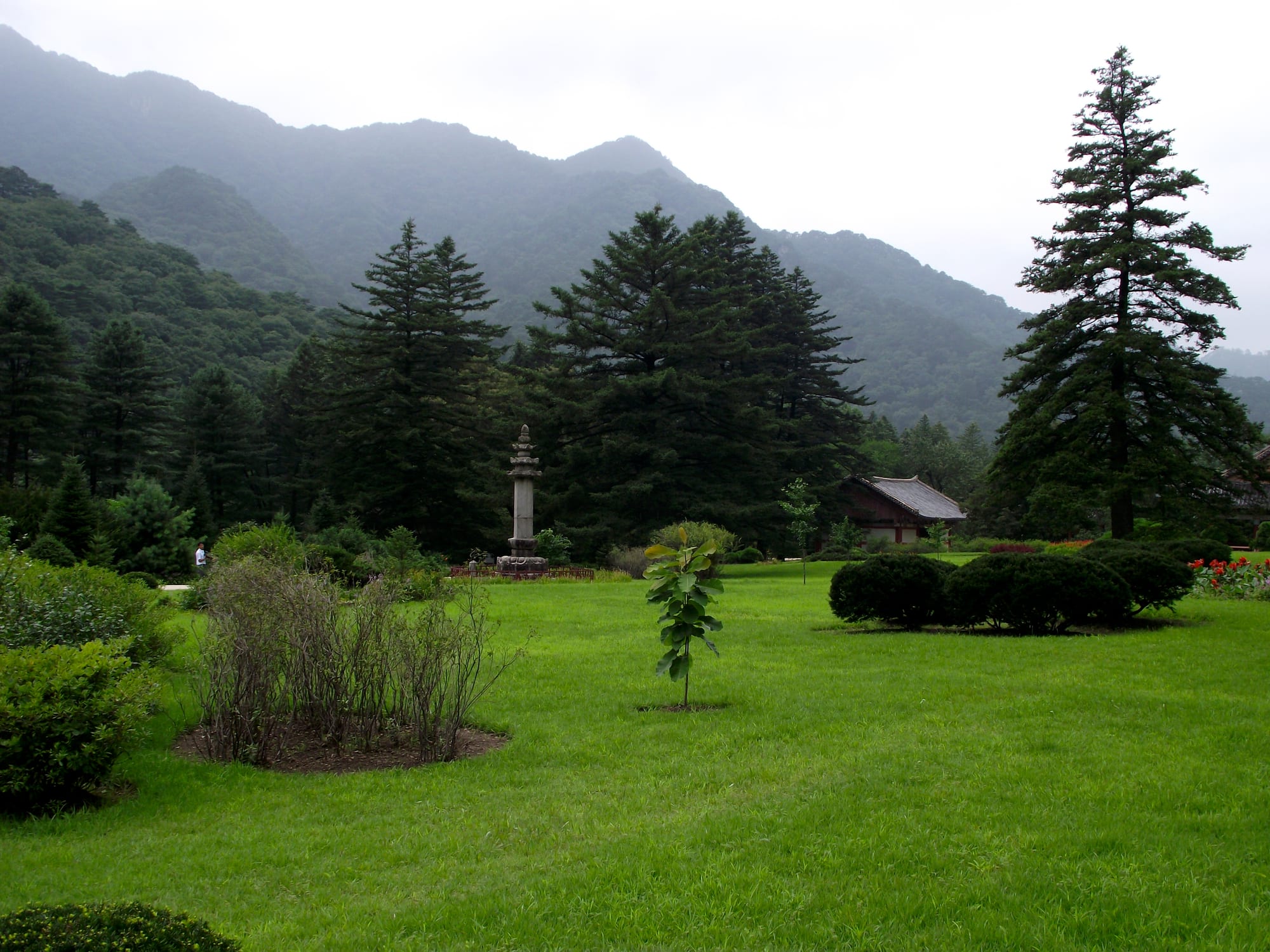
A green lawn with a stone pagoda and tall conifers in front of forested, mist-covered mountain ridges

North Korea

Pyongyang & the West

The grounds of Pohyon Temple beneath the Myohyang mountains in North Pyongan. (Mark Fahey / Wikimedia Commons · CC BY 2.0)

The capital Pyongyang and the western lowlands between the Taedong estuary and the Yalu River border with China — the political showcase of the state, its best-supplied cities, the Myohyang mountains and the border city of Sinuiju. This page is written to explain the region, not to encourage travel.

Explore Pyongyang & the West

History

The Taedong basin is one of the oldest centres of Korean civilisation. Korean tradition places the capital of ancient Gojoseon here, and after Han China conquered that state in 108 BC the Chinese commandery of Lelang ruled from the Pyongyang area for four centuries. In 427 the kingdom of Koguryo moved its capital to Pyongyang, and the painted tombs it left around the city and Nampo are the region's oldest monuments. Under Koryo, Pyongyang was the western capital; under Joseon it was the seat of Pyongan province and a trading city on the road to China, while Sinuiju and Uiju guarded the Yalu crossing.

In 1866 the American merchant ship General Sherman was burned on the Taedong, an episode the state still presents as an early victory over the United States. By the early 20th century Pyongyang had become a centre of Korean Protestantism, and under Japanese rule the region was industrialised, with a railway bridge across the Yalu at Sinuiju.

After 1945 Pyongyang became the capital of the Soviet-backed North. It was occupied by UN forces in late 1950 and almost levelled by bombing during the Korean War; the bridges at Sinuiju were also bombed, and one still ends in mid-river. The city was rebuilt from the 1950s on a Soviet-style plan of wide avenues and monuments, with Kim Il-sung's birthplace at Mangyongdae made a shrine. North Pyongan also holds the Yongbyon nuclear complex, the centre of the state's weapons programme since the 1980s.

Culture & Customs

The west is the core of the Kim-era state culture. The Pyongyang speech of the Pyongan region is the basis of the North's official standard language, and the capital's own manners, dress and accents are treated as the national model. Mass events — parades on Kim Il-sung Square, the Mass Games at the May Day Stadium on Rungra Island, torchlight rallies — are staged here, and all visitors to the Mansu Hill statues are expected to bow, with North Koreans laying flowers.

Older traditions survive in quieter forms. Families mark the lunar new year and Chuseok with visits to ancestral graves. The region's Buddhist heritage lives on in temples such as Pohyon in the Myohyang mountains, though they operate as cultural sites under state control rather than as active religious communities. Pyongyang's pre-war Christian life is now represented only by a few state-approved churches shown to visitors.

Beneath the surface, the region shows the state's human-rights record as clearly as anywhere. A 2014 UN Commission of Inquiry described systematic abuses including political prison camps, among them the camp at Kaechon in South Pyongan known as Camp 14. Songbun, the state's ranking of families by political background, shapes access to education, work and party membership.

Daily Life

Pyongyang has around three million people and is by some distance the best supplied place in the country, with more reliable electricity, new apartment districts and a visible class of officials and traders. Nampo, the capital's port at the mouth of the Taedong, Pyongsong, the capital of South Pyongan, and Sinuiju on the Chinese border are the other main cities, each with a few hundred thousand people.

The economy combines state heavy industry — machine works, the Nampo shipyards and port, coal mining — with the markets that have fed most households since the 1990s famine. Sinuiju's position opposite Dandong makes it a main gateway for trade with China, legal and otherwise, and a relatively prosperous city by North Korean standards. The countryside of the western plain is the country's main rice bowl, and farm work still relies heavily on hand labour and mobilised city workers at planting and harvest.

Days are structured by work units, political study sessions and neighbourhood groups. In the capital, commuters use trolleybuses, trams and the Metro; outside it, walking and bicycles dominate. Movement in and out of Pyongyang is controlled, and power cuts, food prices and the reach of the markets are the everyday concerns.

Food

The west is the home of the dishes North Koreans treat as national showpieces. Pyongyang raengmyeon — buckwheat noodles in a chilled beef broth with radish kimchi, sliced meat, egg and pear — is served most famously at the Okryu-gwan restaurant on the Taedong riverbank. Pyongyang onban is rice in a hot chicken broth topped with chicken, mushrooms and a mung-bean pancake, and nokdu jijim, the thick mung-bean pancake, is eaten on its own with soy dipping sauce. Grey-mullet soup from the Taedong is another dish claimed by the capital.

Kimchi is relied on through the winter, and kimjang, when households make their year's supply of cabbage kimchi, is still a major event. In Nampo and along the coast, shellfish and dried fish supplement the diet.

Drink is led by Taedonggang beer, brewed in Pyongyang in a brewery imported from Britain, and by soju, while the city's restaurants and markets are the only places in the country where many of these dishes are easy to find.

Attractions & Natural Wonders

Pyongyang is laid out for display along the Taedong River. The core sights shown to tour groups are Kim Il-sung Square, the Juche Tower on the opposite bank, the Mansu Hill Grand Monument, the Arch of Triumph and the Kumsusan Palace of the Sun, where Kim Il-sung and Kim Jong-il lie in state. The deep Metro, with chandeliered stations such as Puhung and Yonggwang, the Victorious War Museum with the captured USS Pueblo, Moranbong park, the old Taedong and Pothong gates, the Mangyongdae birthplace and the unfinished-looking pyramid of the Ryugyong Hotel complete the standard circuit.

South-west of the capital, the West Sea Barrage at Nampo crosses the Taedong estuary with locks and a road on top, and is presented as a feat of self-reliant engineering. Near Nampo lie the Kangso Three Tombs, among the painted Koguryo tombs listed by UNESCO, and the Tomb of King Tongmyong on Pyongyang's eastern edge belongs to the same site.

To the north, the Myohyang mountains rise through pine and broadleaf forest, with the 11th-century Pohyon Temple and the vast International Friendship Exhibition, a mountainside vault of gifts to the leaders. At the far north-west, Sinuiju faces China across the Yalu, where the Sino-Korean Friendship Bridge and the broken remains of the older bridge are mostly seen from the Chinese bank at Dandong.

Cities in Pyongyang & the West

Planning basics

Budget

There is no independent budget for this region or any other part of North Korea. When tourism has operated, Pyongyang has been the base of almost every tour, with a fixed all-inclusive price paid in advance to a state-approved agency. Side trips to Nampo, Myohyang or Sinuiju are added to the itinerary at extra cost; spending money in cash goes on souvenirs, drinks and tips in hotel shops.

Daily Budget Midrange
Roughly USD 170–400 per day on a group tour, when tours run
Daily Budget Shoestring
Not applicable — independent travel is not permitted

Tourist access has been almost entirely suspended since the 2020 border closure; carry euros or Chinese yuan in small notes if a tour ever runs.

Safety

The danger is political, not criminal. Foreigners have been arrested and held for long periods for acts as small as trying to take a propaganda poster, the charge on which an American student was imprisoned in 2016; he died soon after his release in 2017. Photographing soldiers, checkpoints, construction or poverty, straying from the group, speaking freely to residents, or any perceived disrespect to images of the leaders can bring detention. Few countries have an embassy in Pyongyang able to help.

Most governments advise against all travel to North Korea and the US bans its citizens from going without special permission. Check current official travel advice before travelling.

Climate

The west has the country's mildest lowland climate but is still sharply continental: hot, humid summers with most of the year's rain in July and August, and cold, dry winters when the Taedong can freeze. The Myohyang mountains are cooler and wetter than the plain, and the Yalu valley around Sinuiju is a little colder in winter than Pyongyang.

Summer
hot and humid, often 25–30°C, with heavy monsoon rain and flood risk in July and August
Winter
cold and dry, often below −5°C in Pyongyang and colder in the northern valleys

Transportation

Pyongyang's Sunan airport and the railway from Dandong through Sinuiju are the two routes into the country that tours have used. Within the region, visitors travel only by chartered bus with guides on approved roads: Pyongyang to Nampo takes roughly an hour, and to Myohyang a few hours along the expressway. Residents need permits to leave their county or enter the capital.

No independent movement is allowed; guides accompany visitors at all times, even in Pyongyang.

Best Time to Visit

For the guided tours that have historically run, late April to June and September to October are the mildest and driest months, with blossom in spring and autumn colour in the Myohyang forests. Pyongyang's large political events cluster around mid-April, 9 September and 10 October.