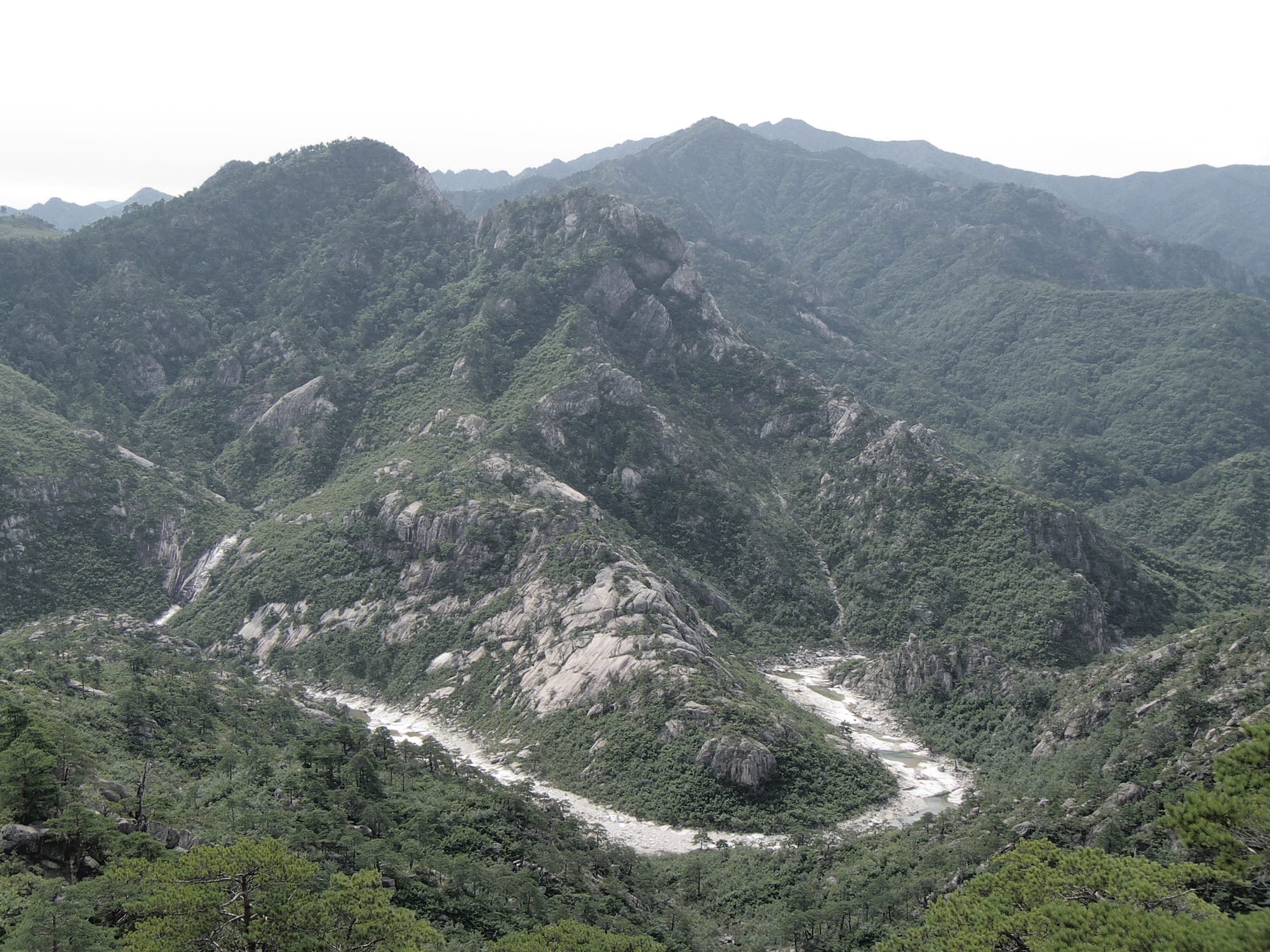
Forested granite mountains with pale rock outcrops above a river winding through a deep green valley

North Korea

Wonsan & the East Coast

A river valley among the granite ridges of the Kumgang mountains in Kangwon province. (Kok Leng Yeo / Wikimedia Commons · CC BY 2.0)

The eastern side of North Korea, where the Taebaek and Hamgyong ranges drop to the Sea of Japan — the port of Wonsan, the industrial city of Hamhung, the Kumgang mountains near the DMZ and a long coast of beaches and fishing towns. This page is written to explain the region, not to encourage travel.

Explore Wonsan & the East Coast

History

The east coast was the frontier of the old Korean kingdoms. Koguryo and then Silla fought over it, and under Koryo the Hamgyong coast was contested with the Jurchen. The Joseon dynasty was born here: its founder Yi Seong-gye came from a military family in the Hamhung region, and his residence there, the Hamhung Pongung, is now a national treasure. The Kumgang mountains were meanwhile one of the great Buddhist landscapes of Korea, dotted with monasteries and hermitages.

Wonsan was opened as a treaty port in 1880 and became a trading and fishing town; under Japanese rule Hamhung and its port of Hungnam were turned into a chemical and fertiliser complex. In the Korean War the region saw some of the fiercest fighting. In late 1950 UN forces were surrounded by Chinese armies at the Chosin Reservoir, known in Korean as Changjin, and fought their way to the coast, where the Hungnam evacuation carried troops and, with smaller lifts from Wonsan and Songjin, about 98,000 civilians south by sea. Wonsan was blockaded and shelled for much of the war.

Hamhung was rebuilt in the late 1950s with help from East Germany. From 1998 the South Korean firm Hyundai Asan ran tours to the Kumgang mountains, a symbol of engagement between the two Koreas, until the fatal shooting of a South Korean tourist in 2008 ended them.

Culture & Customs

The region falls into two cultural halves. South Hamgyong shares the Hamgyong dialect of the north-east, while Kangwon province, divided by the DMZ, has a counterpart of the same name in South Korea. The Kumgang mountains hold a special place in Korean culture on both sides of the border: painted by the 18th-century artist Jeong Seon and praised in centuries of poetry, they were a place of pilgrimage long before the division.

Wonsan has a particular status in the state's story: Kim Il-sung landed there on his return from the Soviet Union in 1945, and Kim Jong Un spent childhood years there. The state has invested heavily in making the city a resort, and its official culture is on display at the Songdowon children's camp and at mass beach and holiday events for loyal workers.

As elsewhere, the region reflects the country's human-rights record. The Yodok political prison camp in South Hamgyong, closed in 2014, was one of the best documented, because some former prisoners were released and later reached the South. Temples in the Kumgang mountains survive mainly as heritage sites.

Daily Life

Hamhung, the capital of South Hamgyong, is the country's second-largest city, and together with Hungnam forms its biggest chemical-industry centre, producing fertiliser, vinalon fibre and plastics. Wonsan, the capital of Kangwon, has a few hundred thousand people and combines a port, shipyards, a university and the state's tourism ambitions. Smaller towns include Sinpo, home to a submarine base, Tanchon with its magnesite mines, and fishing ports along the coast.

Fishing is the lifeline of coastal households, with squid, pollock and crab landed and dried along the shore; the state promotes fishing campaigns. Inland valleys farm maize, potatoes and some rice on narrow plains.

Daily life follows the national pattern of work units, political meetings and markets. Power shortages hamper the ageing chemical plants, and the famine of the 1990s was severe in South Hamgyong's industrial cities, above all Hamhung.

Food

The region's most famous dish is Hamhung naengmyeon, chewy cold noodles made from potato or sweet-potato starch and served with a fiery red-chilli dressing, often topped with raw skate or pollock. It is the counterpart to Pyongyang's buckwheat noodles in broth, and Koreans on both sides argue over which is better.

Seafood dominates the coast: dried and fresh pollock, squid, sea urchin, clams and crab, with Wonsan known for its shellfish. Gajami sikhae, flatfish fermented with millet, radish and chilli, is a Hamgyong speciality, and pollock roe is salted and spiced. Kangwon's mountain valleys grow potatoes, maize and buckwheat, which go into noodles, pancakes and dumplings.

Meals on the coast are simple — rice or maize, kimchi, soup and fish — and meat remains a luxury. Drinks are the national ones: soju and local beers, with state-bottled mineral water from mountain springs.

Attractions & Natural Wonders

The Kumgang mountains, just north of the DMZ, are the region's great landscape: the traditional "12,000 peaks" of granite, in sections known as Inner, Outer and Sea Kumgang. Visitors have walked to the Kuryong waterfall, one of Korea's three great falls, the rock spires of Manmulsang, and the lagoons of Sea Kumgang on the coast, while Pyohun-sa, the only one of the mountain's four great temples to survive the Korean War, stands on the slopes.

Wonsan sits on a wide bay with Songdowon beach, the Kalma peninsula, where the state has built a large beach-resort complex, and the children's camp. Inland, the Masikryong ski resort sits on Taehwa Peak with a hotel and lifts, and the Ulim waterfall lies in the hills west of the city.

Further north, Hamhung has the Hamhung Pongung and the chemical works of the Hungnam district on the coast, while the Chosin Reservoir lies in the highlands inland. Between them, the Sea of Japan — known in Korea as the East Sea — runs past sandy bays, pine-backed dunes and fishing harbours that remain almost entirely closed to outsiders.

Cities in Wonsan & the East Coast

Planning basics

Budget

There is no independent budget. When tourism has operated, Wonsan and Masikryong were added to Pyongyang tours by road or by flight to Kalma, and Kumgang was reached on longer overland itineraries. Earlier, from 1998 to 2008, South Korean companies ran separate tours to Kumgang from the South. Ski packages and beach stays have been sold at a premium over standard tours.

Daily Budget Midrange
Roughly USD 170–400 per day on a group tour, when tours run
Daily Budget Shoestring
Not applicable — independent travel is not permitted

Tourist access has been almost entirely suspended since 2020; any new resort openings for foreigners should be treated with caution until confirmed by official advice.

Safety

The risks are political. Visitors have been detained in North Korea for minor breaches of rules, and the coast here is heavily militarised, with naval bases and missile sites; photographing any of them can lead to arrest. At Kumgang in 2008 a South Korean tourist was shot dead by a soldier after, according to the North, entering a military area; the South's tours ended soon after. Medical care is limited and evacuation slow.

Most governments advise against all travel to North Korea and the US bans its citizens from going without special permission. Check current official travel advice before travelling.

Climate

The mountains shield the east coast from the worst of the Siberian winter, so Wonsan and the coastal plain are milder in winter than Pyongyang, though snow is heavy on the passes and at Masikryong. Summers are warm and humid, with monsoon rain and occasional typhoons, and the upland Chosin area is bitterly cold in winter.

Summer
warm and humid, around 22–28°C on the coast, with heavy July and August rain
Winter
cold but milder than the west on the coast, around −5 to 5°C; much colder and snowy in the mountains

Transportation

A road over the mountains links Pyongyang with Wonsan in a few hours, and the east-coast railway runs north through Hamhung, slowly. Kalma airport at Wonsan has handled occasional domestic flights. Kumgang lies a further few hours south of Wonsan by road. Residents need permits to travel between counties.

All movement is by approved transport with guides; military areas along the coast and near the DMZ are closed.

Best Time to Visit

For tours that have run, September and October are best for the Kumgang mountains' autumn colour and settled weather, and late May to June for the coast before the monsoon. July and August are the beach season at Wonsan; the ski season at Masikryong runs roughly from December to February.