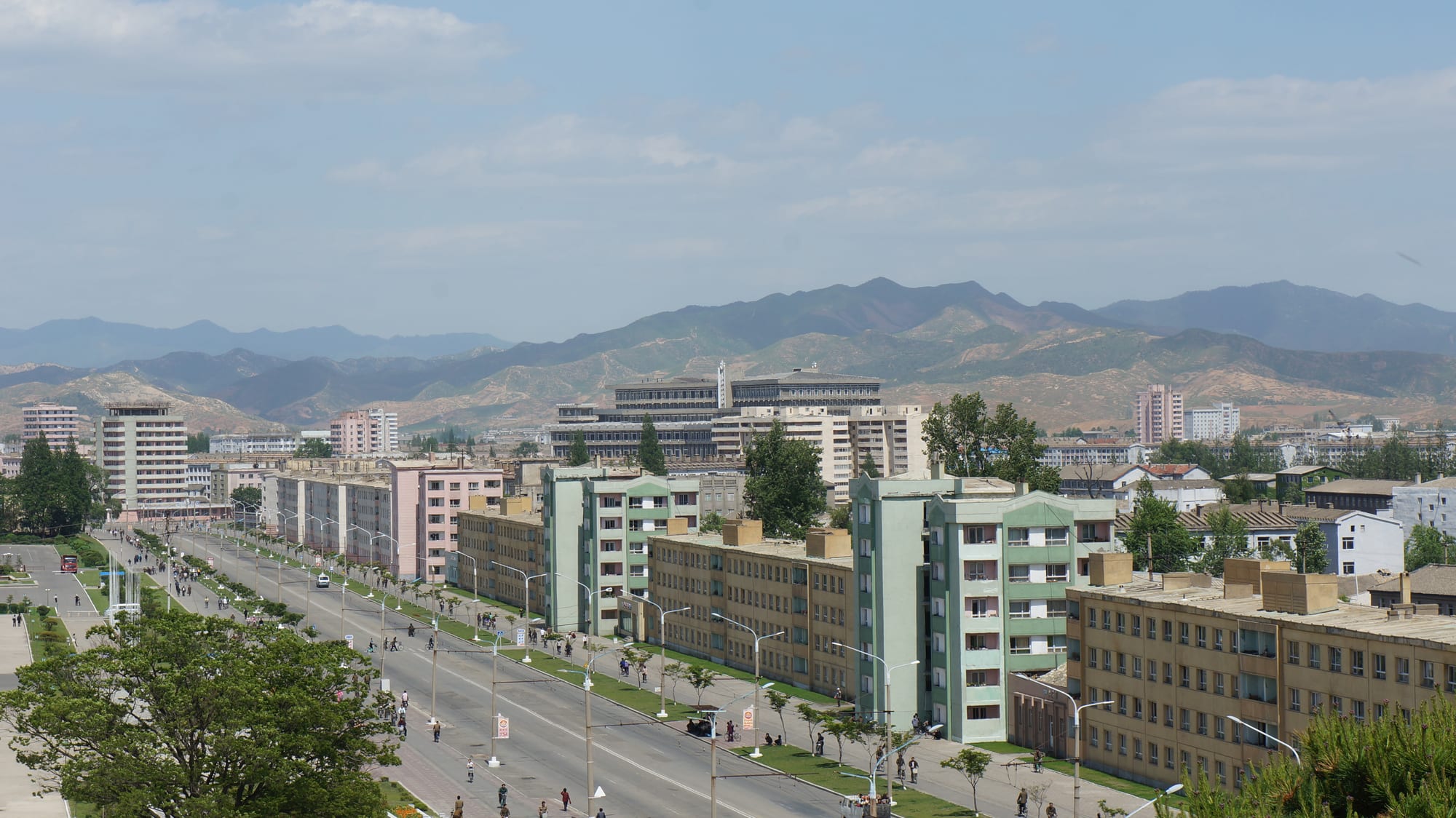
A wide tree-lined boulevard of pastel apartment blocks under a blue sky, with bare brown ridges rising behind the city

Wonsan & the East Coast, North Korea

Hamhung

A main avenue in central Hamhung, with the hills of South Hamgyong behind. (Uri Tours / Wikimedia Commons · CC BY-SA 2.0)

North Korea's second-largest city, on a plain where the Songchon river reaches the Sea of Japan, with its port district of Hungnam beside it. An old provincial seat tied to the founder of the Joseon dynasty, it was turned into a chemical-industry centre in the colonial period, flattened in the Korean War and rebuilt with East German help. This page is written to explain the city, not to encourage travel.

Neighbourhoods

  • The central avenues
    • First-time visitors
    • Post-war architecture

    The rebuilt core between the railway station and the river, laid out in the 1950s on broad boulevards with low pastel blocks, squares and monuments. The theatre, the main administrative buildings and the hotels used by visiting groups are here.

    Open in Maps
  • Tonghung hill
    • Viewpoints
    • Historic sites

    The wooded rise on the eastern edge of the centre, with pavilions, old walls and a long view over the plain and the river. The oldest surviving corners of the city are grouped around its slopes.

    Open in Maps
  • Hungnam
    • Industry
    • The port

    The port and chemical district on the coast about 10 kilometres south, absorbed into the city and the reason for much of its growth — fertiliser and vinalon works, docks and the housing built for their workers.

    Open in Maps
  • The river plain
    • Local life
    • Quiet and residential

    Housing estates, institutes and farmland spread along the Songchon towards the hills, where most residents live. Beaches and fishing villages lie a short distance east along the shore.

    Open in Maps

Things to do

Landmarks in the city

  • Hamhung Grand Theatrelandmark

    A very large post-war theatre on the central square, the largest theatre building in the country.

    Open in Maps
  • Hamhung Royal Villalandmark

    The residence of Yi Seong-gye, founder of the Joseon dynasty, before he took the throne, rebuilt on the site after he abdicated in 1398 and now a listed national treasure.

    Open in Maps

The port and the coast

  • Hungnamneighborhood

    The port district south of the city, built around chemical and fertiliser works, and the site of the large seaborne evacuation of December 1950.

    Open in Maps

Short trips from the city

  • Sinpoattraction

    A port city up the coast, an important base for fishing and aquaculture and a shipbuilding centre.

    Open in Maps
  • Chosin Reservoirattraction

    The upland lake in the mountains inland, known in Korean as Changjin, where one of the harshest battles of the Korean War was fought in late 1950.

    Open in Maps

Eat and drink

Long-standing places and food districts in Hamhung. Hours, ratings and directions come from your maps app, always current.

Hamhung on the plate

  • Hamhung naengmyeonrestaurant

    The city's famous cold noodles, made from potato or sweet-potato starch and served chewy under a fiery chilli dressing, often with raw skate or pollock on top.

    Open in Maps
  • East coast seafoodrestaurant

    Pollock, squid, clams and crab landed at Hungnam and the fishing villages along the shore, eaten fresh, dried or fermented.

    Open in Maps
  • The city marketsmarket

    Hamhung's markets sell grain, vegetables, dried fish and imported goods, though foreign visitors have rarely been taken into them.

    Open in Maps

Experience Hamhung

History

Hamhung was the seat of the Hamgyong frontier under the Joseon dynasty, and the dynasty's founder Yi Seong-gye came from a military family in this region. He retired to Hamhung after giving up the throne, and the Korean expression for a messenger who never returns — a "Hamhung envoy" — comes from the story of the emissaries his son sent to bring him back to the capital. The city kept a royal villa and shrines associated with him, and grew as a garrison and market town on the road north.

Industry arrived under Japanese rule. From the late 1920s the Japanese industrialist Shitagau Noguchi built a nitrogen fertiliser complex at the port of Hungnam, powered by hydroelectric schemes his companies built in the mountains inland, and Hamhung grew into a company city around it. In the Korean War the area was fought over and bombed heavily: United Nations forces held it in late 1950, and as Chinese armies advanced the evacuation from Hungnam between 15 and 24 December carried troops and tens of thousands of civilians out by sea before the port installations were destroyed; counting Wonsan and Songjin, 98,100 civilians were taken out of north-eastern Korea.

Rebuilding began almost at once. From 1955 to 1962 an East German team planned and built a new city of wide avenues and low blocks, a large-scale programme that also trained Korean planners, architects and builders, and the chemical industry was restored and expanded, with the February 8 Vinalon Complex producing the synthetic fibre the state promoted as its own. The collapse of Soviet trade and the famine of the mid-1990s hit the city and its plants exceptionally hard.

Culture & Customs

Hamhung's identity rests on three things: the Joseon foundation story, heavy industry, and its food. The dynasty's early history gives the city its oldest monuments and a place in Korean historical memory on both sides of the border, while generations of chemical and machine work have made it a city of engineers, technicians and factory institutes. Its architecture is unusual in Korea — the 1950s East German plan left long boulevards, formal squares and blocks quite unlike Pyongyang's later monumental style.

The city is the anchor of the Hamgyong north-east culturally as well as administratively. The Hamgyong dialect is spoken here, blunter and sharply different from the standard of Pyongyang, and the region's reputation within Korea is for plain speech and hardiness. Hamhung naengmyeon, the chilli-dressed cold noodles, carries the city's name across the peninsula and is a point of local pride.

Official culture follows the national pattern: monuments and portraits of the leaders, mass gymnastics and dance displays on the anniversaries of the state calendar, and social life organised through work units, schools and neighbourhood groups. As across the country, religious practice is suppressed, and the surviving shrines and pavilions are maintained as heritage rather than as places of worship.

Daily Life

Hamhung has in the region of 770,000 people, making it the country's second city after Pyongyang, and it is the capital of South Hamgyong province. Together with the Hungnam district it forms the largest chemical-industry centre in the country, producing fertiliser, vinalon fibre, plastics and industrial chemicals, alongside machine building, shipbuilding and food processing. A medical college, a chemical-engineering university and a large hospital serve the wider province.

The plants have run intermittently for decades because of power and raw-material shortages, and the city's formal economy has never recovered its pre-1990 scale. Households supplement rationed supplies with market trading, private plots and fishing. Farming on the coastal plain grows maize, rice and potatoes, and the fishing fleet works out of Hungnam and the villages along the shore.

Daily life follows the national rhythm of assigned workplaces, organised study and political meetings, with markets filling the gaps. Electricity is unreliable, and winter heating depends on coal and wood. Trolleybuses and buses run along the wide avenues, bicycles are common, and in summer families go out to the beaches east of the city. The famine of the 1990s was severe here, and the industrial neighbourhoods around the chemical works have remained among the country's poorest.

Food

Hamhung's noodles are the dish everyone knows. Hamhung naengmyeon is made from potato or sweet-potato starch, which gives it a chewy, elastic texture quite unlike the buckwheat noodles of Pyongyang, and it is served with a fierce red chilli dressing rather than cold broth, usually topped with marinated raw skate or pollock. Korean cooks on both sides of the border argue over which of the two cold-noodle traditions is better, and the Hamhung style travelled south with refugees during the Korean War.

The rest of the local kitchen comes from the sea and the cold uplands. Pollock is the staple catch, eaten fresh, dried on racks through the winter and salted as roe; squid is split and hung to dry, and clams, crab and sea urchin come from the bay. Gajami sikhae, flatfish fermented with millet, radish and chilli, is a Hamgyong speciality, sour and hot, and quite distinct from kimchi.

Potatoes and maize matter more than rice in everyday cooking, appearing as noodles, pancakes, dumpling wrappers and cakes. Wild greens and mushrooms are gathered in the hills. For most households meals are plain — maize or rice, kimchi, soup and whatever fish is available — while the multi-course meals put in front of tour groups are arranged by the state and bear little resemblance to them. Soju and locally brewed beer are the usual drinks.

Planning tools

Budget

There is no independent budget. Foreigners have reached Hamhung only on organised tours with guides, usually as part of a longer east-coast itinerary from Pyongyang, and transport, lodging, meals and permits are paid as one fixed price. The city is a long way from the capital, which has made it one of the more expensive stops to add.

Daily Budget Midrange
USD 170–400 per day on a group tour, when tours run
Daily Budget Shoestring
USD 170–400 per day on a group tour (independent travel is not permitted, so there is no budget tier)

Tourist access has been almost entirely suspended since 2020, and permission for the north-east has always been granted case by case.

Best Time to Visit

Late May and June, before the monsoon, and September into early October, when the weather settles and the hills turn, have been the usual touring seasons. Midsummer is hot, humid and wet, and winter on this coast is cold and dry, with much harsher conditions in the mountains inland.

Suggested Number of Days

Hamhung has generally been an overnight stop on a longer east-coast tour, with an extra night if the coast or the mountains inland are added. The length is fixed by the tour rather than chosen by the visitor.

First Visit
1–2 days
With Surroundings
3–4 days

Transportation

All movement is by approved transport with guides. The east-coast railway links the city with Wonsan to the south and Chongjin to the north, slowly, and a road runs inland over the mountains towards Pyongyang. A narrow-gauge line climbs into the highlands towards the Chosin Reservoir. Trolleybuses and buses serve residents, who need permits to travel between counties.

Sightseeing is by chartered bus or car with guides present; the port, the chemical works and military areas along the coast are closed.

Airport & Station Connections

Most visitors have arrived by road or rail from Pyongyang, across the mountains, or by road up the coast from Wonsan, about 100 kilometres to the south. There are no scheduled passenger flights for tourists, and journeys are slow whichever way they are made.

Walkability

The rebuilt centre is flat, laid out on wide, straight avenues and easy enough to cross on foot, but independent walking is not permitted: visitors move between arranged stops with guides. Hungnam is about 10 kilometres from the centre and the beaches further still.

Safety

The risks are political rather than criminal. Visitors have been detained in North Korea for minor breaches of rules, and this is an industrial and military coast: photographing the port, the chemical works, soldiers, checkpoints or signs of poverty can lead to arrest. Medical care is limited and evacuation slow.

Most governments advise against all travel to North Korea and the US bans its citizens from going without special permission. Follow the guides' instructions exactly, ask before every photograph, and do not leave the group. Check current official travel advice before travelling.

Climate

A coastal climate a little milder than the interior, with the sea moderating winter temperatures and mountains shutting out some of the cold from the north. Summers are warm and humid, with monsoon rain in July and August and occasional typhoons; spring is dry and windy.

Summer
warm and humid, around 22–27°C, with the heaviest rain in July and August
Winter
cold and dry, around −8 to 2°C, colder and snowier in the mountains inland

Local Customs

Behaviour towards the state's symbols matters most. Visitors are expected to bow at the leaders' monuments they are taken to, and images of the leaders must not be folded, marked or photographed in part. Photography is restricted, above all around the port, the factories and anything military. Shoes come off indoors, drinks are poured for others rather than oneself, and things are passed with two hands.

Dress neatly at monuments, do not discuss politics with residents or hand them money or gifts, and ask the guides before photographing anyone.

Common Payment Methods

There are no cash machines for foreigners and foreign cards do not work. Costs are settled in advance through the tour operator; small purchases in hotel shops are made in cash, usually in euros, Chinese yuan or US dollars. The local won is not for visitors' use, and changing money back is not possible.