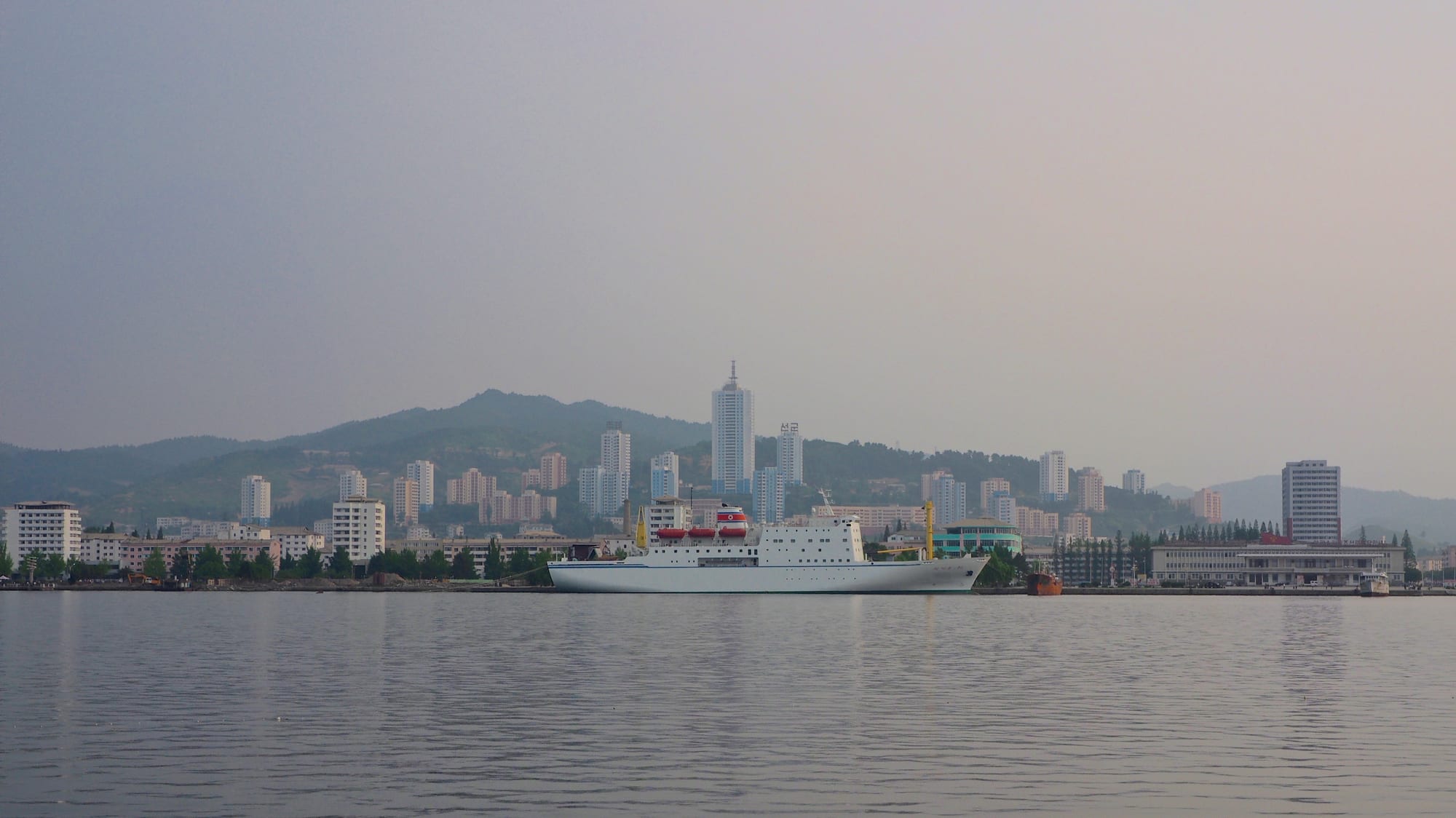
A white ferry moored along a waterfront of low blocks and pale towers, with wooded hills rising behind in grey haze

Wonsan & the East Coast, North Korea

Wonsan

The Wonsan waterfront on Yonghung Bay, with the hills of Kangwon province behind. (Clay Gilliland / Wikimedia Commons · CC BY-SA 2.0)

The main port of North Korea's east coast, on a sheltered bay of the Sea of Japan where wooded mountains meet a sandy shore. Opened to foreign trade in 1880 and rebuilt after the Korean War, it has since been made the focus of the state's tourism plans. This page is written to explain the city, not to encourage travel.

Neighbourhoods

  • The port and city centre
    • First-time visitors
    • The waterfront

    The working heart of the city, where the quays, the ferry berth, the railway station and the main square with its monuments stand within a short distance of one another. Low post-war blocks and wide avenues run back from the water towards the hills.

    Open in Maps
  • Songdowon
    • Beaches
    • Pine woods

    The pine-backed beach district north-east of the centre, long the city's bathing resort, with a sandy shore, shade under the trees and the children's holiday camp that has been part of the state's showcase for foreign visitors.

    Open in Maps
  • Kalma peninsula
    • Beaches
    • New building

    The sand spit that closes the bay, with a long strip of open beach on its seaward side. The airport sits at its base, and a large complex of hotels and apartment towers has been built along the shore as the centrepiece of the state's tourism plans.

    Open in Maps
  • The hill suburbs
    • Quiet and residential
    • Local life

    Housing, farmland and institutes spread inland along the valleys towards the mountain road to Pyongyang, including the agricultural university for which the city is known. This is where most residents live, away from the showcase shoreline.

    Open in Maps

Things to do

The beaches and the bay

  • Songdowon International Children's Campattraction

    The summer camp among the pines behind the city's bathing beach, built for North Korean children and small groups from abroad.

    Open in Maps
  • Wonsan Kalma Coastal Tourist Areaattraction

    The large hotel and apartment complex built along the Kalma peninsula's beach as the country's main seaside resort. It opened in July 2025; foreign tourism there was suspended shortly afterwards, while domestic visitors continued to come.

    Open in Maps

Getting there and away

  • Kalma Airporttransit hub

    The airport on the peninsula beside the city, rebuilt with a new terminal and a runway that doubles as a military airfield.

    Open in Maps

Short trips from the city

  • Masikryong Ski Resortattraction

    A state-built ski resort on the 1,360-metre Taehwa Peak, about 20 kilometres outside the city, opened in 2013, with a hotel at the foot of the slopes.

    Open in Maps
  • Ullim Fallsattraction

    A waterfall in the hills outside Wonsan, marked by the state as a tourist destination.

    Open in Maps
  • Mount Kumgangattraction

    The granite peaks, waterfalls and old temple sites of the Diamond Mountains, a few hours south down the coast near the demilitarised zone.

    Open in Maps

Eat and drink

Long-standing places and food districts in Wonsan. Hours, ratings and directions come from your maps app, always current.

Wonsan on the plate

  • East coast seafoodrestaurant

    Clams, crab, squid and pollock landed on this bay are the city's best-known food, often grilled over coals, and are served to tour groups in state-run restaurants and hotels.

    Open in Maps
  • Hamgyong-style cold noodlesrestaurant

    The chewy starch noodles of the north-east, dressed with chilli rather than served in cold broth, reach Wonsan from the coast to the north.

    Open in Maps
  • The city marketmarket

    Wonsan's markets sell vegetables, grain, dried fish and imported goods, though foreign visitors have rarely been taken to them.

    Open in Maps

Experience Wonsan

History

Wonsan grew from a fishing settlement on Yonghung Bay into one of Korea's first treaty ports, opened to foreign trade in 1880 under pressure from Japan. Western and Japanese merchants settled, a foreign quarter appeared beside the Korean town, and the harbour's deep water and shelter made it the natural outlet for the east coast. Under Japanese rule, when it was known as Genzan, it became a rail junction with lines north to Hamhung, west to Pyongyang and south towards Seoul, and a shipyard and other industry were added. A general strike in 1929, triggered by the treatment of Korean workers under Japanese rule, is remembered in Korean labour history.

Kim Il-sung is recorded as having come ashore at Wonsan in 1945 on his return from the Soviet Union, and the city has held a particular place in the state's account of itself ever since. During the Korean War the port was one of the most heavily attacked places in the country: it was blockaded and shelled by United Nations naval forces from February 1951 until the armistice in July 1953, 861 days and the longest naval blockade in modern history, and the town was largely destroyed.

The post-war city was rebuilt on a wide grid with the port, the shipyard and the railway at its centre, and a fishing fleet, a university of agriculture and a teachers' college beside them. From the 2010s the state redirected the city towards tourism, building the Masikryong ski resort in the hills in 2013, rebuilding the airport, and raising a long line of hotels and apartment towers along the Kalma peninsula's beach.

Culture & Customs

Wonsan's identity is a mixture of port town, holiday resort and showcase. The beach at Songdowon has been a bathing place since the colonial period, and the summer camp there, which has taken both North Korean children and small groups from abroad, is one of the images the state most likes to present. Mass beach events, sports days and holiday stays for workers judged to deserve them are part of the city's calendar.

The official culture is the national one: monuments and portraits of the leaders, organised gatherings on the anniversaries of the state calendar, and the structuring of social life through work units, schools and neighbourhood organisations. Wonsan's place in that story is tied to Kim Il-sung's landing in 1945 and to the leadership's long association with the city, which has helped draw investment that most provincial cities never see.

Culturally the city belongs to Kangwon province, whose name and much of whose landscape are shared with a province of the same name on the southern side of the demilitarised zone. The Kumgang mountains to the south have been a subject of Korean painting and poetry for centuries, and the coast's fishing villages have their own seasonal rhythms and shrines to the sea. Local speech sits between the standard of Pyongyang and the Hamgyong dialect of the north-east.

Daily Life

Wonsan has in the region of 330,000 people and is the capital of Kangwon province. The port, the shipyard, fishing and food processing, a rolling stock and machinery works, and the province's administration provide most formal employment, alongside the agricultural university and the colleges, which give the city a student population.

Fishing shapes the year: squid, pollock and crab are landed at the quays and dried in the open along the shore, and state campaigns push the fleet to meet catch targets. Farming on the narrow coastal plain and in the valleys inland supplies maize, potatoes, rice and vegetables. Construction has been a large employer for a decade, first at Masikryong and the airport, then along the Kalma beach front, work carried out largely by soldiers and mobilised labour.

Daily life follows the national pattern of assigned workplaces, rationing supplemented by markets, and regular political meetings. Electricity is unreliable and heating in winter depends on coal, though the city is better supplied than smaller towns. Residents swim and picnic at Songdowon in summer; trolleybuses and buses run along the main avenues, and bicycles are common. The contrast between the new shoreline towers and the ageing blocks inland is the city's most visible division.

Food

Wonsan eats from the bay. Clams grilled over coals on the sand are the dish most associated with the city, and squid, crab, sea urchin, sea cucumber and pollock come off the boats through the year. Pollock (myongtae) is dried on wooden racks along the coast for winter, its roe salted and spiced, and smaller fish are fermented into sikhae, a sour preserve made with millet and chilli that is a speciality of the north-east.

The region's noodles are famous. Wonsan sits between two traditions: the buckwheat naengmyeon served in cold broth that Pyongyang is known for, and the chewy potato-starch noodles of Hamgyong, dressed with red chilli and often topped with seasoned raw fish. Both are eaten here, along with potato and maize dishes from the mountain valleys inland — pancakes, dumplings and thick starch noodles.

Everyday meals for most households are plain: rice or maize with kimchi, soup and whatever fish is available, with meat a luxury. Seaweed, laver and shellfish gathered from the shore supplement what the ration system and the markets provide. The drinks are the national ones — soju, locally brewed beer, barley tea and bottled mineral water from mountain springs — and the elaborate multi-dish meals served to tour groups bear little relation to what is eaten in the flats behind the sea front.

Planning tools

Budget

There is no independent budget. Foreigners have reached Wonsan only on organised tours with guides, and lodging, meals, transport and permits are paid as one fixed price, so the daily figure is set by the operator rather than the traveller. Beach stays and ski packages at Masikryong have been sold at a premium over standard tours from Pyongyang.

Daily Budget Midrange
USD 170–400 per day on a group tour, when tours run
Daily Budget Shoestring
USD 170–400 per day on a group tour (independent travel is not permitted, so there is no budget tier)

Tourist access has been almost entirely suspended since 2020; any new resort openings for foreigners should be treated with caution until confirmed by official advice.

Best Time to Visit

Late May and June suit the coast, before the monsoon, and September and October bring settled weather and autumn colour in the Kumgang mountains to the south. July and August are the bathing season on the bay, hot and wet. The ski season at Masikryong runs roughly from December to February.

Suggested Number of Days

Wonsan has usually been an overnight stop on a longer tour from Pyongyang, with a second or third night added when the mountains, the ski resort or the coast to the south are included. The length is decided by the tour, not the visitor.

First Visit
1–2 days
With Surroundings
3–4 days

Transportation

All movement is by approved transport with guides. A mountain road links Pyongyang with Wonsan in a few hours, the east-coast railway runs north through Hamhung and south towards the demilitarised zone, and Kalma airport has handled occasional flights. Inside the city, trolleybuses and buses serve residents, who need permits to travel between counties.

Sightseeing is by chartered bus or car with guides present; military areas along the coast and near the border are closed.

Airport & Station Connections

Most visitors have arrived by road from Pyongyang, about 170 kilometres away over a mountain pass, in a few hours, or by rail on the eastern line. Kalma airport beside the city has a modern terminal and has handled domestic flights and occasional charters rather than regular international services.

Walkability

The centre is flat, laid out on wide avenues and small enough to cross on foot, and Songdowon's beach is a few kilometres from it, but independent walking is not permitted: visitors move between arranged stops with guides. The Kalma peninsula stretches several kilometres beyond the town.

Safety

The risks are political rather than criminal. Visitors have been detained in North Korea for minor breaches of rules, and this coast is heavily militarised, with naval bases, an air base beside the airport and missile test sites nearby; photographing any of them can lead to arrest. Medical care is limited and evacuation slow.

Most governments advise against all travel to North Korea and the US bans its citizens from going without special permission. Follow the guides' instructions exactly, ask before every photograph, and do not wander from the group. Check current official travel advice before travelling.

Climate

The mountains shelter the coast from the worst of the Siberian winter, so Wonsan is milder in winter than Pyongyang, though snow is heavy on the passes and at Masikryong. Summers are warm and humid, with monsoon rain in July and August and occasional typhoons in late summer.

Summer
warm and humid, around 22–28°C, with the heaviest rain in July and August
Winter
cold but milder than inland, around −5 to 5°C, with snow on the passes

Local Customs

Behaviour towards the state's symbols matters more than anything else. Statues and portraits of the country's leaders are treated formally: visitors are expected to bow at the monument on the main square, and images must not be folded, cropped or photographed in part. Photography is restricted, above all around the port, the airport and anything military. Shoes come off indoors, drinks are poured for others rather than oneself, and things are passed with two hands.

Dress neatly at monuments, do not discuss politics with residents or give them money or gifts, and never photograph soldiers or people without asking the guides first.

Common Payment Methods

There are no cash machines for foreigners and foreign cards do not work. Almost everything is paid for in advance through the tour operator; small purchases in hotel shops are made in cash, usually in euros, Chinese yuan or US dollars. The local won is not for visitors' use, and there is nowhere to change money back.