Attractions & Natural Wonders · Malaysia
Why does the world's largest flower smell like rotting meat?
Rafflesia has no leaves, stems or roots, and only a few days to be pollinated. Its stench recruits the helpers that reliably come running, carrion flies.
By Globeway Editorial · 2 November 2026
The short answer
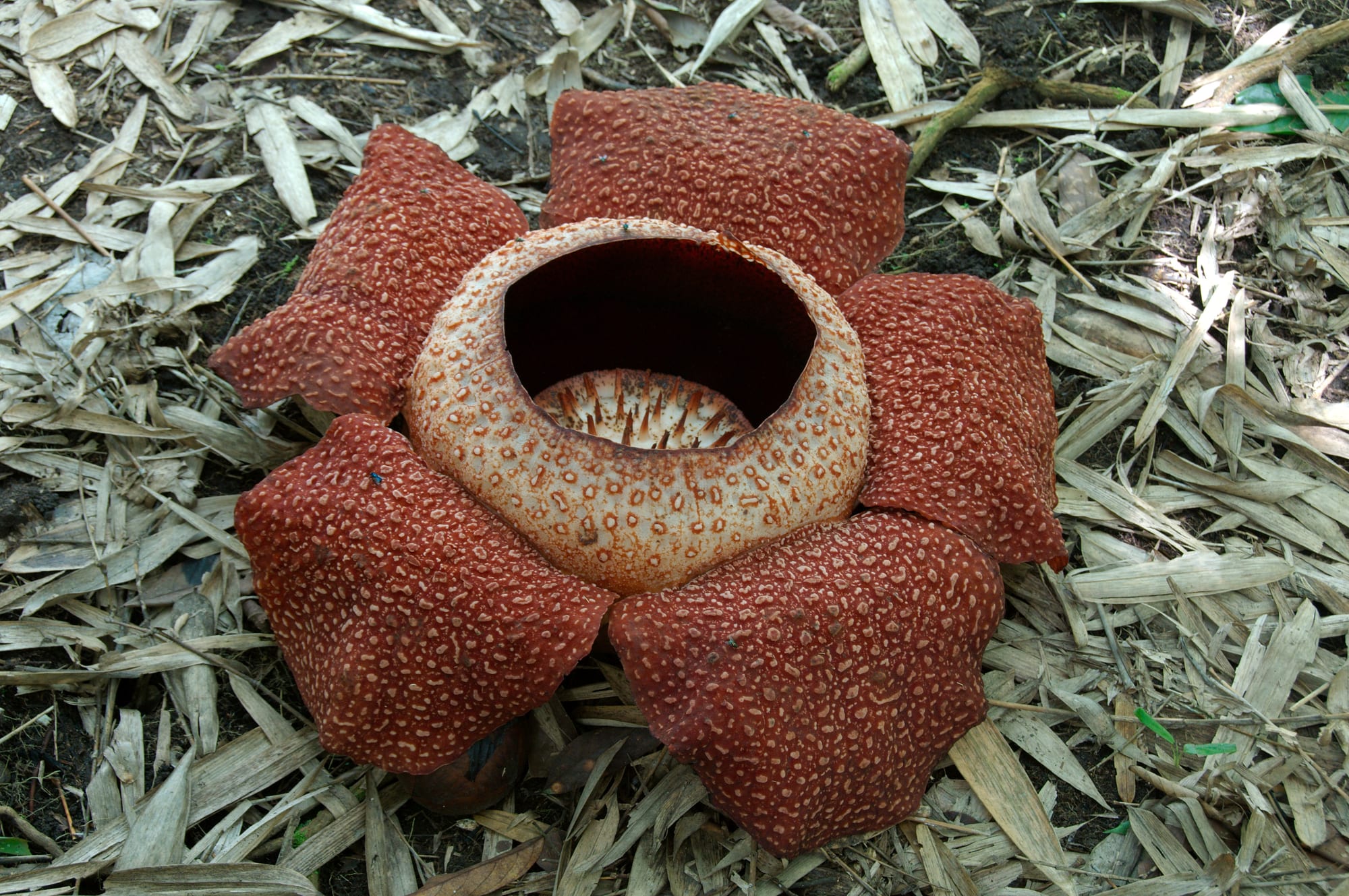
The world's largest single flower belongs to Rafflesia arnoldii, one of a group of Southeast Asian plants called Rafflesia, and it smells like rotting meat because it needs flies that feed and breed on dead animals. Its odour comes from sulphur-containing chemicals, chiefly dimethyl disulfide and dimethyl trisulfide, compounds that are also given off by decomposing matter. Carrion flies, mainly blowflies, follow the smell, land on the flower expecting a carcass, and carry pollen from one bloom to the next.
The flower looks the part too. Its thick, red-brown petals, often blotched with pale warts, resemble decaying flesh. The deception matters because a Rafflesia flower lasts only a few days, and most species have separate male and female flowers, so a fly must visit a male bloom and then a female one for seeds to form. A smell that carrion flies cannot ignore gives the plant its best chance in the dense rainforest.
A flower with no plant attached
Rafflesia is one of the strangest plants on Earth. It has no stems, leaves or roots, and it cannot make its own food. It is a holoparasite, a plant that takes everything it needs from a host, and it lives entirely inside the tissue of vines of the genus Tetrastigma, members of the grape family. Each Rafflesia species grows naturally on only one to three species of Tetrastigma.
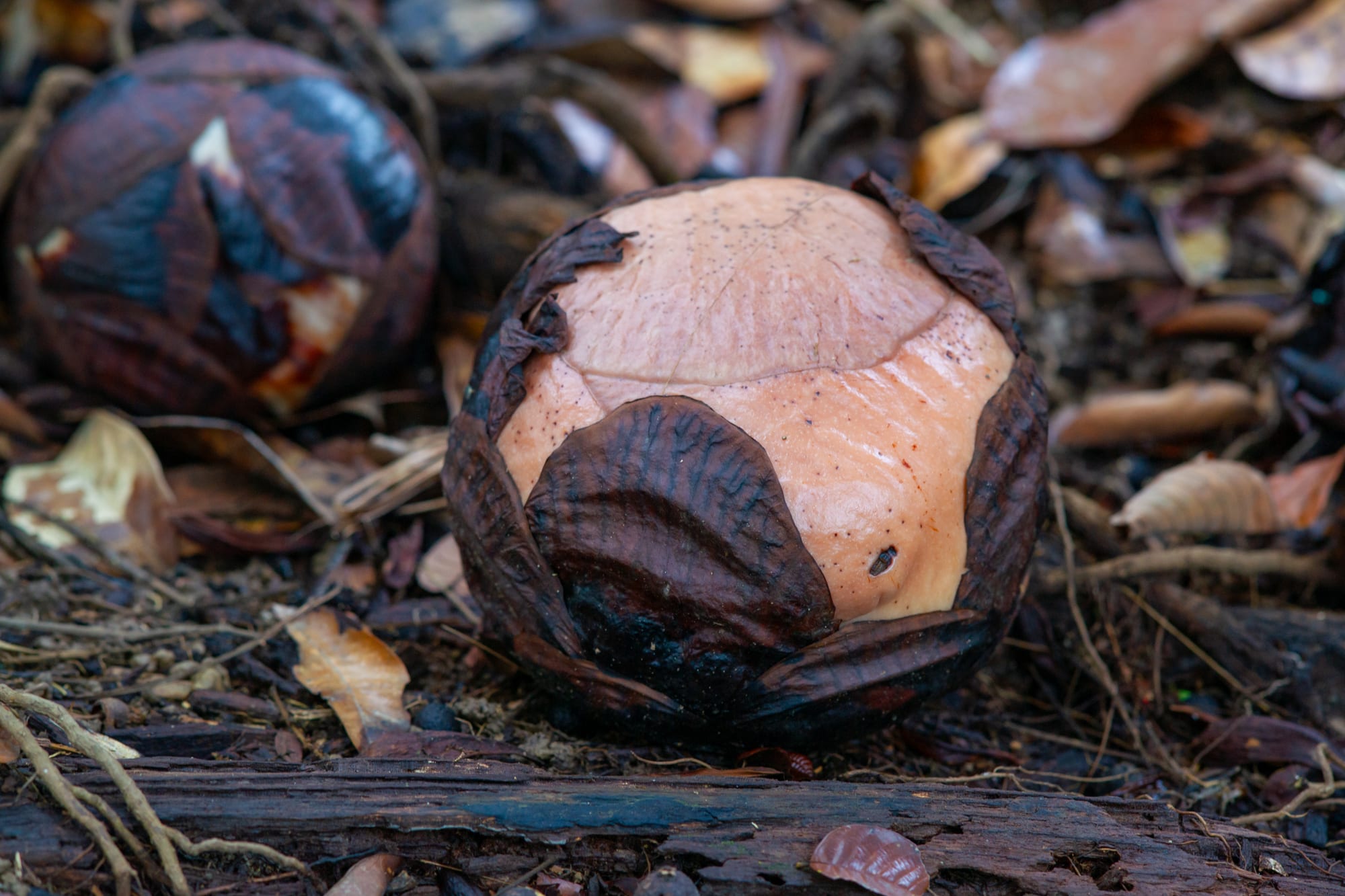
For most of its life the parasite is invisible, its absorbing organ, the haustorium, spread through the vine's tissue. When it is ready to reproduce, a tiny bud breaks through the vine's root or stem and swells over about a year into a dark, cabbage-like head. Then it opens, and the flower, the only part of Rafflesia ever seen outside the host, has just a few days to do its job before it begins to rot.
How the stink does its work
Plants that mimic a corpse to attract pollinators are known as carrion flowers, and Rafflesia is one of the best known of them. The strategy works by deception. Chemical studies of Rafflesia arnoldii found that its scent comes from dimethyl disulfide and dimethyl trisulfide, which flies associate with decaying organic matter. Carrion flies of the family Calliphoridae, the blowflies, are its main pollinators, and other flies and beetles visit too.
Fooled by both the odour and the meat-like colour, the flies mistake the flower for decaying meat and pick up pollen as they explore it. Because most Rafflesia species are dioecious, meaning each flower is either male or female, the pollen only does any good if the same fly later finds a female flower. Flies recorded on the flowers include Chrysomya megacephala, Sarcophaga haemorrhoidalis and Drosophila colorata.
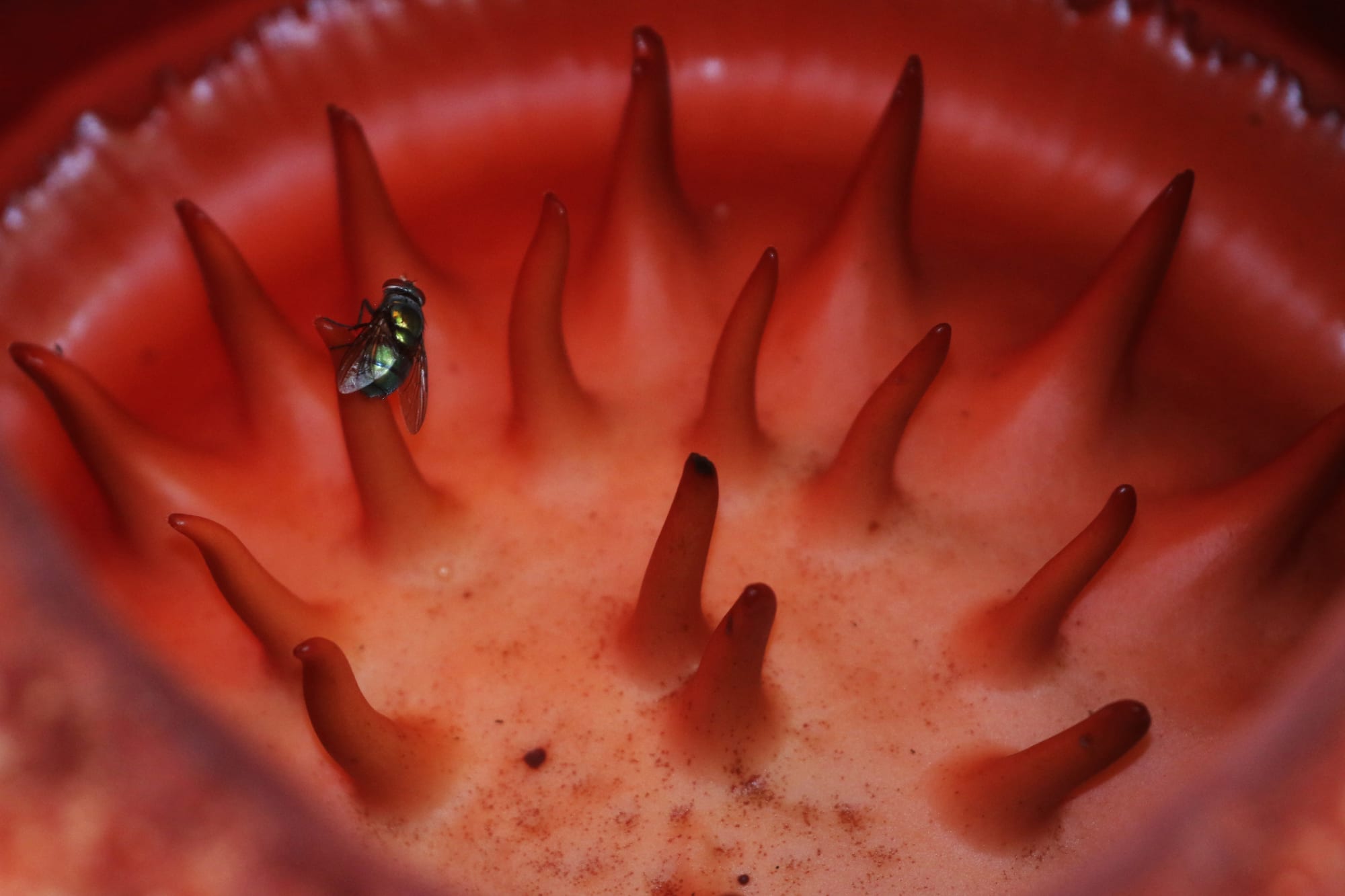
The flies come looking for a carcass and leave with nothing of the kind; the flower has used them. After pollination the flower develops into a fruit holding hundreds of thousands of minute seeds. Tree shrews and other forest mammals eat the fruits, and the tiny seeds are thought to be spread mostly by ants, although much about how they reach a new vine remains unknown.
How big is the biggest
Rafflesia arnoldii, which grows in Sumatra and Borneo, produces the largest single flower of any plant, around 1 metre (3 feet 3 inches) across and up to about 10 kilograms (22 pounds) in weight. A bloom measured in West Sumatra in January 2020 reached 111 centimetres, reported at the time as the widest ever recorded. Even one of the smallest species, R. baletei, has flowers 12 centimetres wide.
There is a common mix-up here. The titan arum, Amorphophallus titanum, is sometimes credited with the world's largest flower, but what it produces is the world's largest unbranched inflorescence, a spike carrying many small flowers. The two plants are unrelated, yet both stink of carrion and both rely on dimethyl sulfides to do it; the titan arum even heats its central spike to spread the smell further.
Rafflesia's size is an evolutionary surprise. DNA studies place the genus within the spurge family as traditionally defined, a group whose members typically have very small flowers. Researchers found that flower size in Rafflesia's lineage grew unusually fast at its origin before settling back to a slower pace of change.
Where to see one in Sabah
Borneo is home to nine Rafflesia species, R. arnoldii among them. Sabah's own star is Rafflesia keithii, which grows only in Sabah and is the largest of the three Rafflesia species found there. It usually blooms on the forest floor from the underground stems and roots of its host vine and is found mostly around Poring, a lowland rainforest resort in Ranau district known for its hot springs.
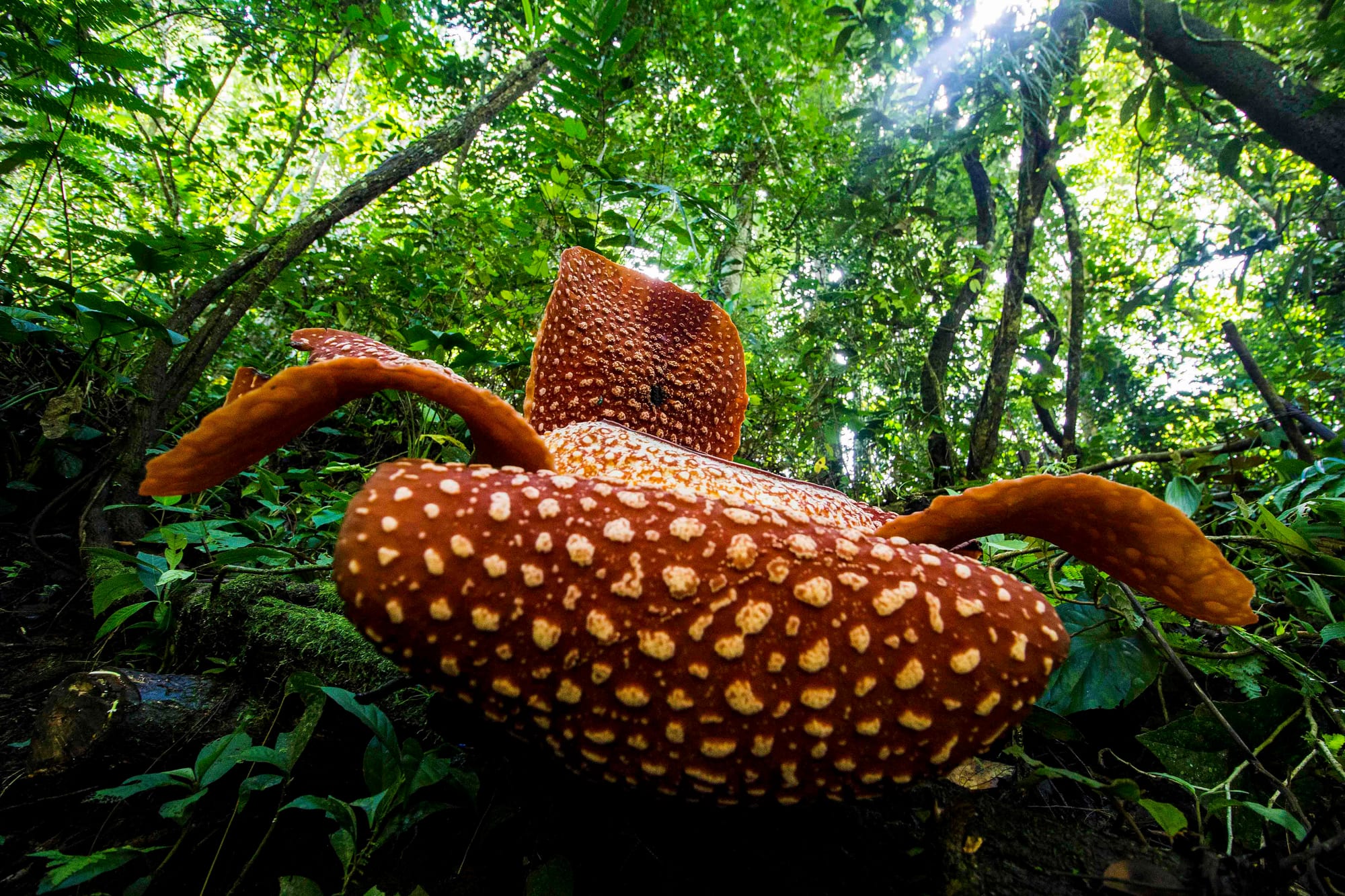
In Tambunan District, the Rafflesia Forest Reserve protects 356 hectares of virgin jungle, mainly for Rafflesia pricei, a species named after the amateur botanist William Price, who found it on Mount Kinabalu in the 1960s. The area was first set aside in 1967 as part of the Crocker Range Forest Reserve and made a separate reserve by the Sabah Forestry Department in 1984. Hiking trails lead from the Rafflesia Information Centre, on the road from Kota Kinabalu to Tambunan, to sites where wild flowers appear.
Because each bloom lasts only days and buds take many months to mature, seeing one open is a matter of luck and timing. Visitors also carry a responsibility: buds are easily crushed underfoot, and at places regularly visited by tourists the number of buds produced each year has fallen.