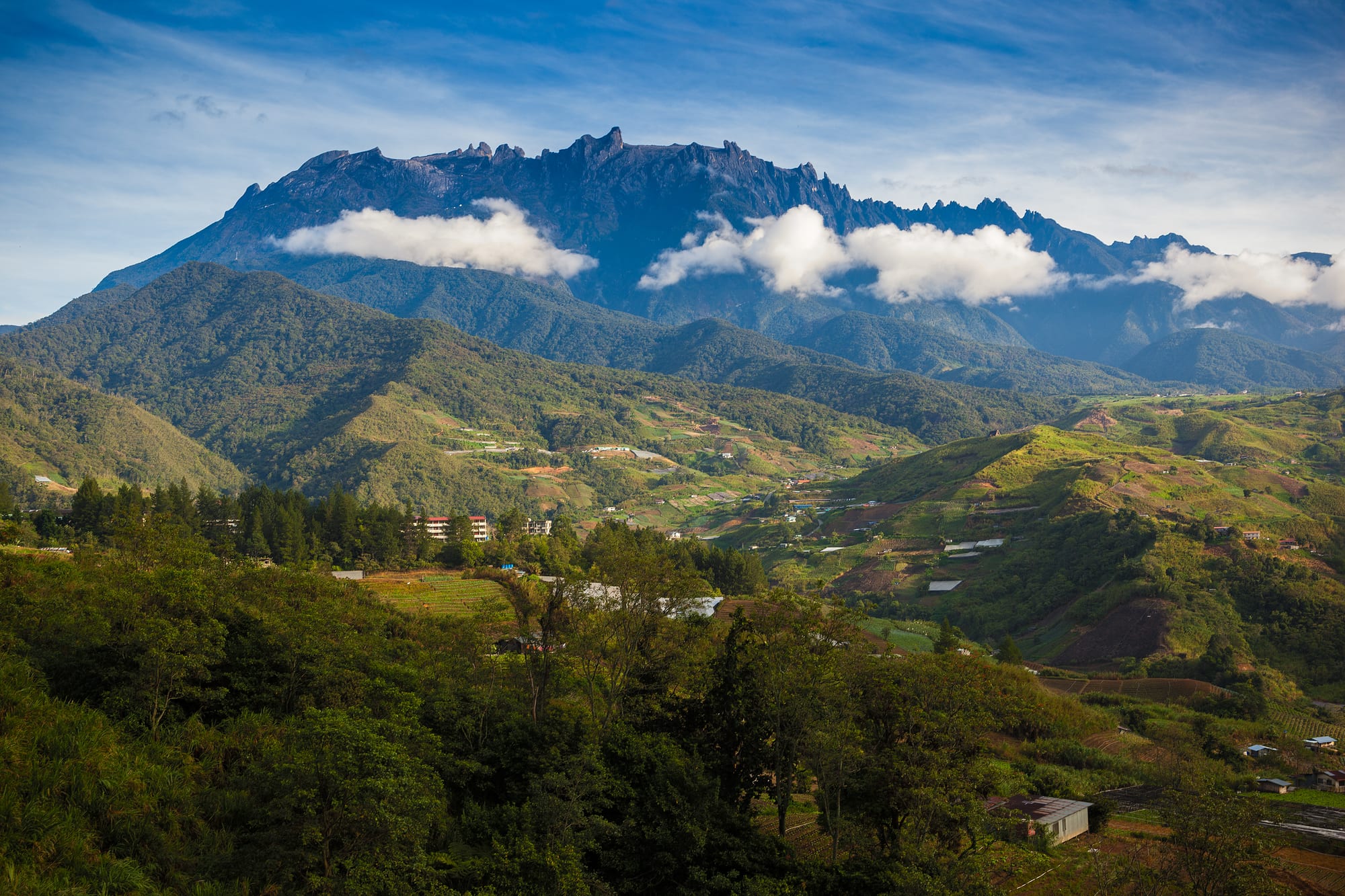
The jagged granite summit of Mount Kinabalu above green forested hills, farmland and scattered houses in morning light

Malaysia

Sabah

Mount Kinabalu seen in the morning from the highland farming district of Kundasang, Sabah. (Anton Zelenov / Wikimedia Commons · CC BY-SA 4.0)

The northern tip of Borneo, made up of the state of Sabah and the small federal territory of Labuan offshore — a land of Indigenous Kadazan-Dusun, Bajau and Murut peoples, rainforest rivers full of wildlife, coral reefs and Mount Kinabalu, one of the highest peaks in Southeast Asia.

Explore Sabah

History

Northern Borneo was a coast of fishing and trading communities, loosely held by the sultanates of Brunei in the west and Sulu in the east, while the Kadazan-Dusun and Murut peoples farmed rice and hunted in the interior. In 1878 the Sultan of Sulu signed an agreement over his territories there with Western merchants, read by the Philippines as a lease and by Malaysia as a cession, and in 1881 the British North Borneo Chartered Company took over the administration, later making Sandakan its capital and opening tobacco and later rubber estates worked by Chinese and other migrant labour. Local resistance, notably Mat Salleh's revolt in the 1890s, was put down.

Labuan island was ceded to Britain by Brunei in 1846 and became a coaling station for steamers. The Second World War brought Japanese occupation and the Sandakan death marches of 1945, in which almost all the Australian and British prisoners held at Sandakan died. The war left Sandakan and Jesselton largely destroyed, and North Borneo became a British crown colony in 1946, with the capital moved to Jesselton, renamed Kota Kinabalu in 1967.

Sabah joined Malaysia in 1963 under the Malaysia Agreement, which promised certain autonomies, including immigration control, that remain a political issue today. The Philippines retains a dormant claim to eastern Sabah based on the 1878 agreement, which Malaysia regards as a non-issue; in 2013 armed followers of a Sulu claimant landed at Lahad Datu and were driven out. Labuan was transferred to the federal government in 1984 and became an offshore financial centre.

Culture & Customs

Sabah has dozens of ethnic groups. The Kadazan-Dusun are the largest and are mostly Christian; the Bajau, many of them Muslim, include the horsemen of Kota Belud on the west coast and the sea-going communities of Semporna in the east; and the Murut live in the south-western interior. Large Chinese — mainly Hakka — and Malay communities, and migrants from the southern Philippines and Indonesia, complete a population that mixes faiths more freely than on the peninsula.

The great festival is Kaamatan, the harvest festival held through May, which honours the rice spirit Bambaazon with ceremonies led by traditional priestesses, the Unduk Ngadau pageant, the sumazau dance and plenty of rice wine. The Bajau of Semporna hold the Regatta Lepa, a parade of brightly decorated boats, and the West Coast Bajau of Kota Belud keep a traditional horse culture.

Sabahans take pride in their easy-going mixing, and a phrase often heard is that everyone is related to everyone. Longhouses survive among the Rungus near Kudat and in parts of the Murut interior. English is widely spoken, and local Sabah Malay has its own slang.

Daily Life

Sabah has about 3.4 million people and Labuan around 100,000. Kota Kinabalu, with roughly half a million in its city area, is the capital and main city; Sandakan and Tawau are the east-coast centres, and Keningau, Lahad Datu and Semporna serve the interior and the east.

The economy rests on palm oil, oil and gas, timber, fishing and tourism, and Labuan's offshore banking and oil-industry services. Much of the state's lowland forest was logged and converted to plantations from the 1970s, leaving wildlife in fragments along the rivers. Despite its resources Sabah has one of the highest poverty rates in Malaysia, and roads, water supply and power cuts are frequent complaints.

Large numbers of undocumented migrants and stateless people, many from the southern Philippines, live in coastal settlements, a long-running political issue. Day-to-day life is informal: the morning coffee shop, the weekly tamu market, church or mosque, and weekend trips to the islands or the hills.

Food

Sabah's cooking combines Indigenous, Chinese and Malay traditions. The Kadazan-Dusun signature is hinava, raw fish cured in lime juice with ginger, chilli, shallots and grated seed of the bambangan, a wild mango that is also pickled and eaten as a relish. Pinasakan is fish braised with a sour fruit and turmeric, and linopot is rice cooked with tapioca or yam and wrapped in a leaf. Rice wine — tapai, and the stronger lihing — is brewed for festivals.

Chinese Sabahans contribute Tuaran mee, springy egg noodles fried with char siu, egg and greens, named after the town north of Kota Kinabalu, and ngiu chap, a beef noodle soup of sliced beef, tripe and other offal. Kota Kinabalu's night market and seafood restaurants grill fish, prawns and squid by the waterfront, and the Bajau of the east coast eat much of their seafood with cassava.

The highlands add their own products: Sabah tea grown near Ranau, Tenom coffee, and fresh milk and vegetables from Kundasang. The local green vegetable sayur manis appears in almost every stir-fry.

Attractions & Natural Wonders

The west coast centres on Kota Kinabalu, with its waterfront markets, the Sabah Museum, the City Mosque on Likas Bay and the five islands of Tunku Abdul Rahman Park a short boat ride away. Inland, Kinabalu Park, a UNESCO World Heritage Site, surrounds Mount Kinabalu, whose summit of Low's Peak is reached by a steep two-day climb; the park headquarters has botanical trails, and nearby Poring has hot springs and a canopy walkway. Further north, the Tip of Borneo near Kudat has Rungus longhouses nearby.

On the east coast, Sandakan is the base for the Sepilok Orangutan Rehabilitation Centre, the neighbouring Bornean Sun Bear Conservation Centre and the Rainforest Discovery Centre, as well as the Sandakan Memorial Park at the old prisoner-of-war camp. The Kinabatangan River, with lodges around Sukau and Bilit, is one of the best places in Borneo to see proboscis monkeys, along with orangutans, hornbills and pygmy elephants, and the Gomantong Caves nearby are harvested for swiftlet nests.

In the south-east, the Danum Valley Conservation Area protects old-growth rainforest, and Sipadan, off Semporna, is one of the world's best-known dive sites, with neighbouring Mabul and Kapalai. Labuan has wartime memorials, a marine park with shipwrecks, and duty-free shopping.

Cities in Sabah

Planning basics

Budget

Sabah costs more than the peninsula for the things most visitors come for. Kota Kinabalu's hostels and food are cheap, but the Kinabalu climb requires a permit, a guide and a booked bed at Laban Rata, Kinabatangan and Danum Valley trips are usually sold as packages, and Sipadan diving is limited by daily permits. Labuan is duty-free.

Daily Budget Midrange
USD 85–200 (hotel or river lodge, guided wildlife trips, domestic flights, diving)
Daily Budget Shoestring
USD 25–45 (hostel, market food, minibuses, public ferries to the islands)

Book the Kinabalu climb and Sipadan permits well ahead, and compare packages for the Kinabatangan and Danum Valley.

Safety

Kota Kinabalu and the west are safe. The specific concern is the east coast islands and waters off Semporna, Lahad Datu and Sandakan, which have a history of kidnapping by armed groups from the southern Philippines; a security zone (ESSZone) operates there under a dedicated security command. Mountain weather on Kinabalu and river hazards are the other risks.

Use licensed operators for diving and river trips in the east, follow local security rules, and climb Kinabalu only with a guide. Check current official travel advice before travelling.

Climate

Hot and humid on the coasts, with rain in every month. Sabah lies south of the typhoon belt, which earned it the name "Land Below the Wind". Rain is generally heaviest from about October to January, and the east coast rivers can flood. Mount Kinabalu is cold at the top, near freezing before dawn, and the Kundasang highlands are cool.

Summer
hot and humid on the coasts, 24–33°C, with afternoon showers; cool in the highlands
Winter
wetter from about October to January, 23–31°C on the coasts; near 0°C on Kinabalu's summit at night

Transportation

Kota Kinabalu's international airport is the main gateway, with flights to Sandakan, Tawau and Lahad Datu that save long road journeys. Buses and minibuses link the main towns — Kota Kinabalu to Sandakan takes the best part of a day by road. Sepilok and the Kinabatangan are reached from Sandakan, Sipadan through Semporna, and Labuan by ferry from Kota Kinabalu or Menumbok. A railway runs south from Tanjung Aru in Kota Kinabalu to Tenom.

Fly to Sandakan or Tawau rather than driving across the state, and let the lodges arrange river and park transfers.

Best Time to Visit

March to September is generally the driest period and the best for climbing Kinabalu, diving at Sipadan and seeing wildlife on the Kinabatangan, where lower water levels bring animals to the riverbanks. The Kaamatan harvest festival fills May with celebrations. Wildlife and diving are possible all year, with more rain in the last months of the year.