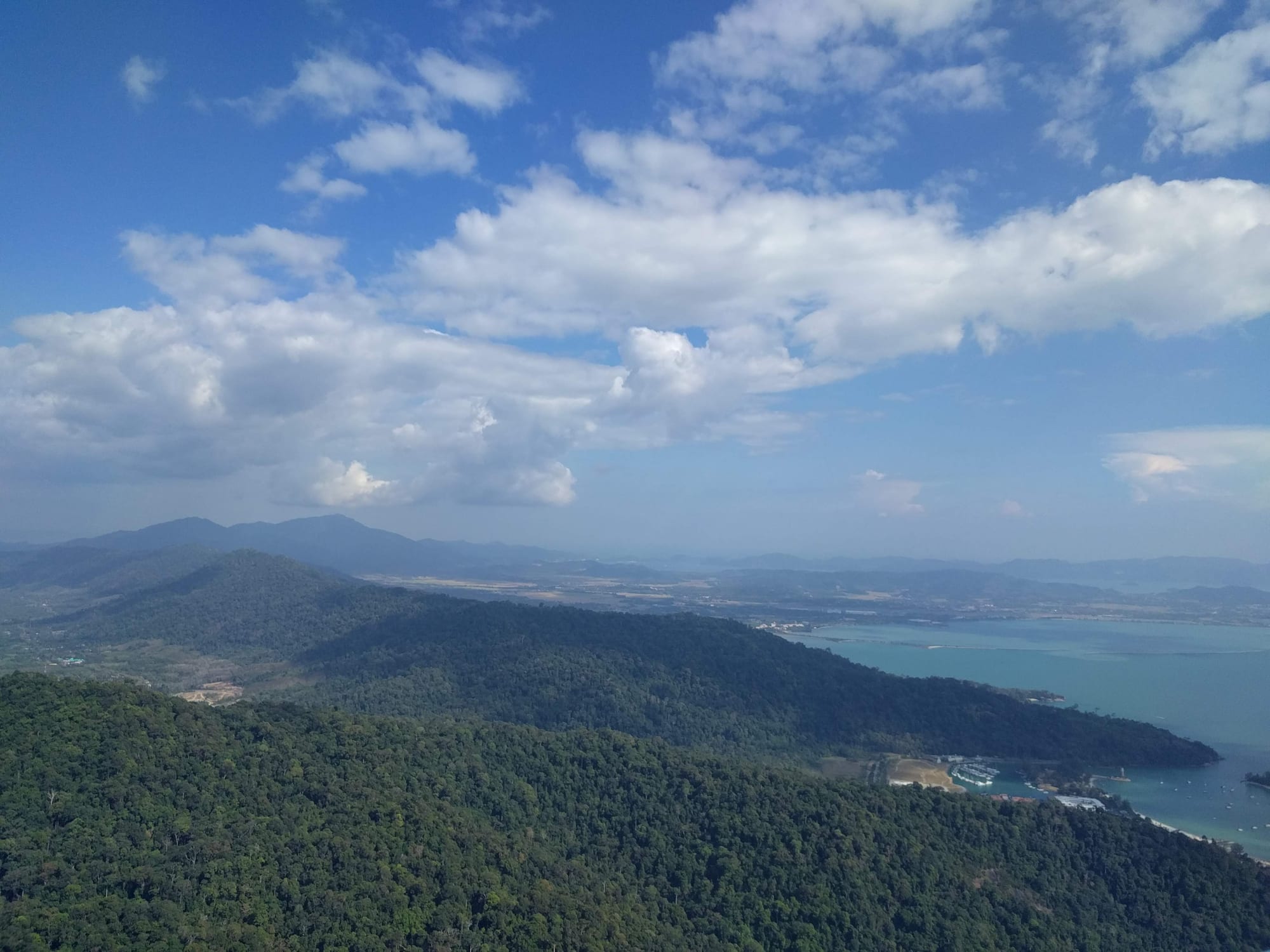
Forested hills falling to a turquoise bay under a blue sky with white clouds, seen from a high summit

Malaysia

Penang & the Northern Peninsula

Langkawi's forested hills, beaches and bays seen from the summit of Gunung Machinchang. (DerYang2004 / Wikimedia Commons · CC BY-SA 4.0)

The north-western corner of Peninsular Malaysia, from the Thai border through the rice plains of Perlis and Kedah to the island of Penang and the old tin state of Perak — a region of Chinese shophouse towns, Malay sultanates, limestone karst and the resort island of Langkawi.

Explore Penang & the Northern Peninsula

History

The north holds some of the oldest traces of human life in the peninsula. In the Lenggong Valley of upper Perak archaeologists found stone-tool workshops and Perak Man, a skeleton around 10,000 years old, and in Kedah's Bujang Valley the remains of brick temples and trading settlements show that Indian and Chinese ships were calling here more than a thousand years ago. Kedah grew into a Malay sultanate, long living between the pull of Siam to the north and the Malay world to the south; Perlis was separated from it in the mid-19th century after a Siamese occupation.

Perak's sultanate was founded in the 16th century by a son of the last ruler of Malacca, and its wealth came from tin. In 1786 Francis Light took possession of Penang island for the East India Company and laid out George Town as a free port; it became part of the Straits Settlements with Malacca and Singapore. The tin rush of the mid-1800s brought tens of thousands of Chinese miners to Larut and the Kinta Valley, and fighting between rival Chinese societies helped justify the 1874 Pangkor Treaty, which put a British Resident at the Perak court. The first Resident, J. W. W. Birch, was killed at Pasir Salak in 1875.

Perak joined the Federated Malay States, and Ipoh and Taiping boomed as mining towns. Kedah and Perlis passed from Siamese to British protection under the 1909 Anglo-Siamese Treaty. After the Japanese occupation, the north became a stronghold of the tin, rubber and rice economy of independent Malaya. The tin collapse of the 1980s hit Perak hard, while Penang reinvented itself as an electronics centre and, in 2008, George Town gained UNESCO World Heritage status jointly with Malacca.

Culture & Customs

The region splits along old lines. Penang and Ipoh are largely Chinese towns, where Penang Hokkien — a dialect peppered with Malay and English words — and Cantonese in Ipoh are heard in the coffee shops, and clan associations, temples and ancestral halls still anchor community life. Kedah and Perlis are predominantly Malay and rural, speaking the northern Malay dialect known as loghat utara, with small Siamese Buddhist communities near the Thai border. Perak mixes both, with a large Indian population around its old estates.

Penang's Peranakan families, descended from Chinese traders who married locally, kept a distinctive style of beadwork, embroidered kebaya and porcelain. Religious festivals are public events: Chinese New Year in George Town, Thaipusam, when devotees carry offerings up to the hilltop Murugan temple on Penang's Waterfall Road, and Hari Raya open houses in the Malay kampungs.

Royal tradition runs deep. Kedah, Perak and Perlis each have a ruler — Perlis's is titled Raja rather than Sultan — and Kuala Kangsar is Perak's royal town, with the gold-domed Ubudiah Mosque. Near it the village of Sayong makes labu sayong, black clay water gourds that are a well-known Perak craft.

Daily Life

Penang state has about 1.8 million people, divided between the island, where George Town spreads into suburbs and high-rise condominiums, and the mainland around Butterworth and Seberang Perai. Perak has around 2.5 million, with Ipoh — a city of roughly 750,000 — as its capital, plus Taiping, Teluk Intan and Kuala Kangsar. Kedah has about 2.1 million and Perlis under 300,000.

Penang is one of the country's industrial success stories, with the Bayan Lepas free-trade zone making and testing semiconductors for global firms, alongside tourism, medical tourism and a large port. Kedah and Perlis are Malaysia's rice bowl, with padi fields stretching flat to the limestone hills, while Perak lives on palm oil, services and a revived Ipoh café and heritage trade after decades of decline following the end of tin.

Mornings start with dim sum or roti canai; Ipoh's old kopitiam fill early for white coffee. Traffic on Penang island, the price of housing near the tech parks, and young people leaving the rural north for the cities are the issues people talk about.

Food

Penang treats food as a point of pride. Its assam laksa — rice noodles in a sour fish broth sharpened with tamarind and topped with mint, pineapple and prawn paste — is the local signature, alongside char kway teow, flat rice noodles fried with prawns and cockles, Penang Hokkien mee, a prawn-stock noodle soup, and nasi kandar, rice with a choice of curries poured over it, a dish that grew from the Indian-Muslim traders of George Town. Cendol, shaved ice with green rice-flour jelly, coconut milk and palm sugar, and Penang rojak, fruit in a thick prawn-paste sauce, follow.

Ipoh has its own canon: tauge ayam, poached chicken served with plump local bean sprouts, sar hor fun, silky flat noodles in a chicken and prawn broth, salt-baked chicken, and Ipoh white coffee, roasted with palm-oil margarine and served with condensed milk, and kaya toast is a breakfast staple.

In Kedah and Perlis the cooking is Malay and rice-based: laksa Kedah, a fish-gravy noodle dish, gulai curries and sweets made from glutinous rice. Perlis is best known for harumanis, a fragrant mango harvested in April and May and prized across the country.

Attractions & Natural Wonders

George Town is the region's centrepiece. The UNESCO-listed core has the carved Khoo Kongsi clan house, the Cheong Fatt Tze "Blue Mansion", Kapitan Keling Mosque and the Kuan Yin temple within a few streets, the stilt houses of the Chew Jetty, Fort Cornwallis on the waterfront and a trail of street murals. Beyond town, the funicular climbs Penang Hill, the Kek Lok Si temple rises above Air Itam, and Penang National Park guards the island's north-western beaches and forest.

In Perak, the limestone hills of the Kinta Valley around Ipoh hold the cave temples of Perak Tong, Sam Poh Tong and Kek Lok Tong, the Gua Tempurung show cave, and the unfinished Kellie's Castle near Batu Gajah. Taiping has its Lake Gardens and the old hill station of Bukit Larut, Kuala Kangsar its royal mosque, Pulau Pangkor its fishing villages and beaches, and the Royal Belum rainforest in the far north its lakes and wildlife. The Cameron Highlands, with the tea estates for which the area is known, lie just across Perak's border in Pahang, and are usually reached by road from Ipoh or Tapah.

Kedah's Langkawi is a UNESCO Global Geopark, with the cable car and Sky Bridge on Gunung Machinchang, the Kilim mangroves, the Seven Wells waterfall and Pantai Cenang beach. On the mainland are Alor Setar's Zahir Mosque and tower, the Bujang Valley museum and Gunung Jerai. Perlis has the Perlis State Park's forests and caves, rice country around Kangar and the border market town of Padang Besar.

Cities in Penang & the Northern Peninsula

Planning basics

Budget

The north is cheaper than Kuala Lumpur. George Town's hawker food is among the best-value eating in the country, though boutique hotels in restored shophouses have pushed up prices in the heritage zone. Ipoh, Alor Setar, Taiping and Kangar are inexpensive; Langkawi is duty-free, so alcohol and chocolate cost less, but beach resorts can be pricey in the dry season.

Daily Budget Midrange
USD 70–130 (heritage or resort hotel, restaurant meals, taxis, a boat or cable-car trip)
Daily Budget Shoestring
USD 25–40 (guesthouse or hostel, hawker meals, buses and trains)

Eat at hawker centres and coffee shops in George Town and Ipoh; save the budget for a Langkawi hotel in the December–March peak.

Safety

The region is safe and relaxed. The common problems are bag-snatching by motorcyclists in George Town and Ipoh, traffic on Penang's congested roads, jellyfish and currents at some Langkawi beaches, and slippery trails in the rainforest parks. Monkeys around temples and hill paths snatch food.

Carry bags away from the road, use Grab or metered taxis, and ask locally about jellyfish before swimming. Check current official travel advice before travelling.

Climate

Hot and humid all year, but the north-west has a clearer dry season than the rest of the peninsula: from about December to March Langkawi, Kedah and Perlis see long runs of sunshine, while September to November is usually the wettest stretch. The Perak hill stations are cooler, and the limestone country around Ipoh stays warm and sticky.

Summer
hot and humid, 27–34°C, with afternoon thunderstorms, heaviest from about August to November
Winter
the drier season from about December to March, 24–33°C, with calmer seas around Langkawi

Transportation

Penang and Langkawi have international airports. The electric ETS trains run up the west coast from Kuala Lumpur through Ipoh (about two and a half hours) to Butterworth, opposite George Town, and on to Alor Setar and Padang Besar on the Thai border. Two road bridges and a ferry link Penang island to the mainland, and ferries reach Langkawi from Kuala Perlis and Kuala Kedah. Intercity buses cover all the towns, and Grab works in the cities.

Take the ETS train to Ipoh and Butterworth, walk or cycle George Town's centre, and hire a car or scooter on Langkawi.

Best Time to Visit

December to March is the best period for Langkawi and the beaches and a comfortable time for George Town. Chinese New Year brings Penang's temples and clan houses to life but fills hotels, and Thaipusam draws huge crowds to Penang's hill temple. Ipoh and Perak's towns can be visited year-round, and occasional haze from regional fires can dull the views from about August to October.