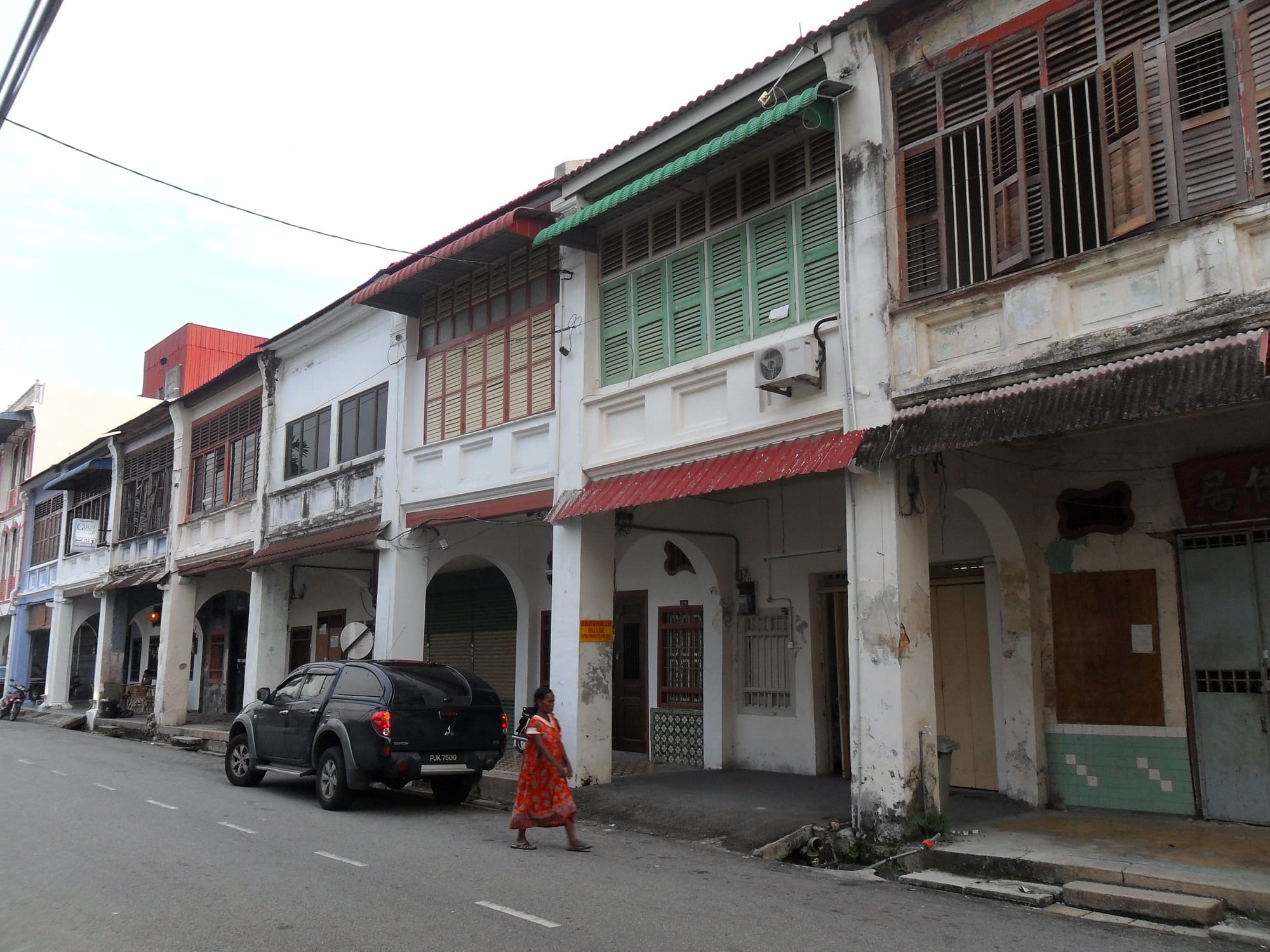
A row of two-storey shophouses with arched five-foot-way arcades and louvred green and cream shutters along a quiet street

Penang & the Northern Peninsula, Malaysia

George Town

Shophouses with arcaded five-foot ways in the old town of George Town, Penang. (Milei.vencel / Wikimedia Commons · CC BY-SA 3.0)

The capital of Penang, founded as a British free port in 1786 on the north-eastern corner of the island and inscribed on the UNESCO World Heritage List in 2008 with Malacca. Its core is a grid of Chinese shophouses, clan houses, mosques, temples and churches, edged by stilt jetties, and it is often called the food capital of Malaysia.

Neighbourhoods

  • The heritage core
    • First-time visitors
    • Historic district
    • Street art

    The UNESCO-listed grid between Lebuh Light and Lebuh Chulia, where shophouses, clan halls, a mosque, a Hindu temple and Chinese temples stand within a few streets of one another. Most of the guesthouses, cafés and murals are here, and almost all of it can be walked.

    Open in Maps
  • Little India
    • Best for food
    • Shopping
    • Local life

    A few blocks around Lebuh Pasar and Lebuh Queen, loud with Tamil music, garland stalls, sari and gold shops and banana-leaf restaurants. It sits inside the heritage zone and is busiest in the late afternoon and during Deepavali.

    Open in Maps
  • The clan jetties and the waterfront
    • Historic district
    • Photography
    • Walks

    Wooden villages built on stilts over the channel at Weld Quay, each settled by one Chinese clan from the late 19th century. Chew Jetty is the most visited; the others are quieter and still residential. Fort Cornwallis and the ferry terminal are a short walk north.

    Open in Maps
  • Pulau Tikus and Gurney
    • Best for food
    • Shopping
    • Seafront

    A wealthier suburb west of the old town, with a well-known morning market, Burmese and Thai temples nearby, and the Gurney Drive seafront promenade lined with hawker stalls and shopping malls.

    Open in Maps
  • Air Itam and Penang Hill
    • Views
    • Temples
    • Day out

    Inland and uphill from the centre, where the Kek Lok Si temple terraces climb above the town and the funicular railway runs up Penang Hill to cooler air and long views over the island and the channel.

    Open in Maps
  • Batu Ferringhi
    • Beaches
    • Resorts
    • Families

    The island's resort strip on the north coast, about half an hour from the centre, with a run of large hotels along a sandy bay and a night market on the main road. The sea is calm but often murky; most people come for the hotels rather than the swimming.

    Open in Maps

Things to do

Heritage buildings and temples

  • Khoo Kongsilandmark

    The most elaborate of Penang's Chinese clan houses, rebuilt in the early 20th century with carved granite, gilded beams and an opera stage facing the hall.

    Open in Maps
  • Cheong Fatt Tze Mansionlandmark

    The indigo-blue courtyard house of a 19th-century Chinese merchant on Leith Street, restored in the 1990s and known simply as the Blue Mansion.

    Open in Maps
  • Kapitan Keling Mosquelandmark

    The mosque founded by Indian Muslim traders in the early 19th century, its domes and single minaret giving the surrounding street its name.

    Open in Maps
  • Goddess of Mercy Templelandmark

    Founded in 1800 and the oldest Chinese temple in Penang, dedicated to the goddess of mercy and wreathed in incense smoke on festival days.

    Open in Maps
  • Sri Mahamariamman Templelandmark

    A South Indian Hindu temple in Little India, with a tower of painted figures over the entrance, and the starting point of processions.

    Open in Maps
  • St George's Churchlandmark

    A Georgian Anglican church of 1818 with a white portico, among the oldest purpose-built Anglican churches in South East Asia.

    Open in Maps
  • Fort Cornwallislandmark

    The star-shaped fort on the waterfront marking where Francis Light landed in 1786, now low ramparts, cannon and a lighthouse.

    Open in Maps
  • Kek Lok Silandmark

    A very large Buddhist temple complex on a hillside at Air Itam, with a tiered pagoda mixing Chinese, Thai and Burmese styles and a tall bronze statue of Kuan Yin.

    Open in Maps

Museums and galleries

  • Pinang Peranakan Mansionmuseum

    A restored Straits Chinese townhouse crowded with furniture, beadwork, porcelain and jewellery, showing how a wealthy Peranakan family lived.

    Open in Maps
  • Penang State Museummuseum

    The state collection of Penang's history and its Malay, Chinese, Indian and Eurasian communities, in a 19th-century school building on Lebuh Farquhar.

    Open in Maps
  • Penang Islamic Museummuseum

    A museum of the island's Muslim history in a villa of 1860 built for an Acehnese pepper merchant and restored in the 1990s.

    Open in Maps

Walks, views and street art

  • Armenian Streetneighborhood

    A narrow lane of restored shophouses at the heart of the heritage core, and the site of the best-known of the murals painted by Ernest Zacharevic from 2012.

    Open in Maps
  • Chew Jettyattraction

    A plank walkway over the water lined with the stilt houses of the Chew clan, ending at a small shrine with a view back to the town.

    Open in Maps
  • Penang Hillviewpoint

    A forested ridge above the city reached by a funicular railway first opened in 1923, cooler than sea level, with colonial bungalows and views over the channel.

    Open in Maps
  • Penang Botanic Gardenspark

    Gardens laid out in a former quarry valley in 1884 at the foot of the hills, with lawns, a waterfall stream and troops of macaques.

    Open in Maps
  • Wat Chayamangkalaramlandmark

    A Thai Buddhist temple in Pulau Tikus holding a long reclining Buddha, with a Burmese temple facing it across the street.

    Open in Maps

Short trips from the city

  • Penang National Parkpark

    Forest, beaches and a meromictic lake at the island's north-western tip, reached on foot or by boat from Teluk Bahang.

    Open in Maps
  • Teluk Bahangattraction

    The fishing village and reservoir at the western end of the north coast, the usual base for walks into the national park.

    Open in Maps
  • Butterworthtransit hub

    The mainland town facing the island across the channel, with the ferry terminal and the railway station used for ETS trains south and north.

    Open in Maps
  • Balik Pulauattraction

    A quieter town on the island's far side among durian orchards, paddy fields and hills, about an hour from the centre by road.

    Open in Maps

Seasonal events

  • Chinese New YearJanuary or February

    The biggest festival in the Chinese quarters, with clan houses open, lion dances, and crowds at Kek Lok Si, which is lit for the season.

  • ThaipusamJanuary or February

    Tamil devotees carry milk pots and kavadi uphill to the Balathandayuthapani Temple above Waterfall Road, which with Batu Caves draws Malaysia's largest Thaipusam crowds.

  • George Town FestivalJuly

    A month of theatre, music, dance and visual art staged in heritage buildings and streets, first held in 2010 to celebrate the UNESCO inscription.

  • Hungry Ghost Festivalseventh lunar month, usually August

    Street-side offerings, paper effigies and open-air Hokkien opera and getai performances across the older neighbourhoods.

  • DeepavaliOctober or November

    Oil lamps, rice-flour kolam patterns and night markets in Little India, and open houses across the city.

Eat and drink

Long-standing places and food districts in George Town. Hours, ratings and directions come from your maps app, always current.

Hawker centres and food streets

  • Lebuh Chulia and Lebuh Kimberleyneighborhood

    Two old streets in the heritage core where coffee shops and evening stalls serve char kway teow, duck kway chap and koay teow th'ng at shared pavement tables.

    Open in Maps
  • Gurney Drive hawker stallsmarket

    A large seafront food court on the promenade west of the centre, the best-known single place to try the Penang standards in one sitting.

    Open in Maps
  • Little Indianeighborhood

    Banana-leaf rice, dosa, tandoori chicken and sweet shops around Lebuh Pasar and Lebuh Penang, with nasi kandar shops on the nearby corners.

    Open in Maps
  • Pulau Tikus marketmarket

    A morning market in the western suburbs with Nyonya kuih, prawn noodles and fruit, busiest well before lunch.

    Open in Maps
  • Batu Ferringhi night marketmarket

    An evening street market along the resort strip, mixing souvenir stalls with satay, grilled fish and roti stands.

    Open in Maps

Penang classics

  • Assam laksamarket

    Thick rice noodles in a sour mackerel and tamarind broth, topped with mint, sliced pineapple, chilli and a spoon of black prawn paste.

    Open in Maps
  • Char kway teowmarket

    Flat rice noodles fried hard over charcoal or high gas flame with prawns, cockles, egg, chives and bean sprouts.

    Open in Maps
  • Nasi kandarmarket

    Rice with several curries ladled over it, a George Town invention of the Indian Muslim community, sold day and night around Lebuh Penang and Jalan Penang.

    Open in Maps

Experience George Town

History

George Town dates precisely to 1786, when Francis Light of the East India Company took possession of Penang island from the Sultan of Kedah and founded a settlement at its north-eastern point, naming it after the British king. Light declared it a free port, and that single decision shaped everything after: traders from southern China, the Coromandel coast, Aceh, Java, Arabia and Armenia settled within a few streets of one another, and the town grew far faster than its size warranted. In 1826 it joined Malacca and Singapore in the Straits Settlements, which it briefly led before Singapore's rise pushed it into second place.

The 19th century built the town that survives. Chinese clan associations, or kongsi, raised elaborate halls; secret societies fought open street battles in 1867; merchants who made fortunes in tin, rubber and shipping put up shophouses, godowns and courtyard mansions, and the stilt jetties over the water at Weld Quay were settled by clans who worked the port. Japanese forces occupied the island from 1941 to 1945, and the town was bombed by Allied aircraft.

Penang lost its free-port status in 1969, and George Town declined; rent control kept the old shophouses cheap and, unintentionally, kept them standing. When control ended in 2001 many emptied, but the UNESCO World Heritage inscription of 2008, shared with Malacca, reversed the direction: the shophouses were restored as hotels, cafés and galleries, a mural trail drew visitors from 2012, and the city's problem became the cost and crowding that came with success.

Culture & Customs

George Town is a Chinese-majority city in a Malay country, with an old Indian quarter and a small Eurasian community, and it wears the mixture openly — a mosque, a Hindu temple, a Chinese temple and an Anglican church stand within a few hundred metres on and around Jalan Masjid Kapitan Keling, a stretch often called the Street of Harmony. Clan associations still own halls and run ancestral rites, and the Peranakan or Straits Chinese families, descended from early Chinese traders who married locally, kept their own cooking, beadwork and embroidered kebaya.

The city's street language is Penang Hokkien, a dialect thick with Malay and English loanwords that outsiders from elsewhere in Malaysia find hard to follow. Festivals are public rather than private: processions at Thaipusam, opera stages and paper offerings during the seventh lunar month, lion dances at Chinese New Year, and open houses at Hari Raya and Deepavali when neighbours are fed regardless of faith.

Since the heritage listing, the town has also become an arts city. The George Town Festival programmes work in shophouses and clan halls each year, the murals and wrought-iron caricatures on the old walls have become part of the streetscape, and a steady argument runs through local life about how much change the core can absorb before the trades, the residents and the ordinary shops that earned the listing are priced out of it.

Daily Life

About 794,000 people live in George Town, whose boundaries have covered the whole of Penang Island since 2015, and Penang state has about 1.75 million. The city proper spreads from the old grid into suburbs of terraced housing and condominium towers along the coast, with the heritage core now holding far fewer residents than it did a generation ago. Housing costs, traffic on the bridges and reclamation projects along the shore are the standing local arguments.

The economy has two engines. The Bayan Lepas free industrial zone in the island's south has made and tested semiconductors and electronics for international firms since the 1970s, giving Penang one of Malaysia's highest incomes and drawing engineers from across the country; tourism, private hospitals treating patients from Indonesia, and the port and shipping trade make up much of the rest.

The day begins early. Coffee shops fill from about seven with kopi, kaya toast and noodles; offices and factories run on a standard working week with Friday prayers carved out of the middle of the day; and the evening belongs to the hawker centres and the seafront at Gurney Drive, which fills with walkers once the heat drops. Many stalls close one day a week and half the old town shuts for several days at Chinese New Year.

Food

Penang's reputation rests on hawker food, and George Town is where most of it is eaten. Assam laksa, the local signature, is thick rice noodles in a sour broth of poached mackerel and tamarind, finished with shredded mint, pineapple, chilli and a spoonful of hae ko, black prawn paste. Char kway teow is flat rice noodles fried over fierce heat with prawns, cockles, chives and egg. Penang Hokkien mee is a prawn-stock soup, orange with chilli oil; koay teow th'ng is its clear-broth opposite. Nasi kandar, rice under a pour of several curries, grew from the Indian Muslim traders who once carried it on a shoulder pole, and is sold around the clock.

Nyonya cooking, the Peranakan kitchen of Chinese ingredients and Malay spicing, gives otak-otak, jiu hu char and kerabu salads, and Penang's version tends sourer and more herbal than Malacca's. Street snacks run from rojak, fruit and fritters in a dark prawn-paste dressing, to lor bak, five-spice pork rolls, and apom balik, a folded peanut pancake. Little India adds banana-leaf rice, dosa and biryani.

Drinks and sweets are their own category: kopi brewed strong and sweetened with condensed milk, teh tarik pulled between two jugs to froth it, fresh sugarcane juice, and cendol — shaved ice, coconut milk, palm sugar and green pandan noodles — sold from carts in the old streets. Nyonya kuih, small steamed cakes of rice flour, coconut and palm sugar, are bought in the morning markets.

Planning tools

Budget

George Town is inexpensive by the standards of most world heritage cities, and hawker meals cost a fraction of restaurant prices. The main variables are the room and the season: restored shophouse hotels in the heritage core cost several times what a guesthouse on Lebuh Chulia does, and prices rise over Chinese New Year, the George Town Festival and school holidays.

Daily Budget Midrange
USD 70–130 (heritage or seafront hotel, restaurant meals, Grab rides, the funicular and a museum or two)
Daily Budget Shoestring
USD 25–45 (guesthouse or hostel bed, hawker meals, buses and walking)

Eat where queues of locals form rather than in the tourist cafés, and use the free Rapid Penang CAT shuttle or Grab instead of taxis flagged on the street.

Best Time to Visit

The city is warm and humid all year and can be visited at any time. December to March is generally the driest and most comfortable stretch and is also when Chinese New Year and Thaipusam fall, filling hotels. September to November is the wettest period, with heavy afternoon storms that pass. July brings the George Town Festival, and the Hungry Ghost month usually falls in August.

Suggested Number of Days

Two to three days cover the heritage core comfortably on foot. Four or five allow the hill, the temples inland and the north-coast beaches as well. Anyone coming mainly for the food should add time and pace themselves; the heat also slows walking down.

First Visit
2–3 days
With Surroundings
4–5 days

Transportation

The old town is small enough to walk, and Rapid Penang buses run from the Weld Quay terminal to the rest of the island, including Air Itam, Penang Hill and Batu Ferringhi. Free CAT shuttle buses loop around the centre. Grab is widely used and cheap. A passenger ferry and two road bridges link the island to Butterworth and the mainland, and trishaws still work the heritage streets.

Traffic is heavy and pavements are often blocked, so allow far longer than the distance suggests for journeys out of the centre at rush hour.

Airport & Station Connections

Penang International Airport is at Bayan Lepas in the island's south, about 16 km from the centre — roughly 30 to 45 minutes by Grab or taxi, or an hour by bus — with flights across Malaysia and to regional hubs. Electric ETS trains from Kuala Lumpur reach Butterworth on the mainland in about four hours; the passenger ferry and buses cross from there. Long- distance coaches use terminals on the island and at Butterworth.

Walkability

The heritage core is one of the most walkable historic centres in Malaysia: flat, compact, and shaded in places by the arcaded five-foot ways in front of the shophouses. Those arcades are frequently blocked by parked motorcycles and goods, so walking often means stepping into the road, and drivers do not expect pedestrians. Heat and humidity make the middle of the day slow going, and anything beyond the old town needs a bus or a Grab.

Safety

George Town is a safe city, and violent crime against visitors is rare. The recurring problems are bag-snatching by riders on motorcycles in the older streets, overcharging by taxis hailed on the street, and traffic: crossings are few, motorcycles use the pavements, and roads are busy. Macaques on Penang Hill and around the Botanic Gardens snatch food and bags.

Use Grab rather than street taxis and watch for motorcycles on the pavements. Check the latest advice before booking any island or dive trip off eastern Sabah, wear bags on the traffic-free side, dress modestly around mosques and in the religious east-coast states, and note that drug trafficking carries a mandatory death penalty. Check current official travel advice before travelling.

Climate

Equatorial and humid, with high temperatures and little seasonal variation. Rain falls all year in short heavy bursts, most often in the late afternoon, and the wettest months are usually September to November. Haze can drift over the island from regional fires between about August and October.

Summer
hot and sticky, typically 26–33°C, with thunderstorms building in the afternoon
Winter
the drier stretch from about December to March, typically 24–32°C, with more sunshine and calmer seas

Local Customs

Penang is a mixed Chinese, Malay and Indian city and the everyday manners of all three overlap. Shoes come off at the door of temples, mosques and many homes; shoulders and knees should be covered in religious buildings, and a headscarf is provided at mosques. The right hand is used for eating and for handing things over. Penang Hokkien is the street language among Chinese Penangites, but English is widely spoken.

Tipping is not expected, though smarter restaurants add a service charge. Ask before photographing people at the clan jetties, which are homes rather than an attraction, and during religious processions.

Common Payment Methods

The currency is the Malaysian ringgit (RM). Cards work in hotels, malls and larger restaurants, and QR payment apps are everywhere, but hawker stalls, markets and trishaws are cash businesses, so small notes are essential. ATMs are common in the centre and the malls.