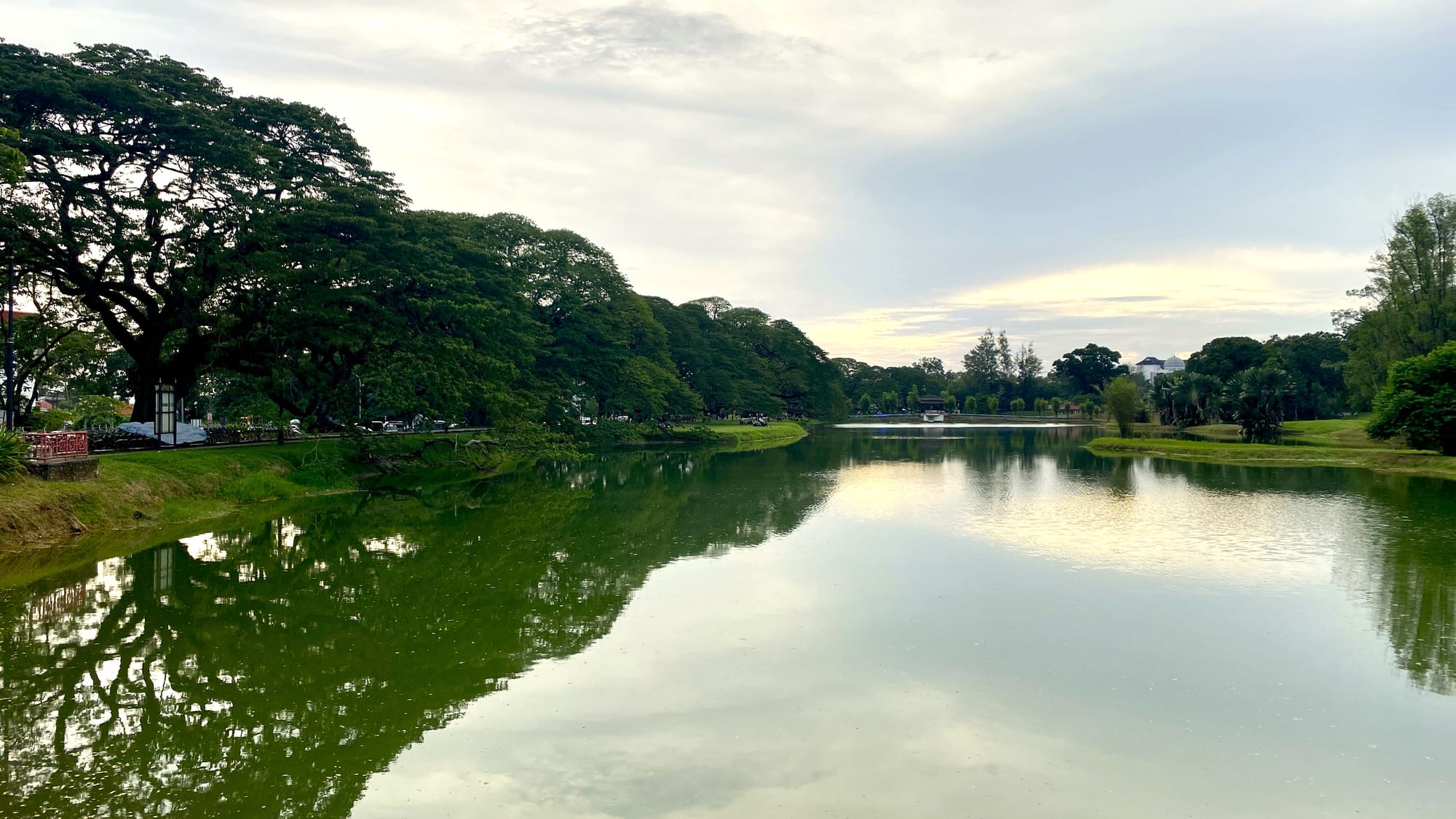
A still green lake reflecting cloud, edged by lawns and a long line of broad rain trees under a pale evening sky

Penang & the Northern Peninsula, Malaysia

Taiping

One of the lakes in the Taiping Lake Gardens, laid out on former tin workings. (Slleong / Wikimedia Commons · CC0)

A town in northern Perak that grew out of the Larut tin fields and the Chinese clan wars fought over them, and was named 'everlasting peace' when the fighting ended. It was the state capital until 1937 and collected a long list of firsts in colonial Malaya; today it is known for its Lake Gardens, its museum and the hill station above it.

Neighbourhoods

  • The old town centre
    • First-time visitors
    • Historic district
    • Best for food

    The grid of shophouse streets around Jalan Kota and the clock tower, holding the market, coffee shops, temples and most of the colonial civic buildings. It is flat, compact and best covered on foot.

    Open in Maps
  • The Lake Gardens and Museum quarter
    • Parks
    • Walks
    • Museums

    The green edge of town below the hills, where the gardens, the lakes, the zoo, the Perak Museum and the old military buildings stand within a short walk of one another. Mornings and late afternoons bring walkers and joggers.

    Open in Maps
  • Bukit Larut
    • Views
    • Cool air
    • Quiet and residential

    The hill station above the town, reached by a steep road, with colonial bungalows, gardens and temperatures several degrees cooler than the plain. There is very little up there beyond the views and the forest.

    Open in Maps
  • Kamunting and the northern edge
    • Local life
    • Transport

    The suburb along the main road north of town, with the bus terminal, industrial estates, newer housing and the everyday shops that serve them, a few kilometres from the old centre.

    Open in Maps
  • Matang and the coast
    • Nature
    • Boat trips
    • Seafood

    The flat country west of town towards the strait, where mangrove forest, charcoal kilns, fishing jetties and a village on stilts sit at the end of a short drive from the centre.

    Open in Maps

Things to do

Parks, lakes and the hill

  • Taiping Lake Gardenspark

    Gardens laid out in 1880 on abandoned tin workings, with a chain of lakes, lawns and an avenue of rain trees whose branches lean far out over the road.

    Open in Maps
  • Bukit Larutviewpoint

    The hill station above the town, formerly Maxwell Hill, established in 1884 and reached by a steep road through forest to bungalows and views over the plain to the sea.

    Open in Maps
  • Taiping Zooattraction

    The oldest zoo in Malaysia, opened in 1961 beside the Lake Gardens, laid out among mature trees and known for its night safari.

    Open in Maps
  • Matang Mangrove Forest Reservepark

    A large managed mangrove forest west of the town, worked for charcoal for more than a century and crossed by boardwalks, with boat trips from the fishing village at Kuala Sepetang.

    Open in Maps

Museums and colonial landmarks

  • Perak Museummuseum

    The oldest museum in Malaysia, founded in 1883, with collections on the state's natural history, Orang Asli communities, weapons and the tin era.

    Open in Maps
  • Taiping War Cemeterylandmark

    Rows of graves of Commonwealth servicemen who died in the Second World War, set in lawns at the foot of the hills on the edge of the gardens.

    Open in Maps
  • All Saints' Churchlandmark

    A wooden Anglican church of 1886, among the oldest in the country, with a small churchyard of colonial graves beside the road to the hill.

    Open in Maps
  • Taiping Clock Towerlandmark

    The white tower at the centre of the old town, first built in 1881 and rebuilt in brick in 1891, used as a police station and later also as the town's fire station, and still its usual meeting point.

    Open in Maps
  • Taiping Prisonlandmark

    A high-walled prison of 1879 in the centre of town, the oldest modern prison in the country and still in use, seen from the street rather than visited.

    Open in Maps

Short trips from the town

  • Kuala Sepetangattraction

    A coastal village of stilt houses, jetties and charcoal kilns at the end of what was once Malaya's first railway line, with boats running into the mangroves.

    Open in Maps
  • Bukit Merah Laketownattraction

    A large reservoir with a lakeside resort and water park, long one of the better-known outings in the Kerian district and popular with Malaysian families at weekends.

    Open in Maps

Seasonal events

  • Chinese New YearJanuary or February

    The town's largest festival, with lion dances, temple offerings and family reunions that shut many shops and coffee shops for several days.

  • ThaipusamJanuary or February

    Processions and kavadi carried by Tamil devotees to the town's Hindu temples, a legacy of Perak's estate communities.

  • Hari Raya Aidilfitrivariable, following Ramadan

    Ramadan bazaars through the fasting month and open houses afterwards in the Malay neighbourhoods, when many people return from the cities.

  • Hungry Ghost Festivalseventh lunar month, usually August

    Roadside offerings, paper effigies and open-air opera stages in the older Chinese streets.

Eat and drink

Long-standing places and food districts in Taiping. Hours, ratings and directions come from your maps app, always current.

Markets and food streets

  • Taiping Larut Matang marketmarket

    The town's main market, with fruit, fish and vegetables downstairs and a cooked-food section busiest early in the day.

    Open in Maps
  • Taiping Food Courtmarket

    A large hawker centre near the centre where stalls cook char kway teow, laksa, satay and rojak through the evening.

    Open in Maps
  • Old town coffee shopsneighborhood

    Marble-topped kopitiam in the shophouse streets serving kopi, kaya toast, half-boiled eggs and noodles from early morning.

    Open in Maps
  • Kuala Sepetang seafoodneighborhood

    Restaurants on stilts over the water at the fishing village west of town, cooking crab, prawns and mangrove fish landed a few metres away.

    Open in Maps

Taiping classics

  • Taiping popiahmarket

    Soft spring rolls of thin wheat wrappers filled with stewed turnip, egg and crushed peanuts, a snack the town is known for across Perak.

    Open in Maps
  • Cendol and ice kacangmarket

    Shaved ice with coconut milk, palm sugar and green pandan noodles, or piled with beans and syrups, sold from stalls in the market and the old streets.

    Open in Maps

Experience Taiping

History

Taiping owes its existence to tin. Deposits found in the Larut valley in the 1840s drew thousands of Chinese miners, organised into rival associations — the Ghee Hin and the Hai San — whose competition for water, land and labour broke into open fighting in a series of conflicts known as the Larut Wars between 1861 and 1874. The disorder, and the interests of Straits merchants, helped push the British into the Pangkor Treaty of 1874, which installed a Resident at the Perak court. When peace was imposed, the settlement was renamed Taiping, from the Chinese for 'everlasting peace'.

As the capital of the new administration it was built up quickly and collected a long list of firsts in British Malaya: the country's first railway line ran from here to Port Weld, now Kuala Sepetang, in 1885; the Perak Museum opened in 1883; the Lake Gardens were laid out on worked-out mining ground in 1880; and the hill station on Maxwell Hill, now Bukit Larut, the prison, the church and the garrison followed. The rain-tree avenues and civic buildings of that period still define the town.

Ipoh's rise with the richer Kinta Valley fields shifted power south, and the state capital moved there in 1937. Japanese forces occupied the town during the Second World War, and the war cemetery dates from its aftermath. Tin declined and finally collapsed in the 1980s, but Taiping, unlike some mining towns, was left with its gardens, institutions and shophouse streets largely intact, and has traded on that quiet inheritance since.

Culture & Customs

Taiping is a small, mixed town where Chinese, Malay and Indian communities have lived side by side since the mining era, and its identity is bound up in being older and gentler than the cities around it. The Chinese population, the largest of the three, keeps clan associations and temples in the old streets; the Malay neighbourhoods centre on their mosques; and the Indian community, descended largely from estate and railway workers, holds the Thaipusam procession each year.

The Lake Gardens are the town's social heart as much as a park. People walk, run and cycle there at first light and again in the cooler evening, families picnic under the rain trees at weekends, and the trees themselves — enormous, leaning out over the road — have become the town's emblem and are photographed endlessly.

Local pride attaches to the long list of colonial firsts, and to a reputation for being unhurried and well mannered. Heritage walking trails, restored shophouses and small museums have grown since the 2000s, and Taiping markets itself on history and greenery rather than nightlife. Everyday customs are conservative: modest dress, shoes left at doorways, and courtesy towards elders, particularly in the villages outside the centre.

Daily Life

About 245,000 people live in the Taiping municipal area, making it the second largest urban area in Perak after Ipoh, with a much smaller number in the old town itself and the rest in Kamunting and the surrounding suburbs and villages. It is a working provincial town rather than a resort: schools, government offices, the hospital and the prison are significant employers, alongside light industry at Kamunting, rubber and oil-palm estates, fishing and charcoal production on the coast, and a steady trade in domestic tourism.

The old centre keeps its rhythm of early mornings and short afternoons. The market and the coffee shops open before dawn, the middle of the day is hot and slow, and the gardens fill again after four. Weekends bring visitors from Penang and Ipoh, and the town is quietest midweek. Rain interrupts everything regularly enough that people plan around it.

The long-standing concerns are familiar ones for a town of this size: young people leaving for Kuala Lumpur, Penang and Singapore, the cost of maintaining ageing shophouses, flooding after heavy storms, and how to benefit from heritage tourism without losing the ordinary trades that give the streets their character.

Food

Taiping's cooking is Perak Chinese with strong Malay and Indian additions, and it is eaten in coffee shops and hawker centres rather than restaurants. Popiah — soft wheat wrappers rolled around stewed turnip, beansprouts, egg and crushed peanuts — is the snack most associated with the town. Char kway teow, Hokkien mee, curry mee and chee cheong fun are the standard hawker orders, and the Cantonese influence shows in roast meats, wonton noodles and claypot rice.

The coast supplies the rest. Kuala Sepetang, a short drive west, lands crab, prawns and mangrove fish that are cooked in stilt restaurants over the water, and the village is known for its charcoal, made from mangrove wood in brick kilns, and for mee udang, a noodle soup heavy with prawns. Salted and dried fish from the same coast reach the town market daily.

Sweets and drinks belong to the heat. Cendol and ice kacang, shaved ice with palm sugar, coconut milk, beans and syrups, are sold in the market streets; kopi is brewed dark and drunk with condensed milk; and the Ipoh style of white coffee is common here too. Local fruit — durian, rambutan, mangosteen and duku — appears from the orchards around the town in the mid-year season.

Planning tools

Budget

Taiping is one of the cheapest places to stay in the region. Hotels are small and modest, hawker meals cost very little, and the gardens, the cemetery and most of the colonial streets cost nothing to see. The main extras are transport, since the hill, the mangroves and the coast all need a vehicle, and the jeep ride up Bukit Larut.

Daily Budget Midrange
USD 50–90 (comfortable hotel, restaurant meals, a hire car or Grab, the hill and a mangrove trip)
Daily Budget Shoestring
USD 18–30 (guesthouse or budget hotel, hawker meals, walking and the occasional Grab)

Weekdays are quiet and cheap; rooms tighten over school holidays and Chinese New Year, when Malaysians come for the gardens and the food.

Best Time to Visit

Any time of year, with the caveat that Taiping is among the wettest towns in Peninsular Malaysia and rain should be expected in any month. The drier and clearer stretch is roughly December to March. Rain usually arrives as a heavy afternoon storm rather than all-day drizzle, and the hill road can be closed after very heavy falls.

Suggested Number of Days

A day covers the old town and the gardens at an easy pace. Two or three allow the hill, the mangroves and the coast as well. Many visitors stop here for a night between Penang and Ipoh, and rain can slow everything down.

First Visit
1–2 days
With Surroundings
2–3 days

Transportation

The old town and the gardens are walkable, and that is how most visitors get about. Grab works but with limited drivers, and taxis are few. Local buses run to Kamunting and the coast. A hire car is the practical way to reach the mangroves, the coast and the reservoir; access up Bukit Larut is by official four-wheel-drive vehicle or on foot.

The hill road is closed to private cars, so plan on the official four-wheel-drive vehicle from the base station or the walk up; the road has been shut by landslide damage in the past, so check that it is open.

Airport & Station Connections

Taiping's railway station is in the town, on the electrified west coast line: intercity ETS trains stop here, as do Komuter services between Ipoh and Butterworth, opposite Penang. Buses use the Kamunting terminal north of the centre. By road the town is just off the north-south expressway, about 70 km from Ipoh and about 90 km from Penang.

Walkability

One of the more walkable towns in Malaysia: the old grid is flat and small, the shophouse arcades give shade, and the Lake Gardens are a long continuous walk in themselves, popular at dawn and dusk. Crossings are few and motorcycles use the arcades. Anything beyond the gardens and the centre — the hill, the mangroves, the station — needs a vehicle.

Safety

Taiping is a quiet town with little crime, and visitors rarely have problems beyond petty theft. The practical risks are traffic, the steep and narrow hill road, slippery forest paths and heavy rain, which floods some streets quickly. Monkeys in the gardens and on the hill take food and loose bags.

Carry bags away from the traffic and keep to the marked paths on the hill. Check the latest advice before booking any island or dive trip off eastern Sabah, wear bags on the traffic-free side, dress modestly around mosques and in the religious east-coast states, and note that drug trafficking carries a mandatory death penalty. Check current official travel advice before travelling.

Climate

Hot, humid and notably wet: Taiping records some of the highest rainfall in Peninsular Malaysia, because storms build against the hills behind the town. Rain comes in heavy bursts, most often in the afternoon or evening, and the greenness of the gardens owes a good deal to it. Bukit Larut is several degrees cooler than the town.

Summer
hot and humid, typically 24–33°C, with frequent and often heavy afternoon storms
Winter
the drier period from about December to March, typically 23–32°C, though rain is still common

Local Customs

Taiping is a mixed town of Malay, Chinese and Indian communities, and its manners are those of provincial Malaysia: shoes off at temples, mosques and many homes, shoulders and knees covered in religious buildings, the right hand used for eating and giving, and unhurried greetings. Cantonese and Hokkien are heard in the coffee shops alongside Malay and English.

Tipping is not expected. Many coffee shops and stalls open at dawn and close by mid-afternoon, and some shut one day a week; ask before photographing worshippers or people at work in the mangrove kilns.

Common Payment Methods

The currency is the Malaysian ringgit (RM). Cards work in hotels and larger restaurants and QR payment apps are widespread, but the market, hawker stalls and older coffee shops run on cash, so small notes are needed. ATMs are easy to find in the town centre.