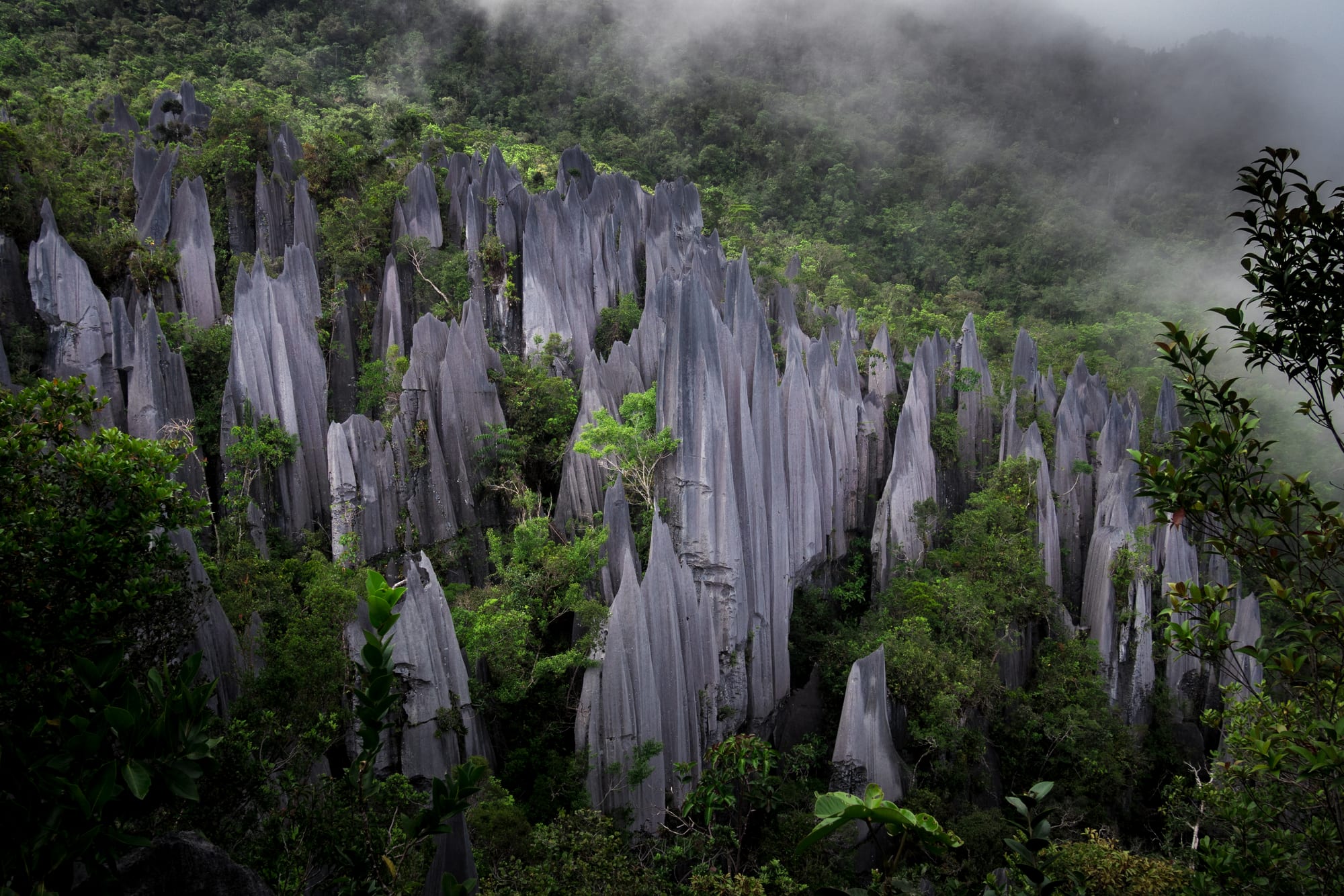
Grey razor-sharp limestone spires rising through green rainforest, with mist drifting over the hillside behind

Malaysia

Sarawak

The limestone Pinnacles near the top of Gunung Api in Gunung Mulu National Park, Sarawak. (Nur Nafis Naim / Wikimedia Commons · CC BY-SA 4.0)

Malaysia's largest state, covering the north-west of Borneo from Kuching to the Brunei border — a land of great rivers, rainforest and limestone caves, ruled for a century by the Brooke "White Rajahs" and home to the Iban, Bidayuh, Melanau and Orang Ulu peoples alongside large Chinese and Malay communities.

Explore Sarawak

History

Sarawak holds some of the oldest evidence of modern humans in Southeast Asia: the Niah Caves near Miri yielded a human skull tens of thousands of years old. Later, trading settlements at Santubong near Kuching exchanged goods with China around a thousand years ago. By the 19th century the coast was a loose province of the Brunei sultanate, while the Iban, Bidayuh and the peoples of the interior lived by shifting rice farming and, for some groups, headhunting.

In 1841 the English adventurer James Brooke helped the Brunei court put down a rebellion and was made Rajah of Sarawak. He and his successors, Charles and Vyner Brooke, expanded the territory by stages at Brunei's expense and ruled for over a century as the "White Rajahs", suppressing headhunting and encouraging Chinese settlement, notably Foochow farmers on the Rajang river around Sibu. Oil was struck at Miri in 1910. After the Japanese occupation of 1941–45, Vyner Brooke ceded Sarawak to Britain in 1946 despite local opposition, and the anti-cession movement led to the killing of the governor at Sibu in 1949.

Sarawak joined Malaysia in 1963, soon facing Indonesia's armed confrontation along the border and a communist insurgency that lasted until 1990. Under long-serving chief ministers, logging, oil palm and large dams such as Bakun transformed the interior, displacing communities and drawing international criticism. Sarawak continues to press for greater autonomy under the Malaysia Agreement, and its head of government has been styled Premier since 2022.

Culture & Customs

Sarawak is one of the most ethnically diverse states in Malaysia. The Iban are the largest community, followed by the Chinese and Malays, with the Bidayuh in the hills around Kuching, the Melanau along the central coast and the Orang Ulu — among them the Kayan, Kenyah, Kelabit and Penan — in the interior. Christianity is the largest religion, with Islam and Chinese religions alongside, and Sarawakians are proud of their tolerance.

The longhouse remains the heart of Iban and Orang Ulu life: a row of family apartments under one roof, joined by a long communal gallery called the ruai. The Gawai Dayak harvest festival on 1 June is the great celebration, with rice wine, dances and visitors from the towns. Iban weavers make pua kumbu, textiles with patterns that once carried ritual meaning; traditional tattoos have seen a revival; and the sape, a boat-shaped lute of the Orang Ulu, has become a symbol of the state's music.

Everyday Sarawak Malay has its own vocabulary, and English is widely spoken. Visitors to a longhouse are expected to greet the headman first, remove shoes and accept at least a sip of tuak.

Daily Life

Sarawak has about 2.5 million people across the largest state in Malaysia. Kuching, the capital, has more than half a million people; Miri, Sibu and Bintulu are the other main towns, and many people still live in longhouses or rural villages along the rivers, though young people continue to move to the towns.

The economy is built on oil and liquefied natural gas around Bintulu and Miri, hydroelectric power, timber, palm oil and pepper, with the state government investing in new industries. Logging and plantations have cleared much of the lowland forest, and land rights for Indigenous communities are a lasting political issue.

Days start with a bowl of laksa or kolo mee in a kopitiam. Boats still link many upriver communities, though roads now reach more longhouses each year. Rural infrastructure — roads, water, schools and internet — and the balance of power with the federal government dominate local debate.

Food

Sarawak laksa is the state's most famous dish: rice vermicelli in a broth of sambal, tamarind, garlic, galangal and coconut milk, topped with prawns, shredded chicken and omelette strips, eaten for breakfast. Kolo mee, springy egg noodles tossed in lard and shallot oil with minced pork and char siu, is the everyday favourite, and Sibu's Foochow community makes kampua mee, a similar noodle dish, and kompia, small sesame buns.

Indigenous cooking uses the forest and river. Manok pansoh is chicken cooked with tapioca leaves inside a bamboo tube over the fire, umai is a Melanau salad of raw fish with lime, chilli and onion, and midin, a crisp jungle fern, is stir-fried with garlic or shrimp paste. Terung Dayak, a round sour aubergine, goes into soups, and Bario rice from the Kelabit Highlands is prized for its fine grains and fragrance.

Kek lapis Sarawak, a layered cake in bright colours and intricate patterns, is baked for festivals, and Sarawak pepper is one of the state's best-known exports. Tuak, a sweet rice wine, is poured generously at Gawai and in the longhouses.

Attractions & Natural Wonders

Kuching is the starting point. The riverside promenade faces the Astana, built for the Brooke rajahs, and Fort Margherita across the water; nearby are the old courthouse, the Main Bazaar, Carpenter Street and the Tua Pek Kong temple, and the Borneo Cultures Museum. The city is famous for its cat statues. Around Kuching, Bako National Park has sandstone sea stacks, beaches and trails through several forest types, with proboscis monkeys and bearded pigs; Semenggoh Wildlife Centre has semi-wild orangutans, and the Sarawak Cultural Village sits below Mount Santubong.

To the south-east, the Batang Ai reservoir is the gateway to Iban longhouses reached by longboat along the rivers that flow into it, and to the forest of Batang Ai National Park. Sibu and the Rajang river lead to Kapit and the interior.

In the north, Gunung Mulu National Park, a UNESCO World Heritage Site, has the Deer Cave with its evening bat flights, Clearwater Cave, the vast Sarawak Chamber and the Pinnacles on Gunung Api. Niah National Park protects the archaeological caves, and Miri has the Grand Old Lady oil well on Canada Hill and offshore reefs. The Kelabit Highlands around Bario offer trekking between longhouses, rice fields and forest near the Indonesian border.

Cities in Sarawak

Planning basics

Budget

Kuching and Miri are inexpensive for food and rooms, but the region's highlights cost more because of access: Mulu and Bario are reached by air, longhouse visits on the Batang Ai usually need a guide and boat transfer, and guided cave and trekking fees add up. Park accommodation is simple and moderately priced.

Daily Budget Midrange
USD 75–170 (hotel or resort, guided cave and longhouse tours, domestic flights)
Daily Budget Shoestring
USD 25–45 (guesthouse, hawker food, buses and park boats)

Book the Mulu and Bario flights early, as the small planes fill quickly, and budget for guides and boat transfers.

Safety

Sarawak is safe, with low crime and a relaxed atmosphere. The risks are natural: floods and fast rivers in the wet season, slippery cave walkways and trails, heat and dehydration on treks, crocodiles in some rivers and estuaries, and rough seas on the boat to Bako.

Walk the more demanding trails and caves with a guide, heed crocodile warnings near water, and carry rain gear. Check current official travel advice before travelling.

Climate

Hot and wet all year, with rain on up to 220 days a year. The heaviest rain falls from about November to February, during the north-east monsoon, when seas are rough and boats to Bako can be disrupted. The Kelabit Highlands, at around 1,000 metres, are noticeably cooler, with cold nights.

Summer
hot and humid, 23–33°C, with afternoon storms
Winter
wettest from about November to February, 22–31°C, with frequent heavy downpours

Transportation

Kuching, Sibu, Bintulu and Miri have airports with links to the peninsula, and smaller planes reach Mulu and Bario from Miri. The Pan Borneo Highway and long-distance buses join the coastal towns, and express boats run up the Rajang river from Sibu. Bako is reached by road and a short boat ride from Kuching, and Batang Ai by several hours on the road and then a boat across the lake.

Fly into Mulu and Bario rather than attempting the long river routes, and arrange longhouse visits through a guide.

Best Time to Visit

March to October is generally drier and best for Bako, the longhouses and trekking in Mulu and the Kelabit Highlands. Gawai Dayak on 1 June is the time to see longhouse celebrations, and the Rainforest World Music Festival brings crowds to the Kuching area in mid-year. The caves can be visited all year.